Diabetic Alert Dog Training: 2026 Scent Imprinting Guide
Master diabetic alert dog training with our 2026 scent imprinting guide. Learn hypoglycemia detection steps, public access prep, and ADI standards.
The Rise of Diabetic Alert Dogs in 2026
As we navigate the landscape of medical assistance animals in 2026, Diabetic Alert Dogs (DADs) have become an indispensable lifeline for individuals managing Type 1 and insulin-dependent Type 2 diabetes. While continuous glucose monitors (CGMs) have seen massive technological leaps this year, they cannot replicate the proactive, life-saving olfactory capabilities of a highly trained canine. A DAD is trained to detect the subtle chemical changes in human breath and sweat that precede dangerous hypoglycemic (low blood sugar) or hyperglycemic (high blood sugar) episodes, often alerting their handler 15 to 30 minutes before a CGM registers a critical drop.
Training a DAD requires a meticulous, science-based approach to scent imprinting, operant conditioning, and rigorous public access proofing. This comprehensive guide outlines the exact protocols used by top-tier assistance dog organizations in 2026 to shape reliable, life-saving alert behaviors.
The Olfactory Science: Detecting Volatile Organic Compounds
To train a DAD effectively, handlers and trainers must understand the biological mechanism behind the alert. When a human's blood glucose levels fluctuate rapidly, the body's metabolic processes shift. During a hypoglycemic event, the body begins to break down fat for energy, releasing specific Volatile Organic Compounds (VOCs) such as isoprene and acetone into the breath and sweat. Dogs possess up to 300 million olfactory receptors and a specialized vomeronasal organ, allowing them to detect these VOCs at concentrations as low as parts per trillion. In 2026, veterinary behaviorists emphasize that we are not training the dog to 'smell sugar,' but rather to identify the distinct chemical signature of metabolic stress.
Phase 1: Proper Scent Collection and Storage Protocols
The foundation of any DAD's success lies in the purity and preservation of the training scents. Contaminated or degraded scent samples will lead to confusion and false alerts.
- Collection Medium: Use sterile, unbleached cotton gauze pads or specialized synthetic scent swabs. Avoid materials with chemical binders or artificial fragrances.
- The Collection Process: When the handler's blood glucose drops below 70 mg/dL (confirmed via a blood prick test, not just a CGM), wipe the gauze firmly along the back of the neck, the sternum, or inside the cheek. These areas are rich in apocrine sweat glands and respiratory vapor.
- Immediate Sealing: Place the swab immediately into an amber glass vial with a PTFE-lined cap. Amber glass prevents UV light degradation, and PTFE prevents chemical leaching.
- Storage: Store the vials in a dedicated refrigerator at 38°F (3°C). In 2026, best practices dictate rotating out frozen scent samples every four months to ensure the VOC profile remains sharp and accurate.
Phase 2: Scent Imprinting and Shaping the Alert Behavior
Imprinting is the process of teaching the dog that a specific odor predicts a high-value reward. We utilize a 'scent wheel' or a series of scent stations to build odor obedience.
Step 1: Introduction to the Scent Wheel
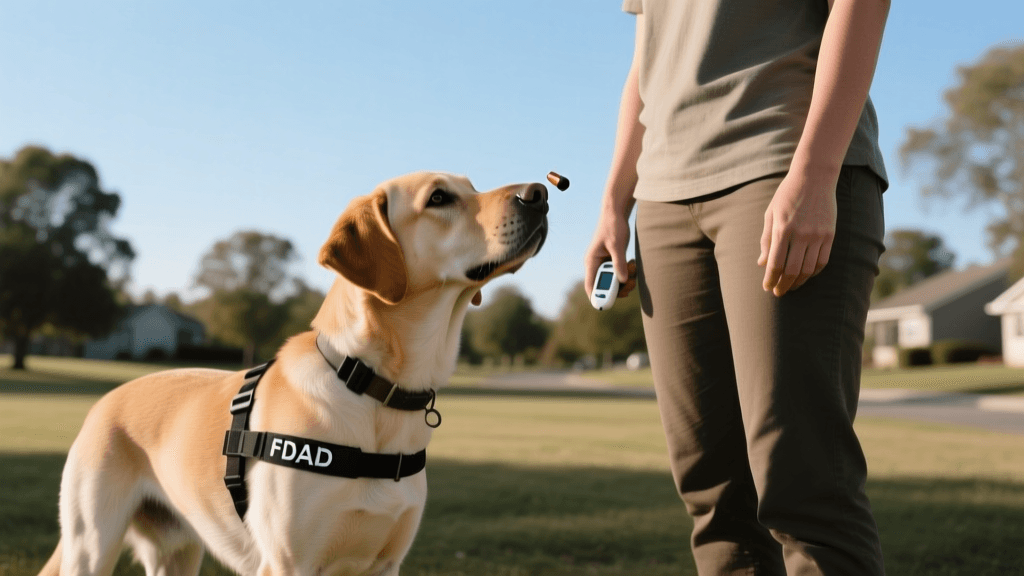
Begin with a single, highly concentrated hypoglycemic scent vial placed in a perforated metal tin. Pair the presentation of the scent with an immediate primary reinforcer (e.g., boiled chicken or freeze-dried liver). The sequence is critical: the dog sniffs the vial, the handler marks the behavior with a clicker or a verbal 'Yes!', and the reward is delivered directly away from the vial. This teaches the dog to seek out the source of the odor. Over several weeks, introduce 'blank' tins and 'distractor' tins (containing normal blood sugar swabs or unrelated scents like coffee or mint) to build discrimination.
Step 2: Shaping the Target Alert
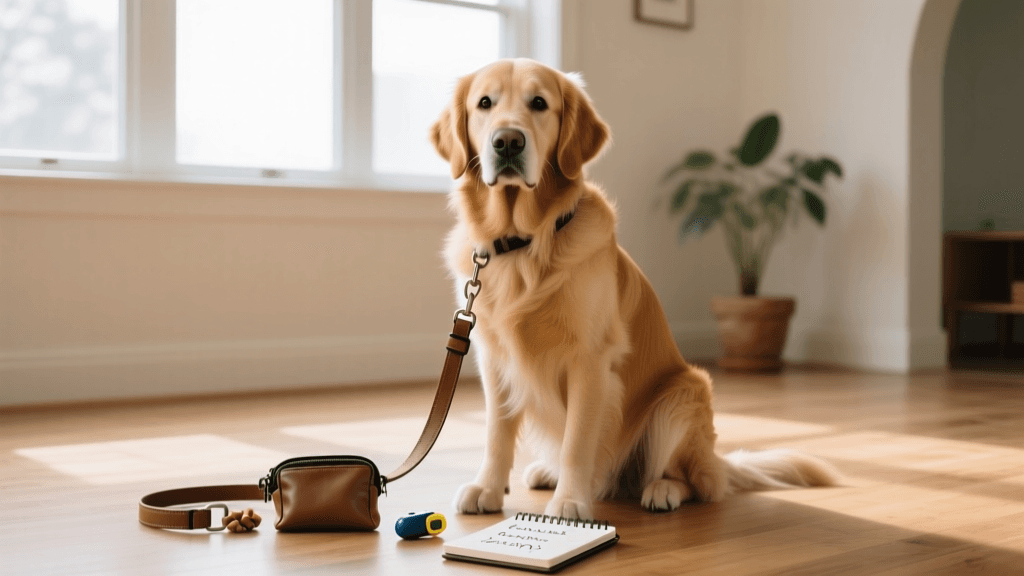
A DAD must perform a clear, unambiguous alert behavior. The two most common alerts are the 'Paw Swipe' (pawing the handler's leg) or the 'Retrieve' (fetching a designated medical pouch). For the retrieve method, use a distinct, easily identifiable item, such as a bright orange K9 medical retrieval pouch. Shape the behavior using backward chaining:
- Reward the dog for looking at the pouch.
- Reward for touching the pouch with the nose.
- Reward for picking the pouch up.
- Reward for holding the pouch and taking a step toward the handler.
- Finally, require the dog to sit and present the pouch to the handler's hand.
Once the physical retrieve is fluent, pair it with the hypoglycemic scent. The dog learns: 'Smell isoprene -> Find pouch -> Bring to handler -> Receive jackpot reward.'
Phase 3: Proofing, Distraction, and Public Access
A DAD must be able to detect a scent drop in a noisy, chaotic environment. Proofing involves systematically introducing environmental stressors while maintaining the dog's focus on the scent profile. Trainers in 2026 utilize controlled public access simulations, incorporating auditory distractions (sirens, dropping metal trays), olfactory distractors (food courts, heavily perfumed individuals), and tactile challenges (grating, escalators, crowded transit). According to the Assistance Dogs International (ADI) standards, a service dog in training must demonstrate the ability to ignore dropped food, remain quiet in public spaces, and perform tasks on command or via scent trigger without seeking attention from strangers.
Diabetic Alert Dog Training Timeline and Milestones
| Age / Timeline | Training Phase | Core Objectives | Evaluation Metrics |
|---|---|---|---|
| 8 - 16 Weeks | Early Socialization & Foundation | Environmental exposure, basic obedience, clicker mechanics, surface habituation. | Passes the AKC S.T.A.R. Puppy equivalent; shows recovery from startle responses. |
| 4 - 9 Months | Scent Imprinting & Shaping | Hypoglycemic scent discrimination, shaping the specific alert behavior (retrieve or paw). | 90% accuracy on a 6-port scent wheel with zero false alerts on blank ports. |
| 9 - 14 Months | Proofing & Public Access | Alerting in high-distraction environments, ignoring dropped food, loose-leash heeling. | Passes the ADI Public Access Test (PAT) with a certified evaluator. |
| 14 - 18 Months | Handler Matching & Team Training | Bonding with the specific handler, learning the handler's unique baseline scent profile. | Successful real-world alerts verified by CGM data logs over a 30-day period. |
Troubleshooting False Alerts and Scent Fatigue
Even the most elite DADs can experience 'scent fatigue' or issue false alerts. A false alert occurs when the dog performs the alert behavior without the presence of the target VOCs. In 2026, behavioral researchers note that false alerts are frequently linked to handler anxiety. When a handler is stressed, their cortisol levels spike, which can alter their natural body odor and confuse the dog. Furthermore, if a handler frequently questions the dog's alert by checking their CGM and dismissing the dog when the numbers are currently normal, the dog may become frustrated and stop alerting altogether. Remember, the dog is smelling the *trend* of the blood sugar drop, not just the current number. Always reward the alert behavior, verify with a blood test, and treat the low if the trend indicates an impending drop.
Navigating Legal Rights and Public Access Laws
Understanding the legal framework is vital for any DAD handler. Under the Americans with Disabilities Act (ADA), Diabetic Alert Dogs are classified as service animals because they are individually trained to perform tasks directly related to a person's disability. Businesses, restaurants, and public transit authorities are legally required to allow the DAD to accompany the handler in all public areas. Staff members are only permitted to ask two specific questions: (1) Is the dog a service animal required because of a disability? and (2) What work or task has the dog been trained to perform? They cannot demand medical documentation, require the dog to demonstrate the task, or ask about the nature of the handler's disability.
For those beginning their journey, foundational obedience and temperament testing are critical. Resources provided by the American Kennel Club (AKC) emphasize that not every dog possesses the neurological stability required for service work. A successful DAD must possess a naturally low startle response, a high food or toy drive, and an innate desire to remain in close proximity to their handler. By adhering to these rigorous 2026 imprinting protocols and maintaining a commitment to ongoing education, handlers can cultivate a reliable, life-saving partnership with their canine companion.
priya-sutaria
All our authors care for dogs every day — read more of their work on the authors page.