Decoding Service Dog Body Language & Stress Signals in 2026
Learn to read service dog body language, recognize subtle stress signals, and master 2026 public etiquette to support working dogs and handlers.
As of 2026, the integration of service dogs into daily public life, hybrid workspaces, university campuses, and specialized medical environments has reached unprecedented levels. With the rising prevalence of psychiatric service dogs (PSDs), autism support dogs, and complex medical alert canines, the public is interacting with working dogs more frequently than ever before. However, this increased visibility brings a critical responsibility: understanding the unique psychology and body language of a working canine. Unlike pet dogs, service dogs are trained to suppress natural behavioral responses to maintain focus on their handlers. Decoding their subtle stress signals and mastering public etiquette is essential for ensuring the welfare of these dedicated animals and the safety of the humans who rely on them.
The Unique Psychology of the Working Canine
To truly understand a service dog, one must first recognize the profound psychological shift that occurs when a dog transitions from a pet to a working partner. Service dogs are not merely well-behaved pets; they are highly trained medical equipment and cognitive anchors for their handlers. The American Kennel Club emphasizes that service dogs undergo rigorous behavioral conditioning to prioritize their handler's medical or psychological needs over their own environmental curiosities.
This conditioning requires immense cognitive load. A working dog must constantly filter out high-value distractions—such as dropped food, other animals, or loud noises—while simultaneously monitoring their handler's biometric or behavioral cues for signs of an impending medical event. This state of hyper-vigilance is mentally taxing. While a pet dog might view a busy airport terminal as an exciting adventure, a service dog experiences it as a complex workspace requiring continuous risk assessment and task readiness. Understanding this psychological baseline is the first step in recognizing when a working dog is becoming overwhelmed.
Identifying Subtle Stress and Fatigue Signals
Because service dogs are heavily reinforced for stoicism and task-focus, they often mask overt signs of distress. A working dog is highly unlikely to bark, lunge, or snap when stressed, as these behaviors have been systematically extinguished during their training. Instead, they rely on subtle, micro-expressions and displacement behaviors to communicate discomfort. Recognizing these signals is crucial for assessing canine welfare in public spaces.
The Canine Stress Matrix: What to Look For
The following table outlines common, yet frequently misunderstood, stress signals exhibited by working dogs in public environments. Recognizing these cues can help you determine if a dog is struggling and if the handler might need space or assistance.
| Body Language Signal | Psychological & Physiological Meaning | Recommended Public Action |
|---|---|---|
| Whale Eye (Showing the whites of the eyes) | The dog is experiencing anxiety or anticipatory stress, often due to an unpredictable environment or invasive public attention. | Avert your gaze immediately. Do not approach the dog or attempt to comfort it. |
| Spatulate Panting (Wide, rapid tongue flicking) | When not thermoregulating (cooling down), this indicates a spike in cortisol and acute psychological stress. | Give the handler and dog a wide berth. The dog needs to decompress. |
| Excessive Lip Licking / Yawning | Displacement behaviors used to self-soothe when the dog feels conflicted, frustrated, or mentally fatigued. | Ignore the dog completely. Allow the handler to manage the dog's focus. |
| Pinned Ears & Low Tail Carriage | Signs of submission, fear, or sensory overload, particularly in loud, crowded, or chaotic 2026 urban environments. | Step back. Do not block the team's exit path. |
| Shaking Off (When not wet) | A physiological reset mechanism used to release accumulated muscular tension and adrenaline after a stressful event. | Allow the dog the space to reset without interruption. |
The 'Vest On' Phenomenon: Cognitive Switching
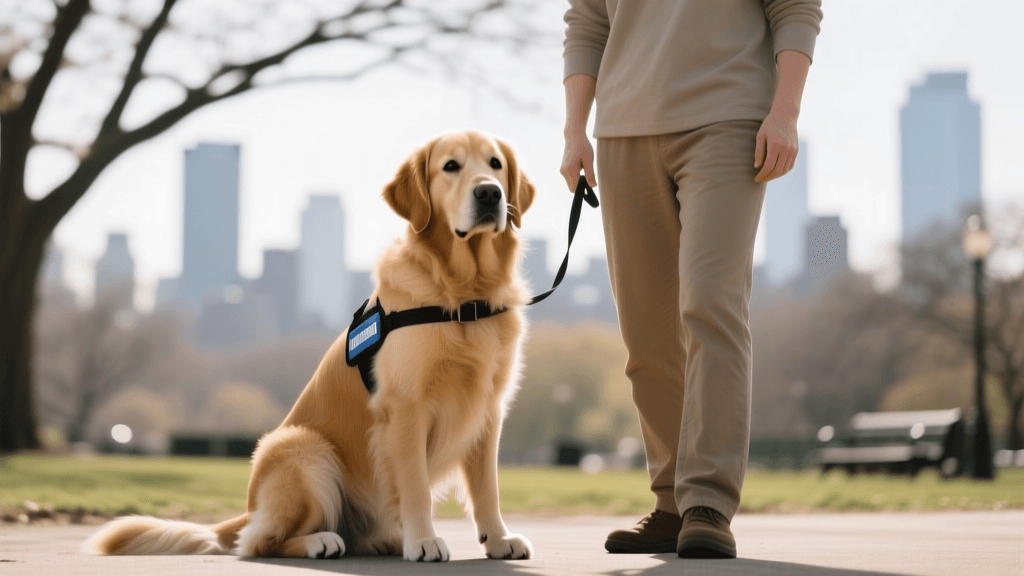
One of the most fascinating aspects of service dog psychology is the 'Vest On' phenomenon. Through thousands of hours of classical and operant conditioning, the service dog harness becomes a powerful environmental cue. When the vest is placed on the dog, it triggers a psychological switch: the dog enters 'work mode.' In this state, the dog's brain prioritizes the handler's safety and task execution over social interaction, play, or exploration.
Conversely, when the vest is removed, the dog is 'off duty' and can engage in typical canine behaviors. This cognitive switching is vital for the dog's mental health, preventing burnout by allowing them designated times to simply 'be a dog.' However, when the vest is on, the dog is actively working, even if they appear to be sleeping or resting under a restaurant table. Resting is a trained behavior designed to conserve energy while maintaining a tethered awareness of the handler. Interrupting this rest with unwanted attention forces the dog to abruptly re-engage their working cognition, leading to cumulative mental fatigue.
2026 Public Etiquette: The 'No-Touch, No-Talk' Rule
Despite widespread awareness campaigns, public interference remains a leading cause of stress for service dog teams. According to the U.S. Department of Justice ADA guidelines, service animals are defined as dogs individually trained to do work or perform tasks for people with disabilities. The law protects the team's right to public access, but it does not mandate that the public interact with the animal. In fact, Assistance Dogs International (ADI) strongly advocates for a strict 'No-Touch, No-Talk, No-Eye-Contact' rule when encountering a working dog.
Why is this rule so critical in 2026? Modern service dogs are often trained for deep pressure therapy (DPT), tactile stimulation, or interrupting dissociative episodes. If a stranger calls out to the dog, makes kissing noises, or reaches out to pet them, the dog may break their tactile connection with the handler to investigate the distraction. For a handler experiencing a PTSD flashback, a diabetic low, or a severe panic attack, this momentary break in the dog's focus can be medically dangerous.
According to Assistance Dogs International (ADI), the most common cause of early retirement for service dogs is not physical ailment, but chronic stress and burnout exacerbated by constant public interference and lack of environmental boundaries.
Why 'Just One Pet' Disrupts the Working Brain
A common misconception among the public is that 'just one quick pet' won't hurt. From a neurological perspective, however, this interaction triggers a dopamine response in the dog's brain. Dogs are inherently social creatures, and positive physical contact releases feel-good neurotransmitters. When a stranger pets a working dog, they are chemically rewarding the dog for breaking its focus on the handler.
This creates a psychological conflict. The dog is torn between the biological reward of social interaction and the trained imperative to remain focused on the handler's medical needs. Over the course of a day, navigating dozens of these micro-conflicts leads to decision fatigue and elevated stress hormones. By refusing to pet, talk to, or offer treats to a service dog, you are actively protecting the dog's cognitive clarity and ensuring they can perform their life-saving tasks without neurological interference.
Supporting the Handler-Dog Bond in Public Spaces
Being an ally to service dog teams in 2026 requires a shift in how we view public spaces. It requires recognizing that the dog is not a public commodity or an educational tool, but a dedicated partner performing a vital medical function. If you see a service dog team in public, the most supportive action you can take is to treat them as you would any other individual navigating the space, while completely ignoring the dog.
If you notice a handler struggling, or if a dog is exhibiting severe stress signals (such as vocalizing or attempting to pull the handler toward an exit), do not intervene by grabbing the dog's leash or calling the dog's name. Instead, speak directly and calmly to the human handler. Ask, 'Do you need any assistance?' or 'Would you like me to clear a path for you?' Always direct your communication to the human, respecting the invisible boundary that exists between the public and the working team.
Conclusion
Understanding the body language and psychology of service dogs is a fundamental aspect of modern canine behavioral science and public etiquette. As the roles of working dogs continue to expand in 2026, so too must our collective empathy and awareness. By learning to identify subtle stress signals like whale eye, displacement panting, and lip licking, we can better appreciate the immense cognitive load these animals carry. Adhering to the 'No-Touch, No-Talk' rule is not an act of rudeness; it is a profound act of respect for the life-saving bond between a handler and their service dog. Ultimately, protecting the working dog's focus ensures they can continue to provide the essential, life-changing support their handlers depend on every single day.
priya-sutaria
All our authors care for dogs every day — read more of their work on the authors page.