Decoding Rescue Dog Stress Signals: First 72 Hours (2026)
Learn to decode your new rescue dog's stress and calming signals during the critical first 72 hours home to ensure a smooth, confident transition in 2026.
Welcome Home: The Critical First 72 Hours
Bringing a new rescue dog home is one of the most rewarding experiences a person can have, but the first few days are often misunderstood. As of 2026, modern veterinary behaviorists emphasize that the initial 72 hours are not a 'honeymoon period' where a dog is simply well-behaved; rather, it is a profound state of neurological decompression. During this time, your new dog is processing a massive environmental shift, and their primary method of coping is through canine communication and body language. Understanding these signals is the cornerstone of the 'Getting a Dog' journey, setting the foundation for trust and preventing behavioral fallout.
Many new owners mistakenly believe a quiet, still dog is a 'good' or 'calm' dog. In reality, stillness can be a profound indicator of fear or shutdown behavior. By learning to read the subtle stress and calming signals your dog exhibits, you can adjust your environment, manage your expectations, and help your new companion decompress safely. According to the ASPCA's Dog Behavior resources, recognizing early signs of stress is the most effective way to prevent anxiety from escalating into fear-based reactivity or destructive habits.
The Science of Canine Decompression
The widely recognized '3-3-3 Rule' of rescue dog adoption outlines the general timeline for a dog's adjustment: 3 days to decompress, 3 weeks to learn your routine, and 3 months to feel truly at home. However, the first 3 days are the most volatile. Your dog's nervous system is flooded with cortisol and adrenaline from the shelter environment, the car ride, and the sensory overload of a new home.
In 2026, force-free training methodologies heavily prioritize 'decompression walks' and 'sniffaris' over strict obedience training during this initial window. The goal is not to teach your dog to sit or stay; the goal is to allow their nervous system to return to baseline. When a dog is over threshold, learning is biologically impossible. Therefore, your primary job as a new owner is to become an astute observer of their physical communication, ensuring you do not accidentally push them past their stress threshold.
5 Critical Calming Signals You Must Not Ignore
Canine calming signals, a concept pioneered by Norwegian dog trainer Turid Rugaas, are subtle body language cues dogs use to self-soothe, de-escalate tension, and communicate peaceful intentions. If you see these signals, your dog is telling you they are uncomfortable and asking for space or a change in the environment.
1. Excessive Yawning
While dogs yawn when they are tired, a sudden yawn in a novel or mildly stressful situation (like meeting a new person or hearing a loud noise) is a classic calming signal. It is a physiological attempt to lower their heart rate and signal that they mean no harm.
2. Lip Licking and Tongue Flicks
A quick flick of the tongue over the nose or repeated lip licking when no food is present is a primary indicator of canine anxiety. You will often see this at the vet's office or when a well-meaning stranger leans over the dog to pet their head. It is a plea for the pressure to be removed.
3. Whale Eye (Half-Moon Eye)
When a dog turns their head away but keeps their eyes fixed on a stressor, the whites of their eyes become visible in a crescent shape. This 'whale eye' is a significant warning sign that the dog is guarding a resource, feels trapped, or is preparing to react defensively if the stressor does not retreat.
4. The 'Shake Off'
If your dog shakes their entire body vigorously from nose to tail—like they are shaking off water, but they are completely dry—they are actively attempting to reset their nervous system. This often happens after a stressful encounter, a tight leash walk, or an overwhelming greeting. It is a healthy coping mechanism that should be allowed to happen without interruption.
5. Displacement Sniffing
Suddenly becoming intensely interested in a patch of carpet or grass during a social interaction is a displacement behavior. The dog is avoiding direct confrontation or eye contact by redirecting their focus to the ground, effectively saying, 'I am not a threat, please give me space.'
Stress vs. Relaxation: A Body Language Comparison Chart
To accurately decode your rescue dog's emotional state during the first week, use this quick-reference chart to evaluate their overall posture. Always look at the whole dog; a wagging tail does not always mean happiness, and a closed mouth does not always mean aggression.
| Body Part | Stress / Anxiety Signal | Relaxation / Comfort Signal |
|---|---|---|
| Ears | Pinned flat back or stiffly forward | Neutral, relaxed, or softly flopped |
| Eyes | Hard stare, whale eye, dilated pupils | Soft gaze, squinty 'smiling' eyes, blinking |
| Mouth | Tightly closed, panting when cool, lip licking | Slightly open, relaxed jaw, soft panting |
| Tail | High and stiff, or tightly tucked between legs | Loose, sweeping wag, or relaxed neutral hang |
| Posture | Leaning away, frozen stiffness, trembling | Loose wiggly body, rolling over, resting |
| Vocalization | High-pitched whining, low warning growls | Sighing, soft grunts when settling down |
Misinterpreted Signals: The Myth of the 'Guilty' Look
One of the most damaging misinterpretations in canine communication is the 'guilty look.' If you come home to find your new dog has chewed a shoe, and they are cowering with flattened ears and averted eyes, they are not feeling guilt. Dogs do not possess the complex cognitive ability to feel remorse for past actions. Instead, they are exhibiting appeasement signals. They are reading your angry body language, tone of voice, and pheromones, and they are using calming signals to say, 'I see you are upset, please do not hurt me.' Punishing a dog for this only increases their fear of you, destroying the trust you are trying to build in those crucial first 72 hours. The American Veterinary Society of Animal Behavior (AVSAB) strongly advises against punishment-based training, noting that it exacerbates anxiety and fails to teach the dog what they should be doing instead.
2026 Environmental Setup to Reduce Canine Anxiety
Setting up your home to proactively minimize stress signals is vital for a smooth transition. In 2026, pet technology and behavioral science have merged to offer incredible tools for decompression.
- Smart Monitoring with AI Anxiety Detection: Devices like the latest 2026 Furbo 360 camera utilize AI to detect stress-related pacing, excessive whining, and vomiting. This allows you to monitor your dog's decompression from work and intervene via two-way audio or treat tossing if they show signs of separation distress.
- Pheromone Therapy: Plug in an Adaptil Optimum diffuser in the room where your dog will spend the most time. The updated 2026 formula mimics the canine appeasing pheromone produced by nursing mothers, biologically signaling safety and reducing visible stress signals like panting and trembling.
- Safe Haven Crating: Use a collapsible, den-like crate such as the Revol or a covered wire crate placed in a low-traffic corner. Drape a breathable blanket over it to create a dark, enclosed sanctuary where the dog can retreat when overwhelmed. Never use the crate as punishment.
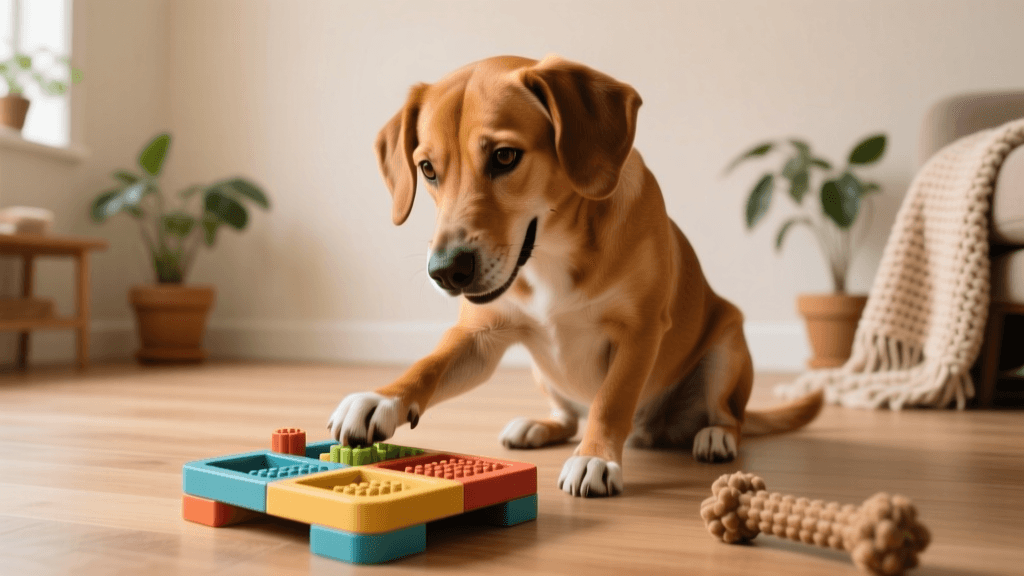
- Scent Enrichment: Scatter feeding or using silicone lick mats smeared with plain pumpkin puree and frozen encourages natural foraging behaviors. Licking and sniffing release endorphins in the canine brain, actively lowering their heart rate.
Actionable Steps: Responding to Your Dog's Signals
When you observe stress or calming signals, your response dictates how quickly your dog will learn to trust you. Here is a step-by-step protocol for the first 72 hours:
- Give Them Space: If your dog retreats to their bed or crate, enforce a strict 'no-touch, no-talk, no-eye-contact' rule for all family members and guests. Let them initiate contact.
- Advocate for Your Dog: If guests are visiting, do not force interactions. Ask guests to ignore the dog completely. This removes the social pressure that triggers appeasement signals like lip licking and yawning.
- Play Pattern Games: Engage in low-pressure games that build confidence without requiring physical handling. The '1-2-3 Find It' game is excellent: say '1, 2, 3' and toss a high-value treat into the grass or onto a snuffle mat. This builds a predictable, positive association with your voice and encourages voluntary engagement.
- Keep Routines Predictable: Feed, walk, and offer potty breaks at the exact same times each day. Predictability reduces the cognitive load on a stressed dog, allowing their nervous system to settle faster.
Conclusion
Getting a dog is a profound commitment that extends far beyond providing food and shelter; it requires a willingness to learn a completely new language. By tuning into your rescue dog's stress and calming signals during the critical first 72 hours, you transition from being just a provider to being a trusted advocate. Remember, decompression is not a linear process, and patience is your most valuable tool. Observe, respect their boundaries, and let your new companion dictate the pace of your growing relationship. In doing so, you will lay an unbreakable foundation of trust that will define your life together for years to come.
anouk-beaumont
All our authors care for dogs every day — read more of their work on the authors page.