Reading Rescue Dog Stress Signals: First 72 Hours (2026)
Learn to decode rescue dog calming signals and stress cues during the critical first 72 hours. Build trust and prevent returns with our 2026 guide.
The Critical First 72 Hours: Why Communication Matters
Bringing a rescue dog home in 2026 is a deeply rewarding experience, but the initial transition period can be fraught with miscommunication. According to the ASPCA, millions of dogs enter shelters annually, and a significant percentage of adoption returns occur within the first two weeks. The primary culprit? A breakdown in canine-human communication. When we misread a dog's stress signals as 'stubbornness,' 'guilt,' or 'aloofness,' we inadvertently damage the fragile trust required for a successful adoption.
Understanding canine calming signals—a concept pioneered by Norwegian dog trainer Turid Rugaas—is no longer just for professional behaviorists; it is an absolute necessity for the modern adopter. Dogs possess a complex, silent language designed to de-escalate tension, express discomfort, and maintain social harmony. In the high-stress environment of a shelter transition, recognizing these signals during the first 72 hours is the key to preventing behavioral fallout and setting your new companion up for lifelong success.
The 3-3-3 Rule and the Decompression Phase
The widely accepted '3-3-3 Rule' of dog adoption dictates that a dog needs three days to decompress, three weeks to learn your routine, and three months to truly feel at home. The first 72 hours (the decompression phase) are the most critical. During this window, a dog's nervous system is often in overdrive. They are processing new scents, new sounds, and new people.
As the American Kennel Club (AKC) notes, dogs use specific body language to cope with this sensory overload. If you push a dog to interact, play, or meet the neighbors before they have signaled they are ready, you risk triggering a fear response. Your primary goal in the first three days is not to train, but to observe, provide space, and respond appropriately to their silent requests for peace.
Top 5 Canine Calming Signals to Watch For
When you bring your new dog home, keep your voice low, your movements slow, and your eyes soft. Watch closely for these five common calming signals:
- 1. Lip Licking and Nose Flicks: If you lean over to pet your new dog and they rapidly lick their lips or flick their tongue over their nose, they are not hungry or tasting the air. This is a polite, low-level request for space. Action: Stop leaning in, step back, and offer a treat by tossing it gently on the floor near them.
- 2. Yawning Out of Context: A dog yawning when they are not tired—such as when you are putting on their harness or when a stranger approaches—is a sign of internal tension. They are trying to calm themselves down. Action: Pause what you are doing, take a deep breath (dogs respond to human breathing patterns), and give them a moment to reset.
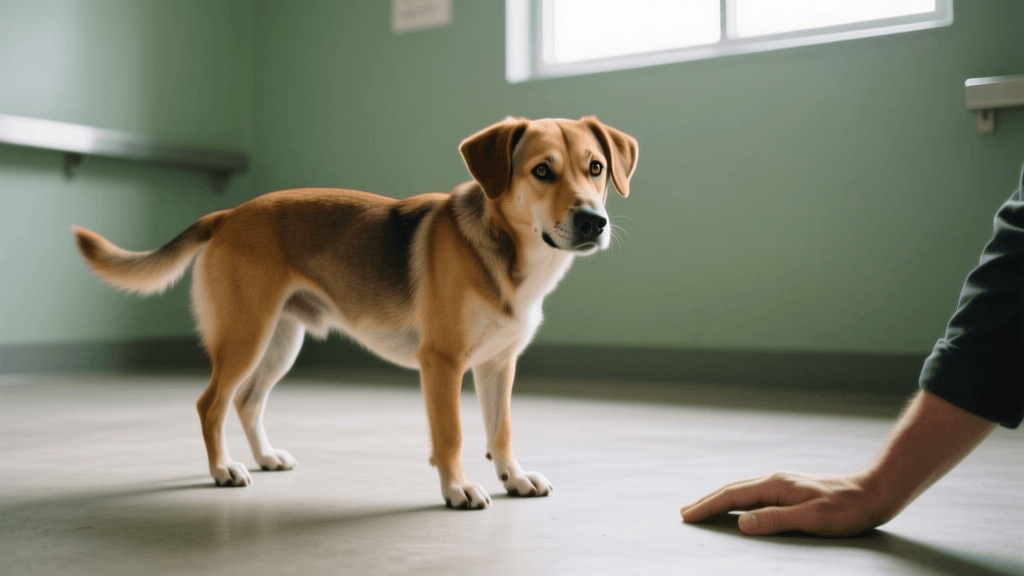
- 3. Turning the Head or Body Away: If you approach your dog and they turn their head to the side or present their side/back to you, they are signaling that they feel overwhelmed by direct confrontation. Action: Mirror their behavior. Turn your own body slightly sideways, avoid direct eye contact, and let them initiate the next interaction.
- 4. Sudden Ground Sniffing: While sniffing is a natural canine behavior, suddenly and intensely sniffing the ground when a new person or dog approaches is a displacement behavior. It is their way of avoiding eye contact and signaling peaceful intentions. Action: Do not pull the leash or force them to look up. Allow them to sniff until they feel safe enough to look up on their own.
- 5. The 'Shake Off': If your dog shakes their entire body vigorously from nose to tail after a stressful encounter (like a vet visit or a loud noise), they are literally 'shaking off' the adrenaline and stress hormones. Action: Praise them softly and allow them a few minutes of quiet time to let their nervous system regulate.
'Dogs are constantly talking to us. The problem is rarely that they are being disobedient; the problem is that we are not listening to their whispers until they are forced to shout.' — Modern Canine Behaviorist Adage
Stress vs. Relaxation: A 2026 Behavioral Checklist
Use this quick-reference table to assess your dog's emotional state during the first week. If you see multiple stress signals, immediately reduce environmental demands.
| Body Part | Stress / Anxiety Signals | Relaxation / Comfort Signals |
|---|---|---|
| Eyes | Whale eye (showing whites), hard staring, dilated pupils, furrowed brow | Soft gaze, squinty eyes, blinking slowly, relaxed brow |
| Ears | Pinned flat back, rigid and pricked forward (hyper-vigilance) | Neutral position, slightly back and relaxed, mobile and responsive |
| Mouth | Lip licking, panting when cool, tight closed mouth, yawning | Slightly open, relaxed jaw, 'smiling' (corners pulled back softly) |
| Tail | Tucked tightly, stiff and high, rapid rigid wagging | Loose, sweeping wag, relaxed neutral carriage, gentle thumping |
| Posture | Cowering, leaning away, tense muscles, freezing in place | Loose wiggly body, leaning in for pets, rolling to expose belly |
Essential 2026 Gear for Decompression and Communication
Equipping your home with the right tools can drastically reduce your dog's stress and help you communicate boundaries to the outside world. Here are the top recommended items for 2026:
- Adaptil Optimum Pheromone Diffuser (2026 Formula): Priced around $65, this diffuser covers up to 700 square feet and releases synthetic dog-appeasing pheromones. Plug it into the wall of your dog's designated 'safe room' 24 hours before they arrive to create an immediate olfactory cue of safety.
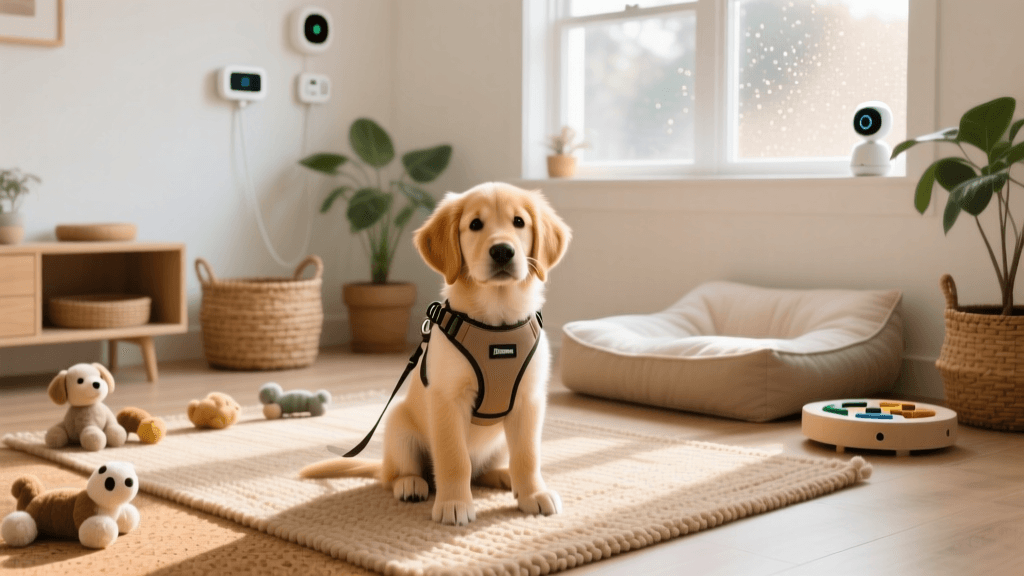
- Julius-K9 IDC Powerharness with Custom Velcro: Costing approximately $85, this ergonomic harness is a favorite among behaviorists. Crucially, you can attach custom velcro patches that read 'NERVOUS' or 'GIVE SPACE.' This communicates your dog's boundaries to well-meaning strangers on walks without you having to constantly defend your dog.
- 15-Foot Biothane Long Line: A standard 6-foot leash creates immediate tension and restricts a dog's ability to use distance as a coping mechanism. A 15-foot Biothane line (approx. $35-$45) allows your dog to sniff, decompress, and choose their distance from you during outdoor potty breaks, fostering trust and autonomy.
- Opaque Visual Barrier Gates: Many modern open-concept homes are overwhelming for shelter dogs. Using a baby gate covered with an opaque fabric or bamboo slat ($40) in doorways prevents your dog from feeling the need to 'guard' or monitor high-traffic areas like the kitchen.
Setting Up a 'Safe Zone' Using Canine Body Language
Do not force your new dog to sleep in your bedroom or the center of the living room if they are showing signs of overstimulation. Observe where they naturally gravitate. If they seek out a quiet corner, a dimly lit hallway, or the space under a desk, honor that choice.
Set up a 'Safe Zone' in that exact spot. Include a high-quality orthopedic bed, a snuffle mat to encourage natural foraging behaviors (which naturally lower a dog's heart rate), and a long-lasting chew like a Yak Cheese stick or a filled Kong. Rule number one for the first 72 hours: No one is allowed to reach into or enter the Safe Zone. If the dog is in their safe zone, they are invisible. This teaches the dog that they have agency and a guaranteed escape route, which paradoxically makes them more likely to venture out and engage with you willingly.
When to Call a Certified Behavior Consultant
While some stress and shutdown behavior is entirely normal during the first 72 hours, there are thresholds that require professional intervention. If your dog refuses to eat or drink for more than 24 hours, exhibits severe fear aggression (lunging, snapping, or biting when cornered), or remains in a state of catatonic 'freeze' for prolonged periods, do not wait out the 3-3-3 rule.
Reach out to a professional accredited by the International Association of Animal Behavior Consultants (IAABC). In 2026, an initial virtual or in-home behavioral consultation typically costs between $150 and $250. A certified consultant will help you read the subtle micro-expressions your dog is displaying and provide a customized desensitization plan that prioritizes emotional welfare over basic obedience. Remember, building a bond with a rescue dog is a marathon, not a sprint. By mastering the language of calming signals, you are giving your new best friend the greatest gift of all: the feeling of being truly understood.
jonas-cole
All our authors care for dogs every day — read more of their work on the authors page.