Decoding Canine Resource Guarding: An Expert Behavior Analysis
Decode canine resource guarding with expert behavior analysis. Learn actionable desensitization protocols, timing, and safe modification techniques today.
The Ethology and Psychology of Resource Guarding
Resource guarding is one of the most misunderstood behaviors in canine psychology. From an expert behavior analysis perspective, guarding is not a symptom of 'dominance,' spite, or a flawed temperament. Rather, it is a deeply ingrained, adaptive survival mechanism rooted in canine ethology. In ancestral environments, food scarcity was a reality, and the ability to secure and defend high-value calories was directly tied to survival. Today, domestic dogs may guard kibble, raw bones, toys, stolen items, or even specific humans and spatial locations.
When a dog exhibits resource guarding, they are communicating a clear emotional state: anxiety over the potential loss of a valued item. As behavioral consultants, our objective is not to 'break' the dog's spirit or assert dominance, but to systematically alter the dog's emotional response to human proximity. By shifting the canine paradigm from 'humans approaching means my resource will be stolen' to 'humans approaching means my resource value will increase,' we can effectively eliminate the underlying anxiety driving the behavior.
Decoding the Canine Escalation Ladder
Dogs rarely bite without warning. Instead, they utilize a complex, tiered communication system known as the escalation ladder. Unfortunately, many owners miss the early, subtle micro-signals of distress and only react when the dog reaches the top of the ladder (growling, snapping, or biting). Punishing a dog for growling is a critical error in behavior modification; it suppresses the warning signal without resolving the underlying anxiety, effectively creating a dog that 'bites without warning.' Understanding this ladder is paramount for safe intervention.
| Escalation Stage | Canine Body Language & Signals | Expert Intervention Protocol |
|---|---|---|
| Stage 1: Early Anxiety | Whale eye (showing whites of eyes), lip licking, yawning, sudden stiffening, freezing over the item. | Stop approaching immediately. Do not reach for the item. Toss a high-value treat from a distance to create a positive association with your presence. |
| Stage 2: Active Warning | Hard stare, low body posture, ears pinned back, raised hackles, low rumbling growl. | Back away slowly to defuse the pressure. Do not make direct eye contact. Call the dog away using a happy, trained recall cue if they are willing to drop the item. |
| Stage 3: Defensive Threat | Air snapping, lunging while tethered, baring teeth, loud and sustained growling. | Evacuate the area. Secure the dog behind a physical barrier (e.g., baby gate). Do not attempt to physically remove the item or punish the dog. |
| Stage 4: Inhibitory Bite | Quick snap making contact but inhibiting bite force (no puncture), meant to increase distance. | Seek immediate veterinary care if needed. Consult a certified applied animal behaviorist (CAAB) or veterinary behaviorist. Muzzle conditioning is now mandatory. |
Expert Behavior Modification: The Desensitization Protocol
To resolve resource guarding, we utilize classical counter-conditioning and operant desensitization. The goal is to change the dog's conditioned emotional response (CER). The most effective, evidence-based method is the 'Trade-Up' protocol, which teaches the dog that relinquishing an item results in an immediate, higher-value reward. According to the American Kennel Club, teaching a dog to trade rather than forcing them to surrender items builds trust and prevents defensive aggression.
Required Tools and Estimated Costs
Successful behavior modification requires precise management and high-value reinforcement. Below is a standardized toolkit for addressing mild to moderate resource guarding:
- High-Value Treats: Freeze-dried beef liver or Zuke's Mini Naturals (approx. $12.00 - $18.00 per bag). Treats must be pea-sized to allow for rapid consumption and repeated trials.
- Treat Pouch: Ruffwear Treat Trader or similar quick-release magnetic pouch (approx. $24.95). Rapid treat delivery within a 300-millisecond marker window is critical for clear communication.
- Management Barriers: Carlson Pet Products Design Studio Metal Pet Gate (approx. $45.00). Essential for spatial management and preventing rehearsal of guarding behaviors in multi-pet homes.
- Basket Muzzle: Baskerville Ultra Muzzle (approx. $18.50). Required for safety during the assessment phase and for dogs with a bite history. Must be properly conditioned using positive reinforcement.
Step-by-Step Timing and Execution
Precision in timing and distance is the cornerstone of this protocol. If you push the dog past their threshold, you risk triggering a guarding response and reinforcing the fear.
- Establish Baseline Distance: Give the dog a low-value item (e.g., a standard kibble-filled Kong). Stand at a distance where the dog shows zero signs of tension (usually 5 to 10 feet). This is your 'sub-threshold' distance.
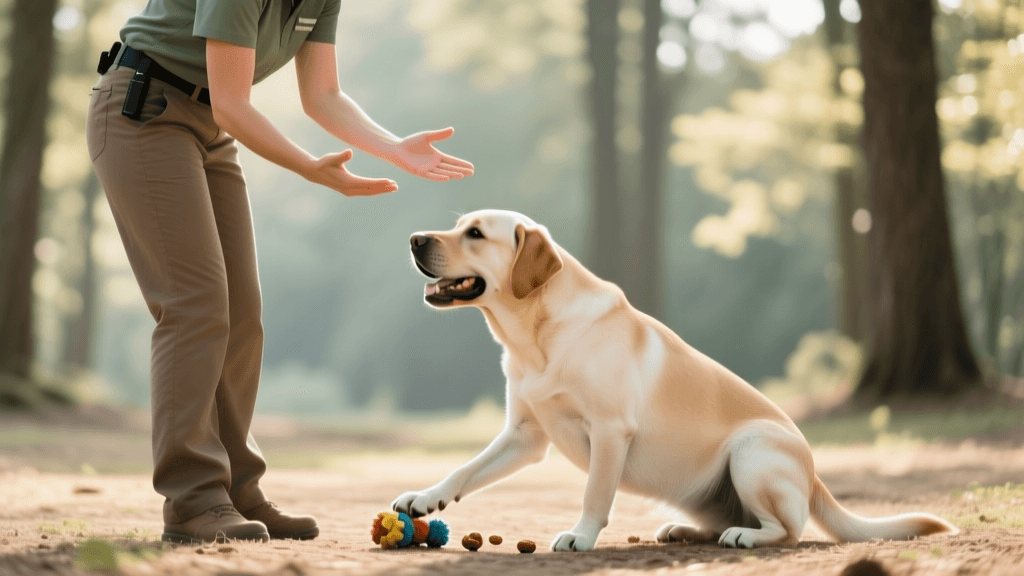
- The Approach and Toss: Take one step toward the dog. The exact millisecond your foot plants, toss a pea-sized piece of high-value treat (e.g., freeze-dried liver) past the dog, away from the guarded item. The dog must leave the item to get the treat.
- Retreat: As the dog eats the treat, immediately take two steps back. This teaches the dog that your approach predicts good things, and your retreat allows them to return to their item without pressure.
- Repetition and Latency: Repeat this sequence 10 to 15 times per session. Keep sessions under 5 minutes to prevent cognitive fatigue. Over days, gradually decrease the distance by 6-inch increments, provided the dog remains relaxed and exhibits loose, wiggly body language.
- The Trade-Up Execution: Once you can stand directly next to the dog without tension, introduce the verbal cue 'Drop it' or 'Trade.' Present the high-value treat directly to the dog's nose. When they drop the low-value item to eat the treat, pick up the low-value item, give them a second treat, and then return the original item. Returning the item is crucial; it proves to the dog that giving up a resource is temporary and safe.
The Behavioral Fallout of Punishment
Historically, outdated training paradigms suggested that owners should forcefully remove items, pin the dog to the floor ('alpha rolls'), or use aversive collar corrections to 'show the dog who is boss.' Modern veterinary behavior science unequivocally rejects these methods. The American Veterinary Society of Animal Behavior (AVSAB) explicitly warns against the use of punishment for behavior modification, noting that aversive techniques can cause severe behavioral fallout, including increased fear, anxiety, and aggression.
"Punishment can suppress the warning signs of aggression, such as growling or snapping, without addressing the underlying emotional cause. This results in a dog that feels the same level of anxiety but no longer communicates its distress before biting."
When you punish a growl, you are essentially removing the smoke detector without putting out the fire. The dog learns that growling results in pain or intimidation, so the next time they feel threatened over a resource, they will bypass the growl and proceed directly to a bite. Furthermore, physical confrontations over resources destroy the human-animal bond, replacing trust with chronic hypervigilance.
Environmental Management and Safety
While desensitization is underway, strict environmental management is non-negotiable. Every time a dog successfully guards an item and keeps the human away, the guarding behavior is negatively reinforced (the dog gets to keep the item because the human retreated). To prevent rehearsal of the behavior, manage the environment proactively:
- Pick up all high-value items: Do not leave bully sticks, raw bones, or pig ears lying around. Only provide these items when the dog is secured in a crate or a separate room behind a baby gate.
- Feed in isolation: If the dog guards their food bowl, feed them in a closed room or a crate. Do not allow children or other pets to approach the feeding area.
- Practice 'Leave It': Train a robust 'Leave It' cue using positive reinforcement for items dropped on the floor, so the dog learns to look to you for a reward rather than diving for the dropped item.
When to Seek Professional Help
Resource guarding can escalate rapidly, especially in households with small children or multiple dogs. If your dog has progressed to Stage 3 or Stage 4 on the escalation ladder, or if the guarding is directed toward humans and involves puncture wounds, home modification protocols are insufficient and potentially dangerous. In these cases, it is imperative to consult a veterinarian to rule out underlying medical causes (such as pain or neurological issues) and to hire a certified applied animal behaviorist (CAAB) or a veterinary behaviorist (DACVB). Understanding your dog's behavior through an empathetic, science-based lens is the first step toward a safer, more harmonious relationship.
tom-renshaw
All our authors care for dogs every day — read more of their work on the authors page.