2026 Separation Anxiety Guide: Graduated Departure Training
Learn how to cure your dog's separation anxiety in 2026 using the graduated departure protocol and smart treat cameras for stress-free alone time.
Understanding Canine Separation Anxiety in 2026
As we navigate the hybrid and return-to-office work models of 2026, a significant number of dogs are struggling to adapt to prolonged periods of solitude. Dogs that grew accustomed to constant human presence over the past few years are now facing sudden isolation, leading to a documented spike in separation anxiety cases across the country. Separation anxiety is not merely 'bad behavior' or a lack of obedience; it is a profound, clinical panic response. If your dog is destroying furniture, howling incessantly, or injuring themselves trying to escape when you leave, this comprehensive guide is for you. In this 2026 training manual, we will break down the gold-standard 'Graduated Departure Protocol,' leveraging the latest smart pet cameras and interactive enrichment tools to help your dog build confidence and actually enjoy their alone time.
Before diving into training, it is crucial to distinguish between true separation anxiety and simple boredom or under-stimulation. According to the ASPCA, true separation anxiety is a panic disorder. Dogs with this condition will exhibit signs of distress the moment you begin your pre-departure routine (putting on shoes, grabbing keys) and will escalate into destructive behavior, inappropriate elimination, or vocalization within minutes of your departure. Boredom, on the other hand, usually results in chewing or digging that occurs at random times when the dog is left alone, without the intense panic and physiological stress markers (like excessive drooling, panting, or trembling) seen in separation anxiety.
Essential 2026 Gear: Smart Cameras and Enrichment Tools
To successfully execute a graduated departure protocol, you need eyes on your dog when you are not there. The smart pet camera market in 2026 has evolved significantly, offering AI-driven anxiety detection, automated treat tossing, and integration with smart home ecosystems. Below is a comparison of the top three smart treat-dispensing cameras currently dominating the market, helping you choose the right tool for your training protocol.
| Camera Model | AI Anxiety Detection | Treat Tossing | Price (2026 Est) | Best For |
|---|---|---|---|---|
| Furbo 4K 360 | Yes (Bark/Pacing alerts) | Yes (Automated schedules) | $219 | Severe pacing & multi-room tracking |
| Petcube Bites 2 Lite | No | Yes (Manual only) | $149 | Budget-conscious owners |
| Eufy Smart Pet Camera | Yes (Vocalization tracking) | Yes (Manual & Scheduled) | $179 | High-res treat tossing & local storage |
The 30-Day Graduated Departure Protocol
The Humane Society of the United States emphasizes that you cannot cure separation anxiety by simply forcing a dog to 'cry it out.' This outdated method, known as flooding, only worsens the trauma and reinforces the panic loop. Instead, we use systematic desensitization to change the dog's emotional response to your departure.
Week 1: Desensitizing Pre-Departure Triggers
Dogs are masters of pattern recognition. Your dog knows you are leaving long before you walk out the door. Spend the first week neutralizing these environmental triggers. Pick up your car keys and sit back down on the couch. Put on your work shoes and immediately take them off to watch TV. Grab your coat and fold it on the bed. Do this 15 to 20 times a day. The goal is to make these actions completely boring, predictable, and meaningless to your dog, breaking the associative bond between the trigger and the panic of your absence.
Week 2: The Threshold Game
Once your dog reliably ignores your keys and shoes, move to the door. Touch the doorknob, then walk away. Open the door an inch, then close it and sit down. Gradually work up to opening the door, stepping outside for exactly one second, and immediately returning. Do not say goodbye when you leave, and do not offer enthusiastic greetings when you return. Keep arrivals and departures incredibly low-key and emotionally neutral. Your departures must become the most boring part of your dog's day.
Week 3: Micro-Absences and Camera Integration
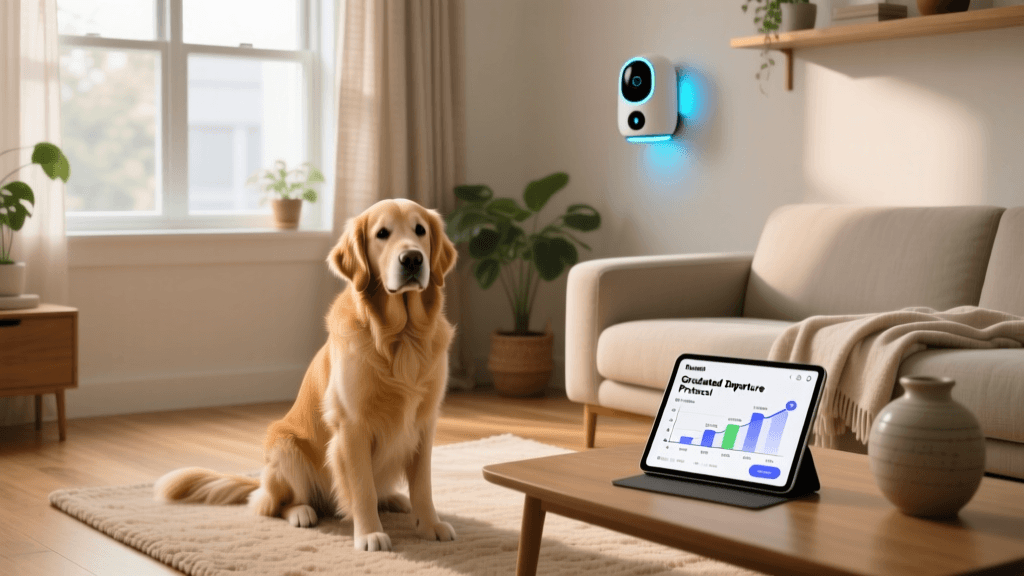
This is where your 2026 smart camera becomes invaluable. Step outside, close the door, and watch your dog on your smartphone via the camera app. Leave for 10 seconds, then 30 seconds, then 1 minute. If your dog shows signs of distress (panting, pacing, whining) on the camera, you have moved too fast. Return before the panic fully sets in. Use the camera's treat-tossing feature to dispense a high-value reward, such as freeze-dried liver or chicken bites, the exact moment your dog settles on their designated resting mat.
Week 4: Extending Time and Adding Enrichment
Gradually increase your absences to 5, 10, and then 20 minutes. To bridge the gap between your departure and your return, introduce long-lasting enrichment. The American Kennel Club (AKC) highly recommends puzzle feeders to keep a dog's brain engaged and redirect their focus. Freeze a mixture of plain yogurt, pumpkin puree, and kibble inside a Kong Classic, or use a Nina Ottosson Dog Brick puzzle toy. Give this to your dog right as you step out the door. The physical acts of licking and chewing release endorphins that naturally soothe canine anxiety and lower their heart rate.
Tracking Physiological Stress with Smart Collars in 2026
Behavioral observation is critical, but tracking physiological data provides an objective measure of your dog's stress levels. In 2026, smart collars like the Fi Series 3 and Whistle Health offer advanced biometric tracking, including resting heart rate and sleep quality metrics. A dog suffering from separation anxiety will often exhibit an elevated resting heart rate and disrupted sleep patterns even when you are home. By monitoring these baselines via the companion apps, you can objectively measure whether your graduated departure protocol and environmental changes are actually reducing your dog's underlying physiological stress over time.
Creating a Safe Haven Environment
Your dog's physical environment plays a massive role in their ability to self-soothe. Veterinary behaviorists recommend creating a dedicated 'decompression zone' rather than relying solely on crate training, which can induce claustrophobia and escalate panic in anxious dogs. Implement the following environmental modifications:
- Adaptive Pheromones: Plug in an Adaptil DAP (Dog Appeasing Pheromone) diffuser in the room where your dog spends the most time. These synthetic pheromones mimic the comforting scent of a nursing mother dog and have been clinically shown to reduce stress behaviors.
- Acoustic Masking: Leave a white noise machine or a smart speaker playing classical music or reggae (studies show these specific genres lower canine heart rates) to drown out triggering neighborhood noises like delivery trucks or passing dogs.
- Scent Anchoring: Leave an unwashed t-shirt you have worn recently on your dog's bed. Your familiar scent provides a powerful psychological anchor that promotes a sense of security.
Common Mistakes That Sabotage Progress
Even with the best intentions, owners frequently make errors that undermine the desensitization process. Avoid these common pitfalls:
- Punishing Anxiety: Never scold your dog for destructive behavior or accidents that occurred while you were away. They are acting out of panic, not spite. Punishment only increases their overall anxiety baseline and damages your bond.
- Inconsistent Schedules: If you do 20-minute absences on Monday but take your dog to the pet store with you on Tuesday, you disrupt the desensitization curve. Consistency is non-negotiable during the initial 30-day protocol.
- Emotional Goodbyes: Making a fuss, using a high-pitched voice, or repeatedly petting your dog before you leave signals that something significant and potentially scary is about to happen.
When to Consult a Veterinary Behaviorist
While the graduated departure protocol is highly effective for mild to moderate cases, severe separation anxiety often requires pharmacological intervention. If your dog is injuring themselves (breaking teeth on crates, tearing out nails on doors), or if they refuse to eat high-value treats when left alone, it is time to consult a board-certified veterinary behaviorist. In 2026, veterinarians have access to advanced, fast-acting anti-anxiety medications, including modified fluoxetine protocols and situational trazodone. These medications can lower your dog's panic threshold enough for the behavioral training to actually take root. Medication is not a failure; it is a vital, science-backed tool that opens the neurological window for learning and emotional regulation.
Conclusion
Curing separation anxiety is a marathon, not a sprint. By combining the structured, science-backed graduated departure protocol with the advanced smart cameras and biometric trackers available in 2026, you can systematically rebuild your dog's confidence. Stay patient, remain consistent with your low-key departures, and remember that every small victory is a step toward a happier, more independent companion.
anouk-beaumont
All our authors care for dogs every day — read more of their work on the authors page.