A Step-by-Step Guide to Curing Dog Resource Guarding
Learn why dogs resource guard and follow our step-by-step training guide using desensitization to build trust and safely eliminate aggressive behavior.
Understanding the Psychology Behind Resource Guarding
Resource guarding is one of the most misunderstood behaviors in canine psychology. When a dog stiffens, growls, or snaps over a bone, toy, or food bowl, many owners mistakenly label the dog as 'dominant' or 'aggressive.' In reality, resource guarding is a natural, evolutionary survival instinct. In the wild, canines must protect valuable calories and assets to survive. Your dog is simply exhibiting a deeply ingrained fear of scarcity.
According to the American Kennel Club (AKC), resource guarding is driven by anxiety and the amygdala's fight-or-flight response, not a desire to assert dominance over humans. Punishing a dog for growling only suppresses the warning signal, leading to a dog that bites without notice. To truly cure this behavior, we must change the dog's underlying emotional response using desensitization and counter-conditioning. This step-by-step guide will walk you through the exact protocol to transform your dog's fear into positive anticipation.
Essential Tools for Counter-Conditioning
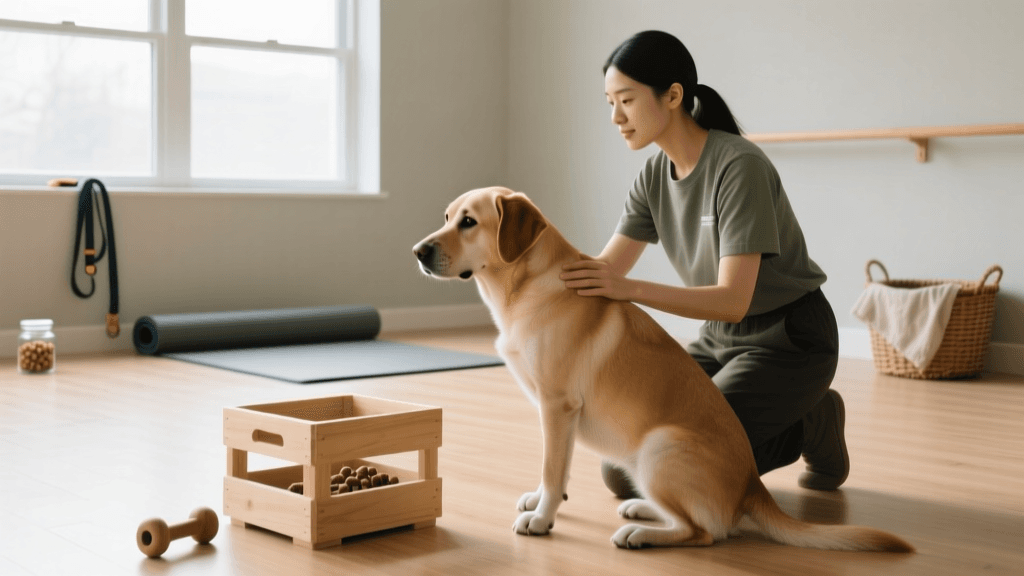
Before beginning your training sessions, you need the right equipment. Success relies on precise timing, high-value reinforcement, and safety management.
- High-Value Treats: Dry kibble will not work. Use boiled chicken breast, freeze-dried liver, or Zuke's Mini Naturals (approx. $14 for a 16oz bag). The treat must be more valuable than the guarded item.
- 15-Foot Biothane Long Line: Costs around $30-$40. This allows you to manage the dog's movement and safely intervene without hovering directly over them, which can trigger guarding.
- Baskerville Ultra Muzzle: Priced between $20-$30. Essential for safety during the initial phases if your dog has a history of biting. It allows the dog to pant, drink, and take treats while preventing injury.
- Trade-Up Items: A KONG Classic ($15-$25) stuffed with peanut butter and frozen chicken broth. This serves as the ultimate 'trade' item.
Step-by-Step Training Protocol
Keep training sessions short—10 to 15 minutes maximum—to prevent cognitive fatigue. Always work in a quiet, low-distraction environment.
Step 1: Identify the Threshold Distance
The 'threshold' is the exact distance at which your dog notices a human approaching but does not exhibit guarding behaviors (stiffening, whale eye, lip licking, or growling). For most dogs, this distance is between 6 to 10 feet. Use a tape measure or count your paces (roughly 2.5 feet per pace) to find this baseline. Never cross this threshold during early training; doing so will trigger the dog's defensive amygdala response and set your progress back.
Step 2: The 'Treat and Retreat' Method
This step builds a positive association with human proximity. 1. Give your dog a low-to-medium value item (e.g., a cotton rope toy). 2. Stand at the threshold distance (e.g., 8 feet away). 3. Toss a high-value treat (like boiled chicken) behind the dog. 4. Tossing the treat behind the dog forces them to voluntarily leave the resource to get the chicken. This removes the confrontation of you reaching into their space. 5. Repeat this 10-15 times per session. You must deliver the treat within a 0.5-second window of the dog noticing you to forge a strong neurological link.
Step 3: The Approach and Retreat
Once the dog is happily wagging their tail and looking up at you when you appear at the threshold, decrease the distance by one foot. Walk toward the dog, stop at the new distance, toss the high-value treat behind them, and then immediately turn and walk away. The 'retreat' is crucial; it proves to the dog that your approach predicts good things and that you have no intention of stealing their item.
Step 4: The Trade-Up Game
Only attempt this step when the dog is completely relaxed with you standing 2 to 3 feet away. When the dog has a low-value item, approach calmly and offer the frozen, stuffed KONG. Say a cue word like 'Trade.' When the dog drops the toy to eat the KONG, calmly pick up the toy, let them finish the KONG, and then give the toy back. Giving the item back proves that human hands near their resources result in upgrades, not theft.
Resource Guarding Progression Chart
Use this chart to track your dog's emotional state and determine when it is safe to move to the next phase. Do not rush the timeline; some dogs may spend weeks in Phase 1.
| Training Phase | Distance to Resource | Human Action | Expected Canine Response |
|---|---|---|---|
| Phase 1: Threshold | 8 to 10 feet | Walk parallel, toss high-value treat behind dog | Relaxed body, wags tail, eats treat, returns to item |
| Phase 2: Approach | 4 to 7 feet | Walk toward, stop, toss treat, retreat | Looks up happily, anticipates treat, leaves item willingly |
| Phase 3: Proximity | 2 to 3 feet | Approach, offer high-value trade-up item | Drops item willingly, happy demeanor, no stiffness |
| Phase 4: Hand Target | 0 feet (Next to bowl) | Drop treats directly into bowl while dog eats | Dog pauses eating to look for treats, wags tail |
Common Mistakes to Avoid
According to the American Veterinary Society of Animal Behavior (AVSAB), the use of punishment and dominance-based theories (such as 'alpha rolls' or forcibly taking items from a dog's mouth) is scientifically proven to increase fear and aggression. Avoid these common pitfalls:
- Punishing the Growl: A growl is a gift; it is your dog's way of communicating discomfort. If you punish the growl, the dog will learn to skip the warning and go straight to a bite.
- Reaching Over the Dog's Head: In canine body language, a hand reaching over the head or neck is perceived as a threat. Always approach from the side and keep your hands below the dog's chin level.
- Chasing the Dog: If your dog grabs a forbidden item (like a shoe) and runs, chasing them turns it into a game of keep-away, which reinforces the guarding behavior. Instead, use the 'Trade-Up' method with a piece of chicken.
When to Call a Professional
While mild to moderate resource guarding can be managed with this step-by-step protocol, severe cases require professional intervention. If your dog has already bitten and broken skin, or if they guard unpredictable items (like dust bunnies or shadows), you must seek help immediately. Look for a certified professional who aligns with modern, force-free behavioral science. The Best Friends Animal Society recommends consulting a Certified Applied Animal Behaviorist (CAAB) or a veterinarian behaviorist to create a tailored, safe modification plan. Always prioritize safety by utilizing a basket muzzle and baby gates to manage the environment while you work on changing your dog's emotional response.
beth-carrasco
All our authors care for dogs every day — read more of their work on the authors page.