Why your dog yawns and what it actually means
Yawns are rarely about tiredness. A look at the four most common reasons dogs yawn, and what each one tells you about how they feel.
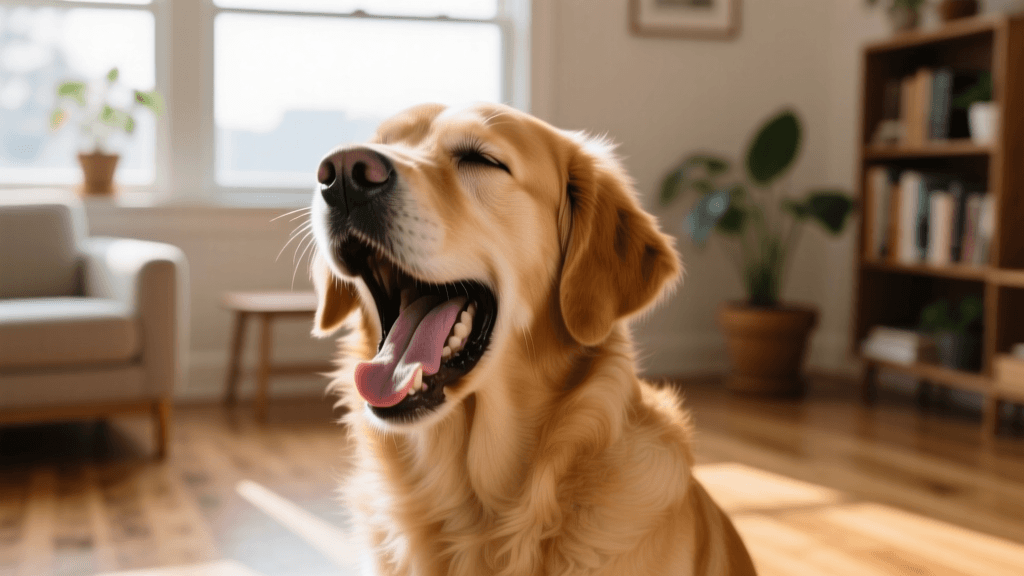
A dog yawn looks a lot like a human yawn, but it does not usually mean the same thing. Research over the last two decades has shown that canine yawning is more often a signal of mild stress, social tension, or transition than of tiredness.
That does not mean every yawn is a red flag. Reading a yawn in isolation tells you very little — the context, and the other signals around it, do most of the work.
Reason one — appeasement
The classic stress yawn is part of what Norwegian trainer Turid Rugaas (Calming Signals, 2006) called the canine appeasement repertoire. A dog uses a yawn the way a polite human uses a soft "sorry, my mistake" — to defuse a tense moment.
You will often see appeasement yawns when an unfamiliar person leans over the dog, when two dogs meet face-to-face, or when an owner is mildly frustrated during training. The yawn says: "I'm not a threat — please de-escalate."
Reason two — empathy and contagion
Dogs catch yawns from humans they are bonded to. A 2013 study by Romero, Konno and Hasegawa (PLOS One) tested 25 pet dogs and found that 72% yawned when their owner yawned, compared to only 8% when a stranger yawned. The contagious yawn appears to require an existing social bond and is one of the earliest pieces of evidence that dogs have a form of empathy with humans.
Reason three — anticipation and arousal
A dog at the start of a walk, watching you pick up the lead, will often yawn. This is not stress — it is arousal management. The yawn helps the dog regulate excitement before the walk begins.
You will also see anticipation yawns during agility, at the start of fetch, and when the dog senses dinner is imminent. The yawn here is closer to a sigh-of-readiness than to a sign of distress.
Reason four — sleep and waking
Dogs do yawn when they are genuinely tired or just waking up — but this accounts for a smaller share of yawns than most owners think. Researchers estimate sleep-related yawns at roughly 18% of total observed yawns in pet dogs (Mariti et al., Veterinary Behaviour, 2017).
What the yawn looks like in each context
| Yawn type | Body context | Other signals usually present |
|---|---|---|
| Appeasement | Stiff body, lowered head | Lip lick, head turn, weight back |
| Contagion | Calm, near a familiar human | Soft eye, slow blink |
| Anticipation | Alert, weight forward | Quick head turns, body shake-off |
| Tiredness | Slowing down, eyes closing | Lying down, slow movement |
Three scenarios you will recognise
The visiting relative scenario. A friend leans down to greet your dog and pats them on the head. The dog yawns, turns its head, and tries to step away. This is appeasement. Politely ask the visitor to give the dog space.
The lead-picking-up scenario. You pick up the lead. The dog yawns, shakes off, then trots towards the door. This is anticipation. No action needed — your dog is regulating excitement.
The grooming scenario. You start brushing your dog. After 30 seconds the dog yawns repeatedly with a closed mouth between yawns. This is stress. Pause the grooming, give a treat for being calm, then re-introduce the brush more gradually.
"A yawn is information. The job of the owner is to read it, not to ignore it because it is convenient." — Marcus Aldridge, CCAB.
Yawns are one piece of a much larger conversation. Once you know what to look for, your dog becomes easier to interpret, easier to support, and easier to live alongside. That benefits both of you.
Marcus Aldridge
All our authors care for dogs every day — read more of their work on the authors page.