Crate Training a Puppy at Night: Top Questions Answered
Discover answers to the most-asked Google questions about crate training a puppy at night, including crying, schedules, and the best gear.
Introduction: The Midnight Puppy Dilemma
Bringing a new puppy home is an exhilarating experience, but when the sun goes down and the house goes quiet, many new pet parents face a daunting challenge: nighttime crate training. A quick look at Google Trends reveals that thousands of exhausted owners search for answers to questions like why is my puppy crying in the crate at night and how long can a puppy hold its bladder. If you are currently losing sleep and wondering if you are doing something wrong, take a deep breath. You are not alone, and the solutions are rooted in canine behavioral science.
Crate training is not just about protecting your furniture; it is about providing your dog with a secure, den-like sanctuary. According to the American Kennel Club (AKC), dogs are naturally den animals, and a properly introduced crate becomes their safe retreat. However, the nighttime transition requires patience, a strict schedule, and the right equipment. In this comprehensive guide, we answer the most frequently asked questions about nighttime crate training to help you and your puppy finally get a good night's rest.
1. How Long Can a Puppy Stay in the Crate at Night?
One of the most common questions searched online is how many hours a puppy can physically hold their bladder while crated. The general rule of thumb recommended by veterinarians and the ASPCA is that a puppy can hold it for one hour per month of age, plus one additional hour. However, nighttime bladder control is slightly different because a sleeping puppy's metabolism slows down, allowing them to hold it a bit longer than during the day.
Setting realistic expectations is crucial to prevent accidents and frustration. If you expect an eight-week-old puppy to sleep for eight straight hours, you are setting yourself up for failure and your puppy for distress. Below is a general guideline for maximum nighttime crate duration based on age.
Nighttime Crate Duration Chart
| Puppy Age | Maximum Nighttime Crate Time | Required Midnight Potty Breaks |
|---|---|---|
| 8 - 10 Weeks | 3 to 4 hours | Yes (1-2 breaks) |
| 11 - 14 Weeks | 4 to 5 hours | Yes (1 break) |
| 15 - 16 Weeks | 5 to 6 hours | Maybe (1 early morning break) |
| 4 - 5 Months | 6 to 7 hours | No (usually sleep through) |
| 6+ Months | 8 hours | No |
Note: Always take your puppy out for a potty break immediately before crating for the night, and the very first thing in the morning.
2. Should I Ignore My Puppy Crying in the Crate at Night?
This is arguably the most stressful aspect of puppy ownership. When your puppy whines, barks, or howls at 2:00 AM, your instinct is to comfort them or let them out. However, behavioral conditioning dictates that if you let a puppy out of the crate while they are crying, you have just taught them that crying is the key to unlocking the door.
The Humane Society of the United States advises owners to differentiate between a potty-need cry and an attention-seeking cry. If your puppy has been in the crate for less than two hours and was fully exercised and emptied before bed, the crying is likely due to loneliness or anxiety. In this case, ignoring the behavior is necessary to prevent reinforcing it. Expect an extinction burst—a temporary increase in the volume and intensity of the crying before the puppy finally gives up and goes to sleep.
Pro-Tip for Anxious Puppies: Invest in a behavioral aid like the SmartPetLove Snuggle Puppy (typically priced around $40-$50). This plush toy features a simulated heartbeat and a heat pack that mimics the physical sensation of sleeping against a littermate. Placing this inside the crate can drastically reduce nighttime anxiety and whining within the first few weeks.
3. What Size Crate Should I Buy?
Buying a crate that is too large is a frequent mistake. If a puppy has enough room to sleep in one corner and eliminate in another, the crate loses its effectiveness as a housetraining tool, as dogs naturally avoid soiling their immediate sleeping area. The ideal crate size allows your puppy to stand up without hitting their head, turn around comfortably, and lie down stretched out—but nothing more.
To measure your puppy for a crate that will fit their adult size, look at the breed's estimated adult weight and dimensions. Most high-quality wire crates, such as the MidWest iCrate ($50-$80), come with an adjustable divider panel. This allows you to buy a crate sized for your dog's adult dimensions (e.g., 36-inch or 42-inch) and block off the excess space while they are small, saving you from buying multiple crates as they grow.
Crate Type Comparison
| Crate Type | Best For | Pros | Cons | Average Cost |
|---|---|---|---|---|
| Wire Crate | Puppies, Housetraining, Home Use | Excellent visibility, foldable, includes divider | Heavy, not den-like without a cover | $50 - $90 |
| Plastic Kennel | Travel, Anxious Dogs, Den-seekers | Cozy, enclosed feeling, airline approved | Poor ventilation, harder to clean | $40 - $100 |
| Soft-Sided | Fully trained adult dogs, Car rides | Lightweight, portable, easy storage | Easily destroyed by chewing puppies | $30 - $60 |
4. Where Should the Crate Be Placed at Night?
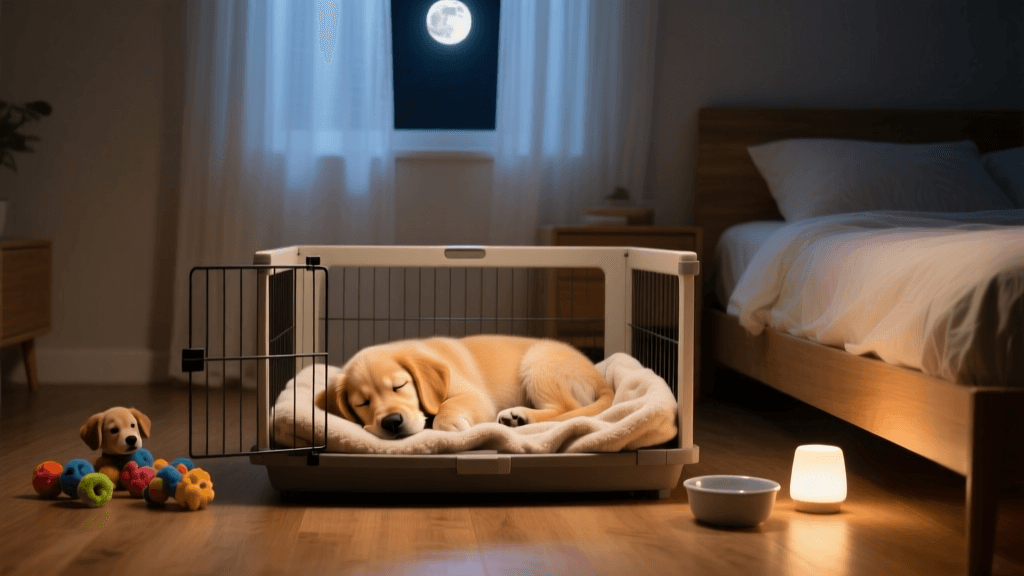
Location matters immensely during the early stages of crate training. While you may ultimately want the dog to sleep in the living room or a dedicated dog room, a young puppy needs to feel connected to their pack. For the first few weeks, place the crate in your bedroom, within sight of your bed. Hearing your breathing and smelling your scent provides immense comfort to a puppy separated from their mother and littermates for the first time.
As the puppy becomes more confident and sleeps through the night without incident, you can gradually move the crate a few feet closer to the door each night until it reaches its permanent location. Avoid placing the crate in high-traffic areas, near drafty windows, or directly next to heating vents, as temperature regulation is vital for a comfortable sleep.
5. What is the Ideal Nighttime Crate Routine?
Success in crate training relies heavily on predictability. Dogs thrive on routine, and establishing a strict evening schedule signals to your puppy's brain that it is time to wind down. Here is a highly effective, actionable evening routine for a 10-week-old puppy:
- 6:30 PM - Dinner Time: Serve the final meal of the day. Remove the food bowl after 15 minutes to establish a strict feeding schedule, which directly correlates to predictable potty habits.
- 7:30 PM - Water Cut-Off: Pick up the water bowl. While hydration is important, removing water two to three hours before bed minimizes the need for midnight bathroom trips.
- 8:30 PM - Active Play & Training: Engage in 15-20 minutes of active play or basic obedience training (like sit and touch) to mentally and physically tire the puppy out.
- 9:30 PM - Wind Down: Lower the lights and reduce household noise. Offer a chew toy or a frozen Kong stuffed with dog-safe peanut butter (cost: ~$15 for the toy and treats) to encourage calm, independent relaxation.
- 10:00 PM - Final Potty Break: Take the puppy outside on a leash. Keep the lights low and avoid playing. Use a consistent cue word like go potty. Once they eliminate, offer quiet praise and head straight back inside.
- 10:15 PM - Crate Time: Place the puppy in the crate with a safe, non-destructible bed and the Snuggle Puppy. Cover the top and sides of a wire crate with a breathable blanket to simulate a dark, secure den. Set your alarm for 2:00 AM for the mandatory midnight potty break.
Conclusion: Patience Pays Off
Nighttime crate training is undeniably one of the most taxing phases of puppyhood, but it is a temporary investment in your dog's long-term safety and well-being. By understanding your puppy's biological limitations, utilizing tools like heartbeat toys and divider panels, and sticking to a rigid evening routine, you will navigate this phase successfully. Remember that consistency is your greatest tool. The nights will get longer, the crying will stop, and eventually, your puppy will walk into their crate willingly, curl up, and sleep soundly until morning.
beth-carrasco
All our authors care for dogs every day — read more of their work on the authors page.