2026 Cooperative Care Dog Training: Build Trust & Reduce Vet Stress
Discover how cooperative care training and the bucket game build trust, reduce vet stress, and strengthen your bond with your dog in 2026.
The 2026 Paradigm Shift: From Restraint to Cooperation
Welcome to 2026, where the days of pinning down a terrified dog for a simple nail trim or blood draw are firmly in the past. Over the last few years, veterinary behaviorists and certified trainers have championed a revolutionary approach to canine husbandry: Cooperative Care. This methodology shifts the dynamic from forced compliance to willing participation. By giving your dog a voice and the power to 'opt-out' of uncomfortable procedures, you are not just making grooming and vet visits easier; you are profoundly deepening the bond of trust between you and your dog.
According to the Fear Free Pets initiative, which has seen massive adoption in veterinary clinics throughout 2026, animals that are allowed to participate in their own care exhibit significantly lower cortisol levels and faster recovery times. But beyond the clinical benefits, cooperative care is a masterclass in relationship building. When your dog realizes that you respect their boundaries, their baseline anxiety drops, and their attachment to you as a safe, predictable caregiver skyrockets.
The Neurochemistry of Canine Consent
Why does cooperative care build such a strong bond? The answer lies in mammalian neurochemistry. When you engage your dog in consent-based training, you trigger a positive feedback loop of oxytocin—the 'love hormone'—in both the human and the dog. Mutual gaze, cooperative problem-solving, and the relief of stress all stimulate oxytocin production.
When a dog is held down against their will, their brain is flooded with adrenaline and cortisol, which actively inhibits oxytocin and damages the human-animal bond. By utilizing positive reinforcement and consent signals, you are quite literally rewiring your dog's brain to associate your presence, and even the presence of grooming tools, with safety and reward. The ASPCA emphasizes that positive reinforcement strategies are the most effective way to build lasting confidence and trust in dogs, making it the gold standard for modern behavioral health.
Core Technique 1: Teaching the 'Chin Rest' Target
The chin rest is one of the most versatile cooperative care behaviors. It is used to keep a dog's head perfectly still for eye exams, ear cleaning, or blood draws from the jugular vein. More importantly, it serves as a built-in consent mechanism: if the dog lifts their head off the target, the procedure stops immediately.
Step-by-Step Chin Rest Training
- Phase 1: Target Introduction. Hold a small, textured silicone mat (or your cupped hand) an inch from your dog's nose. The moment they investigate and touch it with their nose or chin, click your clicker and offer a high-value treat. Repeat 10-15 times.
- Phase 2: Adding Duration. Wait for your dog to rest their chin heavily on the mat for one full second before marking and rewarding. Gradually increase this duration to 3, then 5, then 10 seconds. Feed continuously while their chin remains on the target.
- Phase 3: The Opt-Out Rule. This is the most critical step for bonding. If your dog lifts their head, do not force them back down. Simply stop feeding, wait patiently, and allow them to choose to return to the mat. When they do, resume feeding. This teaches the dog that they have control over the interaction.
- Phase 4: Introducing the Tool. While your dog is resting their chin and eating, gently touch their shoulder with the back of a brush. Mark and reward. Slowly progress to touching their ears, then their face, always respecting the opt-out rule.
Core Technique 2: The Bucket Game for Grooming
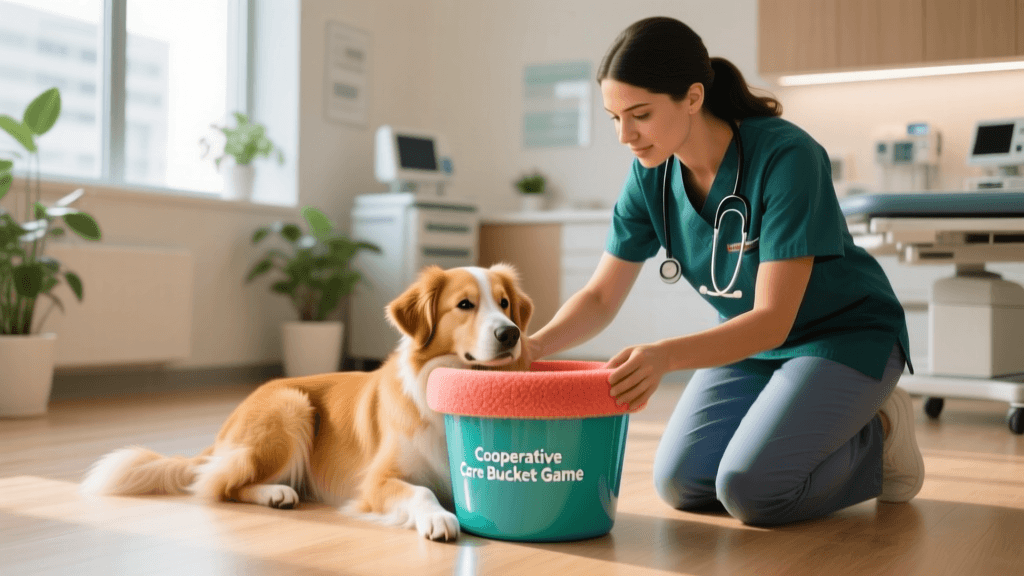
Pioneered by international animal behaviorist Chirag Patel, the 'Bucket Game' is a brilliant consent-based protocol for full-body grooming, nail clipping, and veterinary exams. It utilizes a bucket (or a stool) filled with high-value treats or a lick mat as the dog's 'consent button.'
How to Play the Bucket Game
- The Setup: Place a sturdy bucket on the floor. Top it with a lick mat smeared with plain pumpkin puree or low-sodium bone broth, frozen solid for longevity.
- The Rule: As long as the dog is eating from the bucket, you may proceed with the grooming procedure (e.g., gently handling their paw).
- The Opt-Out: The moment the dog stops eating and turns their head away from the bucket, you must immediately drop the grooming tool and step back.
- The Opt-In: Wait quietly. When the dog chooses to return to the bucket and resume licking, you may resume the grooming procedure.
'The Bucket Game isn't just about distracting the dog; it is about giving them a clear, unambiguous way to say "I need a break." When we honor that request, we build a level of trust that makes future sessions exponentially easier.' — Certified Applied Animal Behaviorist, 2026 Canine Husbandry Summit.
Comparison Chart: Traditional Restraint vs. Cooperative Care
Understanding the physiological and emotional differences between these two handling methods highlights why the veterinary industry has rapidly adopted cooperative care standards in 2026.
| Metric | Traditional Restraint (Force/Pinning) | Cooperative Care (Consent-Based) |
|---|---|---|
| Cortisol Levels | Spikes significantly; remains elevated for 24-48 hours post-visit. | Minimal spike; returns to baseline within 30-60 minutes. |
| Heart Rate Variability (HRV) | Decreases, indicating high sympathetic nervous system arousal (fight/flight). | Remains stable or slightly elevated, indicating engaged but relaxed focus. |
| Post-Session Bonding | Dog may exhibit avoidance behaviors toward the owner or handler. | Dog seeks proximity and physical contact with the owner; oxytocin release. |
| Future Vet/Grooming Anxiety | Anticipatory anxiety increases with each subsequent visit. | Anticipatory anxiety decreases; dog willingly engages with equipment. |
| Procedure Accuracy | Lower; struggling makes precise needle placement or clipping difficult. | Higher; a still, relaxed dog allows for safe, accurate veterinary work. |
2026 Recommended Gear for Cooperative Husbandry
To set yourself and your dog up for success, you need the right tools. Here are the top-rated, welfare-focused husbandry tools dominating the market in 2026:
- Hyper Pet IQ Treat Mat (Approx. $16): The suction cups on this silicone mat allow you to stick it to walls, bathtubs, or the side of a grooming table. It is essential for the Bucket Game or for distracting a dog during baths.
- Chippin Silver Carp Training Treats (Approx. $14): High-value, single-ingredient treats are crucial for cooperative care. Silver carp is a novel protein that is highly palatable, hypoallergenic, and sustainable, making it perfect for dogs with sensitive stomachs who need a high-reward incentive.
- Karen Pryor iClick Mini (Approx. $9): A quiet, unobtrusive clicker. The raised button is easy to press with one hand while your other hand holds a grooming tool or treat pouch.
- ScratchBoard (DIY or Commercial, Approx. $35): A textured board that allows dogs to file their own front nails by scratching. This entirely removes the need for nail clippers for many dogs, eliminating a major source of husbandry stress.
Reading the 'Opt-Out' and Stress Signals
True bonding requires empathy, which means you must become fluent in canine body language. Sometimes a dog won't physically leave the target mat, but they will display 'calming signals' or micro-stress indicators that mean 'I need a break.' Resources from the Humane Society highlight the importance of recognizing these subtle cues before a dog feels forced to escalate to growling or biting.
Watch for these Micro-Stress Signals:
- Whale Eye: Showing the whites of their eyes while keeping their head relatively still.
- Lip Licking: Quick, repetitive flicks of the tongue over the nose when no food is present.
- Freezing: A sudden cessation of movement or panting. A dog that suddenly goes rigid is not 'being good'; they are experiencing a fear-based freeze response.
- Yawning: Out-of-context yawning is a classic sign of cognitive overload and stress.
If you see these signals, honor the opt-out. Put the tools away, scatter some treats on the floor for a sniffing break (which naturally lowers a dog's heart rate), and try again later or the next day.
Conclusion: Patience is the Ultimate Bonding Tool
Transitioning to cooperative care in 2026 is an investment in your dog's lifelong emotional wellbeing. It requires patience. A nail trim that used to take five minutes of wrestling might now take three weeks of desensitization and bucket-game training. However, the trade-off is invaluable. You are no longer your dog's captor; you are their partner. By prioritizing their consent, you build a profound, unbreakable bond rooted in mutual respect, ensuring that your dog feels safe, heard, and deeply loved throughout their entire life.
priya-sutaria
All our authors care for dogs every day — read more of their work on the authors page.