Managing Canine Separation Anxiety: A Behaviorist's Routine
Learn expert behavior analysis techniques to manage canine separation anxiety. Discover step-by-step departure routines, timings, and proven protocols.
The Behavioral Science of Separation-Related Behaviors
When a dog destroys a doorframe, vocalizes incessantly, or eliminates indoors only when left alone, owners often misinterpret these actions as 'spite' or 'bad behavior.' From an expert behavior analysis perspective, these are not operant choices designed to punish the owner; they are clinical signs of a panic response. Separation-related behaviors (SRBs) are rooted in a dysregulated autonomic nervous system. The dog is experiencing a genuine fight-or-flight response triggered by isolation or the departure of an attachment figure.
To effectively modify this behavior, we must move away from punitive measures—which only suppress symptoms and increase underlying anxiety—and instead apply a dual approach: systematic desensitization (to reduce the predictive power of departure cues) and counterconditioning (to change the emotional valence of being alone). According to the ASPCA, separation anxiety is one of the most common behavioral issues in dogs, requiring structured, science-based intervention rather than simple obedience training.
Deconstructing the Departure Behavior Chain
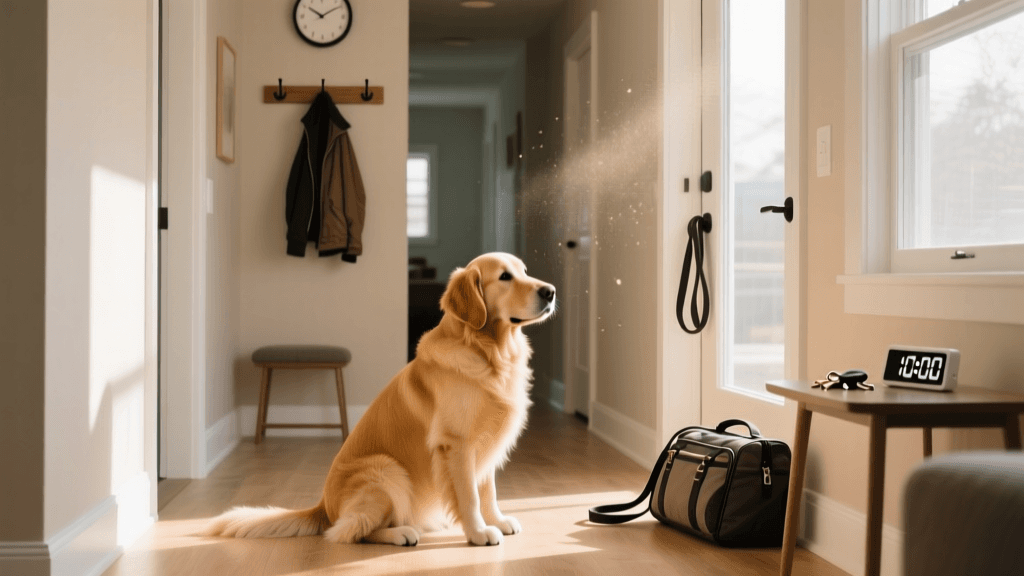
Dogs are masters of predictive learning. Through classical conditioning, your dog has memorized the 'behavior chain' that precedes your departure. This chain might look like: putting on socks, grabbing keys, putting on shoes, picking up a bag, and opening the door. By the time you reach for the doorknob, your dog's cortisol levels have already spiked, and they are well over their behavioral threshold.
Before we can train the dog to tolerate your absence, we must break the predictive power of these cues. This process, known as desensitization, involves exposing the dog to the trigger (the cue) at an intensity so low that it does not elicit the panic response, thereby promoting latent inhibition. The dog learns that 'keys jingling' no longer reliably predicts 'owner leaving for 8 hours.'
Step 1: Desensitization to Pre-Departure Cues
You must perform these desensitization exercises 2 to 3 times daily, completely independent of your actual departures. The goal is to make your departure cues entirely mundane. Below is a structured hierarchy for desensitizing your dog to common triggers.
| Departure Cue | Action Protocol | Daily Repetitions | Success Metric (Under Threshold) |
|---|---|---|---|
| Keys | Pick up keys, jingle once, put them back on the hook. | 10-15x | Zero ear flicks, no pacing, dog remains seated or resting. |
| Shoes | Put on work shoes, sit on the couch for 2 minutes, take them off. | 5-10x | Dog does not approach the door or whine; maintains relaxed body posture. |
| Jacket/Bag | Put on coat, pick up bag, walk to the kitchen, make coffee, remove coat. | 5-8x | Heart rate remains normal; dog engages with a toy or chews a bone. |
| Doorknob | Touch the handle, release. Progress to turning the handle, then opening the door 1 inch, then closing it. | 10x | No panting, drooling, or scratching at the door mat. |
Note: If your dog shows signs of anxiety at any step, you have moved too quickly. Return to the previous successful step and increase the rate of reinforcement (treats) for calm behavior.
Step 2: Operant Conditioning and Shaping Absences
Once the pre-departure cues no longer trigger a panic response, you can begin shaping the duration of your absence using operant conditioning. The most common mistake owners make is increasing the time away too rapidly, which leads to an 'extinction burst'—a sudden escalation of destructive or vocal behaviors when the dog realizes their usual coping mechanisms are failing.
The 1-Second Rule: Begin by stepping out the door and closing it for exactly 1 second. Return before the dog can become anxious. Do not make a fuss upon returning; keep arrivals and departures incredibly boring to lower the emotional arousal associated with the door.
Progress the duration using a variable ratio schedule: 1 second, 3 seconds, 2 seconds, 5 seconds, 10 seconds, 4 seconds, 15 seconds. Once you can comfortably leave for 20 minutes without the dog exhibiting stress signals (monitored via a camera), you can begin to increase the time in 5-to-10-minute increments. Research from Texas A&M Veterinary Medicine emphasizes that pushing a dog past their threshold during absence training will set your progress back significantly, making patience and precise timing critical.
Step 3: Counterconditioning and Enrichment Tools
While desensitization addresses the predictive cues, counterconditioning changes the dog's emotional response to the actual state of being alone. We want the dog to associate your departure with a high-value, highly engaging activity. This is where specific enrichment tools and precise timing come into play.
- KONG Classic Rubber Toy ($15 - $20): Stuff the KONG with a mixture of wet dog food, plain pumpkin puree, and low-sodium chicken broth, then freeze it overnight. A frozen KONG requires 30 to 45 minutes of active licking and chewing, which stimulates the release of endorphins and dopamine, naturally soothing the nervous system.
- LickiMat Soother ($12 - $15): Spread plain, unsweetened Greek yogurt or mashed sardines across the textured surface. The repetitive licking action is a self-soothing behavior in canines that lowers cortisol levels.
- Furbo 360 Dog Camera ($100 - $210): Essential for behaviorists and owners alike. You must be able to monitor your dog's body language remotely to ensure they remain under threshold. The treat-tossing feature can also be used to reinforce calm settling behaviors from a distance.
- Adaptil Pheromone Diffuser ($25 - $30): Plug this synthetic dog-appeasing pheromone (DAP) diffuser into the room where the dog rests. While not a standalone cure, it provides olfactory support that can lower the baseline anxiety level, making conditioning easier.
Timing is Everything: Present the high-value enrichment item (like the frozen KONG) exactly 15 to 20 minutes before you initiate your departure sequence. If you hand the dog the toy as you walk out the door, the toy becomes a predictor of your departure, which can cause the dog to reject the food entirely due to acute stress.
Management vs. Modification: Budgeting Time and Money
Behavior modification takes time—often 8 to 12 weeks of daily, consistent practice. During this period, you cannot leave the dog alone for longer than they have been successfully trained to handle. If you spend two weeks training the dog to tolerate a 10-minute absence, and then leave them home alone for 8 hours while you go to work, you will completely undo your progress and sensitize the dog further.
Therefore, management is a non-negotiable financial and logistical requirement during the modification process. You must budget for alternative care arrangements:
- Doggy Daycare: Expect to pay $25 to $50 per day. This is ideal for social dogs who do not exhibit generalized anxiety but specifically struggle with isolation.
- In-Home Pet Sitters: Platforms like Rover or Wag offer drop-in visits or full-day sitting, costing $20 to $60 per day depending on your region. This keeps the dog in their safe environment while preventing isolation.
- Dog Walkers: If you only need to cover a 4-hour window, a mid-day walker ($15 - $25 per walk) can break up the isolation period, provided the dog has been conditioned to tolerate the first 2 hours alone.
Avoiding the Extinction Burst and Spontaneous Recovery
As you implement these protocols, be prepared for an 'extinction burst.' When a previously reinforced behavior (e.g., barking to make the owner return) no longer works, the dog will temporarily increase the intensity, frequency, and duration of the behavior before it extinguishes. If you return home or yell through the door during an extinction burst, you have just reinforced the escalated behavior on a variable intermittent schedule—the most powerful and resistant schedule of reinforcement in behavioral science. You must wait for a minimum of 3 to 5 seconds of absolute silence before re-entering.
Furthermore, be aware of 'spontaneous recovery,' where a previously extinguished anxiety response suddenly reappears after a period of time, often triggered by a change in routine, a thunderstorm, or a minor illness. This is a normal part of the learning process. Simply return to the last successful step in your desensitization hierarchy and rebuild the duration.
Conclusion
Managing canine separation anxiety requires a shift in perspective. By viewing your dog's behavior through the lens of applied behavior analysis, you replace frustration with empathy and strategy. Through meticulous desensitization of departure cues, systematic shaping of absence durations, and strategic counterconditioning with high-value enrichment tools, you can help your dog build the neurological resilience needed to feel safe when alone. Consistency, precise timing, and strict threshold management are the keys to transforming your daily departure routine from a source of panic into a predictable, peaceful transition.
priya-sutaria
All our authors care for dogs every day — read more of their work on the authors page.