Understanding Canine Panic Responses In Emergencies
Learn how to safely manage canine panic during emergencies. Discover body language cues, essential safety gear, and evacuation protocols for dogs.
The Neurology of Canine Panic: Understanding the Flight-or-Fight Response
When an emergency strikes—whether it is a sudden house fire, a severe natural disaster, or a traumatic car accident—the environment instantly transforms into a landscape of chaos. For our canine companions, this sudden shift triggers a profound neurological response. Understanding the psychology behind canine panic is not just an academic exercise; it is a critical safety skill that can prevent severe bites, fatal escapes, and long-term behavioral trauma.
At the core of a dog's panic response is the amygdala, the brain's threat-detection center. When a dog perceives a sudden, overwhelming danger (like the deafening crack of an explosion or the blaring of a smoke alarm), the amygdala hijacks the nervous system. This triggers the sympathetic nervous system to flood the dog's body with adrenaline and cortisol. In this state of 'amygdala hijack,' the prefrontal cortex—the area responsible for learned behaviors, obedience training, and rational thought—is effectively bypassed.
This means that in a true emergency, your dog will likely not respond to a 'sit' or 'stay' command. Even the most well-trained, gentle family dog can revert to primal survival instincts. The two primary survival responses are flight (bolting blindly into traffic or wilderness) and fight (biting anyone who attempts to restrain them, including their beloved owners). Recognizing that this behavior is a biological reflex, not disobedience, is the first step in safely managing your dog during a crisis.
Reading the Canine Fear Escalation Ladder
To intervene before a dog reaches the point of no return, owners must be fluent in canine body language. According to the American Kennel Club, dogs communicate their stress levels through a progressive series of physical signals. In an emergency, you may only have seconds to read these signs and adjust your approach.
Below is a structured breakdown of the canine fear escalation ladder, detailing what to look for and how to react to keep both you and your dog safe.
| Escalation Stage | Physical & Behavioral Signs | Psychological State | Required Safety Action |
|---|---|---|---|
| Stage 1: Early Stress | Lip licking, yawning, whale eye (showing whites of eyes), pinned ears. | Heightened alertness; dog senses something is wrong but is still processing. | Speak in a calm, low tone. Avoid direct eye contact. Secure the leash loosely. |
| Stage 2: Active Anxiety | Pacing, trembling, whining, tucked tail, raised hackles (piloerection). | Adrenaline is flowing. The dog is seeking an escape route or looking to the owner for guidance. | Move to a quieter area if possible. Apply gentle, steady pressure (like a ThunderShirt). Do not pull tightly on the leash. |
| Stage 3: Defensive Posturing | Stiff body, hard stare, low guttural growl, weight shifted forward or crouched back. | The dog feels trapped. The amygdala has taken over. A bite is imminent if the pressure continues. | Stop advancing. Give the dog space. Use a high-value food lure or a familiar toy to redirect focus. Prepare a muzzle if handling is mandatory. |
| Stage 4: Panic and Flight | Frantic scrambling, digging, chewing through barriers, unresponsive to pain or loud noises. | Full 'fight-or-flight' survival mode. The dog is completely deaf to commands and driven purely by instinct. | Do not chase. Chasing triggers the prey drive and increases panic. Use a secure physical barrier or a snare pole if trained. Call animal control for assistance. |
Essential Emergency Safety Gear for Panicked Dogs
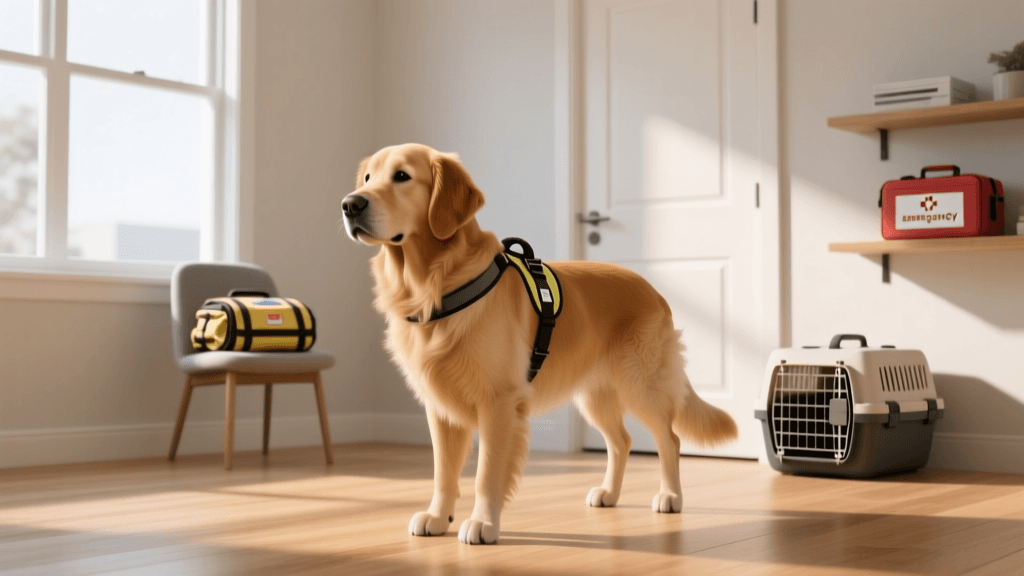
Hope is not a strategy when it comes to emergency preparedness. Having the right safety gear pre-fitted and easily accessible is paramount. Standard flat collars are highly dangerous during a panic episode, as a terrified dog can easily back out of them and bolt. Here is a curated list of emergency gear, complete with measurements, costs, and application timing.
1. The Escape-Proof Restraint System
- Product Recommendation: Country Brook Design Martingale Collar paired with a Ruffwear Front Range Harness.
- Cost: $15 (Collar) + $40 (Harness) = $55 total.
- Measurements: Measure the widest part of the dog's neck for the martingale, and the girth (widest part of the ribcage) for the harness. Add two inches for comfort.
- Why it Works: A martingale collar tightens just enough to prevent the dog from slipping backward out of the collar when they pull in a panic, without choking them. The harness provides a secure handle on the dog's back, allowing you to lift or guide them without putting dangerous pressure on their trachea.
2. Emergency Bite Prevention
- Product Recommendation: The Company of Animals Baskerville Ultra Muzzle.
- Cost: $18 - $25 depending on size.
- Measurements: Measure snout length (from base of nose to tip) and snout circumference (around the widest part of the snout, one inch below the eyes).
- Why it Works: Injured or terrified dogs will bite reflexively. The Baskerville Ultra is made of durable, moldable thermoplastic rubber that allows the dog to pant and drink water—crucial for temperature regulation during high-stress events—while completely preventing bites. Keep it in your emergency 'go-bag' and practice putting it on with peanut butter treats long before an emergency occurs.
3. Redundant Tracking Technology
- Product Recommendation: Fi Series 3 Smart GPS Dog Collar.
- Cost: $149 for the hardware + $8/month for the subscription.
- Timing: The battery lasts up to 3 months on standard mode, but in 'Lost Dog Mode' (which pings GPS every minute), it lasts up to 48 hours. Activate Lost Dog Mode via the app the second your dog bolts.
- Why it Works: If a dog slips its harness during a natural disaster or car crash, a microchip is only useful if someone catches the dog and takes them to a scanner. A GPS collar allows you to track their real-time location through debris, woods, or unfamiliar neighborhoods.
Scenario-Specific Emergency Protocols
Different emergencies require distinct psychological and physical approaches. The Federal Emergency Management Agency (FEMA) strongly advises that pet owners have a specific, practiced plan for the disasters most common to their region.
Scenario A: House Fires and Sudden Evacuations
The primary danger in a house fire is not just the flames, but the disorienting smoke and the blaring, high-decibel smoke alarms. Dogs have significantly more sensitive hearing than humans; a standard 85-decibel smoke alarm can cause immediate auditory pain and disorientation, leading to hiding behavior.
Action Plan: Do not waste precious minutes searching under beds. If your dog hides, use a 'slip lead' (a leash that loops into a collar) kept on your nightstand. Slip it over their head gently but firmly. If the dog is thrashing, throw a heavy blanket over them. This technique, known as 'burrito wrapping,' restricts their limbs safely, prevents biting, and provides deep pressure therapy that can momentarily calm the nervous system while you carry them out. Once outside, immediately secure them in a hard-sided travel crate inside your vehicle; leaving a panicked dog tied to a fence outside a burning building often results in them chewing through their leash or slipping their collar to flee the noise.
Scenario B: Car Accidents and Roadside Safety
If you are involved in a vehicular collision, your dog may be physically unharmed but psychologically shattered by the impact, the sound of crushing metal, and the sudden deployment of airbags.
Action Plan: Before opening any car doors, ensure your dog is leashed. A panicked dog will bolt out of an open door directly into oncoming traffic. If the dog is trapped in the footwell or under a seat, do not reach in blindly. A trapped, injured dog is highly likely to bite. Speak softly, offer a high-value treat (like a squeeze tube of peanut butter kept in your glovebox), and wait for them to crawl to you. If first responders need to extract the dog and the dog is showing Stage 3 or Stage 4 aggression, inform the paramedics immediately so they can use catch poles or heavy blankets rather than bare hands.
Post-Emergency Decompression: The 72-Hour Rule
The emergency does not end when you reach a safe location. The psychological aftermath of a traumatic event lingers in a dog's body long after the physical threat is gone. According to veterinary behaviorists and guidelines supported by the ASPCA, it takes a minimum of 72 hours for cortisol and adrenaline levels to return to baseline after a severe panic episode.
During this 72-hour decompression window, your dog's nervous system is highly reactive. A dog that is normally friendly may snap at a stranger, resource-guard their food bowl, or react aggressively to sudden movements. To support their psychological recovery:
- Enforce a 'Low-Stimulus' Environment: Keep the dog in a quiet, dimly lit room. Avoid inviting friends or family over to 'check on them' immediately after the event.
- Stick to a Rigid Routine: Predictability lowers anxiety. Feed, walk, and potty-break your dog at the exact same times you did before the emergency.
- Utilize Calming Pheromones: Plug in an Adaptil (DAP) diffuser in the dog's safe room. These synthetic pheromones mimic the nursing hormones produced by mother dogs and have been clinically shown to reduce heart rate and stress behaviors in canines.
- Avoid Forced Affection: Let the dog initiate contact. Hovering over a decompressing dog or forcing hugs can trigger a defensive bite if their nervous system is still on high alert.
Expert Insight: 'Punishing a dog for fear-based behavior during or immediately after an emergency will only compound the trauma and deepen the behavioral fallout. Safety, patience, and environmental management are your most effective tools.' - Canine Behavioral Science Principles
By understanding the biological mechanisms of canine panic and preparing with the right gear and protocols, you transition from a reactive owner to a proactive guardian. In the chaos of an emergency, your calm, informed response is the anchor that will keep your dog safe, secure, and alive.
aaron-whyte
All our authors care for dogs every day — read more of their work on the authors page.