Understanding Canine OA: Pain Signals and 2026 Treatments
Learn to decode the hidden behavioral signals of canine osteoarthritis and explore the latest 2026 treatments to restore your dog's comfort and personality.
Beyond the Limp: The Psychology of Canine Osteoarthritis
Osteoarthritis (OA) is widely recognized as the most common joint disease in dogs, but it is frequently misunderstood as a purely physical ailment. As we navigate the veterinary landscape of 2026, our understanding of canine psychology has profoundly shifted. We now recognize that chronic joint pain is a massive behavioral and psychological disruptor. Dogs do not experience pain in a vacuum; chronic nociceptive signals rewire their nervous system, alter their body language, and fundamentally change how they interact with their environment and their human families. To truly support an aging or arthritic dog, we must look beyond the obvious limp and learn to decode the subtle behavioral signals of chronic discomfort.
The Evolutionary Mask: Why Dogs Hide Joint Pain
To understand how canine osteoarthritis manifests behaviorally, we must first look at evolutionary biology. In the wild, displaying weakness or physical vulnerability makes a canid a target for predators or a liability to the pack. Consequently, modern domestic dogs possess a deeply ingrained instinct to mask pain. By the time a dog exhibits a clear, visible limp or vocalizes when standing up, the osteoarthritis has often progressed to an advanced stage. According to the WSAVA Global Pain Council, chronic pain in dogs often presents as a series of micro-behavioral changes rather than acute distress signals. Owners frequently misinterpret these subtle shifts as "slowing down due to old age" or "developing a stubborn streak," when in reality, the dog is employing complex coping mechanisms to manage daily discomfort.
Decoding the Hidden Language of Chronic Joint Pain
Because dogs cannot verbally articulate a dull, aching hip or a stiff lumbar spine, they communicate their osteoarthritis through altered body language and spatial avoidance. Recognizing these signals is the first step in effective behavioral and medical intervention.
Micro-Expressions and Calming Signals
When a dog with OA is asked to perform a physically demanding task—such as climbing a flight of stairs or stepping into a vehicle—they may exhibit stress-related micro-expressions. These include excessive lip licking, sudden yawning, pinned-back ears, or "whale eye" (showing the whites of the eyes). These are not signs of disobedience; they are autonomic nervous system responses to anticipated pain. The dog's brain is associating a specific environmental cue with a negative physical sensation, triggering a mild anxiety response.
Spatial Avoidance and Altered Greetings
A once-boisterous dog that suddenly greets you from a seated position, or a dog that begins sleeping in isolated corners of the room rather than on the shared sofa, is engaging in spatial avoidance. They are subconsciously modifying their environment to minimize the need for sudden movements, rapid direction changes, or navigating around unpredictable toddlers and other pets. This withdrawal is often mislabeled as canine depression or cognitive decline, when it is actually a highly logical behavioral adaptation to joint instability.
The Behavioral Translation Guide to Canine OA
The following table highlights common behavioral shifts in dogs with osteoarthritis, contrasting the typical owner assumption with the underlying physiological reality.
| Behavioral Shift | What Owners Often Assume | The Osteoarthritis Reality |
|---|---|---|
| Hesitation at the car door | Stubbornness or distraction | Anticipatory pain from the jumping motion and joint impact upon landing. |
| Growling when brushed or petted | Sudden aggression or bad mood | Referred pain from the hip, spine, or shoulder being touched unexpectedly. |
| Sleeping in a tight, rigid ball | Feeling cold or seeking cozy comfort | Guarding joints and minimizing pressure on the affected, inflamed side. |
| Pacing or restlessness at night | Need to go outside or excess energy | Inability to find a comfortable, pain-free resting position due to joint stiffness. |
| Reluctance to eat from floor bowls | Picky eating or loss of appetite | Cervical spine or shoulder pain triggered by bending the neck downward. |
Central Sensitization: When Pain Rewires the Brain
One of the most critical advancements in veterinary behavioral medicine leading into 2026 is the focus on "central sensitization." When a dog lives with untreated osteoarthritis, the constant barrage of pain signals from the joints eventually alters the central nervous system. The spinal cord and brain become hyper-reactive, meaning that even mild stimuli (like a gentle touch or a normal noise) can be perceived as painful or highly stressful. This neurological rewiring is a primary cause of late-onset noise phobias, leash reactivity, and generalized anxiety in senior dogs. Treating the joint is not enough; we must treat the nervous system's response to the pain to restore the dog's psychological baseline.
Modern 2026 OA Treatments That Restore Behavioral Health
The 2026 veterinary pharmacopeia offers targeted therapies that do more than just mask inflammation; they actively interrupt the pain-behavior loop. The FDA's resources on animal osteoarthritis highlight the importance of multimodal pain management, which combines pharmaceuticals with environmental and behavioral modifications.
Anti-NGF Monoclonal Antibodies (Librela)
Bedinvetmab, marketed as Librela, has fundamentally transformed the canine OA landscape. Unlike traditional NSAIDs that target inflammation at the joint level, this monthly injection utilizes monoclonal antibody technology to bind to and neutralize Nerve Growth Factor (NGF) before it can transmit pain signals to the brain. From a behavioral perspective, the results are often described by owners as "getting their puppy back." By stopping the pain signal at the neurological level, Librela reduces the central sensitization that causes anxiety and irritability, allowing the dog's true, pre-pain personality to re-emerge.
EP4 Receptor Antagonists (Galliprant)
For dogs requiring daily oral medication, Grapiprant (Galliprant) remains a cornerstone of 2026 treatment protocols. By specifically targeting the EP4 prostaglandin receptor—the primary mediator of OA pain and inflammation—it provides robust pain relief while sparing the gastrointestinal, renal, and hepatic systems. This safety profile is crucial for senior dogs, as it allows for consistent, uninterrupted pain management, which is vital for maintaining stable behavioral routines and preventing the anxiety associated with fluctuating pain levels.
Disease-Modifying Osteoarthritis Drugs (DMOADs)
Injectable polysulfated glycosaminoglycans, such as Adequan Canine, continue to be utilized to protect existing cartilage and improve joint lubrication. While not an acute painkiller, preserving joint mechanics helps maintain the dog's confidence in movement, preventing the psychological "fear of falling" that often leads to severe mobility avoidance in large breed dogs.
Environmental Psychology: Reducing Cognitive Friction
Treating canine OA requires modifying the home environment to reduce what animal behaviorists call "cognitive friction." Every time an arthritic dog has to calculate whether they can safely jump onto the bed or navigate a slippery hardwood floor, it induces mental fatigue and stress. The AAHA Pain Management Guidelines strongly advocate for environmental adaptations as a primary pillar of multimodal therapy.
- Modular Ramps and Stairs: High-density foam or adjustable wooden ramps eliminate the need for explosive jumping, preserving the dog's energy and preventing micro-traumas to the joints.
- Traction Modifications: Placing non-slip rugs or applying paw-grip coatings over slippery floors prevents the constant, low-grade muscle tension dogs use to stabilize themselves, allowing their nervous system to truly relax.
- Elevated Resources: Raising food and water bowls by a few inches prevents cervical strain, making mealtime a comfortable experience rather than a painful chore.
- Orthopedic Support: Investing in high-density, therapeutic memory foam beds (specifically those designed with bolsters for head and neck support) helps distribute weight evenly and prevents pressure sores on bony prominences.
Cognitive Enrichment When Physical Exercise Declines
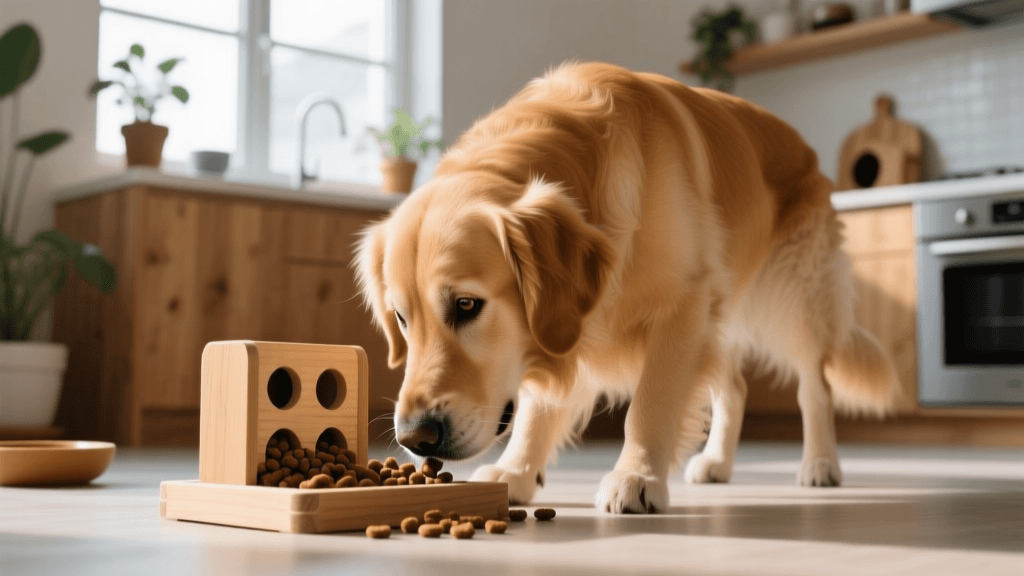
As osteoarthritis progresses, a dog's physical exercise capacity naturally decreases. If this physical outlet is not replaced with mental stimulation, dogs quickly develop frustration-based behaviors, such as excessive licking, destructiveness, or vocalization. In 2026, veterinary behaviorists emphasize the importance of "low-impact, high-reward" enrichment. Scent work, snuffle mats, and frozen lick mats engage the dog's olfactory and problem-solving centers, burning mental energy and releasing endorphins without placing mechanical stress on degenerating joints. Teaching a senior dog new, low-mobility tricks (like "touch" or "look at that") maintains neural plasticity and reinforces the human-animal bond, proving that a dog's mind remains vibrant even when their body requires a slower pace.
Conclusion: Empathy Through Understanding
Canine osteoarthritis is not merely a mechanical failure of the joints; it is a complex condition that touches every aspect of a dog's behavioral and emotional life. By learning to read the subtle body language of pain, embracing advanced 2026 neurological treatments like anti-NGF therapies, and thoughtfully redesigning their environment, we can lift the heavy burden of chronic discomfort. When we treat the pain, we don't just save their joints—we rescue their spirit, allowing our loyal companions to navigate their golden years with confidence, comfort, and joy.
priya-sutaria
All our authors care for dogs every day — read more of their work on the authors page.