Osteoarthritis Dog Training & Mobility Care in 2026
Discover 2026 low-impact training routines and mobility conditioning tips to keep your dog mentally stimulated while managing canine osteoarthritis.
Adapting Training for Dogs with Osteoarthritis
When a beloved dog is diagnosed with osteoarthritis (OA), many owners mistakenly believe that all training, tricks, and structured activities must come to an immediate halt. However, mental stimulation and modified physical conditioning are just as critical for an arthritic dog as they are for a healthy, active pup. In fact, completely stopping training can lead to boredom, anxiety, and accelerated muscle atrophy, which ultimately worsens joint instability. As we navigate canine care in 2026, the focus of obedience and trick training for dogs with OA has shifted toward low-impact mental enrichment, mobility conditioning, and treatment acceptance training.
According to the American Kennel Club, osteoarthritis is a degenerative joint disease that affects a significant percentage of senior dogs, but with the right management and modified training routines, these dogs can maintain a high quality of life. This guide will walk you through the best low-impact training techniques, mobility exercises, and desensitization protocols to help your arthritic dog thrive in 2026.
The 2026 Landscape of Canine Osteoarthritis Management
Before diving into training modifications, it is essential to understand the current veterinary landscape. As of 2026, the gold standard for managing canine OA pain involves a multimodal approach. Monthly anti-NGF (Nerve Growth Factor) monoclonal antibody injections, such as bedinvetmab, have become widely accessible and highly effective at neutralizing pain signals before they reach the brain. When combined with modern joint supplements, omega-3 fatty acids, and weight management, dogs are experiencing significantly better pain control than in previous decades.
Because pain management is more effective today, dogs are capable of participating in structured, low-impact training sessions. However, owners must still respect the biomechanical limitations of compromised joints. Training sessions should be kept short—typically five to ten minutes—and always performed on non-slip surfaces like yoga mats or specialized canine traction rugs to prevent sudden slips that could trigger a flare-up.
Low-Impact Trick Training for Mental Stimulation
Mental fatigue is often more tiring for a dog than physical exertion. Teaching tricks that require brainpower rather than physical acrobatics is the perfect way to tire out an arthritic dog without stressing their joints.
1. The 'Touch' Command (Targeting)
Targeting is a foundational skill that encourages a dog to move deliberately and at their own pace. It is highly useful for guiding a dog onto a raised orthopedic bed or into a car ramp without the need for physical lifting, which can torque arthritic hips and shoulders.
- Step 1: Hold a small, high-value treat in your closed fist and present it to your dog while they are lying comfortably on their bed.
- Step 2: The moment their nose touches your hand, say 'Yes!' or click your clicker, and open your hand to deliver the treat.
- Step 3: Gradually increase the distance by a few inches, encouraging the dog to shift their weight or take a single step to touch your hand.
- Step 4: Introduce the verbal cue 'Touch' just before presenting your hand.
2. Modified 'Spin' to 'Slow Circle'
While rapid spinning is dangerous for arthritic spines and hips, a slow, controlled circle is an excellent mobility exercise that promotes spinal flexibility and core engagement.
- Step 1: With your dog in a standing position, hold a treat at their nose level.
- Step 2: Slowly lure their nose toward their shoulder, then toward their hip, creating a wide, gentle circle.
- Step 3: Reward them for completing the half-circle, and eventually the full circle, at a snail's pace.
- Important: Never lure the dog's head up or down, as this can compress the cervical or lumbar spine. Keep the lure perfectly level with their snout.
3. 'Chin Rest' and 'Paw Target'
Teaching a dog to rest their chin on a designated target (like a small cushion or your lap) or to place their front paws on a specific mat builds focus and impulse control. These stationary tricks are entirely zero-impact and can be performed while the dog is lying down or sitting on a supportive orthopedic surface.
Mobility Conditioning and Rehab Training
According to veterinary experts at Texas A&M College of Veterinary Medicine, maintaining muscle mass is one of the most effective ways to support arthritic joints. Muscle acts as a shock absorber; when it atrophies, the joints take the full brunt of the impact. Conditioning exercises are essentially physical therapy disguised as training.
Cavaletti Pole Training
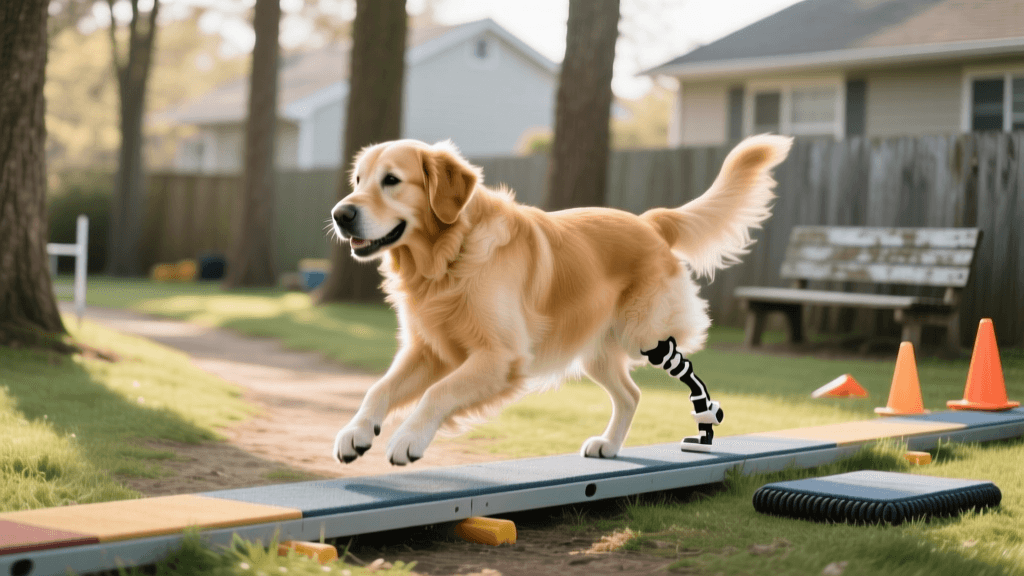
Cavaletti poles are low hurdles placed on the ground that encourage a dog to lift their paws higher than normal, increasing joint range of motion and engaging the core. In 2026, adjustable, lightweight foam Cavaletti sets are widely available for home use.
- Set up three to four poles on a non-slip surface, spaced apart at a distance equal to your dog's normal walking stride.
- Set the height of the poles to just an inch or two off the ground—enough to require a conscious lift of the paw, but not so high that it causes joint strain.
- Walk beside your dog on a short leash, guiding them slowly over the poles. Reward them heavily at the end of the run.
Cookie Stretches (Baited Stretches)
This exercise improves neck and back flexibility while strengthening the abdominal muscles.
- With your dog standing, hold a treat at their nose.
- Lure their nose down toward their front paws, then slowly move the treat between their front legs toward their chest, encouraging them to tuck their chin and round their upper back.
- Next, lure the treat slowly out to the side of their hip, encouraging a lateral spinal stretch. Hold for three seconds before rewarding.
High-Impact vs. Low-Impact Training Alternatives
It is crucial to audit your current training repertoire and replace high-impact movements with joint-friendly alternatives. Below is a comparison chart to help you adapt your routine.
| Traditional High-Impact Trick | Why It Is Harmful for OA | 2026 Low-Impact Alternative |
|---|---|---|
| Sit Pretty / Beg | Places extreme compressive force on the lumbar spine and hips. | Chin Rest on a Stool |
| Jump / Hurdles | High impact on landing stresses carpal and shoulder joints. | Paw Target on a Flat Mat |
| Weave Poles | Rapid lateral twisting torques the spine and stifle joints. | Slow Cavaletti Pole Walks |
| Fetch / Frisbee | Sudden stops, starts, and leaping cause micro-trauma to joints. | Scent Work / Hide and Seek |
| Roll Over | Requires awkward spinal twisting and hip splaying. | Side-Lying 'Dead Bug' Stretch |
Training for Treatment Acceptance
A major, often overlooked aspect of training an arthritic dog is teaching them to willingly accept their daily treatments. In 2026, canine rehabilitation involves a variety of at-home therapies, including therapeutic laser devices, custom orthotic braces, and joint injections. If a dog fights these treatments, the resulting stress can elevate cortisol levels, which increases pain perception.
Orthopedic Brace Desensitization
If your veterinarian has prescribed a custom carpal or stifle brace, forcing it onto a resistant dog can cause panic and exacerbate pain. Use classical conditioning to change their emotional response to the brace.
- Phase 1: Place the brace on the floor next to the dog. Every time they look at it, click and treat. Repeat until the dog happily nudges the brace expecting a reward.
- Phase 2: Touch the brace to the dog's limb for one second, then remove it and treat. Gradually increase the duration of contact over several days.
- Phase 3: Secure the brace loosely for just a few seconds while feeding a high-value chew (like a lick mat). Slowly increase the tightness and duration over a two-week period.
At-Home Laser Therapy Conditioning
Many owners now use FDA-cleared, low-level laser therapy (LLLT) wands at home to reduce joint inflammation. Some dogs are sensitive to the device's hum or the physical pressure of the wand. Train a 'Statue' or 'Freeze' command using a mat, rewarding the dog for remaining perfectly still while you gently glide the device over their back and shoulders, avoiding the painful joints until the dog is entirely relaxed.
Conclusion
Managing canine osteoarthritis in 2026 is about finding the delicate balance between rest and active rehabilitation. By swapping out high-impact tricks for mentally stimulating, low-impact alternatives, and incorporating daily mobility conditioning, you can preserve your dog's muscle mass and joint flexibility. Furthermore, training your dog to cooperatively participate in their own medical care reduces stress and strengthens the bond between you. Always consult with your veterinarian or a certified canine rehabilitation therapist before starting a new exercise regimen, and remember that patience, consistency, and positive reinforcement are the ultimate keys to keeping your senior dog happy, healthy, and engaged.
tom-renshaw
All our authors care for dogs every day — read more of their work on the authors page.