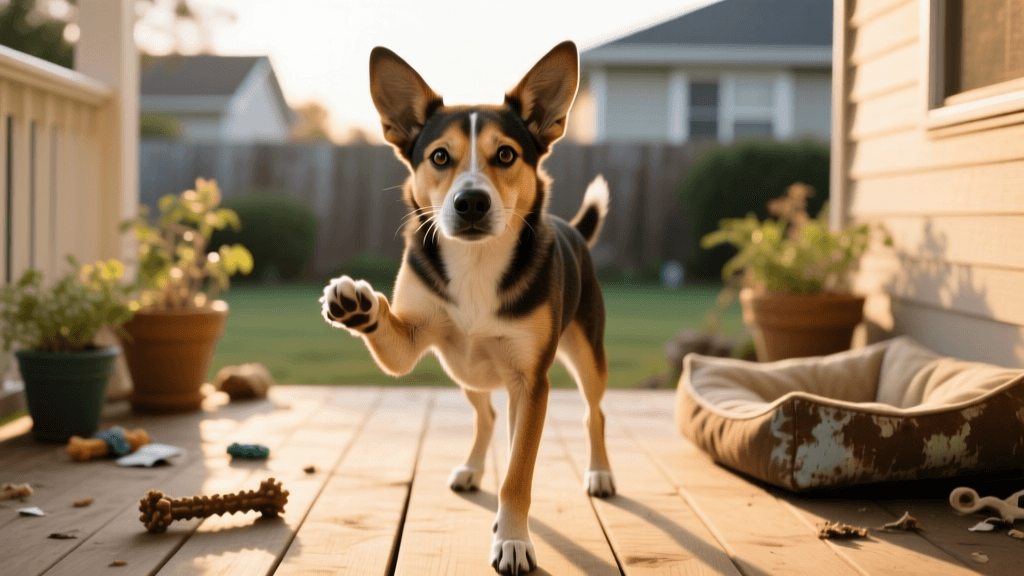
Understanding Canine Arousal: Step-by-Step Mat Training
Learn to decode your dog's arousal signals and follow our step-by-step mat training guide to teach impulse control and a reliable settle behavior.

The Psychology of Canine Arousal
To truly understand your dog, you must first understand the concept of arousal. In canine psychology, arousal does not refer to sexual excitement; rather, it describes the activation level of your dog's central nervous system. A dog's arousal levels fluctuate constantly based on environmental stimuli, internal drives, and emotional states. When a dog is under-aroused, they may appear lethargic or unresponsive. When appropriately aroused, they are engaged, focused, and ready to learn. However, when a dog becomes over-aroused, their sympathetic nervous system takes over, triggering a 'fight, flight, or freeze' response that makes learning impossible.
According to the ASPCA's guide on understanding dog body language, recognizing the subtle physical shifts that indicate rising arousal is the first step in behavioral intervention. By reading these signals early, owners can implement training protocols that help the dog self-regulate before they cross the threshold into reactivity or panic.
Decoding Arousal: The Body Language Matrix
Before beginning any step-by-step training guide, you must learn to read your dog's current emotional state. Training a dog who is already over-threshold is an exercise in frustration. Use the matrix below to assess your dog's arousal level before initiating a training session.
| Arousal Level | Physical Body Language | Cognitive State | Training Action Required |
|---|---|---|---|
| Low (Under-aroused) | Sluggish movement, lowered head, resting ears, slow tail wags. | Bored, disengaged, or fatigued. | Increase reward value; use play to build engagement. |
| Optimal (Green Zone) | Relaxed but alert posture, soft eyes, ears forward, willing eye contact. | Receptive, capable of operant conditioning. | Proceed with step-by-step shaping and new cues. |
| High (Yellow Zone) | Tense muscles, pinned ears, whale eye, lip licking, panting. | Distracted, stressed, impulse control fading. | Lower criteria, increase distance from triggers, offer calming chews. |
| Over-Threshold (Red Zone) | Stiff posture, raised hackles, barking, lunging, freezing. | Survival mode; learning is neurologically blocked. | Remove from the environment immediately. Do not train. |
Why Mat Training is the Ultimate Impulse Control Tool
Mat training, often referred to as teaching the 'Place' or 'Settle' command, is widely misunderstood as a simple physical boundary exercise. In reality, it is a profound psychological tool for emotional regulation. When you train a dog to go to a specific mat, you are not just teaching them where to put their paws; you are creating a classical conditioning anchor. The mat becomes a predictor of calmness, safety, and low-arousal reinforcement.
The American Kennel Club (AKC) notes that teaching a place command gives dogs a clear, alternative behavior to perform when they are unsure or overwhelmed by their environment. Instead of defaulting to jumping, barking, or pacing, the dog defaults to the mat. This step-by-step guide will walk you through building a bulletproof settle protocol that actively lowers your dog's heart rate and shifts them from the sympathetic to the parasympathetic nervous system.
Step-by-Step Guide to the 'Settle' Protocol
Step 1: Gathering the Right Gear
Success in impulse control training requires setting up the environment for victory. You will need a dedicated mat that is easily distinguishable from the rest of your flooring. Avoid using towels or blankets that get mixed up with laundry. Invest in a dedicated training bed like the Ruffwear Knot-a-Hitch (approx. $45) or a portable Kuranda Chewproof Cot (approx. $120). For rewards, you need a tiered treat system: low-value kibble for initial shaping, and high-value, slow-consuming rewards like a Kong Classic stuffed with frozen plain pumpkin and peanut butter (approx. $15) to promote licking, which releases endorphins and naturally lowers canine arousal.
Step 2: Shaping the Initial Engagement (Days 1-3)
Place the mat in a low-distraction area of your home, such as a quiet bedroom. Stand near the mat with your dog on a 6-foot nylon leash. Do not give any verbal commands yet. The moment your dog looks at the mat, mark the behavior with a clicker or a verbal 'Yes!' and toss a treat onto the mat. If your dog steps onto the mat to eat the treat, mark and reward again. We are shaping the behavior through approximations. Your goal is to deliver 15 to 20 rewards per minute for any interaction with the mat. Keep these sessions strictly to 3 minutes to prevent mental fatigue.
Step 3: Capturing the Down and Adding Duration (Days 4-7)
Once your dog is confidently stepping onto the mat, raise your criteria. Now, withhold the click until your dog offers a sit or a down on the mat. A down position is biomechanically incompatible with high arousal; it is much harder for a dog to feel panicked or aggressive while lying flat on their side or in a sphinx position. When your dog lies down, begin feeding treats directly to their mouth rather than tossing them. This keeps the dog anchored to the spot. Start with 2-second intervals between treats, gradually stretching to 10-second intervals as your dog's breathing slows and their muscles relax.
Step 4: Introducing the Cue and Distance (Week 2)
Only after your dog reliably offers a down on the mat without prompting should you attach the verbal cue 'Settle' or 'Place'. Say the cue exactly once, pause for one second, and then point or guide the dog to the mat. Once they comply, reward heavily. Begin adding distance by taking one step away from the mat, immediately returning to reward before the dog has a chance to break the position. Slowly increase the distance to 10 feet, then 20 feet, always returning to the mat to deliver the reinforcement. The dog must learn that the reward comes to them on the mat; they do not leave the mat to get the reward.
Step 5: Proofing Against Environmental Arousal (Week 3 and Beyond)
This is where understanding your dog's body language becomes critical. Introduce mild distractions: drop a set of keys, knock on the front door, or have a family member walk across the room. Watch your dog's ears, eyes, and breathing. If they tense up (Yellow Zone), immediately step in, block their line of sight if necessary, and feed high-value treats to reinforce staying on the mat. If they break the mat, calmly guide them back without repeating the cue or showing frustration. The Humane Society emphasizes that managing a dog's environment and preventing rehearsal of unwanted behaviors is key to long-term behavioral modification.
Troubleshooting Common Behavioral Roadblocks
My dog falls asleep, then wakes up and leaves the mat.
This is actually a success! Your dog achieved a state of deep parasympathetic rest. If you want them to remain on the mat while awake, you must intermittently reinforce them before they decide to self-release. Set a silent timer on your watch and deliver a treat every 3 to 5 minutes.
My dog whines or paws at me while on the mat.
This indicates frustration, often caused by a history of being rewarded for demanding behavior. You must extinguish this by completely ignoring the whining. Turn your back, cross your arms, and wait for three full seconds of silence and a relaxed posture before marking and rewarding. If the whining escalates, you have pushed the arousal level too high; increase the distance from the trigger or lower the difficulty of the environment.
- Pacing on the mat: If your dog cannot physically lie down and instead paces or spins on the mat, the mat is too small, or the dog's internal arousal is too high. Upgrade to a larger cot (minimum 36x24 inches) and practice 'capturing calmness' in a smaller, quieter room before returning to the mat.
- Resource guarding the mat: Occasionally, a dog may begin to guard their settle mat from other pets or humans. If you notice stiffening, lip curling, or hard staring when someone approaches the mat, immediately consult a certified veterinary behaviorist. Do not punish the guarding; instead, manage the environment by picking up the mat when not in active training sessions.
- Breaking for high-value triggers: If your dog holds the settle for a dropped piece of cheese but breaks for a doorbell, you have skipped steps in the proofing phase. Return to the 3 Ds (Distance, Duration, Distraction) and lower the intensity of the trigger. Use a recorded doorbell sound played at 10% volume from your phone, rewarding heavily for maintaining the down position.
True impulse control is not about suppressing a dog's natural instincts through fear or correction; it is about teaching the dog that calmness is the most rewarding and reliable strategy for navigating a chaotic world.
Conclusion
Understanding your dog's arousal levels and providing them with a structured outlet for their energy is the cornerstone of a harmonious relationship. By following this step-by-step mat training guide, you are not merely teaching a party trick; you are giving your dog a lifelong coping mechanism. Through consistent observation of their body language, strategic use of reinforcement, and patience, you can transform a hyperactive or anxious dog into a grounded, confident companion capable of settling anywhere.
aaron-whyte
All our authors care for dogs every day — read more of their work on the authors page.