DIY Dog Enrichment: Fulfilling Instincts on a Budget
Discover the psychology behind canine enrichment and learn budget-friendly DIY games to fulfill your dog's natural instincts without breaking the bank.
The Psychology of Canine Enrichment
To truly understand your dog, you must look beyond basic obedience and physical exercise. Dogs are complex cognitive beings with deep-rooted evolutionary instincts. In the wild, canines spend up to 80% of their waking hours scavenging, hunting, and foraging for food. When we place a bowl of kibble in front of our pets and they finish it in thirty seconds, we are stripping them of their natural drive to work for their meals. This discrepancy between their biological imperatives and their domestic reality is a primary driver of behavioral issues, including destructive chewing, excessive barking, and separation anxiety.
Canine enrichment is the practice of providing environments and activities that allow dogs to express these natural behaviors in a safe, constructive way. However, many pet owners mistakenly believe that enrichment requires expensive puzzle toys, specialized agility equipment, or premium subscription boxes. The truth is that understanding your dog's psychology allows you to create highly effective, budget-friendly enrichment using everyday household items.
The Olfactory Brain: Why Sniffing Matters
Before diving into DIY projects, it is crucial to understand the sheer power of your dog's nose. A dog's olfactory bulb is proportionally 40 times larger than a human's, and they possess up to 300 million olfactory receptors (compared to our mere 6 million). When a dog sniffs, they are not just smelling; they are processing complex chemical data about their environment, other animals, and the passage of time.
According to research from the Horowitz Dog Cognition Lab at Barnard College, sniffing is deeply tied to a dog's emotional well-being. Studies have shown that allowing dogs to use their noses lowers their heart rate and induces a state of calm. Scent-based enrichment is incredibly tiring for a dog; twenty minutes of intensive sniffing can provide the same level of mental exhaustion as a two-hour physical walk. For owners on a budget or those with high-energy dogs in small apartments, scent work is a game-changer.
The Neurochemistry of Licking and Chewing
Enrichment isn't just about the nose; it's also about the mouth. Licking and chewing are self-soothing behaviors for dogs. These actions trigger the release of endorphins and dopamine in the canine brain, acting as a natural stress reliever. When you provide a budget-friendly licking or chewing activity, you are actively helping your dog regulate their nervous system, which is particularly useful during thunderstorms, fireworks, or when you need them to settle down while you work from home.
Budget-Friendly DIY Enrichment Ideas
You do not need to spend $50 on a plastic puzzle feeder to engage your dog's brain. Here are three highly effective, low-cost DIY enrichment activities that tap directly into your dog's foraging and scavenging instincts.
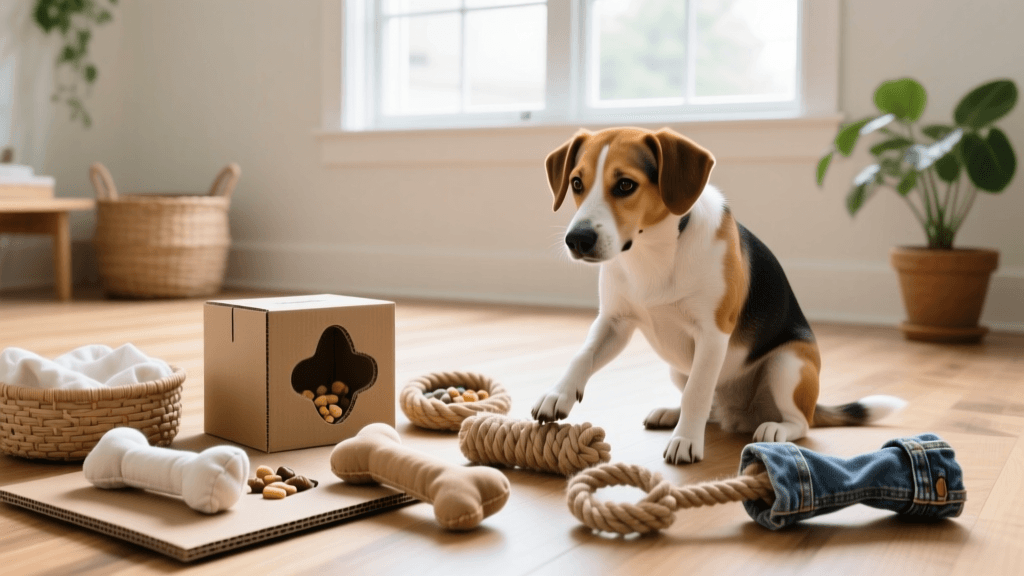
1. The Cardboard Foraging Box (Cost: $0)
Dogs love to shred, dig, and scavenge. The cardboard foraging box satisfies all three urges while costing absolutely nothing if you recycle your delivery boxes.
- Materials: A medium-sized cardboard box, empty toilet paper rolls, crumpled paper, and your dog's daily kibble or low-calorie treats.
- Instructions: Place the empty toilet paper rolls upright inside the box. Fold the edges of the rolls inward to hide treats inside them. Scatter kibble at the bottom of the box, and fill the remaining space with crumpled, unscented paper or old, clean rags.
- The Psychology: Your dog must use their nose to locate the food, their paws to dig through the paper, and their teeth to manipulate the cardboard rolls. This mimics the multi-sensory experience of foraging in the underbrush.
- Safety Note: Always supervise your dog to ensure they are spitting out the cardboard and paper rather than swallowing large pieces.
2. Upcycled Fleece Snuffle Mat (Cost: $5)
Commercial snuffle mats can cost upwards of $40, but you can make a superior version at home for a fraction of the price.
- Materials: A rubber sink mat with holes (usually $3-$5 at a discount store) and 2-3 yards of cheap, no-sew fleece fabric from a craft store.
- Instructions: Cut the fleece into strips roughly 1 inch wide and 6 inches long. Tie each strip through the holes of the rubber mat using a simple double knot. Pack the strips tightly so they stand up like a thick, shaggy carpet.
- The Psychology: By burying dry treats deep within the fleece strands, you force your dog to rely entirely on their olfactory senses. The soft texture of the fleece is also gentle on their nose and paws.
3. DIY Frozen Broth Blocks (Cost: $2)
This is an excellent enrichment tool for hot weather or for dogs that eat their meals too quickly.
- Materials: Low-sodium, onion-and-garlic-free chicken or beef broth, a silicone ice cube tray or muffin tin, and a mix of your dog's favorite safe vegetables (like carrots or green beans).
- Instructions: Place a few pieces of vegetables and kibble into each compartment of the tray. Fill with broth and freeze overnight. Pop them out and serve in a bowl or on a towel.
- The Psychology: This engages the licking and chewing instincts mentioned earlier. As the ice melts, the food is slowly revealed, requiring patience and persistence, which builds focus and impulse control.
Cost Comparison: Commercial Toys vs. DIY Enrichment
Understanding your dog's needs allows you to substitute expensive gear with clever, cheap alternatives. Below is a comparison of traditional commercial enrichment products versus their DIY counterparts.
| Enrichment Type | Commercial Product | Avg. Retail Cost | Budget DIY Alternative | DIY Cost | Mental Stimulation Level |
|---|---|---|---|---|---|
| Foraging / Puzzle | Plastic Puzzle Feeder | $25 - $45 | Cardboard Foraging Box | $0 | High (Destructive/Scavenging) |
| Scent Work | Premium Snuffle Mat | $35 - $60 | Fleece & Sink Mat Snuffle | $5 | Very High (Olfactory) |
| Calming / Licking | Textured Lick Mat | $15 - $25 | Frozen Broth Muffin Tin | $2 | Moderate (Soothing) |
| Chewing | Stuffed Rubber Toy | $20 - $30 | Frozen Wet Food in a Recycled Bone | $3 | High (Gnawing Instinct) |
Reading Body Language: Is Your Dog Enriched or Stressed?
A core tenet of the Best Friends Animal Society approach to animal care is observing the animal's feedback. When introducing DIY enrichment, it is vital to read your dog's body language to ensure the activity is fulfilling rather than frustrating.
Signs of Healthy Engagement
When a dog is properly enriched, their body language will be relaxed but focused. Look for a softly wagging tail (not stiff or high), relaxed facial muscles, and a willingness to use their paws and nose. If they are sniffing intently and working methodically to extract food from a cardboard box, their brain is in a state of positive, rewarding engagement.
Signs of Frustration and Stress
If a puzzle is too difficult, or if a DIY toy breaks apart in a way that denies them the reward, your dog may exhibit displacement behaviors. As noted by Fear Free Pets, boredom and frustration can quickly escalate into stress. Watch out for:
- Excessive Pawing: Frantically scratching at a box without using their nose indicates they have abandoned the cognitive task and are resorting to brute force.
- Displacement Behaviors: Sudden yawning, lip licking, or shaking off (as if wet) when they are actually dry. These are canine calming signals indicating internal conflict or stress.
- Walking Away: If your dog sniffs the DIY toy and immediately walks away to sleep or stare at the wall, the task may be too difficult, or the reward value is not high enough to motivate their foraging instinct.
Pro Tip: Always set your dog up for success. When introducing a new DIY enrichment game, make it incredibly easy at first. Let them see you hide the high-value treats, and ensure they can access them within seconds. Gradually increase the difficulty as their confidence and problem-solving skills grow.
Conclusion: Enrichment is a Mindset, Not a Purchase
Understanding your dog means recognizing that they are hardwired to work, sniff, and explore. By shifting your perspective from 'feeding a pet' to 'facilitating a foraging experience,' you can vastly improve your dog's behavioral health and emotional stability. The most effective enrichment tools are not necessarily the ones with the highest price tags or the flashiest packaging; they are the ones that tap into the ancient, instinctual drives that make your dog who they are. With a little creativity, some recycling, and a keen eye on your dog's body language, you can provide a rich, fulfilling life for your canine companion on any budget.
priya-sutaria
All our authors care for dogs every day — read more of their work on the authors page.