Budget Dog Enrichment: Free and Cheap Mental Stimulation
Discover the psychology of canine enrichment and learn budget-friendly, DIY mental stimulation games to keep your dog happy without breaking the bank.
When we think about keeping our dogs happy and well-behaved, the pet industry often convinces us that we need to spend hundreds of dollars on interactive electronic toys, subscription puzzle boxes, and high-tech treat dispensers. However, understanding the fundamental psychology and evolutionary biology of your dog reveals a powerful secret: true canine enrichment does not require a massive budget. In fact, some of the most psychologically fulfilling activities for your dog are completely free or cost only pennies using household recycling.
To master budget-friendly dog care, we must first look through the lens of canine ethology—the study of dog behavior in its natural context. Dogs are not simply small humans in fur coats; they are scavengers, hunters, and olfactory geniuses. When we align our enrichment strategies with their hardwired instincts, we can provide profound mental stimulation without breaking the bank.
The Psychology of the SEEKING System
To understand why budget DIY toys often outperform expensive commercial ones, we have to look at the neurobiology of the canine brain. The late neuroscientist Jaak Panksepp identified seven primary emotional systems in the mammalian brain, one of the most important being the SEEKING system. This neural network is responsible for motivation, foraging, and exploration.
When a dog is searching for food, tracking a scent, or figuring out how to extract a treat from a cardboard box, their brain releases a steady stream of dopamine. Crucially, the dopamine is released during the search and the struggle, not just the final consumption of the reward. In the wild, canids spend up to 80% of their waking hours foraging and scavenging. In a modern home, eating kibble from a stainless steel bowl in three seconds completely bypasses the SEEKING system, leading to boredom, frustration, and destructive behaviors.
By utilizing household items to create foraging challenges, you are hacking your dog's SEEKING system. You are giving them the psychological gift of a 'hunt' that costs you absolutely nothing.
The Olfactory Brain: Why Sniffaris Are Free Therapy
One of the most common mistakes dog owners make is treating physical exercise as a substitute for mental enrichment. While a two-mile jog might tire your dog's muscles, it does little to exhaust their brain. To truly tire a dog out and fulfill their psychological needs, you must engage their nose.
A dog's olfactory bulb is proportionally 40 times larger than a human's, and they possess up to 300 million olfactory receptors (compared to our mere 6 million). According to the American Kennel Club, sniffing is a deeply enriching, self-soothing behavior for dogs. When a dog sniffs a fire hydrant, they are not just smelling urine; they are processing complex chemical signatures that reveal the age, sex, diet, and emotional state of the animals that passed by. This mental mapping requires immense cognitive processing.
How to Conduct a Zero-Dollar Sniffari
A 'Sniffari' is a decompression walk where the dog leads the way and the primary goal is olfactory exploration rather than physical distance or heel training.
- Use a Long Line: Attach a 10-to-15-foot lightweight leash to a comfortable harness. This costs less than $15 and allows the dog a wide radius to explore scents safely.
- Ditch the Destination: Do not walk to get from Point A to Point B. Walk to let the dog read the 'pee-mail' of the neighborhood.
- Let Them Linger: If your dog wants to spend three minutes sniffing a single patch of grass, let them. This intense mental focus lowers their heart rate and releases endorphins, acting as free canine therapy.
DIY Foraging Games: Hacking the SEEKING System
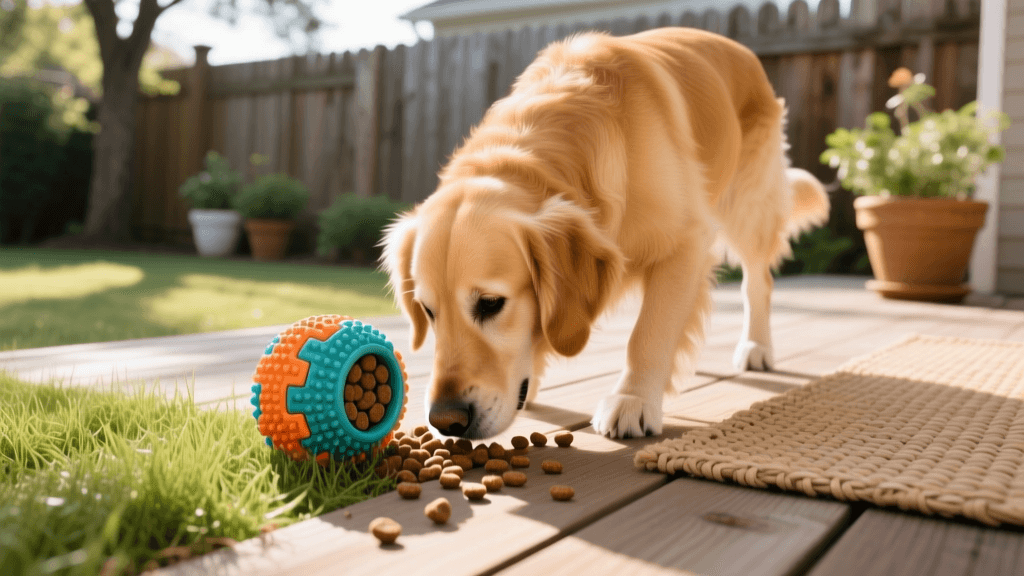
Instead of buying a $40 plastic puzzle toy that your dog will figure out in three days, look in your recycling bin. Dogs are natural scavengers, and the act of shredding, pawing, and dismantling objects mimics the process of tearing into a carcass or digging for roots in the wild. Always supervise your dog with DIY toys to ensure they do not ingest indigestible materials, a safety guideline heavily emphasized by the ASPCA.
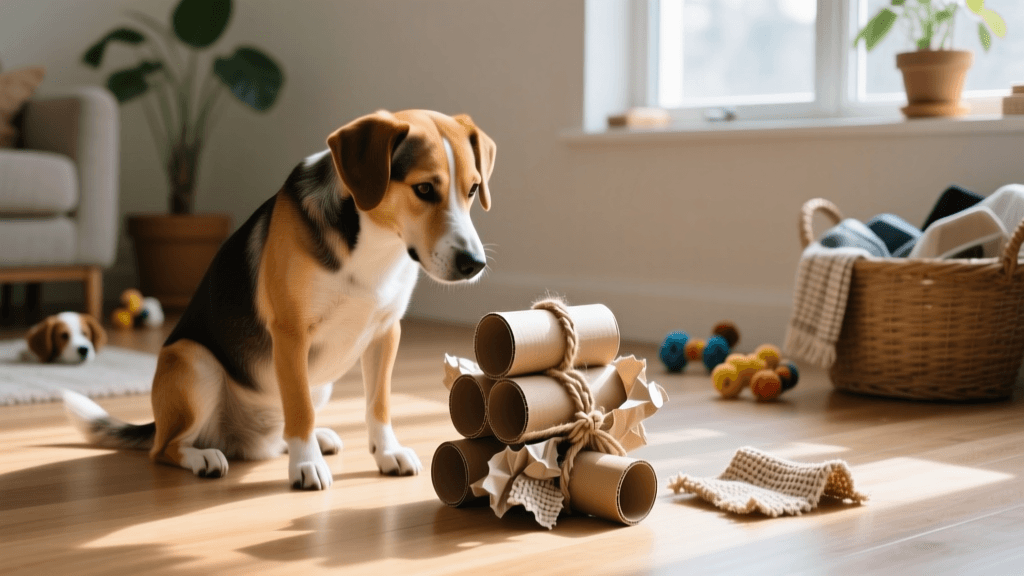
1. The Cardboard Box Forage (Cost: $0)
Save your Amazon delivery boxes and paper towel tubes. This game satisfies the destructive shredding instinct that often ruins expensive dog beds.
- Take a medium-sized cardboard box and place a few high-value treats or your dog's daily kibble ration inside.
- Add 'junk' to the box: crumpled paper, empty toilet paper rolls, and old, clean egg cartons.
- Close the flaps loosely. For advanced dogs, tape the box shut with a single strip of paper tape.
- Present the box to your dog and let them tear it apart to find the hidden treasure.
Psychological Benefit: This engages the SEEKING system while providing an acceptable outlet for destructive chewing and shredding behaviors.
2. The Towel Roll-Up (Cost: $0)
If your dog eats their food too quickly, this DIY slow-feeder promotes problem-solving and extends mealtime from 30 seconds to 10 minutes.
- Lay an old, clean bath towel flat on the floor.
- Sprinkle your dog's dry kibble evenly across the towel.
- Roll the towel up tightly into a long cylinder.
- For a harder difficulty level, tie the rolled towel into a loose knot or place it inside an empty cardboard box.
Psychological Benefit: Dogs must use their paws and snouts to unroll the towel, mimicking the physical manipulation required to extract food from crevices in nature.
3. The Muffin Tin Shell Game (Cost: $0)
This game utilizes a standard kitchen muffin tin and tennis balls to test your dog's memory and scent discrimination.
- Place a few smelly treats (like freeze-dried liver or small pieces of cheese) into a few of the muffin tin cups.
- Cover every cup with a tennis ball or a crumpled pair of socks.
- Allow your dog to knock the balls off to find the treats.
Psychological Benefit: This encourages scent discrimination and gentle paw-targeting, teaching the dog to use their nose rather than just their eyes to solve a problem.
Cost Comparison: Commercial Gear vs. Budget Hacks
When we analyze the financial and psychological return on investment, DIY enrichment consistently outperforms commercial alternatives. The table below illustrates how understanding your dog's psychology saves you money.
| Enrichment Method | Avg. Cost | Psychological Benefit | Prep Time |
|---|---|---|---|
| Commercial Electronic Puzzle Toy | $45 - $80 | Moderate (dogs quickly learn the mechanical trigger, leading to habituation) | Low |
| Sniffari Decompression Walk | $0 | Extremely High (engages the olfactory cortex, lowers cortisol, provides mental mapping) | None |
| DIY Cardboard Box Forage | $0 | High (satisfies scavenging and destructive shredding instincts safely) | 3 mins |
| Commercial Snuffle Mat | $25 - $40 | Moderate to High (good for foraging, but requires frequent washing and eventual replacement) | Low |
| DIY Towel Roll-Up | $0 | High (requires physical manipulation and problem-solving to unroll) | 2 mins |
As the data shows, the most psychologically taxing and rewarding activities for your dog rely on their natural biology, not on microchips or expensive plastics. Furthermore, organizations like the Humane Society of the United States frequently advocate for rotating homemade toys and household items to keep a dog's environment novel and engaging, which prevents the habituation that occurs when a dog is left with the same expensive toy day after day.
Safety First: Supervising Budget Enrichment
While budget-friendly enrichment is fantastic for your wallet and your dog's brain, it requires active supervision. Unlike heavy-duty rubber commercial toys, household items like cardboard, paper, and fabric can pose an ingestion risk if your dog is an aggressive chewer who tends to swallow non-food items.
Always remain in the room while your dog is interacting with a cardboard box or towel roll-up. If your dog begins to consume the cardboard rather than just shredding it to get to the treats, calmly interrupt the behavior, remove the indigestible materials, and pivot to a safer alternative like scattering kibble in the grass. The goal is to stimulate the mind, not to create a veterinary emergency.
Conclusion
Understanding your dog means recognizing that their deepest psychological needs are rooted in their evolutionary past. They do not care about the brand name on a puzzle toy or the price tag attached to a plush squeaker. They care about the thrill of the hunt, the rich tapestry of scents in the morning air, and the dopamine rush of solving a problem to earn their keep.
By shifting your perspective from buying products to providing experiences, you can deliver world-class, budget-friendly dog care. Save your boxes, roll up your old towels, and let your dog lead the way on their next sniffari. Your dog's brain will be fulfilled, their behavior will improve, and your bank account will thank you.
anouk-beaumont
All our authors care for dogs every day — read more of their work on the authors page.