How to Brush Your Dog's Teeth: A Step-by-Step Guide
Learn how to brush your dog's teeth with our step-by-step training guide. Discover the best tools, techniques, and tips for optimal canine dental health.
The Hidden Epidemic of Canine Periodontal Disease
Dental health is a foundational pillar of your dog's overall wellbeing, yet it remains one of the most overlooked aspects of routine pet care. According to the American Veterinary Medical Association (AVMA), periodontal disease is the most common clinical condition occurring in adult dogs, with over 80% of dogs showing signs of dental disease by the time they reach three years of age. If left untreated, the bacteria from infected gums can enter the bloodstream, potentially causing irreversible damage to the heart, liver, and kidneys.
While professional veterinary cleanings under anesthesia are necessary for removing hardened tartar, daily at-home brushing is the gold standard for preventing plaque accumulation. However, you cannot simply introduce a toothbrush to your dog and expect compliance. Training your dog to accept teeth brushing requires a systematic, reward-based desensitization protocol. This step-by-step guide will walk you through the exact behavioral training methods, tools, and techniques required to turn dental care into a stress-free bonding experience.
Gathering Your Dental Arsenal: Tools and Costs
Before initiating the training protocol, you must acquire the proper supplies. Never use human toothpaste, as ingredients like xylitol and fluoride are highly toxic to dogs. Invest in the following specific items to ensure safety and efficacy:
- Enzymatic Toothpaste: We recommend Virbac C.E.T. Enzymatic Dog Toothpaste (Poultry or Beef flavor). The dual-enzyme system actively breaks down plaque chemically, even if your brushing technique isn't perfect. Cost: ~$8.99 per 3.5 oz tube.
- Dual-Headed Toothbrush: The Boshel Dual-Headed Dog Toothbrush features a large and small brush head on a single handle, allowing you to clean both the inner and outer surfaces of the teeth simultaneously. Cost: ~$6.50 for a 2-pack.
- Finger Brush: A soft silicone finger brush (often included with toothpaste kits) is essential for the early desensitization phases. Cost: ~$3.00.
- High-Value Training Treats: Use soft, low-calorie treats that can be consumed quickly to maintain training momentum. Zuke's Mini Naturals (under 2 calories per treat) are ideal. Cost: ~$5.49 per 6 oz bag.
Dental Care Products Comparison Chart
| Product Type | Primary Function | Pros | Cons | Average Cost |
|---|---|---|---|---|
| Enzymatic Toothpaste | Chemical plaque breakdown | Safe to swallow; continues working post-brushing | Requires daily application for maximum efficacy | $7.00 - $12.00 |
| Dual-Headed Brush | Mechanical plaque removal | Cleans multiple surfaces at once; angled for gumline | Can be too bulky for toy breeds (under 10 lbs) | $5.00 - $9.00 |
| Silicone Finger Brush | Desensitization & gentle cleaning | Excellent for puppies; allows owner to feel teeth | Cannot reach deep molars; less friction for tartar | $3.00 - $6.00 |
| Dental Wipes | Surface wiping & breath freshening | Convenient for travel; easy for dogs to tolerate | Ineffective against heavy plaque or subgingival areas | $6.00 - $10.00 |
The 14-Day Step-by-Step Brushing Training Protocol
Dogs are naturally sensitive to anything entering their mouths. The American Kennel Club (AKC) emphasizes that forcing a toothbrush into a dog's mouth will create a lifelong fear response. Instead, we use classical counter-conditioning over a 14-day period. Keep all training sessions strictly between 30 to 60 seconds to prevent frustration.
Phase 1: Muzzle Desensitization (Days 1-3)
Goal: Teach your dog that hands near their mouth predict high-value rewards.
- Sit with your dog in a quiet, distraction-free environment.
- Gently touch the outside of their muzzle for one second, then immediately say "Yes!" and deliver a high-value treat.
- Repeat this 10 times per session. If your dog pulls away, you are moving too fast; revert to simply reaching toward the muzzle without touching it.
- By Day 3, progress to gently lifting the upper lip (the "flews") to expose the canine teeth for two seconds before treating. Do not attempt to open their jaw or touch the teeth directly yet.
Phase 2: Taste and Scent Acclimation (Days 4-6)
Goal: Associate the enzymatic toothpaste with a positive culinary experience.
- Squeeze a pea-sized amount of the Virbac C.E.T. toothpaste onto your index finger.
- Allow your dog to lick the toothpaste off your finger freely. The poultry or beef flavoring makes this highly rewarding.
- Once they are eagerly licking the paste, gently rub your paste-covered finger along the outside of their front canine teeth and gumline for 3 to 5 seconds.
- Reward immediately with a treat and verbal praise. Repeat this process twice daily, gradually moving your finger further back toward the premolars as the dog remains relaxed.
Phase 3: Tool Introduction (Days 7-10)
Goal: Desensitize the dog to the physical presence and texture of the brush.
- Apply a small dab of toothpaste to the silicone finger brush or the bristles of the dual-headed toothbrush.
- Let your dog lick the paste directly off the bristles. This familiarizes them with the texture of the brush without the pressure of scrubbing.
- Gently touch the bristles to the outer surface of the canine teeth without moving them. Hold for two seconds, then treat.
- Over the next few days, introduce tiny, circular motions on just the front four teeth. Keep the pressure exceptionally light—imagine you are brushing a ripe tomato and do not want to break the skin.
Phase 4: The Brushing Technique (Days 11-14)
Goal: Execute a full-mouth brushing routine focusing on the critical gumline.
- Apply a pea-sized amount of toothpaste to your dual-headed brush.
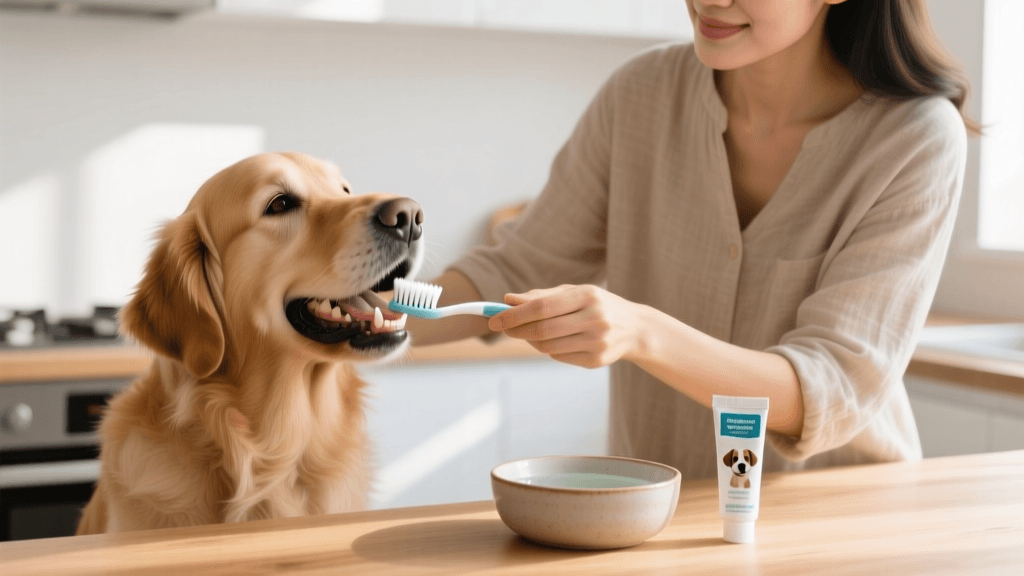
- Lift the upper lip to expose the gumline. Plaque accumulates most aggressively where the tooth meets the gum tissue.
- Hold the brush at a 45-degree angle to the gumline. Use gentle, circular motions, covering 2 to 3 teeth at a time.
- Focus primarily on the buccal surfaces (the outer surfaces facing the cheeks). The dog's tongue naturally helps keep the inner surfaces relatively clean, making the outer surfaces the priority for at-home care.
- Work from the front canines backward to the molars. Aim for 30 seconds on the left side, a quick treat break, and 30 seconds on the right side.
Understanding the VOHC Seal for Maintenance
Even with diligent brushing, some dogs are genetically predisposed to rapid tartar buildup. To supplement your daily brushing routine, incorporate dental chews or water additives that have earned the Veterinary Oral Health Council (VOHC) seal of acceptance. The VOHC is an independent entity that rigorously tests pet dental products to verify their claims of reducing plaque and tartar. Products like Purina Pro Plan Dental Chewz or Greenies Original Dental Dog Treats feature the VOHC seal and utilize mechanical abrasion or specific kibble matrices to scrape teeth as the dog chews. Always select chews appropriate for your dog's weight class to prevent choking hazards or gastrointestinal blockages.
Troubleshooting Common Training Roadblocks
- The Dog Bites or Nips the Brush: This indicates the dog is treating the brush as a toy or feels threatened. Immediately halt the session, remove the brush, and ignore the dog for 30 seconds. Return to Phase 1 desensitization the following day, ensuring you use higher-value treats (like a tiny smear of dog-safe peanut butter on the brush handle).
- Gagging or Excessive Drooling: You may be using too much toothpaste or pushing the brush too far back into the oral cavity. Stick to a strict pea-sized measurement and avoid the back molars until the dog is fully comfortable with the front teeth.
- Red or Bleeding Gums: If you notice bleeding during the first week of actual brushing, do not panic. This is often a sign of existing gingivitis. The enzymatic toothpaste and gentle mechanical stimulation will help heal the gums over 7 to 10 days. However, if bleeding is profuse or accompanied by loose teeth, halt brushing and schedule a veterinary dental exam immediately.
Conclusion
Training your dog to accept teeth brushing is an investment that pays dividends in their longevity and quality of life. By utilizing high-value rewards, respecting your dog's threshold for stress, and adhering to a structured 14-day counter-conditioning protocol, you can transform a dreaded chore into a manageable daily habit. Remember that consistency is far more important than perfection; even a brief, 30-second focused brushing of the outer gumline every day will drastically reduce your dog's risk of painful periodontal disease and expensive veterinary extractions down the road.
hannah-wickes
All our authors care for dogs every day — read more of their work on the authors page.