Top Mobility Harnesses for Large Service Dogs in 2026
Compare the top mobility harnesses for large service dogs in 2026. We review Brilliant K9, RITA, and DogLeggs for balance, brace, and PTSD support.
The Evolution of Mobility Harnesses in 2026
For individuals living with mobility impairments, postural instability, or severe PTSD, a highly trained service dog is not just a companion; they are a vital piece of medical equipment. When a service dog is tasked with brace work, counterbalance, or momentum pulls, the gear they wear must withstand immense physical forces while protecting their musculoskeletal system. As we move through 2026, the standards for working dog equipment have evolved significantly, shifting away from restrictive, mass-produced vests toward custom-fitted, biomechanically engineered harnesses.
According to Assistance Dogs International (ADI), the welfare of the working dog is paramount, and utilizing improper gear during mobility tasks is a direct violation of ethical training standards. A dog performing brace work can absorb up to 40% of their handler's body weight during a stabilization event. If the harness distributes this weight poorly, it can lead to severe spinal compression, shoulder chafing, and long-term joint degradation. In this comprehensive 2026 guide, we evaluate the top-tier mobility harnesses designed specifically for large breed service dogs, focusing on structural integrity, canine comfort, and handler ergonomics.
Why Standard 'Service Dog' Vests Fail at Mobility Work
Many novice handlers mistakenly believe that any vest labeled 'Service Dog' is suitable for physical tasks. Standard identification vests are designed solely to hold patches and provide a handle for basic guidance. They lack the internal framing, reinforced stitching, and wide weight-dispersion panels required for mobility work.
When a handler leans their full weight onto a standard vest's handle, the force concentrates entirely on the dog's spine and ribcage. Research highlighted by the Cornell University College of Veterinary Medicine indicates that repetitive uneven loading on a canine's thoracic and lumbar spine can accelerate the onset of osteoarthritis and intervertebral disc disease. True mobility harnesses feature rigid or semi-rigid internal frames, wide neoprene or Biothane belly bands, and handles positioned precisely over the dog's center of gravity to ensure the force is distributed across the chest and shoulders rather than the spine.
Top 3 Mobility Harnesses for Large Breeds (2026 Review)
1. Brilliant K9 Custom Balance Harness
The Brilliant K9 Custom Balance Harness remains the gold standard for mobility and PTSD grounding work in 2026. Handcrafted in the USA, this harness is fully customizable to the exact measurements of your dog. It features a rigid internal frame that prevents the harness from collapsing or twisting when lateral (side-to-side) force is applied during counterbalance work.
- Pros: Unmatched weight distribution; fully customizable handle placement (front, back, or dual); premium aerospace-grade aluminum handles that will not bend under heavy loads; extensive color and Biothane options.
- Cons: High price point; requires a 4 to 6-week lead time for custom manufacturing; the rigid frame requires a brief conditioning period for the dog to get used to the feel.
- 2026 Pricing: $385 - $450 (depending on custom additions like drag straps or extra D-rings).
- Best For: Handlers requiring heavy counterbalance, momentum pulls, and deep pressure therapy (DPT) grounding.
2. RITA (Response & Interactive Training Assist) Harness
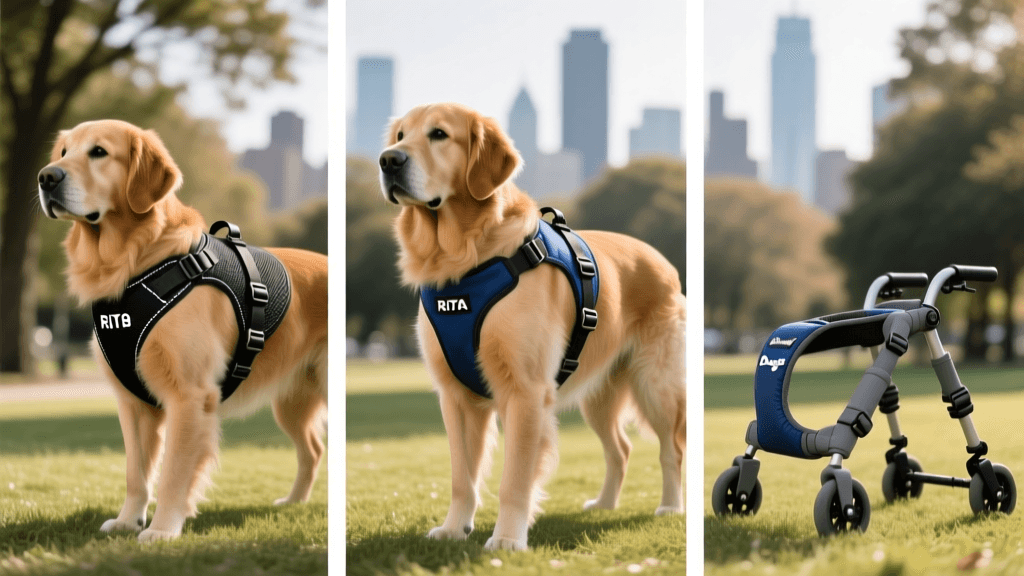
The RITA harness has gained massive popularity in the service dog community over the last few years due to its innovative modular handle system. Unlike traditional fixed handles, the RITA harness utilizes a specialized track system that allows the handle to slide slightly, accommodating the natural gait and shoulder extension of the dog while still providing rigid support for the handler.
- Pros: Excellent freedom of movement for the dog's front assembly; modular handle system adapts to the handler's height and grip style; lightweight yet incredibly strong Cordura and Biothane construction.
- Cons: The sliding handle mechanism takes practice for handlers to master during sudden brace events; limited belly band width compared to the Brilliant K9.
- 2026 Pricing: $310 - $360.
- Best For: Active handlers who need a mobility harness that does not impede the dog's natural running or walking gait during off-duty or light-tasking periods.
3. DogLeggs Therapeutic Mobility Harness
Originally designed for canine physical therapy and rehabilitation, the DogLeggs harness has been adapted by many mobility handlers due to its exceptional support structure. It features a unique saddle-like design that wraps securely around the dog's torso, providing excellent lateral stability.
- Pros: Incredible lateral support for dogs that tend to lean too far; easy to put on and take off via heavy-duty Velcro and quick-release buckles; highly adjustable for growing dogs or dogs with fluctuating weight.
- Cons: The heavy-duty Velcro can wear out faster than buckle systems if used for daily, heavy brace work; the handle is slightly narrower, which can cause hand fatigue for the handler during prolonged leans.
- 2026 Pricing: $225 - $280.
- Best For: Handlers on a budget, or dogs in training who need a highly adjustable harness before investing in a fully custom rigid-frame model.
Feature Comparison Chart
| Feature | Brilliant K9 Custom | RITA Harness | DogLeggs Therapeutic |
|---|---|---|---|
| Internal Frame | Rigid Custom Mold | Semi-Rigid Modular | Flexible Padded Saddle |
| Handle Type | Aerospace Aluminum | Sliding Track System | Padded Nylon Strap |
| Weight Distribution | Exceptional (Chest & Shoulders) | Very Good (Dynamic) | Good (Torso Wrap) |
| Gait Restriction | Minimal (Custom Fitted) | None (Sliding Handle) | Moderate (Bulkier Fit) |
| 2026 Est. Price | $385 - $450 | $310 - $360 | $225 - $280 |
Proper Fitting: The 2026 Biomechanical Standard
Purchasing a high-end mobility harness is only half the battle; achieving a perfect fit is what prevents injury. According to the American Kennel Club (AKC), working dogs must be fitted for gear while in a natural, standing posture, not while sitting or lying down. When measuring your dog for a custom harness in 2026, you must capture three critical dimensions:
- The Girth: Measure the widest part of the ribcage, just behind the front elbows. Ensure you can slide two fingers flat between the tape measure and the dog's coat.
- The Chest Plate Clearance: Measure from the base of the neck (where the collar naturally sits) down the sternum to the end of the ribcage. The chest plate must never press against the dog's throat or restrict shoulder extension.
- The Handle Height: Have the handler stand naturally next to the standing dog. The handle must align with the handler's natural wrist drop. If the handle is too low, the handler will hunch, causing back pain; if too high, the handler will pull upward, lifting the dog off its center of gravity.
Conditioning Your Dog for Brace and Counterbalance Work
A dog should never be subjected to full body weight immediately after receiving a new mobility harness. Conditioning is a gradual process that builds the dog's core strength and confidence. Begin by having the dog wear the harness for short, 10-minute intervals during positive reinforcement training sessions. Reward the dog heavily for walking calmly while feeling the rigid frame against their body.
Once the dog is comfortable wearing the gear, introduce 'lean' cues. Start by placing just 5% of your body weight on the handle, immediately rewarding the dog for bracing their legs and holding their ground. Over several months, gradually increase the weight and duration of the leans. Always monitor the dog for signs of fatigue, stress, or physical discomfort, such as lip licking, yawning, or shifting weight away from the harness. Remember, mobility work is physically demanding, and regular veterinary orthopedic check-ups are essential to ensure your dog remains healthy and pain-free throughout their working career.
Maintenance and Care for Working Gear
Mobility harnesses endure sweat, dirt, and immense physical stress. To ensure your gear remains safe for use in 2026 and beyond, establish a strict maintenance routine. If your harness features Biothane components, wipe them down with a damp cloth and mild antibacterial soap after heavy use. For Cordura or nylon sections, hand wash with a gentle detergent and allow to air dry completely to prevent mildew.
Most importantly, inspect the stitching and hardware weekly. Check the base of the handle where the most stress is applied. If you notice fraying threads, stretched D-rings, or micro-fractures in aluminum handles, retire the harness immediately and contact the manufacturer for repairs or replacement. Your service dog gives their physical well-being to support you; maintaining their gear is the least you can do to ensure their safety and longevity in their vital working role.
beth-carrasco
All our authors care for dogs every day — read more of their work on the authors page.