Best Dog Breeds for Specific Training Goals Compared
Discover the best dog breeds for agility, obedience, and therapy training. Compare learning curves, costs, and breed-specific conditioning needs.
Matching Genetics to Training Goals
Selecting a dog is often an emotional decision driven by appearance or childhood nostalgia. However, for owners with specific training aspirations—whether competitive agility, advanced obedience, or professional therapy work—genetics play a foundational role. While every dog is capable of learning basic manners and household rules, breed-specific traits dictate the speed, motivation, and ultimate ceiling of their training potential. According to the ASPCA, matching a dog's inherent energy level and breed traits to your lifestyle and goals is the most critical step in preventing behavioral issues and ensuring training success. This comprehensive guide compares top breeds across various disciplines, providing actionable timelines, cost estimates, and conditioning strategies to help you select the right canine partner.
The Science of Biddability and Drive
In the dog training world, 'biddability' refers to a dog's inherent willingness to please and work cooperatively with a human. Breeds developed for retrieving or herding, such as Golden Retrievers and Border Collies, typically exhibit high biddability. Conversely, breeds developed for independent work, like Livestock Guardian Dogs or scent hounds, possess high problem-solving intelligence but lower biddability, making them more challenging to train for rapid-response obedience. Understanding the difference between 'prey drive' (the desire to chase and grab), 'toy drive' (the desire to play and tug), and 'food drive' is essential for selecting a breed that aligns with your preferred training methodology and reward systems.
Comprehensive Breed Comparison Chart
The following table outlines the general training profiles, primary motivations, and estimated financial and time investments required to reach an advanced level of mastery in specific disciplines for four popular breeds.
| Breed | Ideal Discipline | Primary Motivation | Est. Professional Training Cost | Time to Advanced Mastery |
|---|---|---|---|---|
| Border Collie | Agility & Herding | Toy & Prey Drive | $1,500 - $2,500 | 12 - 18 Months |
| Golden Retriever | Obedience & Therapy | Food & Praise | $1,000 - $2,000 | 18 - 24 Months |
| Belgian Malinois | Protection & Agility | High Toy & Work Drive | $2,500 - $4,500 | 18 - 24 Months |
| Cavalier King Charles | Emotional Support | Praise & Gentle Play | $800 - $1,500 | 12 - 15 Months |
Agility and High-Drive Sports
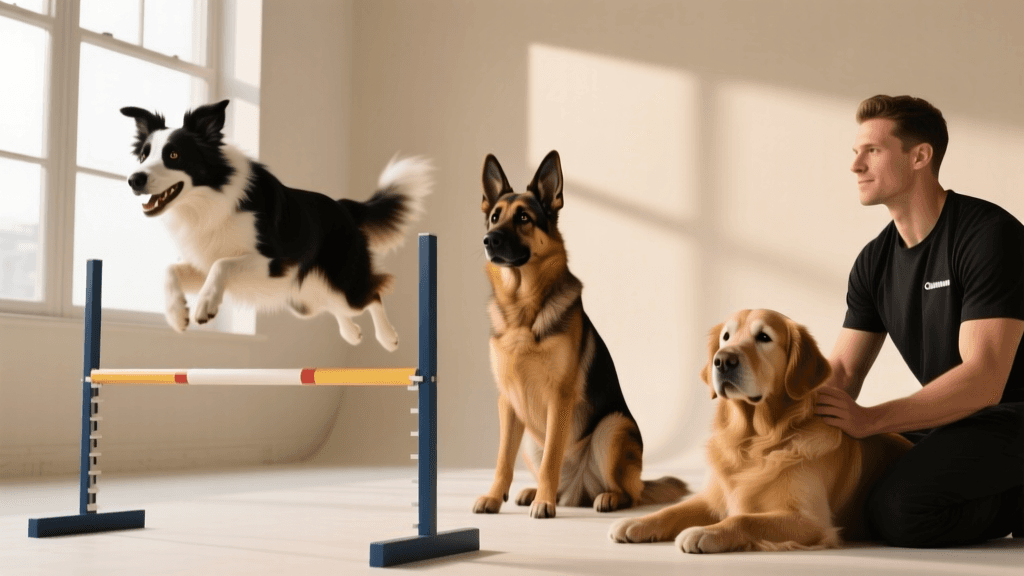
For competitive agility, the Border Collie, Shetland Sheepdog, and Belgian Malinois are unparalleled. These breeds possess the fast-twitch muscle fibers, spatial awareness, and intense handler focus required to navigate weave poles, A-frames, and teeter-totters at high speeds. However, training a high-drive dog requires strict impulse control exercises from day one. Puppies should engage in flatwork, tunnel navigation, and proprioception exercises (like walking over cavaletti rails) while avoiding repetitive jumping until their growth plates fully close, typically between 14 and 18 months of age. The AKC Agility guidelines emphasize the importance of foundational conditioning to prevent long-term orthopedic injuries. Equipment investments for agility are significant; expect to spend $250 on a set of competition-grade weave poles, $150 on a sturdy A-frame ramp for home practice, and $80 on a supportive Ruffwear Web Master Harness for spotting your dog on elevated obstacles.
Advanced Obedience and Canine Good Citizen (CGC)
If your goal is precision obedience, off-leash reliability, or achieving the AKC Canine Good Citizen (CGC) and advanced rally titles, the Golden Retriever, Standard Poodle, and German Shepherd are exceptional choices. These breeds thrive on structured, repetitive learning and excel in environments that require sustained 'stay' commands and precise heeling. Training should utilize a high-value reward system, such as Zuke's Mini Naturals or boiled chicken breast, paired with a Karen Pryor Clicker for precise behavioral marking. A major hurdle in advanced obedience is the 'adolescent regression' phase, which typically occurs between 6 and 10 months of age. During this period, previously reliable commands may deteriorate due to hormonal shifts and increased environmental distraction. Owners must commit to 15-minute focused training sessions, three times a day, utilizing a 30-foot biothane long line to safely proof recall commands in highly distracting environments like public parks.
Therapy and Emotional Support Conditioning
Therapy work requires a vastly different temperament than competitive sports. The ideal therapy dog—often a Labrador Retriever, Greyhound, or Cavalier King Charles Spaniel—must possess a low startle response and an innate affinity for human contact, even when handled clumsily. The core of therapy training is desensitization. Puppies must be exposed to the sounds of dropping metal pans, the sight of wheelchairs and crutches, and the feeling of slippery hospital linoleum floors. The American Veterinary Society of Animal Behavior (AVSAB) highlights that the critical window for socialization occurs between 3 and 14 weeks of age. Missing this window can result in permanent fear responses to novel stimuli. Actionable therapy conditioning involves weekly 'field trips' to nursing homes and hospitals (with prior permission) to practice the 'leave it' command around dropped medications and the 'settle' command on a designated therapy mat. A high-quality, washable therapy mat and a custom-fitted 'Therapy Dog' vest are essential gear investments, costing roughly $100 combined.
Financial and Time Investments in Professional Training
Regardless of the breed, achieving advanced training goals often requires professional guidance. Understanding the financial landscape helps prospective owners budget appropriately. Group puppy kindergarten classes typically cost between $150 and $300 for a six-week session, providing foundational socialization and basic cues. However, for high-drive breeds like the Malinois or for owners pursuing competitive titles, private 1-on-1 sessions are necessary. Private trainers generally charge $100 to $250 per hour. For intensive behavioral conditioning or advanced agility handling, 'board-and-train' programs are an option, though they are the most expensive route, averaging $1,500 to $3,500 for a three-to-four-week immersive stay. It is crucial to remember that board-and-train programs require significant owner education upon the dog's return; the handler must learn to maintain the criteria established by the professional trainer.
Key Takeaways for Breed Selection
- Assess Your Time Commitment: High-drive herding and protection breeds require 1 to 2 hours of physical and mental conditioning daily. If you work long hours, a lower-drive companion breed is a more ethical and practical choice.
- Budget for Specialized Gear: Beyond standard leashes and collars, specific disciplines require specialized equipment, from agility jumps to scent-work harnesses and long lines.
- Prioritize Early Socialization: The AVSAB strongly advocates for safe, early exposure to diverse environments to build the neurological pathways necessary for confident, adaptable adult dogs.
Conclusion
Ultimately, the most trainable dog is one whose genetic predispositions align seamlessly with your lifestyle, patience, and goals. By objectively comparing breed traits, understanding the financial and temporal investments required, and utilizing science-based conditioning methods, you can forge a deeply rewarding partnership. Whether you are navigating the high-speed weave poles of an agility course or providing quiet comfort in a hospital ward, selecting the right breed is the first and most vital step in your training journey.
tom-renshaw
All our authors care for dogs every day — read more of their work on the authors page.