Understanding Border Collie Herding Instincts and Behavior
Discover why Border Collies herd, decode their body language, and learn actionable training tips to manage high-energy instincts safely.
The Evolutionary Purpose of the Border Collie
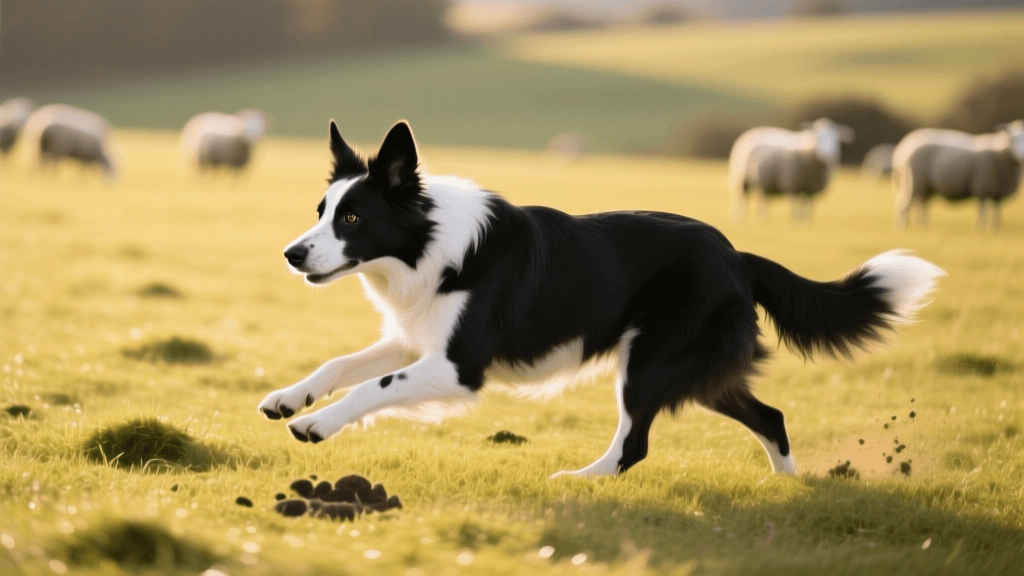
Originating in the rugged, hilly border country between Scotland and England, the Border Collie was meticulously bred for one primary purpose: to herd sheep across uneven terrain using intimidation and agility rather than physical force. According to the American Kennel Club, this breed is defined by its intense focus, boundless energy, and an innate psychological need to control the movement of its environment. Unlike livestock guardian breeds that protect flocks from predators, herding breeds are hardwired to manipulate the spatial dynamics of a herd.
This evolutionary background means that a Border Collie's brain is fundamentally structured around motion detection and spatial prediction. When a Border Collie watches a flock of sheep, a flock of birds, or a group of children playing in a park, their neural pathways fire in the exact same sequence. They are not merely observing; they are calculating trajectories, identifying outliers, and formulating a strategy to group and direct the moving subjects. Understanding this psychological baseline is the first step in preventing behavioral issues and fostering a harmonious relationship with your dog.
Decoding the 'Eye' and Herding Body Language
The most iconic trait of the Border Collie is 'The Eye'—a hypnotic, unblinking stare used to exert psychological pressure on livestock. This body language is deeply ingrained and serves as a non-verbal communication tool. However, to the untrained owner, the crouching, stalking, and intense staring can easily be mistaken for predatory aggression or fear-based reactivity.
To effectively manage your dog, you must learn to differentiate between innate herding behaviors and true aggression or anxiety. Below is a comparison chart to help you decode your Border Collie's body language in real-time.
| Behavioral Cue | Herding Instinct (Normal) | Aggression or Reactivity (Concerning) |
|---|---|---|
| The Stare | Intense, unblinking focus with a lowered head and relaxed jaw. Used to control movement. | Hard stare accompanied by raised hackles, stiff body posture, and low growling. |
| Stalking / Crouching | Lowering the front half of the body to creep closer. Fluid, calculated movements. | Freezing completely, tail tucked or rigidly high, whale eye (showing whites of eyes). |
| Nipping / Biting | Quick, inhibited snaps at the heels or hocks of moving targets to urge them forward. | Deep, sustained biting, lunging at the face or neck, shaking the head violently. |
| Vocalization | Mostly silent while working, though some may use short, sharp barks to move stubborn stock. | Continuous, high-pitched barking, snarling, or aggressive lunging while barking. |
When Instincts Become Problematic in a Domestic Setting
While these traits are highly prized on a farm, they can become dangerous and stressful in a suburban or urban environment. A Border Collie that lacks an appropriate outlet for its herding drive will inevitably create one. This often manifests as herding running children by nipping at their ankles, aggressively chasing passing cars or bicycles, or obsessively shadowing the family cat.
According to the ASPCA, many common dog behavior issues, including destructiveness, excessive barking, and escape attempts, are directly linked to boredom and a lack of adequate mental and physical stimulation. For a working breed, a simple 30-minute walk around the block is not just insufficient; it is a recipe for psychological distress. When their genetic imperative to work is suppressed without an alternative outlet, Border Collies can develop severe neuroses, including shadow-chasing, fly-snapping, and severe separation anxiety.
Actionable Management: Physical and Mental Enrichment
Managing a Border Collie requires a strategic approach that balances physical exhaustion with deep cognitive fatigue. Mental work is actually more tiring for a herding dog than physical exercise. A good rule of thumb is that 15 minutes of intense, focused mental training is equivalent to an hour of vigorous running.
Daily Exercise and Timing Protocols
- Morning (45 Minutes): Begin the day with a structured 'working walk.' Use a 15-foot biothane long line to allow sniffing and exploration, but incorporate 10 minutes of obedience drills (sit, down, recall, and directional sends) every mile.
- Mid-Day (20 Minutes): Engage in impulse control games. Practice the 'leave it' and 'wait' commands using high-value treats. This mimics the self-control a herding dog must exhibit when holding a flock in place.
- Evening (60 Minutes): High-intensity physical output combined with spatial problem-solving. Fetch is often not enough because it lacks the cognitive challenge of predicting erratic movement.
Recommended Gear and Estimated Costs
To simulate the erratic movement of sheep and engage your dog's spatial reasoning, invest in specialized enrichment tools. Here are specific product recommendations and their average market costs:
- Jolly Pets 10-inch Megga Ball ($25 - $35): Unlike standard tennis balls, this large, uneven, and unpredictable ball bounces erratically. It forces the dog to use its entire body to corral and push the object, satisfying the urge to move large livestock.
- Outward Hound Snuffle Mat ($15 - $25): Essential for post-exercise decompression. Foraging for kibble in the fleece strips lowers the dog's heart rate and engages their olfactory senses, providing a necessary mental cool-down.
- Pro Training Flirt Pole with Bungee Cord ($30 - $45): A 23-foot flirt pole allows you to cast a lure across a 30-yard radius. This simulates the darting movements of prey or breaking sheep, allowing the dog to practice the 'stalk and chase' sequence safely without reinforcing car-chasing behaviors.
Alternative Outlets: Treibball and AKC Herding
If you live in an urban area without access to livestock, you can still provide your Border Collie with a legitimate job. AKC Herding events and instinct tests are available nationwide, allowing dogs to work with ducks, sheep, or cattle under the guidance of professional handlers. However, traveling to rural farms for weekly lessons can be cost-prohibitive, often ranging from $50 to $100 per session.
A highly accessible and increasingly popular alternative is Treibball (pronounced 'try-ball'). Often described as 'urban herding,' Treibball involves the dog using its nose and shoulders to herd large exercise balls into a designated goal area, guided entirely by the handler's verbal and whistled commands.
'Treibball taps directly into the Border Collie's innate need to gather and drive, but replaces the unpredictable nature of livestock with a controlled, safe, and highly trainable environment.' - Canine Sports Enrichment Guidelines
Getting Started with Treibball:
You can begin training in your own backyard or living room. You will need a set of large yoga or exercise balls (ranging from 45cm to 75cm in diameter, costing about $20 each on Amazon) and a sturdy rectangular goal, which can be constructed from PVC pipe for under $40. Start by teaching your dog to target a single ball with their nose using a clicker and high-value rewards like freeze-dried liver. Once the 'target' command is solid, introduce the 'push' command, gradually increasing the distance from 5 feet to 30 feet. A complete starter kit, including a training whistle and target stick, will cost approximately $60 to $100.
Conclusion: Honoring the Working Dog
Owning a Border Collie is not merely about providing food, shelter, and affection; it is about honoring a centuries-old genetic blueprint. Their herding instincts are not 'bad habits' to be punished or suppressed, but rather brilliant cognitive tools that require direction. By understanding the psychology behind 'The Eye,' differentiating between herding and aggression, and investing in structured mental and physical enrichment, you can transform a chaotic, frustrated dog into a focused, fulfilled, and deeply bonded companion. Remember, a tired Border Collie is a good dog, but a mentally fulfilled Border Collie is an extraordinary one.
aaron-whyte
All our authors care for dogs every day — read more of their work on the authors page.