Why Dogs Roll In Smelly Things
Learn about why dogs roll in smelly things with expert tips and data-backed advice.
The Instinct Behind the Roll
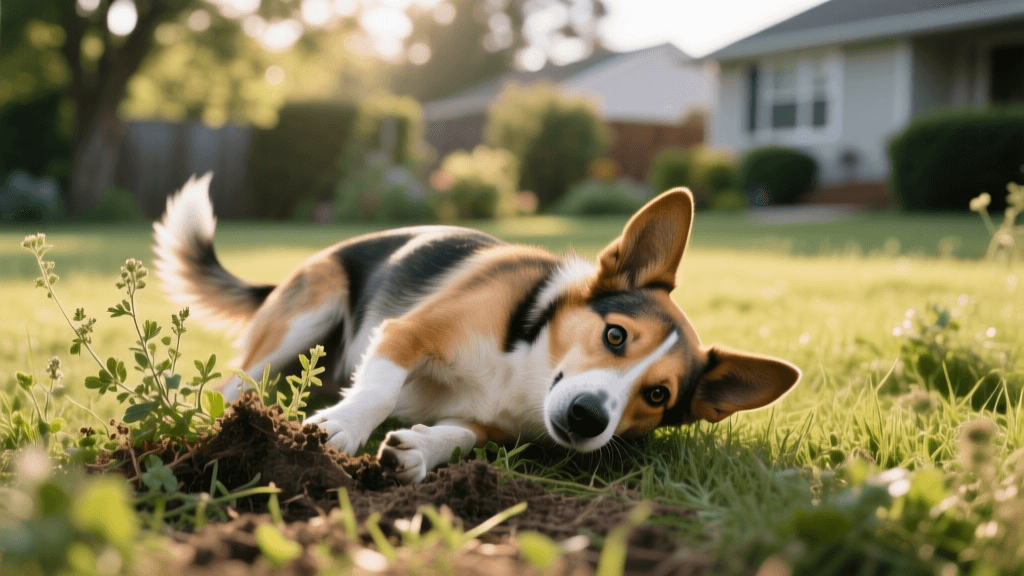
Few dog behaviours provoke as much bewilderment — and disgust — as the enthusiastic full-body roll in something foul. One moment your dog is trotting happily through the park; the next, they have dropped a shoulder into a pile of fox scat and are writhing with what can only be described as pure joy. The behaviour is ancient, deeply wired, and far more purposeful than it appears. Understanding it requires looking past the immediate offence to the evolutionary pressures that shaped modern dogs long before they shared our sofas.
Scent Masking: The Predator's Toolkit
The most widely cited explanation for scent-rolling is olfactory camouflage. By coating themselves in the smell of prey, carrion, or another animal's territory, a canid can approach quarry without triggering an alarm response. Wolves — the direct ancestors of domestic dogs — have been observed rolling in the urine and faeces of elk, deer, and bison in Yellowstone National Park, often within hours of a hunt. Researchers at the University of Alberta documented this behaviour in a 2004 field study, noting that wolves rolled most frequently in ungulate scent during the pre-hunt phase of group activity.
The logic is straightforward from a predator's perspective. A deer's nose can detect a wolf at distances exceeding 300 metres under favourable wind conditions. Masking canid body odour with a familiar environmental smell reduces that detection range significantly, improving the odds of a successful stalk. Domestic dogs retain this behaviour even though they no longer need to hunt for survival — the neural circuitry that rewards scent-rolling with a flood of dopamine has not been edited out by 15,000 years of domestication.
What the Wolf Studies Tell Us
Long-term behavioural monitoring at Yellowstone, conducted by the Wolf Project since 1995, has produced some of the most detailed records of wild canid scent-rolling available. Observers noted that individual wolves showed strong preferences for particular odour sources. Aged carcasses, the anal gland secretions of prey species, and the faeces of competing predators such as bears and cougars were all preferred targets. Crucially, rolling was almost always followed by a return to the pack, suggesting a social communication function running in parallel with any camouflage benefit.
Social Signalling and Information Sharing
The camouflage hypothesis, while compelling, does not fully account for all observed rolling behaviour. Dogs frequently roll in substances that would be useless for masking their scent during a hunt — rotting vegetation, dead fish on a beach, the urine of other dogs. A second, well-supported explanation is that scent-rolling functions as a form of olfactory news-sharing within a social group.
When a wolf or dog returns to its group carrying a novel smell, other members investigate intensely. The returning animal essentially becomes a mobile scent sample, broadcasting information about what it encountered, where, and how recently. This is particularly valuable in species that range over large territories. A wolf that has located a carcass 8 kilometres from the den can communicate that discovery to packmates through smell before any vocalisation or visual signal is possible.
Dr. Roger Abrantes, an ethologist affiliated with the Ethology Institute Cambridge, has argued that this information-transfer function may be the primary driver of the behaviour in social canids, with scent masking as a secondary benefit. His position is supported by the observation that rolling frequency increases in multi-dog households and in dogs that spend time in dog parks — environments where social information exchange has high value.
The Role of the Vomeronasal Organ
Dogs process scent through two distinct systems: the main olfactory epithelium and the vomeronasal organ (VNO), also called Jacobson's organ. The VNO is particularly sensitive to non-volatile chemical compounds — the heavy molecules found in urine, faeces, and glandular secretions. When a dog investigates a scent source before rolling, the characteristic lip-curling and slow inhalation (the flehmen response, more pronounced in cats but present in dogs) draws these compounds into the VNO for analysis. The dog is not simply smelling the substance; it is reading a detailed chemical profile that includes species identity, sex, reproductive status, diet, and health indicators.
This level of chemical literacy makes the decision to roll a more deliberate act than it appears. Dogs do not roll in everything they encounter. They select specific substances, often after a period of careful investigation, suggesting a degree of assessment rather than pure reflex.
What Dogs Actually Choose to Roll In
Field observations and owner surveys consistently identify a hierarchy of preferred rolling substrates. A survey of 1,500 dog owners conducted by the Animal Behaviour Research Group at the University of Edinburgh in 2019 found the following distribution of reported rolling targets:
| Substance | % of owners reporting | Likely function |
|---|---|---|
| Fox or other predator faeces | 41% | Scent masking / social signal |
| Dead animals or carrion | 28% | Scent masking / information transfer |
| Other dogs' urine or faeces | 17% | Social signalling |
| Rotting vegetation or compost | 9% | Unclear — possibly sensory stimulation |
| Fish or marine matter | 5% | Scent masking (coastal populations) |
The dominance of fox faeces in this list is notable. Fox anal gland secretions contain a complex mixture of sulphur compounds, trimethylamine, and short-chain fatty acids that are highly persistent on fur — a quality that would maximise both the masking effect and the duration of the social signal carried back to other dogs.
Breed Differences in Rolling Frequency
Not all dogs roll with equal enthusiasm. Scent hounds — Beagles, Bloodhounds, Basset Hounds — show significantly higher rolling frequency than herding breeds or toy breeds. This aligns with the hypothesis that the behaviour is linked to olfactory engagement: breeds selected for scent work have stronger neural reinforcement pathways associated with smell-related activities. A 2017 study published in Applied Animal Behaviour Science by researchers at Wageningen University in the Netherlands found that Beagles rolled in novel scent sources at a rate approximately 3.4 times higher than Border Collies in matched experimental conditions.
The Neurochemistry of the Roll
From the dog's perspective, rolling in something repellent is not an act of defiance or mischief. It is genuinely pleasurable. The behaviour triggers the release of dopamine and endorphins through the same reward pathways activated by eating, playing, and social bonding. This is why dogs often display a characteristic sequence of behaviours around a rolling episode:
- Intense sniffing and circling of the target substance, sometimes for 30–90 seconds before contact
- A sudden drop of one shoulder, followed by a full lateral roll with legs in the air
- Vigorous writhing, often accompanied by vocalisation (grunts, sighs)
- A post-roll "zoomie" burst of energy, indicating elevated arousal
- Repeated returns to the same spot if interrupted before the dog considers the roll complete
The shoulder-drop initiation is particularly diagnostic. It is the same movement pattern used by wolves when they first make contact with a scent source, and it appears to be hardwired rather than learned. Puppies as young as 6 weeks old, with no prior exposure to strong odours, will perform a rudimentary version of the shoulder-drop when presented with novel smells — evidence that the motor programme is innate.
The intensity of the reward response also explains why recall commands frequently fail at the critical moment. A dog mid-roll is in a state of high neurochemical reward. Competing with that using a verbal cue requires either an exceptionally strong recall history or a counter-reward of comparable value — which is why high-value treats are the most effective interruption tool.
Managing the Behaviour Without Suppressing the Dog
Because scent-rolling is driven by deep instinct and reinforced by neurochemical reward, punishment-based approaches are both ineffective and counterproductive. A dog that is scolded after rolling does not connect the punishment to the act — the roll is already complete and the reward already received. What the dog learns instead is that returning to the owner after rolling produces an unpleasant outcome, which can damage recall reliability.
Effective management focuses on prevention and redirection rather than correction:
- Anticipate the pre-roll sequence. The circling and intense sniffing that precede a roll give owners a 15–30 second window to intervene with a recall or a "leave it" cue before the behaviour is initiated.
- Use high-value reinforcement for recall. In environments where rolling targets are likely (woodland, beaches, areas with wildlife), carry rewards that genuinely compete with the dopamine hit of a roll — real meat, cheese, or a favourite toy.
- Provide alternative scent enrichment. Dogs that have regular access to scent games, tracking activities, or nose work classes show reduced compulsive rolling, likely because their olfactory reward pathways are being satisfied through other channels.
- Accept that some rolling will happen. A dog that rolls occasionally in fox scat is expressing a normal, healthy behaviour. The goal is management, not elimination.
The Battersea Dogs & Cats Home in London, which has worked with tens of thousands of dogs across its rehoming programmes, recommends framing scent-rolling as an enrichment behaviour rather than a problem behaviour. Their training guidance notes that dogs with outlets for natural scent-seeking behaviours show lower rates of anxiety-related issues such as destructive chewing and excessive barking — a reminder that instincts suppressed in one channel tend to emerge in another.
Understanding why dogs roll in smelly things does not make the smell any more tolerable, but it does reframe the behaviour from inexplicable grossness to coherent evolutionary strategy. Your dog is not being difficult. They are being, in the most literal sense, exactly what millions of years of selection pressure made them.
Beth Carrasco
All our authors care for dogs every day — read more of their work on the authors page.