Best Dog Breeds For Families With Young Children
Learn about best dog breeds for families with young children with expert tips and data-backed advice.
What Makes a Dog Truly Family-Friendly?
Bringing a dog into a home with young children is one of the most rewarding decisions a family can make — and one of the most consequential. The right match can give children a lifelong companion, teach empathy and responsibility, and fill a home with energy and joy. The wrong match can lead to stress, injury, and heartbreak for both the family and the dog. Before looking at specific breeds, it helps to understand what qualities actually matter when children under ten are in the picture.
Temperament is the single most important factor. A dog's temperament is shaped by genetics, early socialisation, and training — but breed tendencies provide a reliable starting point. The American Kennel Club (AKC, 2023) classifies temperament traits across more than 200 recognised breeds, noting that dogs bred historically for herding, guarding, or fighting carry instincts that require experienced handling around small children. Conversely, breeds developed as companions or sporting dogs tend to show higher tolerance for the unpredictable noise and movement that young children produce.
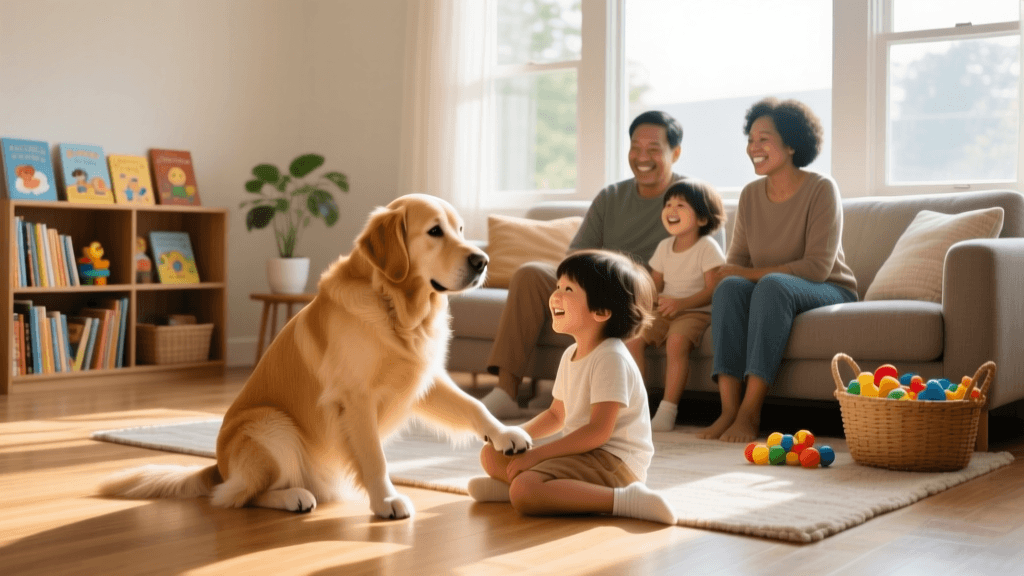
Size matters, but not in the way most people assume. A large, gentle breed like a Golden Retriever is often safer around toddlers than a small, anxious terrier. Small dogs are more easily startled, more prone to defensive biting, and more likely to be accidentally hurt by a child — which can trigger a fear response. The key is matching the dog's energy level and resilience to the household's reality.
Top Breeds Recommended for Families With Young Children
The following breeds consistently appear on veterinary and kennel club shortlists for family suitability. Each has a documented history of gentle behaviour, trainability, and patience — qualities that matter enormously when a two-year-old decides to use a dog as a pillow.
Golden Retriever
The Golden Retriever has ranked in the top five most popular breeds in the United Kingdom for over a decade, according to The Kennel Club's registration data (The Kennel Club, 2024). It is not hard to see why. Goldens are bred to work closely with humans, which makes them highly attuned to emotional cues. They have a soft mouth — a trait developed for retrieving game without damage — which translates into gentle play with children. Their average lifespan is 10 to 12 years, and they typically weigh between 25 and 34 kilograms.
Goldens require significant daily exercise: at least 2 hours for an adult dog. Families in flats or without garden access should factor this in carefully. They also shed heavily twice a year, and grooming costs can run to £40–£60 per session at a professional groomer. Despite these demands, their consistent temperament makes them one of the most forgiving breeds for first-time dog owners with children.
Labrador Retriever
The Labrador Retriever has held the position of the UK's most registered breed for 27 consecutive years as of 2023, per The Kennel Club. Labs come in three colours — black, yellow, and chocolate — but colour has no bearing on temperament, despite popular myths. They are energetic, food-motivated, and exceptionally easy to train, which makes managing their behaviour around children straightforward for most families.
One consideration: Labradors are prone to obesity. The Royal Veterinary College (RVC) found in a 2022 study that Labradors are 8.8 times more likely to become obese than other breeds, partly due to a genetic mutation affecting the POMC gene that regulates hunger. Families need to be disciplined about not feeding scraps — something young children are notoriously bad at.
Cavalier King Charles Spaniel
For families in smaller homes or with less active lifestyles, the Cavalier King Charles Spaniel offers a gentler option. Weighing just 5 to 8 kilograms, they are small enough to be manageable but sturdy enough to handle children's affection. They are ranked among the calmest breeds by the British Veterinary Association and are known for their patience and adaptability.
Prospective owners should be aware of the breed's significant health challenges. Cavaliers have a high prevalence of mitral valve disease (MVD), with research from the University of Copenhagen suggesting that over 50% of Cavaliers show signs of MVD by age five. Lifetime veterinary costs for a Cavalier can exceed £15,000. Pet insurance is not optional for this breed — it is essential.
Breeds That Require More Careful Consideration
Some breeds are loving and loyal but carry traits that require experienced handling in a household with young children. This does not mean they are bad family dogs — it means the family needs to go in with clear expectations and a commitment to training.
Border Collies are extraordinarily intelligent and energetic, but their herding instinct can lead them to nip at running children. They need upwards of 3 hours of exercise and mental stimulation daily. Without it, they become destructive and anxious. German Shepherds are deeply loyal and protective, but their guarding instinct requires careful socialisation from puppyhood. Dalmatians, despite their appealing appearance, were bred as carriage dogs and have very high exercise needs and a tendency toward deafness — approximately 8% are bilaterally deaf, according to the Dalmatian Club of America.
Adoption vs. Buying From a Breeder
The decision between adopting a rescue dog and purchasing from a breeder is one of the most significant choices a family will make. Both routes have genuine merit, and both carry risks that are worth understanding honestly.
Rescue organisations such as Dogs Trust and Battersea Dogs & Cats Home in the UK rehome thousands of dogs each year. Dogs Trust alone rehomed 12,000 dogs in 2023. Many rescue dogs are adults with known temperaments, which can actually be an advantage over a puppy whose adult personality is still unknown. Rescue fees typically range from £150 to £250 and usually include vaccinations, microchipping, and neutering.
The challenge with rescue dogs and young children is that many organisations are cautious about rehoming to families with children under five. This is not a blanket policy — it depends on the individual dog's history and assessment. Families should contact their local rescue centre directly and be honest about their home situation. Battersea, for example, conducts detailed home assessments and will match families with dogs whose histories are compatible with children.
Buying from a breeder gives families more predictability in terms of health history, early socialisation, and temperament. The Kennel Club's Assured Breeder Scheme sets minimum standards for health testing, puppy socialisation, and breeding conditions. Families should only purchase from breeders registered with this scheme or an equivalent body. Prices for KC-registered puppies from reputable breeders range from £1,200 for a Labrador to over £3,000 for some smaller breeds. Be deeply suspicious of any puppy priced significantly below market rate — this is a common indicator of puppy farming.
The Real Costs of Dog Ownership
Many families underestimate the financial commitment of dog ownership. The PDSA Animal Wellbeing (PAW) Report 2023 estimated that the lifetime cost of owning a medium-sized dog in the UK is between £21,000 and £33,000, depending on breed, health, and lifestyle choices.
| Cost Category | Estimated Annual Cost (UK) | Notes |
|---|---|---|
| Food | £400–£1,000 | Varies significantly by breed size and food quality |
| Veterinary care (routine) | £200–£400 | Vaccinations, flea/worm treatment, annual check-up |
| Pet insurance | £300–£800 | Higher for breeds with known health issues |
| Grooming | £100–£600 | Depends on coat type; some breeds need monthly professional grooming |
| Training classes | £100–£300 | Puppy classes strongly recommended in year one |
| Boarding/dog sitting | £200–£800 | Essential for family holidays |
These figures do not include the initial purchase or adoption cost, equipment (crate, bed, leads, harness, bowls), or unexpected veterinary emergencies. A single emergency surgery can cost £2,000–£5,000 without insurance. Families should have a financial buffer or comprehensive insurance in place before bringing a dog home.
Preparing Your Home and Children Before the Dog Arrives
The weeks before a new dog arrives are as important as the breed selection itself. Children need to understand how to interact safely with dogs — not just their new dog, but all dogs. The Blue Cross charity recommends teaching children the following before any dog enters the home:
- Never approach a dog that is eating, sleeping, or caring for puppies
- Always ask an owner's permission before touching an unfamiliar dog
- Move calmly and quietly around dogs, especially in the first weeks
- Never pull a dog's ears, tail, or fur
- Understand that a dog showing its teeth or growling is communicating discomfort, not playing
The home itself needs preparation too. A new dog — especially a puppy — needs a safe space that children understand is off-limits. A crate or a gated area gives the dog somewhere to retreat when overwhelmed. This is not cruelty; it is essential for the dog's wellbeing and reduces the risk of stress-related snapping.
A Pre-Arrival Checklist for Families
- Purchase a crate appropriate for the dog's adult size
- Secure garden fencing — check for gaps at ground level
- Remove toxic plants from the garden (daffodils, foxgloves, and yew are common hazards)
- Store cleaning products, medications, and small objects out of reach
- Register with a local vet before the dog arrives, not after
- Book puppy classes in advance — good trainers fill up quickly
- Agree as a family on rules: where the dog sleeps, who feeds it, and who is responsible for walks
The First Two Weeks: Setting the Foundation
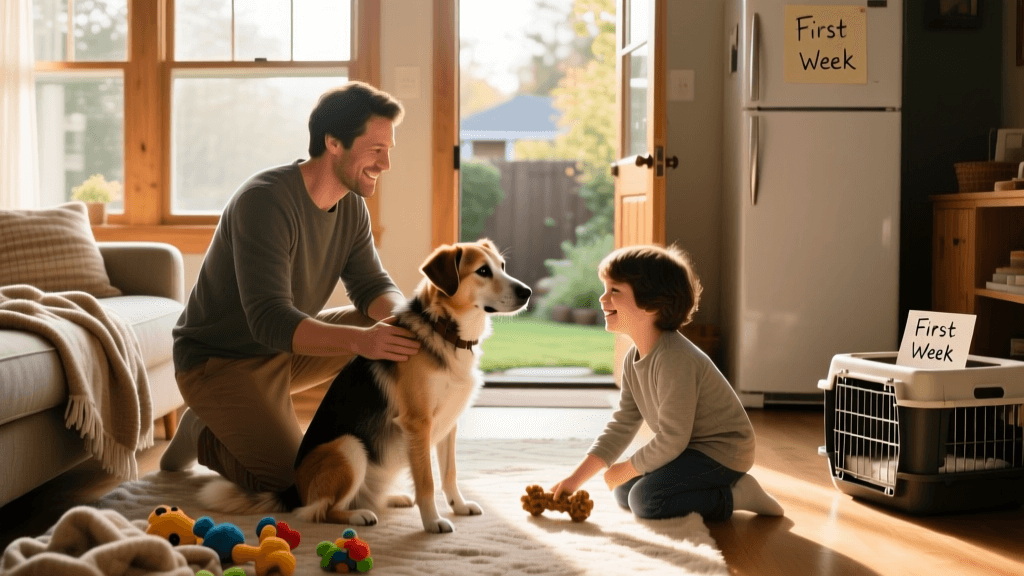
The first two weeks with a new dog are often called the "decompression period" by animal behaviourists. During this time, the dog is adjusting to a completely new environment, new smells, new sounds, and new people. Families should resist the urge to invite friends and relatives over to meet the dog immediately. Keep the household calm, establish a consistent routine for feeding and toileting, and allow the dog to approach family members on its own terms rather than forcing interaction.
Children should be supervised with the dog at all times during this period — not because the dog is dangerous, but because both the child and the dog are still learning each other's signals. Even the most patient breed can react unpredictably when startled or overwhelmed in an unfamiliar environment. Supervision is not a sign of distrust; it is responsible ownership.
Finding Reputable Sources and Support
Families navigating breed selection and the adoption process have access to excellent resources in the UK. The Kennel Club's website provides breed health information, a breeder search tool, and guidance on what questions to ask when visiting a litter. Dogs Trust operates a network of rehoming centres across the UK and offers free post-adoption support. The Association of Pet Behaviour Counsellors (APBC) can connect families with qualified behaviourists if challenges arise after the dog comes home.
For families uncertain about which breed suits their lifestyle, many rescue centres offer "foster to adopt" programmes, where a dog lives with the family for a trial period before a permanent commitment is made. This is an underused option that removes much of the uncertainty from the process and gives both the family and the dog a chance to find out whether the match works in practice.
Dog ownership with young children is not something to approach casually, but it is also not something to fear. With the right breed, honest preparation, and a commitment to training and supervision, a family dog becomes one of the most positive forces in a child's early years — teaching patience, compassion, and the quiet comfort of unconditional companionship.
Tom Renshaw
All our authors care for dogs every day — read more of their work on the authors page.