Before And After: 30-Day Puppy Potty Training Guide
Discover a real before and after puppy potty training transformation. Learn the exact 30-day schedule, costs, and tools to stop indoor accidents.
The "Before" Snapshot: Chaos, Carpets, and Sleepless Nights
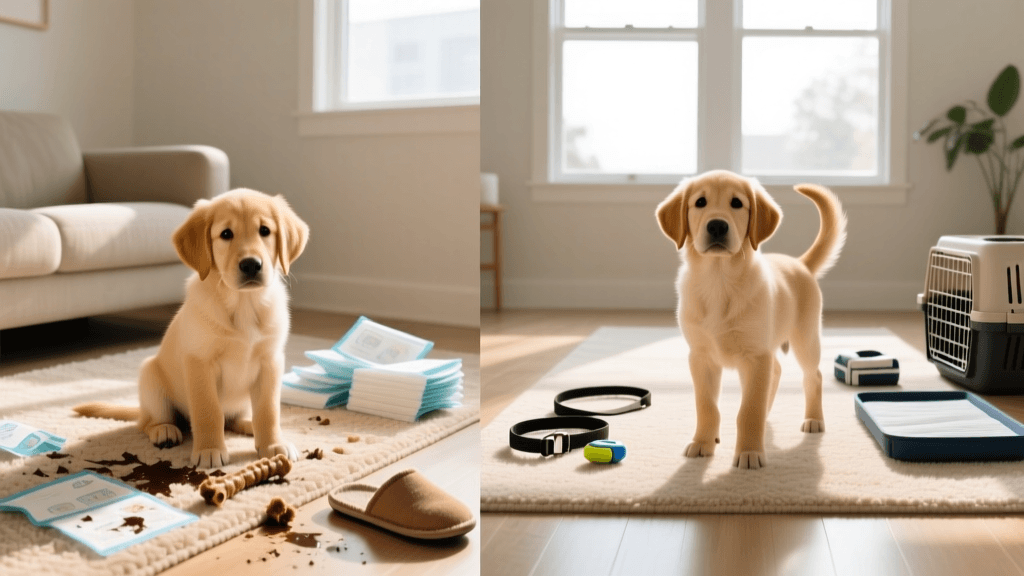
Bringing home a new puppy is a dream come true for many families, but the reality of the first few weeks can quickly devolve into a stressful nightmare. Before we dive into the actionable steps of our 30-day transformation protocol, let us establish the baseline. Meet Buster, a fictional but highly representative 10-week-old Golden Retriever mix. In his first week home, Buster's potty habits were entirely unpredictable. He was having six to eight indoor accidents a day, primarily targeting the expensive Persian rug in the living room. Nighttime was even worse; he would cry in his crate for over 45 minutes at 2:00 AM, leading to exhausted owners and a chaotic household.
This "before" state is incredibly common. New puppy owners often underestimate the sheer frequency with which a young dog needs to eliminate, as well as the psychological stress an unstructured environment places on the animal. The financial toll is also real: between ruined rugs, carpet cleaning rentals, and replacing chewed baseboards, the average owner spends upwards of $150 in the first month simply dealing with the fallout of poor potty management. But it does not have to be this way. With a structured, data-driven approach, you can completely transform your puppy's habits in just 30 days.
The Turning Point: Investing in the Right Tools
You cannot build a house without the right tools, and you cannot potty train a puppy without the proper equipment. Before starting Day 1 of our transformation, we invested in a specific suite of products designed to set the puppy up for success. Here is the exact shopping list, complete with measurements and costs, that facilitated Buster's transformation.
- MidWest Homes for Pets Single Door Crate (36-inch with Divider): Cost: $55. The divider is crucial. According to expert guidelines, a crate should only be large enough for the puppy to stand up, turn around, and lie down. If it is too large, they will use one corner as a bathroom and sleep in the other.
- Nature's Miracle Advanced Stain and Odor Eliminator: Cost: $14. Enzymatic cleaners are non-negotiable. Standard household cleaners do not break down the uric acid crystals in dog urine, meaning the puppy can still smell it and will return to the same spot. You must soak the area for a full 10 to 15 minutes to allow the enzymes to work.
- Mighty Paw Smart Bell 2.0: Cost: $16. A wall-mounted potty bell eliminates the need for the puppy to scratch at your door, saving your paint and drywall from damage.
- Zuke's Mini Naturals Training Treats: Cost: $8 per bag. At less than 3 calories per treat, these allow for high-frequency reward scheduling without causing gastrointestinal upset or obesity.
Total Initial Investment: $93.00. When compared to the cost of professional carpet cleaning or replacing damaged flooring, this investment pays for itself in the first week.
The 30-Day Transformation Schedule
The core of this before-and-after transformation relies on a strict, phased approach. Puppies thrive on predictability. By controlling their environment and their intake, we can accurately predict their output.
Week 1: The Umbilical Cord Method
During the first seven days, the puppy is never left unsupervised. We use the "umbilical cord" method, attaching a 4-foot lightweight leash to the owner's belt loop while inside the house. This prevents the puppy from wandering into another room to have an accident. The schedule is rigid: the puppy goes outside immediately upon waking, 15 minutes after eating, 10 minutes after vigorous play, and every 45 minutes otherwise. Every successful outdoor elimination is rewarded with three Mini Naturals treats and a high-pitched verbal marker like "Yes!"
Week 2: Expanding the Radius and Crate Conditioning
In week two, we begin to expand the puppy's indoor radius, allowing them off-leash time in the living room, but only immediately after a successful outdoor potty break. This is also when we heavily focus on crate conditioning. Following the Humane Society's crate training resources, we ensure the crate is associated exclusively with positive experiences. Meals are fed inside the crate with the door open, and high-value chews are only given when the puppy is inside. Nighttime crying drops dramatically as the puppy learns the crate is a safe den, not a prison.
Week 3: Introduction of the Bell and Communication
By week three, the puppy's bladder capacity has increased, and they are beginning to understand the concept of "holding it." We introduce the wall-mounted potty bell. Every time we take the puppy outside, we gently guide their nose or paw to ring the bell before opening the door. Within four to five days, the puppy begins to ring the bell independently to signal their need to go out. This is the pivotal moment in the transformation where the dog takes an active role in their potty training.
Week 4: Freedom, Proofing, and Fading Treats
The final week is about proofing the behavior. We begin to fade the treats from a continuous reinforcement schedule (every single time) to a variable ratio schedule (rewarding every second or third successful trip). We also introduce mild distractions outside, ensuring the puppy can still eliminate even if there are squirrels or neighborhood noises. Indoor supervision is relaxed, allowing the puppy to roam freely between the living room and kitchen without the umbilical leash.
Data Table: Before vs. After Metrics
To truly understand the impact of this 30-day protocol, let us look at the hard data. The following table tracks Buster's key metrics from the chaotic first day to the fully trained 30th day.
| Metric | Day 1 (Before) | Day 15 (Midpoint) | Day 30 (After) |
|---|---|---|---|
| Daily Indoor Accidents | 6 - 8 | 1 - 2 | 0 |
| Nighttime Crate Crying | 45+ minutes | 10 minutes | 0 minutes |
| Duration of Outdoor Trips | 20+ minutes (distraction) | 10 minutes | 3 - 5 minutes |
| Monthly Cleaning Costs | $45 (Carpet shampoo rentals) | $14 (Enzyme spray) | $0 |
| Owner Stress Level (1-10) | 9 | 5 | 1 |
"Potty training is not about teaching a dog where to go; it is about managing their environment so they have no choice but to succeed, and then rewarding that success until it becomes a lifelong habit."
Expert Insights and Authoritative Guidelines
This transformation protocol is not based on guesswork; it is rooted in established veterinary and behavioral science. According to the ASPCA's official guidelines on house-training, establishing a consistent routine and utilizing positive reinforcement are the most effective methods for teaching a puppy appropriate elimination habits. The ASPCA specifically warns against punishing a puppy for accidents, noting that rubbing a dog's nose in it or yelling only teaches the dog to fear the owner, leading them to hide behind furniture to eliminate in the future.
Furthermore, crate training is heavily supported by behavioral experts when done correctly. The crate taps into a dog's natural denning instinct. However, it is vital to adhere to proper time limits. A general rule of thumb is that a puppy can hold their bladder for one hour for every month of age, plus one. Therefore, a 10-week-old (roughly 2.5 months) puppy can only hold it for about 3 to 3.5 hours maximum during the day, and slightly longer at night when their metabolism slows down.
Troubleshooting Setbacks and Regressions
No transformation is perfectly linear. Around Day 18, Buster experienced a minor regression, having two accidents indoors after a week of being completely clean. This is incredibly common and usually tied to one of three factors: a growth spurt, teething discomfort, or a change in the household routine. Instead of reverting to frustration, we simply returned to the Week 1 umbilical cord protocol for 48 hours. By temporarily restricting freedom and increasing the frequency of outdoor trips, we quickly re-established the habit without damaging the puppy's confidence.
The "After" Snapshot: A Harmonious Home
Fast forward to Day 30. The Persian rug is safe. Buster now sleeps peacefully in his crate from 10:30 PM to 6:30 AM without a single whimper. When he needs to go out during the day, he walks over to the back door and confidently bats the Mighty Paw bell with his paw. The frantic, stressful dashes to the backyard have been replaced by calm, business-like potty trips that take less than five minutes. The financial drain of carpet cleaners has ceased, replaced by a harmonious, trusting bond between dog and owner.
Final Thoughts on the Transformation
The journey from a chaotic, accident-prone puppy to a reliable, well-mannered companion does not happen by accident. It requires a deliberate, structured approach, a modest financial investment in the right tools, and an unwavering commitment to consistency. By viewing potty training as a 30-day transformation project rather than a daily chore, you shift your mindset from frustration to proactive management. Stick to the schedule, utilize the enzymatic cleaners, respect the crate, and celebrate the small victories. Your future self—and your carpets—will thank you.
aaron-whyte
All our authors care for dogs every day — read more of their work on the authors page.