2026 Backyard Dog Agility Course Setup And Training Guide
Discover how to build a safe, affordable backyard dog agility course in 2026. Expert tips on PVC obstacles, space requirements, and foundational training.
The Rise of Backyard Agility in 2026
Dog agility has evolved from a niche competitive sport into a mainstream lifestyle activity for dog owners worldwide. As we move through 2026, the trend of building customized, modular backyard agility courses has reached an all-time high. Whether you are looking to burn off your border collie's endless energy, build confidence in a shy rescue, or lay the groundwork for local weekend trials, a home setup offers unparalleled convenience. According to the American Kennel Club's agility guidelines, the sport is one of the fastest-growing canine activities, emphasizing teamwork, communication, and physical fitness.
However, setting up a backyard course requires more than just tossing a few plastic jumps onto the lawn. It demands careful consideration of space, surfacing, equipment safety, and foundational training methodologies. This comprehensive guide will walk you through everything you need to know to design, build, and train on your very own backyard dog agility course in 2026.
Essential Equipment for Your Home Course
The agility equipment market in 2026 offers fantastic options ranging from budget-friendly PVC kits to professional-grade aluminum setups. Here is a breakdown of the core obstacles you need to start.
1. Jumps and Wing Designs
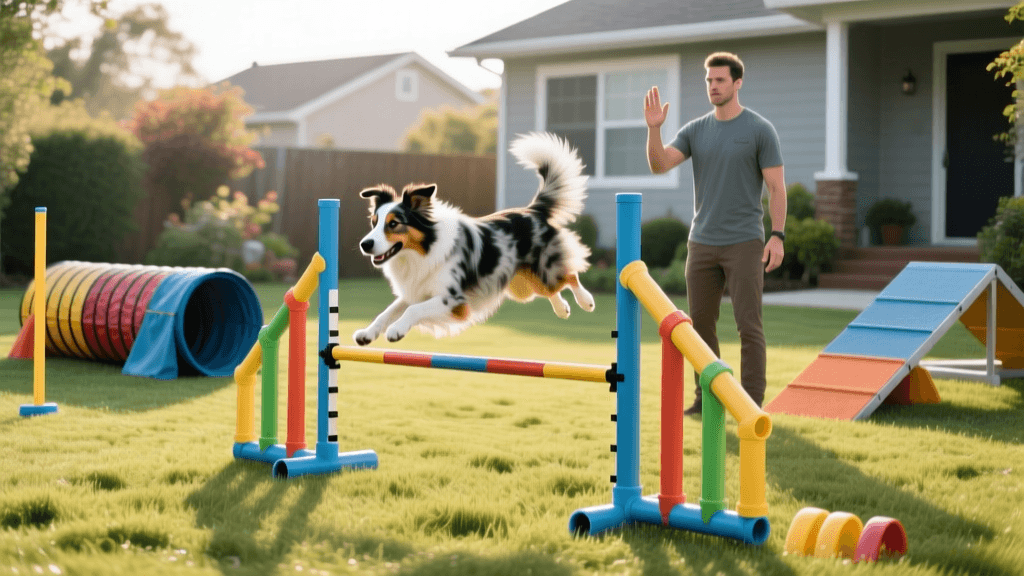
Jumps are the most frequently used obstacles in any agility course. For a backyard setup, adjustable PVC jumps with dislodging bars are the gold standard for beginners. They are lightweight, easy to move, and safe if your dog misjudges a stride. Look for jumps with a minimum height adjustment of 4 inches and a maximum of 24 inches. In 2026, many manufacturers include breakaway bar cups as a standard safety feature, ensuring the bar falls cleanly if the dog clips it with their hind legs.
2. The Agility Tunnel
A tunnel is often a dog's favorite obstacle. For home use, a 10-foot to 15-foot open tunnel with a 24-inch diameter is ideal. Ensure the tunnel is made of heavy-duty, tear-resistant ripstop nylon or reinforced vinyl. You must also invest in heavy tunnel bags or sandbags to secure the tunnel to the ground; an unsecured tunnel can roll or collapse, which is a major safety hazard that can severely damage a dog's confidence.
3. Weave Poles
Weave poles are notoriously the most difficult obstacle to train. For backyard practice, a set of six to twelve adjustable weave poles is essential. In 2026, the most popular home training method utilizes "2x2" weave pole bases or channel-style weaves, which allow you to open the poles into a wide channel and gradually close them as the dog learns the footwork.
4. Contact Obstacles (A-Frame and Dog Walk)
Full-sized contact equipment is massive, expensive, and difficult to move. For most backyards, trainers recommend using low-profile "contact Trainers" or mini A-frames. These allow you to teach the crucial "two-on, two-off" contact behavior without the joint impact of a full-sized 8-foot drop.
2026 Agility Equipment Comparison Chart
Choosing the right material for your obstacles depends on your budget, climate, and long-term goals. Below is a comparison of the most common materials available on the market this year.
| Material Type | Average Cost (2026) | Durability & Weather Resistance | Best Suited For |
|---|---|---|---|
| Modular PVC | $150 - $350 per set | Moderate; can become brittle in extreme UV or freezing cold over time. | Beginners, small to medium backyards, budget-conscious handlers. |
| Powder-Coated Aluminum | $400 - $800 per set | Excellent; rust-proof, lightweight, and withstands all weather conditions. | Serious competitors, large yards, those needing frequent course changes. |
| Solid Wood / Steel | $600 - $1,500+ per set | High, but heavy and prone to rot if not treated and stored properly. | Permanent course setups, club training facilities. |
Designing Your Space: Surfacing and Layout
One of the most critical, yet frequently overlooked, aspects of backyard agility is the ground surface. Running on uneven, hard, or slippery ground is a leading cause of canine sports injuries.
Space Requirements
To safely sequence even three or four obstacles, you need a minimum flat area of 50x50 feet. This allows for adequate approach and departure strides, preventing your dog from having to make sharp, high-speed turns near fences or trees.
Surface Safety
Natural, well-maintained grass is generally the best and most forgiving surface for backyard agility. However, if you live in a climate where grass turns to mud or dust, you may need to consider alternatives. In 2026, specialized K9 artificial turf with a short pile and high-drainage backing has become highly accessible. Avoid concrete, asphalt, or packed dirt at all costs, as these surfaces offer zero shock absorption and will quickly lead to shoulder and joint deterioration. The American Veterinary Medical Association consistently highlights the importance of appropriate, forgiving exercise surfaces to maintain long-term joint health in active dogs.
Foundational Training: Flatwork Before Obstacles
The biggest mistake novice handlers make is putting their dog on equipment before teaching them how to move in partnership with the handler. "Flatwork" refers to agility training done entirely on the flat ground without any obstacles. It is the absolute foundation of the sport.
Engagement and Focus
Before you even approach a jump, your dog must be able to maintain focus on you in the backyard environment. Practice recall games, tug-of-war, and hand-targeting. Your dog should view you as the most rewarding part of the yard, far more interesting than the neighbor's squirrel.
Front Crosses and Rear Crosses
Agility is a dance. You must teach your dog how to read your body language to know when to turn. Practice "front crosses" (changing sides in front of your dog while they are moving) and "rear crosses" (changing sides behind your dog) using just a cone or a bucket as a focal point. Reward heavily when the dog correctly follows your shoulder and foot cues.
Mastering the Weave Poles: The 2x2 Method
If you are setting up weave poles in your yard, the 2x2 method remains the most effective and dog-friendly way to teach the skill. Instead of forcing the dog through a straight line of poles using wires or guides, the 2x2 method breaks the poles into pairs.
- Start with one pair: Set up just two poles. Stand so the dog approaches the poles at a slight angle, encouraging them to pass through the middle with their left shoulder entering first.
- Reward placement: Throw the treat or toy directly ahead of the poles to build forward momentum and drive.
- Add pairs gradually: Once the dog is confidently driving through the first pair, add a second pair about 20 inches away. Treat them as two separate tasks.
- Close the gaps: Over several weeks, gradually move the pairs closer together until they form a continuous line of six or twelve poles.
This method builds incredible independence and speed, as the dog is actively thinking about the entry rather than just being physically guided through a chute.
Smart Timing and Video Analysis in 2026
Technology has deeply integrated into canine sports. In 2026, handlers are utilizing AI-powered smartphone applications to analyze their dog's jumping mechanics and stride length. By setting up your phone on a tripod and recording your backyard sessions, modern apps can automatically track your dog's takeoff point, peak jump height, and landing angle. This data is invaluable for identifying early signs of fatigue or subtle physical asymmetries that could indicate an impending soft-tissue injury. Utilizing these tools allows backyard trainers to practice with the same analytical rigor as Olympic-level canine conditioning coaches.
Canine Conditioning and Injury Prevention
Agility is a high-impact sport. Just as a human marathon runner wouldn't sprint without stretching, your dog requires a proper warm-up and cool-down routine. Before stepping onto your backyard course, spend 10 to 15 minutes doing dynamic movements. This includes trotting in large figure-eight patterns, playing gentle tug to engage the core, and practicing "cookie stretches" to mobilize the spine.
Furthermore, incorporate canine fitness exercises into your weekly routine. Using specialized inflatable canine balance discs or peanut-shaped stability balls, you can help your dog build the deep core muscles necessary to stabilize their spine while navigating the weave poles or hitting the contact zones on the A-frame. Remember, agility should always be a game. Keep your backyard training sessions short—no more than 10 to 15 minutes at a time—to ensure your dog remains physically safe and mentally enthusiastic about the sport.
hannah-wickes
All our authors care for dogs every day — read more of their work on the authors page.