Canine Leash Reactivity: An Applied Behavior Analysis Guide
Discover how applied behavior analysis and functional assessments resolve canine leash reactivity using evidence-based counter-conditioning protocols.

Understanding Leash Reactivity Through the Lens of ABA
Leash reactivity is one of the most common and frustrating behavioral challenges faced by dog owners. However, from the perspective of Applied Behavior Analysis (ABA), reactivity is not a sign of dominance or a bad dog. Rather, it is a highly functional, measurable behavior driven by specific environmental antecedents and maintained by distinct consequences. As an expert behavior analyst, my goal is to shift the focus from suppressing the symptom (barking and lunging) to modifying the underlying emotional and operant drivers of the behavior.
When a dog exhibits reactivity—defined as an overreaction to stimuli such as other dogs, humans, or vehicles—they are typically operating from a place of fear, anxiety, or barrier frustration. To resolve this, we must utilize evidence-based protocols rooted in classical counter-conditioning and operant desensitization, avoiding aversive punishments that the American Veterinary Society of Animal Behavior (AVSAB) warns can exacerbate aggression and fear.
The Functional Behavioral Assessment (FBA)
Before implementing a modification plan, a behavior analyst conducts a Functional Behavioral Assessment (FBA). This involves observing the dog in its natural environment to identify the ABCs of the behavior: Antecedent, Behavior, and Consequence.
| Component | Definition | Example in Leash Reactivity |
|---|---|---|
| Antecedent (A) | The environmental trigger or context that precedes the behavior. | An unfamiliar dog approaches within 40 feet on a narrow sidewalk. |
| Behavior (B) | The observable, measurable action performed by the subject. | Lunging to the end of the leash, hard staring, piloerection, and vocalizing. |
| Consequence (C) | The immediate result that reinforces or punishes the behavior. | The trigger dog crosses the street (Negative Reinforcement: distance increases, relief is felt). |
In the example above, the behavior of lunging is negatively reinforced. The dog learns that barking and lunging successfully makes the scary stimulus go away. This makes the behavior more likely to occur in the future, and often at greater distances, as the dog attempts to increase the buffer zone sooner.
Neurological Thresholds and the Amygdala Hijack
A critical concept in behavior analysis is the threshold. The threshold is the exact distance or intensity at which a dog notices a trigger but remains capable of cognitive processing and learning. Once a dog crosses over the threshold, the amygdala hijacks the brain, flooding the body with cortisol and epinephrine. The sympathetic nervous system activates the fight-or-flight response.
"A dog over threshold is not being stubborn; their neurological learning centers are temporarily offline due to an amygdala hijack. All behavior modification must occur sub-threshold."
When a dog is over threshold, operant conditioning (e.g., asking for a sit or look at me) is neurologically impossible. According to the American Kennel Club (AKC), managing the environment to keep your dog under threshold is the foundational step of any successful reactivity protocol.
Understanding Trigger Stacking
In behavior analysis, we must also account for trigger stacking. This phenomenon occurs when multiple sub-threshold stressors accumulate over hours or days, effectively lowering the dog's overall threshold for reactivity. For example, a thunderstorm in the morning, a loud garbage truck outside the window, and a rushed bathroom break can elevate a dog's baseline cortisol levels. By the time they encounter another dog on a walk, their threshold has dropped significantly, resulting in a reaction at a distance they normally tolerate. Recognizing trigger stacking requires meticulous data collection and adjusting your daily management protocols to include structured decompression activities, such as sniffaris in isolated areas or snuffle mat work indoors, to lower baseline arousal.
Essential Equipment and Budgeting for Behavior Modification
Effective behavior modification requires precise timing, high-value reinforcement, and safe management tools. Here is a breakdown of the essential gear and estimated costs for a DIY behavior modification setup:
- Front-Clip Harness: 2 Hounds Design Freedom No-Pull Harness (~$28). A front-clip attachment point gently redirects the dog's momentum toward the handler if they lunge, preventing tracheal damage associated with flat collars.
- High-Value Reinforcers: Zuke's Mini Naturals or boiled chicken breast (~$8-$15). Food must be high-value, soft, and pea-sized to allow for rapid consumption and continuous engagement.
- Marker Signal: Karen Pryor i-Click Clicker (~$4). A mechanical clicker provides a precise, consistent acoustic marker that predicts the delivery of a reward.
- Treat Pouch: Doggy Style or similar quick-access pouch (~$15). Fumbling in pockets creates latency in reinforcement, which degrades the conditioning process.
- Long Line: 15-foot biothane long line (~$25). Provides the dog with a sense of freedom and allows for safe emergency U-turns without the tension of a standard 6-foot leash.
Total Startup Cost: Approximately $80 to $90.
Evidence-Based Protocol: Desensitization and Counter-Conditioning (DS/CC)
To change the dog's emotional response to the antecedent (the trigger), we use Desensitization (gradual exposure below threshold) paired with Counter-Conditioning (changing the emotional association from negative to positive).
Step 1: Baseline Data Collection and Threshold Mapping
Spend one week simply observing and recording your dog's reactions. At what distance do their ears pin back? At what distance do they stiffen? At what distance do they bark? Map out these distances. If your dog reacts at 30 feet, your new working distance for training is 50 feet.
Step 2: The Engage-Disengage Game (Operant Conditioning)
Developed by Leslie McDevitt, this game teaches the dog that looking at a trigger predicts a reward, and voluntarily disengaging from the trigger earns the reward.
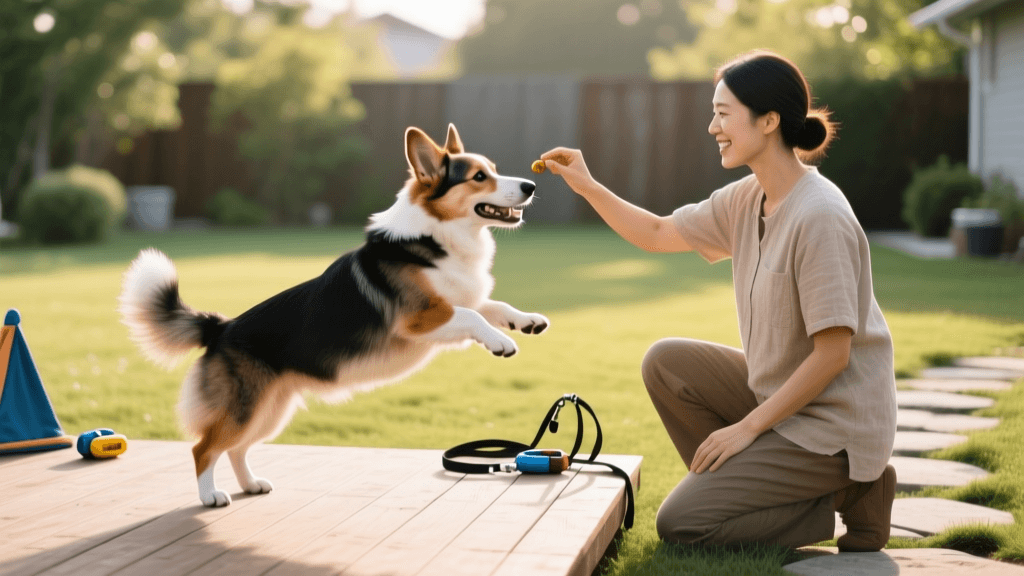
- Engage: Your dog spots the trigger at a sub-threshold distance (e.g., 50 feet). Within 0.5 seconds, click your clicker. The dog will turn to you to get the treat.
- Disengage: As your dog improves, wait to click. Allow the dog to look at the trigger, then voluntarily turn their head away from it. Click the moment they disengage, then reward.
This shifts the dog's operant behavior from lunging to create distance to looking and turning away to earn food.
Step 3: Classical Counter-Conditioning (The Open-Bar/Closed-Bar Method)
If the dog is too fearful to engage in operant tasks, rely purely on classical conditioning. When the trigger appears, a continuous stream of high-value food begins (the Open Bar). When the trigger disappears, the food stops immediately (the Closed Bar). The dog learns: Trigger equals Chicken. No Trigger equals No Chicken. This rewires the amygdala's predictive coding regarding the antecedent.
Time, Cost, and Professional Intervention
Behavior modification is not a quick fix; it is a lifestyle adjustment. Expect to invest 15 to 20 minutes daily in structured DS/CC sessions, alongside constant environmental management during regular walks. If your dog has a bite history, or if their threshold is so low that you cannot safely maintain a sub-threshold distance in your neighborhood, it is imperative to hire a certified professional. Seek out a Certified Applied Animal Behaviorist (CAAB) or a trainer certified by the ASPCA or CCPDT who strictly adheres to force-free, LIMA (Least Intrusive, Minimally Aversive) methodologies.
Conclusion
Canine leash reactivity is a complex behavioral puzzle, but it is entirely solvable when approached with the scientific rigor of Applied Behavior Analysis. By conducting a functional assessment, respecting neurological thresholds, and utilizing precise desensitization and counter-conditioning protocols, you can change not just your dog's behavior, but their underlying emotional state. Patience, precise timing, and high-value reinforcement are your most powerful tools in transforming a reactive dog into a confident, relaxed companion.
anouk-beaumont
All our authors care for dogs every day — read more of their work on the authors page.