Understanding Apartment Dog Reactivity to Hallway Noises
Discover why your apartment dog barks at hallway noises. Learn the psychology behind urban canine reactivity and actionable tips to restore peace.
The Urban Canine Dilemma: High-Density Living and Territorial Stress
Urban living offers incredible amenities, walkability, and vibrant communities, but it also presents unique psychological stressors for our canine companions. When you bring a dog into an apartment or high-rise condominium, you are fundamentally altering how they interact with their environment. In the wild or in rural settings, dogs patrol expansive perimeters, using scent marking and visual landmarks to establish boundaries. In an apartment, their territory ends abruptly at a wooden door, while the shared hallway remains a chaotic, high-traffic 'no man's land' filled with the sounds and smells of invisible strangers.
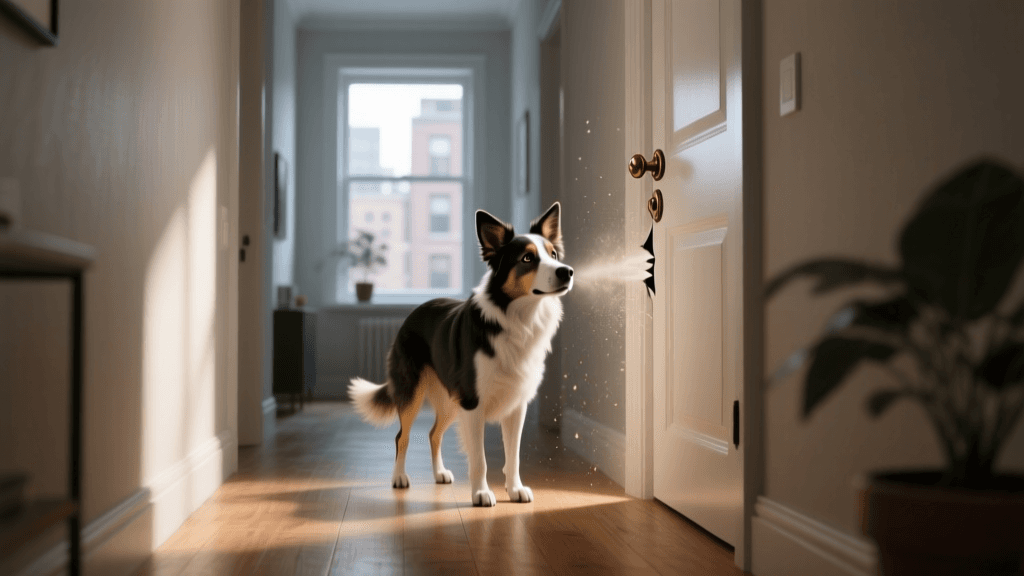
This evolutionary mismatch is the root cause of one of the most common behavioral issues in urban dog ownership: hallway reactivity. If your dog lunges, growls, or barks frantically every time a neighbor walks past your door, rides the elevator, or jingles their keys, they are not simply being 'bad.' They are experiencing a complex mix of territorial anxiety, barrier frustration, and acoustic overload. Understanding the psychology behind these behaviors is the first step toward transforming your high-rise home into a peaceful sanctuary.
The Psychology Behind Hallway Reactivity
To understand why apartment dogs react so intensely to hallway noises, we must look at canine sensory processing and territorial instincts. Dogs possess an auditory range of up to 45,000 Hertz, compared to the human limit of roughly 20,000 Hertz. Furthermore, they have 18 muscles in their ears that allow them to pinpoint the exact location and distance of a sound. When your dog hears footsteps three floors down, their brain triggers an 'orienting response,' forcing them to assess the potential threat.
According to the American Kennel Club's training experts, alert barking is a natural canine behavior designed to warn the pack of approaching changes in the environment. However, in an apartment, the 'pack' is just you, and the 'approaching changes' happen dozens of times a day. Because your dog cannot visually verify who is in the hallway, their imagination fills in the blanks, often defaulting to a defensive posture. This chronic state of hyper-vigilance can lead to elevated cortisol levels, making it difficult for your dog to achieve deep, restorative sleep.
Barrier Frustration vs. Fear-Based Reactivity
It is crucial to differentiate between barrier frustration and genuine fear. Barrier frustration occurs when a dog is highly aroused by a stimulus (like another dog walking in the hallway) but is physically prevented from approaching it by the front door. This thwarted desire often manifests as aggressive-sounding barking that instantly dissipates if the door were to open. Fear-based reactivity, on the other hand, is rooted in a desire to increase the distance between the dog and the perceived threat. A fearful dog will bark, retreat, tuck their tail, and display whale eye (showing the whites of their eyes). Identifying which emotional state is driving the behavior will dictate your training approach.
Trigger Analysis and Management Matrix
Not all hallway noises are created equal. Below is a structured breakdown of common urban triggers, the underlying canine emotional response, and immediate management strategies to mitigate the stress.
| Common Apartment Trigger | Acoustic Profile | Canine Emotional State | Immediate Management Strategy |
|---|---|---|---|
| Heavy Footsteps / Pacing | Low-frequency, rhythmic thudding (20-250 Hz) | Territorial Alert / Hyper-vigilance | Place a dense rubber mat outside the neighbor's door (if permitted) or use a white noise machine inside. |
| Elevator Dings & Mechanical Hum | High-frequency chimes followed by low rumble | Anticipatory Anxiety / Arousal | Desensitization using recorded elevator sounds paired with high-value treats. |
| Neighboring Dog Barking | Mid-to-high frequency, highly variable | Barrier Frustration / Social Arousal | Acoustic masking with pink noise; engage the dog in a scent-based puzzle toy. |
| Keys in the Lock / Door Handles | Sharp, metallic, high-frequency clicking | Startle Response / Fear | Counterconditioning; toss treats away from the door every time a metallic click is heard. |
Actionable Urban Solutions: Modifying the Environment
Before attempting complex behavioral modification, you must manage the environment to lower your dog's baseline stress. You cannot train a dog that is actively over threshold. Here are specific, actionable modifications tailored for apartment living.
Strategic Acoustic Masking
White noise is not enough to mask the low-frequency thud of footsteps. You need 'pink noise' or 'brown noise,' which emphasize lower frequencies. Invest in a high-quality sound machine like the LectroFan Evo (approximately $45). Place the machine within three feet of your front door, pointing toward the hallway, not toward your dog's bed. Set the volume to roughly 55-60 decibels—loud enough to blur the sharp transients of hallway noises, but quiet enough to allow you to hear a fire alarm. Leave it running 24/7 to prevent the 'startle effect' that occurs when the machine is turned on and off.
Visual and Olfactory Barriers
If your apartment features a ground-floor window facing a busy sidewalk, or a front door with glass panes, your dog is likely experiencing visual triggers. Apply Rabbitgoo Frosted Window Film ($10-$15) to the bottom two-thirds of the glass. This blocks the sightline of passing dogs and pedestrians while still allowing natural light to enter. Additionally, plug in an Adaptil Calm Pheromone Diffuser near your dog's primary resting area. Adaptil releases a synthetic copy of the dog-appeasing pheromone produced by nursing mothers, which has been clinically shown to reduce signs of stress in enclosed environments.
Behavioral Modification: The Sound Desensitization Protocol
Once the environment is managed, you can begin changing your dog's emotional response to the noises. The ASPCA's guide on common dog behavior issues highly recommends desensitization and counterconditioning for noise-based reactivity. Here is a step-by-step protocol tailored for apartment dwellers:
- Source the Audio: Find YouTube videos or sound libraries featuring 'apartment hallway ambiance,' 'elevator dings,' and 'muffled footsteps.' Alternatively, record the specific sounds in your own building using your smartphone.
- Set the Baseline: Play the audio on your phone or Bluetooth speaker at a volume so low (e.g., 10%) that your dog notices it but does not bark, pace, or pant. This is called 'sub-threshold' exposure.
- Pair with High-Value Rewards: The exact second the sound plays, feed your dog a high-value treat like Zuke's Mini Naturals or boiled chicken. The sequence must be: Sound -> Treat. Stop the treat when the sound stops.
- Gradually Increase Intensity: Over several weeks, incrementally raise the volume by 5% or move the speaker closer to the front door. If your dog reacts, you have moved too fast; lower the volume and return to the previous step.
"The goal of counterconditioning is not to distract the dog from the noise, but to fundamentally change the dog's emotional prediction. The noise must become the reliable predictor of something wonderful, rather than a herald of an invisible intruder."
The 'Place' Command for High-Rise Emergencies
In an apartment, you cannot always control the hallway. Sometimes, a neighbor will stop right outside your door to chat, or a delivery driver will aggressively knock. In these moments, you need an incompatible behavior that gives your dog a 'job' to do. The 'Place' command is invaluable for urban dog owners.
Teach your dog to go to a specific mat (such as the Kurgo Loft Dog Bed) and remain there until released. Start training in a quiet room, luring them onto the mat with treats and rewarding heavily for a 'down' position. Once the behavior is fluent, add the trigger. When you hear a knock or a loud hallway noise, cheerfully say 'Place!' and guide your dog to the mat. Reward them continuously with a long-lasting chew, like a frozen KONG Classic stuffed with plain Greek yogurt and peanut butter, while the noise persists. This redirects their mental energy from guarding the door to working on a puzzle, effectively short-circuiting the reactivity loop.
When to Seek Professional Help
While environmental management and basic counterconditioning work for the majority of apartment dogs, some cases require professional intervention. If your dog exhibits signs of chronic stress—such as excessive lip licking, yawning, panting when it is not hot, refusal to eat, or destructive behavior when left alone near the door—it is time to consult a professional. Seek out a Certified Applied Animal Behaviorist (CAAB) or a veterinary behaviorist (DACVB). These experts can design customized behavior modification plans and, if necessary, discuss anti-anxiety medications that can help lower your dog's neurochemical arousal enough for training to take hold.
Conclusion
Living in an apartment with a reactive dog can feel isolating and exhausting, but it is important to remember that your dog is not trying to be difficult. They are simply a territorial animal trying to make sense of a high-density, high-noise environment. By understanding the psychology of barrier frustration and auditory sensitivity, you can implement strategic environmental modifications and targeted training protocols. With patience, consistency, and the right tools, you can help your urban dog feel safe, secure, and relaxed in their high-rise home.
tom-renshaw
All our authors care for dogs every day — read more of their work on the authors page.