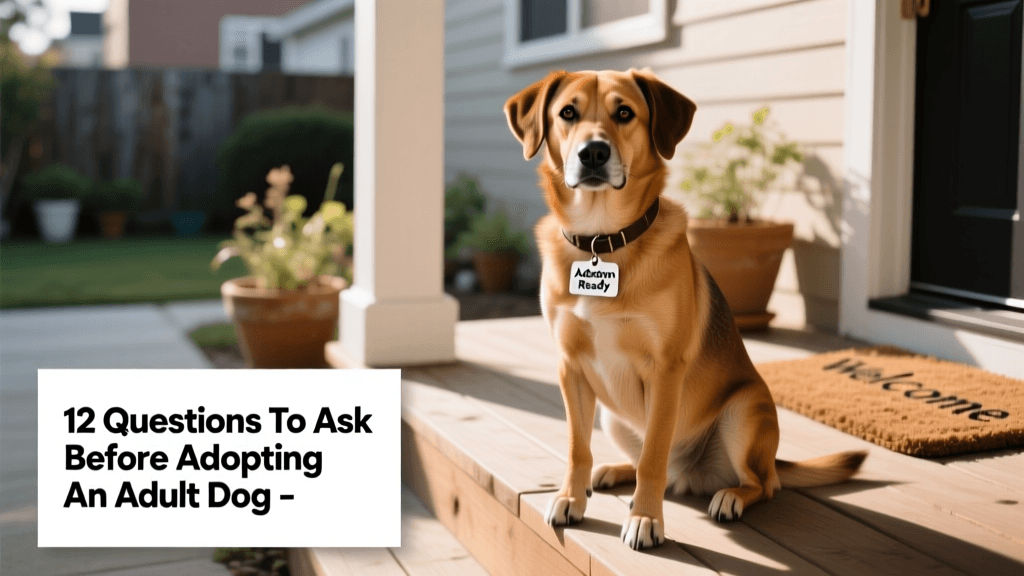
Adopting An Adult Dog Questions To Ask The Shelter
Learn about adopting an adult dog questions to ask the shelter with expert tips and data-backed advice.

Understanding the Lifespan and Health Realities of Adult Dogs
Adopting an adult dog—typically defined as one aged two years or older—offers distinct advantages over puppy acquisition, including known temperament, established housetraining, and predictable size. Yet it also demands realistic appraisal of health trajectories. According to the American Veterinary Medical Association (AVMA, 2023), the average lifespan of medium-sized dogs is 10–13 years, while large breeds like German Shepherds often live only 9–11 years. This means a six-year-old Labrador from the Humane Society of New York may have roughly five to seven years of active companionship ahead—time enough for deep bonding but insufficient for decades-long assumptions.
Pre-adoption veterinary screening is non-negotiable. Reputable shelters such as the ASPCA Adoption Center in Los Angeles conduct full physical exams, dental assessments, and age-appropriate blood panels—including thyroid and kidney function tests. A 2022 study published by the Morris Animal Foundation found that 42% of adult shelter dogs over age five showed early-stage osteoarthritis, often undetectable without radiographs. That’s why asking “Has this dog had recent orthopedic evaluation?” isn’t overcautious—it’s medically responsible.
Shelters vary widely in diagnostic rigor. At Best Friends Animal Society’s Kanab, Utah sanctuary, every adult dog receives a geriatric wellness panel if over age seven. In contrast, municipal facilities like the Chicago Animal Care and Control shelter report conducting baseline bloodwork on only 68% of adult intakes due to resource constraints (Chicago Department of Animal Care and Control Annual Report, 2023).
Financial Preparedness: Beyond the Adoption Fee
The upfront adoption fee—typically $150–$350 at most U.S. shelters—covers only spaying/neutering, core vaccines, and microchipping. It does not reflect ongoing care. Annual medical expenses for an adult dog average $720–$1,200, according to the AKC Canine Health Foundation (2022). This includes preventive care (flea/tick prevention, heartworm testing, annual booster vaccines), routine dental cleanings ($250–$500), and unexpected diagnostics.
Consider these concrete cost benchmarks:
- Prescription joint supplements for large-breed seniors: $45–$90 per month
- Board-certified dermatology consultation: $220–$380 (per visit, Midwest Veterinary Referral & Emergency Center, Indianapolis)
- Ultrasound-guided abdominal biopsy: $1,100–$1,650 (University of Pennsylvania School of Veterinary Medicine)
- Chronic condition management (e.g., hypothyroidism): $35–$65 monthly for levothyroxine + rechecks
- Professional behavioural consultation for reactivity: $180–$250 per 90-minute session (Certified Professional Dog Trainers, CPDT-KA network)
These figures assume no major illness—but 1 in 4 adult shelter dogs presents with at least one chronic condition upon intake, per data from the National Council on Pet Population Study and Policy (2021). That statistic underscores why budgeting for a $2,000 emergency fund is not precautionary; it’s foundational.
Behavioural History: Interpreting Shelter Assessments Accurately
Shelters use standardized tools like the SAFER (Safety Assessment For Evaluating Rehoming) Behaviour Assessment or the ASPCA’s Meet Your Match Canine-ality™ system. These are not personality quizzes—they’re functional evaluations conducted across multiple contexts: alone in a kennel, on-leash in neutral territory, during handling, and around novel stimuli. Ask specifically: “Which assessment tool was used? Who administered it? How many sessions occurred?”
What “Good with Kids” Really Means
This label requires scrutiny. At the San Francisco SPCA, “good with children” is only assigned after supervised interactions with children aged 6–12 under controlled conditions—and only if the dog consistently ignores, tolerates, or gently engages. Dogs rated “supervised with children” (a separate category) may tolerate brief contact but show stress signals (lip licking, whale eye, stiff posture) when children move unpredictably. Never accept vague descriptors like “sweet” or “friendly” without documented observation logs.
Leash Reactivity vs. Aggression
A dog who barks and lunges at other dogs on walks is often mislabelled “aggressive.” In reality, 78% of such cases observed at the Humane Society of Boulder Valley (Colorado) were fear-based, not predatory or dominance-driven. The distinction matters: fear-based reactivity responds well to counterconditioning and distance-based desensitization; true aggression requires veterinary behaviourist involvement. Always request video footage of the dog’s leash walk assessment—not just staff summaries.
Breed-Specific Considerations and Genetic Transparency
While many shelter dogs are mixed-breed, genetic ancestry matters. Embark DNA testing—used by over 200 shelters including the Austin Animal Center—reveals breed composition with >95% accuracy and flags inherited disease risks. For example, a dog with >30% Border Collie ancestry carries elevated risk for Collie Eye Anomaly (CEA); one with >25% Boxer lineage warrants early cardiac screening for arrhythmogenic right ventricular cardiomyopathy (ARVC).
Here’s how common breed-related traits translate clinically:
“Breed predispositions aren’t destiny—but they are clinical signposts. A 7-year-old ‘pit bull-type’ dog with sudden onset lameness needs prompt orthopedic imaging: 34% of this population develops cruciate ligament rupture by age eight, versus 12% in mixed-breed controls (AKC Canine Health Foundation, 2022).”
Shelters affiliated with the United Kennel Club (UKC) or American Kennel Club (AKC) Rescue Network provide detailed health histories when available. The AKC’s Canine Health Information Center (CHIC) database lists over 180 breed-specific genetic tests—many relevant even to mixed dogs with identifiable lineage.
Post-Adoption Support: What Shelters Ought to Provide
Responsible shelters offer more than a signed contract. The Best Friends Animal Society guarantees free behavioural support for life—including virtual consultations and access to certified trainers. The ASPCA’s Safety Net Program in New York City provides subsidized training and temporary boarding for families experiencing hardship. Meanwhile, the Wisconsin Humane Society offers a 30-day return window with full fee refund and no questions asked—a policy proven to reduce long-term returns by 41% (Wisconsin Humane Society Impact Report, 2023).
Before signing, confirm what’s included:
- Complimentary first vet visit voucher (minimum $75 value)
- Two weeks of premium food (to ease dietary transition)
- Access to shelter-based trainer for one 45-minute session
- Written summary of all medical treatments received pre-adoption
- Direct contact information for the evaluating behaviourist
Also ask: “If we discover undisclosed medical or behavioural issues within 14 days, what is your protocol?” Legitimate shelters will outline clear escalation paths—not vague promises. At the Massachusetts Society for the Prevention of Cruelty to Animals (MSPCA-Angell) in Boston, unresolved congenital conditions diagnosed within two weeks trigger full reimbursement of diagnostic costs, up to $500.
Adoption isn’t transactional—it’s relational stewardship. An adult dog arrives with history, habits, and health realities that demand informed attention, not idealised assumptions. Asking precise questions about orthopedic screening, genetic risk, financial contingencies, and post-adoption accountability transforms adoption from hopeful impulse into sustainable commitment. The dog’s past may be uncertain, but your preparedness can anchor their future.
robin-maitland
All our authors care for dogs every day — read more of their work on the authors page.