2026 Guide: Adaptive Obedience Training for Dogs With OA
Discover how to adapt obedience training and mental conditioning for dogs with osteoarthritis in 2026, featuring low-impact techniques and OA pain management.
The Intersection of Canine OA Treatment and Behavioral Training
As we navigate the landscape of dog care in 2026, the approach to canine osteoarthritis (OA) has fundamentally shifted. Osteoarthritis is a progressive, degenerative joint disease that affects a significant portion of the aging dog population, as well as younger dogs with genetic predispositions or previous orthopedic injuries. Historically, a diagnosis of severe canine OA meant a drastic reduction in a dog's physical activity, which often led to a cessation of training, mental stimulation, and behavioral conditioning. However, modern veterinary science has changed this narrative entirely.
Today, advanced OA treatments—most notably the widespread use of anti-NGF (Nerve Growth Factor) monoclonal antibody therapies like bedinvetmab (Librela)—have revolutionized pain management. According to the official Librela resource center, these monthly injections target the root cause of OA pain signaling, allowing dogs to move with a comfort level that was unimaginable a decade ago. But this medical triumph introduces a unique challenge for dog trainers and owners: a dog that feels less pain may overexert themselves, unaware of their structural joint limitations.
This is where adaptive obedience training becomes critical. Training a dog with OA in 2026 is no longer about pushing physical boundaries; it is about pivoting toward low-impact mental conditioning, modifying traditional obedience commands to protect vulnerable cartilage, and utilizing behavioral enrichment to tire the brain without stressing the joints. The WSAVA Global Pain Council emphasizes that multimodal management, which includes controlled, appropriate physical and mental exercise, is essential for maintaining muscle mass and joint stability in arthritic dogs.
Modifying Core Obedience Commands for Joint Health
Traditional obedience training relies heavily on repetitive physical movements. Commands like 'sit,' 'down,' and 'jump' require deep flexion of the hips, knees, and elbows. For a dog with compromised cartilage and synovial fluid degradation, repeatedly dropping into a sit or stand position can cause micro-traumas and inflammation, even if their pain medication is masking the immediate discomfort.
To maintain a well-behaved and engaged dog, we must substitute high-impact commands with joint-friendly alternatives. Below is a comparison chart detailing how to adapt standard obedience for the OA patient in 2026.
| Traditional Command | Joint Stress Factor | 2026 OA-Friendly Alternative | Behavioral Benefit |
|---|---|---|---|
| Sit / Sit-Stay | High hip and stifle (knee) flexion; difficulty rising | Stand-Stay or 'Settle' | Maintains handler engagement and impulse control without joint compression |
| Down / Down-Stay | Elbow and shoulder strain; requires lying flat on hard surfaces | Chin Rest on Orthopedic Mat | Lowers the dog's center of gravity and head without full body collapse |
| Recall (Running) | High impact on carpal (wrist) and tarsal (ankle) joints | Scent-Trail Recall | Engages the olfactory system, limiting high-speed physical impact |
| Agility / Jumping | Severe spinal and joint shock upon landing | Target Training (Nose Touch) | Provides intense mental fatigue and focus with zero physical impact |
Mastering the 'Stand-Stay' and 'Settle'
Teaching a 'Stand-Stay' is incredibly valuable for an arthritic dog. It is much easier for a dog with hip dysplasia or severe knee OA to remain standing than to repeatedly sit and stand. To train this, use a high-value, soft treat (like freeze-dried salmon pieces) to lure the dog's nose forward while they are already standing. Mark and reward for remaining stationary. Over time, fade the lure and introduce the verbal cue 'Stand.' Similarly, the 'Settle' command teaches the dog to relax in a standing or loosely draped position over a supportive surface, preventing the stiffness that sets in when they lie on cold or hard floors.
Low-Impact Mental Conditioning: Scent Work and Puzzles
When physical exercise is restricted due to an OA flare-up or post-injection soreness, mental conditioning must take over. The American Kennel Club notes that mental stimulation can be just as exhausting for a dog as a vigorous physical run. Scent work is the ultimate low-impact training modality for the senior or arthritic dog.
Setting Up an Indoor Scent Trail
You do not need a massive backyard to practice scent work. In 2026, indoor enrichment is a cornerstone of adaptive training. Start by purchasing a set of canine-safe essential oils (such as birch, anise, or clove) and cotton swabs. Hide the scented swab in an easy-to-reach location, like the corner of a room or under a lightweight, breathable blanket. Encourage your dog to 'find it.' Because the dog only needs to walk at a slow, deliberate pace to use their nose, the cardiovascular and orthopedic strain is minimal, yet the cognitive load is immense. A 15-minute scent work session can effectively replace a 45-minute walk in terms of caloric burn and mental satisfaction.
Interactive Puzzle Toys
Utilize advanced puzzle toys that require nose-pushing, paw-swiping, or sliding compartments rather than vigorous shaking or tossing. Snuffle mats are excellent for OA dogs, as they encourage natural foraging behaviors while keeping the dog's spine in a neutral, comfortable position. Ensure that any puzzle toy used is placed on a raised, ergonomic stand if your dog suffers from severe cervical (neck) or shoulder OA, preventing them from having to bend down to floor level.
Timing Training Sessions Around 2026 OA Medications
Understanding the pharmacokinetics of your dog's OA treatment is vital for scheduling effective training sessions. If your dog is receiving monthly anti-NGF injections, you may notice a 'wear-off' effect in the final few days before the next dose, where stiffness and reluctance to train may return. Plan your most demanding mental conditioning sessions (like learning new trick sequences or complex scent trails) for the first two weeks post-injection when joint comfort is at its peak.
For dogs on daily NSAIDs (Non-Steroidal Anti-Inflammatory Drugs) or joint supplements containing UC-II collagen and omega-3 fatty acids, schedule training sessions about 2 to 3 hours after their morning medication, once the drug has reached peak plasma concentration. Keep all training sessions in 'micro-doses'—no longer than 3 to 5 minutes at a time. This prevents the dog from holding static positions too long, which can cause joint stiffness and muscle fatigue.
Creating a Joint-Friendly Training Environment
The environment in which you train an OA dog is just as important as the commands you teach. Slipping and sliding on hardwood or tile floors is a primary cause of acute soft-tissue injuries in dogs with chronic OA. When a dog's paws splay out on a slick surface, the resulting strain on the hip adductors and shoulder ligaments can set back their mobility progress by weeks.
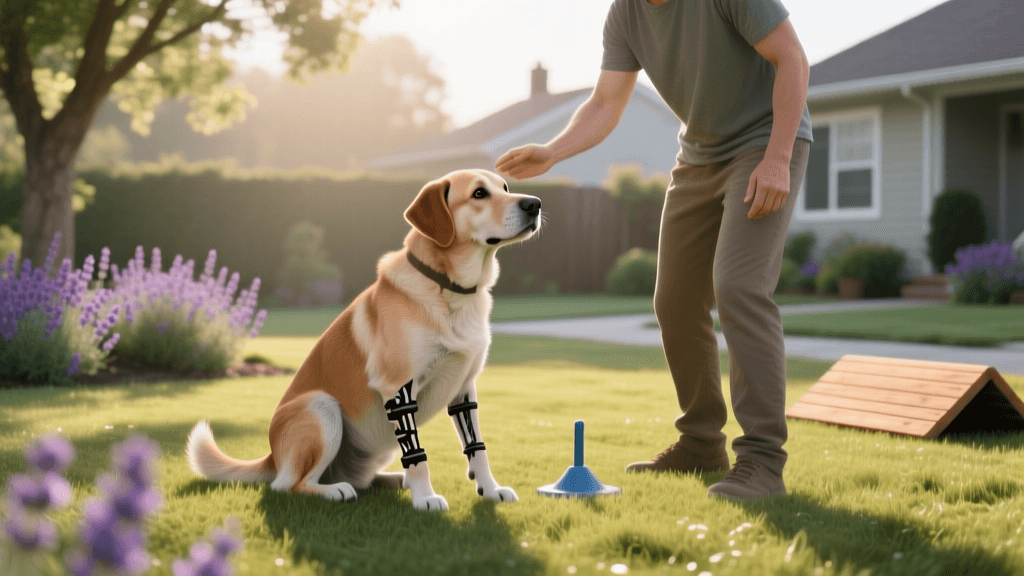
- Surface Preparation: Always train on high-traction surfaces. Use interlocking foam gym tiles, thick yoga mats, or specialized canine grip-rugs. In 2026, many owners utilize non-slip paw grips or breathable traction socks to give their dogs confidence during standing obedience drills.
- Orthopedic Support: When teaching the 'Place' command, never use a flat, thin mat. Invest in a therapeutic, multi-layer memory foam bed (such as those featuring cooling gel tops for inflamed joints) to ensure the dog associates the 'Place' command with physical relief rather than pressure-point pain.
- Temperature Control: Cold environments exacerbate joint stiffness and synovial fluid thickening. Ensure your training area is climate-controlled and warm. If training outdoors in cooler weather, utilize canine joint-wrapping thermal sleeves to keep the major joints warm and pliable during the session.
Conclusion: Training as a Pillar of Holistic OA Care
A canine osteoarthritis diagnosis in 2026 is not a reason to stop training; it is a mandate to train smarter. By adapting your obedience expectations, leveraging the power of scent work, and synchronizing your sessions with modern pain management protocols, you can preserve your dog's cognitive sharpness and behavioral manners. Training provides a vital psychological anchor for dogs who may feel frustrated by their physical limitations, proving that a strong bond and a well-conditioned mind are entirely possible, regardless of the state of their joints.
jonas-cole
All our authors care for dogs every day — read more of their work on the authors page.