Adaptive Training Techniques for Canine OA Dogs: 2026
Learn how to modify obedience training and mental enrichment for dogs with osteoarthritis in 2026 to reduce joint strain while keeping their minds sharp.
The Intersection of Canine OA and Behavioral Training
As we navigate the veterinary landscape of 2026, the treatment for canine osteoarthritis (OA) has evolved dramatically. With the widespread adoption of advanced therapies like anti-NGF monoclonal antibodies, dogs are experiencing unprecedented pain relief and mobility. However, a critical and often overlooked pillar of comprehensive OA management is behavioral conditioning and adaptive obedience training. When a dog is diagnosed with OA, their physical capabilities change, but their need for mental stimulation, structure, and bonding remains exactly the same.
Many owners mistakenly believe that a dog with OA should simply rest and avoid training altogether. This is a profound error. According to the American Kennel Club, mental stagnation in senior or mobility-impaired dogs can lead to behavioral depression, anxiety, and destructive habits born of frustration. Adaptive training serves as a vital complementary treatment for canine OA, allowing you to keep your dog's mind sharp while strictly protecting their compromised joints from biomechanical stress.
The Biomechanics of Obedience: Why Traditional Cues Hurt
Traditional obedience training was designed for able-bodied, working dogs. Commands that we consider 'basic' actually require significant joint flexion, weight-shifting, and impact. For a dog with osteoarthritis in their hips, stifles (knees), or carpal (wrist) joints, performing a standard 'sit' or 'down' can cause micro-trauma and acute pain flare-ups.
When a dog with OA refuses a command, they are rarely being 'stubborn.' They are communicating that the biomechanical cost of the movement is too high. For example, a standard 'sit' requires the dog to flex the stifle and hip joints while bearing weight on their hindquarters. A standard 'down' requires them to lower their center of gravity, which places immense strain on the elbows and shoulders. By continuing to demand these traditional movements, owners inadvertently punish their dogs for experiencing pain, which damages the human-animal bond and increases the dog's stress levels.
Adaptive Obedience: Modifying the Core Commands
To successfully train a dog with OA, we must replace high-impact physical cues with low-impact, adaptive alternatives. The goal is to achieve the same behavioral outcome—control, focus, and calmness—without requiring the dog to compromise their joint health. Below is a comparison chart of traditional cues and their 2026 adaptive alternatives.
| Traditional Cue | Biomechanical Stressor | Adaptive Alternative | Joint Benefit |
|---|---|---|---|
| Sit | Hip and stifle flexion under load | Stand / Target | Keeps joints in neutral alignment |
| Down | Elbow and shoulder impact on hard floors | Settle on Raised Cot | Eliminates impact; provides orthopedic support |
| Fetch / Retrieve | High-impact sprinting, sudden stops, jumping | Scent Work / Find It | Zero impact; burns immense cognitive energy |
| Heel (Pacing) | Sustained walking on hard surfaces | Chin Rest / Hand Target | Stationary focus; builds core stability gently |
Teaching the 'Settle' on an Orthopedic Cot
Instead of asking your dog to lie down on a hard floor, teach them to 'Settle' on a raised, orthopedic cot. Raised cots eliminate the jarring impact of lowering to the ground and getting back up. Use a cot with a supportive, memory-foam insert. Lure your dog onto the cot with a high-value treat, mark the behavior with a clicker or a verbal 'yes,' and reward them while they are standing on it. Gradually shape the behavior so they lower themselves onto the cot at their own pace. Never force or physically push a dog with OA into a down position.
Hand Targeting to Replace the 'Heel'
Hand targeting (teaching your dog to touch their nose to your palm) is a phenomenal adaptive tool. It allows you to guide your dog's movement, turn their head, and shift their weight gently without using a leash to apply physical pressure to their cervical spine. This is particularly useful for guiding them onto non-slip ramps or into vehicles without requiring them to jump.
Cognitive Enrichment as a Complementary OA Treatment
Physical exercise is heavily restricted for dogs with severe OA, but cognitive exercise is not. In fact, veterinary behaviorists emphasize that 15 minutes of intense scent work can tire a dog out just as effectively as a 45-minute run, making it a cornerstone of OA behavioral treatment.
Box Search Scent Work
Set up a 'box search' in your living room using a dozen small cardboard boxes. Hide a strong-smelling treat or a specific scent article (like a cotton swab with a drop of birch essential oil) in one of the boxes. Encourage your dog to use their nose to find the target. This requires slow, deliberate walking and mental problem-solving. It keeps the dog's brain highly engaged, releasing dopamine and endorphins that act as natural pain modulators, all while keeping their heart rate and joint impact low.
Adaptive Puzzle Toys
When selecting puzzle toys for a dog with OA, avoid toys that require heavy pawing, scratching, or aggressive biting, as these actions strain the carpal joints and the temporomandibular joint (TMJ). Instead, opt for snuffle mats, lick mats, and foraging boxes. In 2026, many owners use freeze-dried raw toppers spread thinly over textured silicone lick mats. The repetitive licking action is highly soothing for dogs and promotes salivation, which aids in digestion and reduces systemic stress hormones.
Setting Up a Joint-Friendly Training Environment
The environment in which you train your dog with OA is just as important as the commands you use. Slippery floors are the enemy of osteoarthritic joints. When a dog's paws slip, their adductor and abductor muscles spasm in an attempt to stabilize the joint, leading to severe secondary muscle soreness.
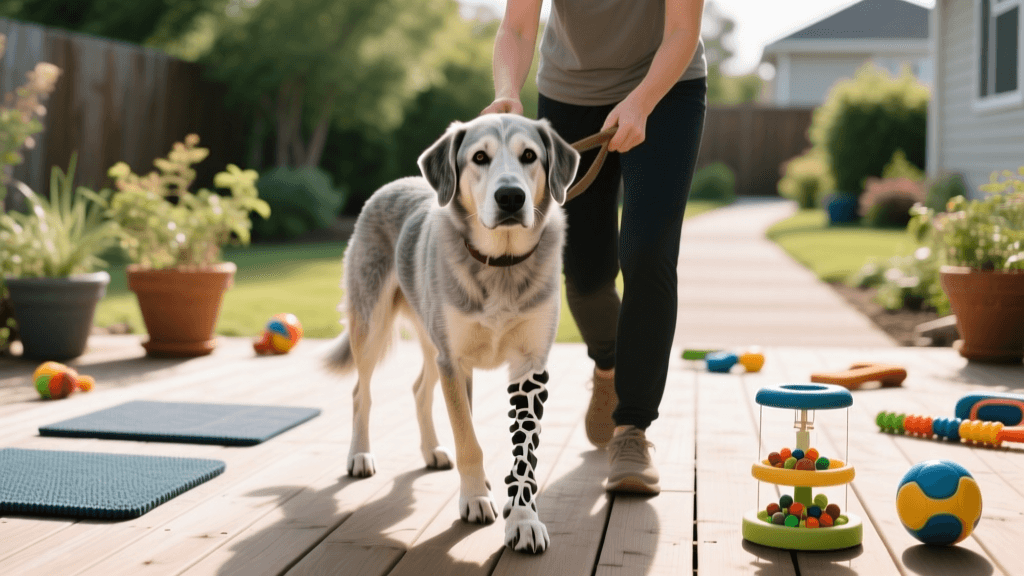
Before initiating any training session, ensure the area is covered with high-traction surfaces. Interlocking foam mats with faux-wood finishes or specialized PVC-coated polyester runners are excellent choices for creating a safe training zone in your home. Furthermore, consider the height at which you deliver treats. Bending down to eat from the floor or reaching up high requires neck and spinal flexion. Deliver treats directly at your dog's muzzle level, or use a raised, elevated treat bowl for 'place' command rewards to keep their cervical spine in a neutral, pain-free position.
Recognizing Micro-Expressions of Pain During Sessions
Even with adaptive techniques, you must remain vigilant for signs of pain. The Texas A&M College of Veterinary Medicine notes that dogs are masters at masking chronic pain. During training, watch for micro-expressions that indicate discomfort. These include:
- Whale Eye: Showing the whites of their eyes when asked to turn their head.
- Lip Licking and Yawning: Displacement behaviors that signal stress or physical discomfort.
- Trembling: Fine muscle tremors in the hindquarters when holding a standing position.
- Refusal to Take Treats: A sudden loss of appetite for high-value rewards is a primary indicator of acute pain overriding the drive to eat.
If you observe any of these signs, end the training session immediately on a positive note. Ask for a simple, pain-free behavior like a 'look' or a 'chin rest,' reward generously, and allow your dog to rest. The ASPCA advises that senior and mobility-impaired dogs thrive on short, 3-to-5-minute micro-training sessions rather than prolonged 20-minute drills.
Conclusion: Training as Therapy
Treating canine osteoarthritis in 2026 requires a holistic approach that goes beyond pharmaceuticals and joint supplements. By modifying your obedience training techniques, embracing cognitive enrichment, and curating a joint-friendly environment, you provide your dog with a vital sense of purpose and joy. Adaptive training is not just about maintaining manners; it is a profound act of empathy that honors your dog's physical limitations while celebrating their enduring intelligence and spirit.
anouk-beaumont
All our authors care for dogs every day — read more of their work on the authors page.