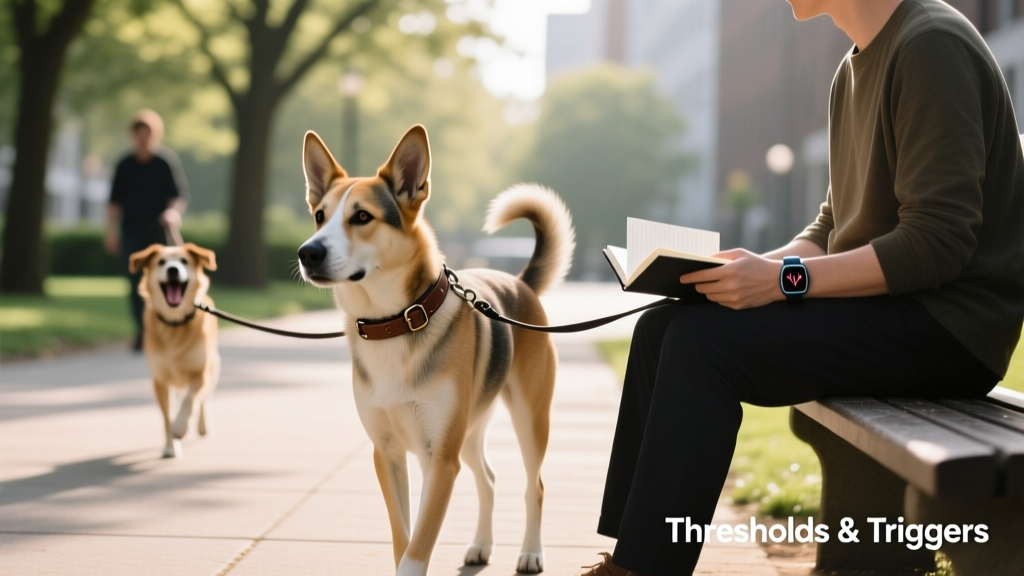
10 Tricks to Teach Dogs That Actually Solve Behavior Problems
Discover 10 tricks to teach dogs that double as behavior modification tools.

If you've ever searched for "tricks to teach dogs" hoping for a cute party trick, you're not alone — but here's what most trainers know and rarely say out loud: the best tricks aren't just entertaining. They're functional behavior modification tools disguised as fun. Teaching your dog to spin, target, or settle on a mat isn't just about impressing guests. These exercises build impulse control, redirect anxiety, and give reactive or bored dogs a job that replaces the problem behavior you're actually trying to fix.
After years of working with dog owners frustrated by leash pulling, door-dashing, counter-surfing, and separation distress, I've seen the same pattern: dogs who learn structured tricks improve faster than dogs who only get corrective training. The reason is rooted in canine behavioral science — tricks activate the prefrontal cortex, build confidence in fearful dogs, and create a communication system between you and your dog that makes every other training goal easier.
This guide covers 10 specific tricks to teach dogs that serve double duty as behavior solutions, complete with step-by-step protocols, timeline expectations, and the science behind why they work.
What Qualifies as a Behavior Problem vs. Normal Dog Behavior
Behavior Problem Threshold: A dog behavior crosses from "normal" to "problem" when it meets one or more of these criteria:
- Frequency: Occurs more than 3-4 times per week in predictable patterns
- Intensity: Causes property damage exceeding $20-50 per incident, injury to humans or other animals, or self-injury
- Duration: Persists beyond 10-15 minutes without the dog self-settling
- Context spread: Appears in 3+ different environments (not just one trigger location)
- Quality of life impact: Prevents the dog or household from engaging in normal activities (walks, visitors, car rides)
Normal dog behaviors that are often mislabeled as problems: occasional barking at the door, digging in one yard spot, chewing appropriate toys, brief excitement jumping on familiar people, and sniffing on walks.
Understanding where your dog falls on this spectrum matters because the tricks and protocols below work differently for a mildly bored dog versus one with clinical anxiety or fear-based reactivity. A dog who counter-surfs twice a week needs a different approach than one who has developed resource guarding around food.
Root Cause Analysis: Why Your Dog Acts Out
Before teaching any trick as a behavior intervention, you need to identify what's driving the problem. Most unwanted behaviors trace back to one of these five root causes:
| Root Cause | Common Signs | Behaviors It Produces | Which Tricks Help Most |
|---|---|---|---|
| Boredom / Understimulation | Excessive chewing, digging, pacing, shadow chasing, vocalizing when left alone | Destructive behavior, counter-surfing, escaping yards | Targeting, fetch shaping, puzzle-based tricks |
| Fear / Anxiety | Lip licking, yawning, whale eye, trembling, hiding, startle responses | Reactivity on leash, hiding from visitors, noise phobia | Mat settle, eye contact, emergency U-turn |
| Lack of Impulse Control | Pulls toward everything, grabs food, jumps on people, bolts through doors | Door-dashing, leash pulling, jumping, snatching | Wait/release, leave-it, go-to-mat |
| Territorial / Protective | Alert barking, fence running, lunging at passing dogs, blocking doorways | Reactivity at windows/fences, aggression toward visitors | Quiet cue, go-to-place, recall away from triggers |
| Medical / Pain-Based | Sudden behavior change, reluctance to perform known cues, irritability when touched | Aggression, house soiling, refusal to lie down, restlessness | N/A — requires veterinary treatment first |
According to a 2024 study published in the Journal of the American Veterinary Medical Association, approximately 20-25% of behavior referrals in general practice have an underlying medical component that must be addressed before behavioral modification can succeed. Skipping this step is the most common reason "nothing works."
Medical Rule-Out: See Your Vet Before Training
Always consult your veterinarian before beginning a behavior modification plan if your dog shows any of the following red flags. Pain, endocrine disorders, and neurological issues can mimic or worsen behavioral problems — and no trick will fix a dog who hurts.
See your vet FIRST if your dog displays:
- ☐ Sudden onset aggression in a previously friendly dog (rule out pain, hypothyroidism, cognitive dysfunction)
- ☐ New house soiling in a previously house-trained adult (rule out UTI, kidney disease, Cushing's disease, diabetes)
- ☐ Reluctance to lie down or perform "down" position (rule out hip dysplasia, arthritis, IVDD)
- ☐ Compulsive behaviors like flank sucking, tail chasing for 30+ minutes (rule out neurological issues, GI discomfort)
- ☐ Restlessness and inability to settle especially at night (rule out cognitive dysfunction in seniors 8+, pain)
- ☐ Fear responses that appeared suddenly without a known traumatic event (rule out vision/hearing loss, thyroid dysfunction)
- ☐ Any behavior change in dogs over 7 years old — age-related conditions are a frequent hidden cause
Typical diagnostic workup costs: Blood panel ($150-$300), urinalysis ($40-$80), thyroid panel ($80-$150), orthopedic exam with X-rays ($250-$600). Your vet will determine which tests are appropriate.
I once worked with a family whose 6-year-old Lab had started growling when the kids hugged him. They thought it was dominance. A veterinary exam revealed bilateral hip dysplasia with significant arthritis pain. Two weeks of anti-inflammatory medication and the growling stopped entirely. No trick training needed — the dog wasn't being aggressive; he was hurting.
10 Tricks to Teach Dogs That Solve Real Behavior Problems
Each trick below targets a specific behavioral issue. These aren't random party tricks — they're chosen for their therapeutic value in behavior modification programs.
Trick 1: "Go to Your Mat" (Settle on a Place)
Behavior it addresses: Door-dashing, jumping on guests, begging at the table, anxiety pacing
Why it works: Gives the dog a default incompatible behavior — they physically cannot jump on guests while lying on a mat 10 feet away. Builds duration settling, which is the foundation for impulse control.
Step-by-step protocol:
- Place a specific mat (use the same one every time — a folded towel or a Kuranda cot works well) on the floor. The mat itself becomes the cue.
- When your dog steps onto the mat with all four paws, click/mark and treat. Repeat 10-15 times in a 3-minute session.
- Add a verbal cue ("Place" or "Mat") just before they step on. Mark and treat for compliance.
- Begin adding duration: wait 2 seconds before marking, then 5 seconds, then 10. Use a release word like "Free" to end the behavior.
- Once your dog reliably stays for 30 seconds, begin adding distance — step 2 feet away, return, reward on the mat.
- Add distractions gradually: drop a toy nearby, have someone walk past, ring the doorbell.
Timeline: Most dogs learn the basic mat behavior in 5-7 days of two 5-minute daily sessions. Reliable duration of 5+ minutes with household distractions typically takes 3-4 weeks.
Pro tip: Feed your dog's meals on the mat during the learning phase. This builds a strong positive association and makes the mat a "good things happen here" location.
Trick 2: "Look at Me" (Eye Contact on Cue)
Behavior it addresses: Leash reactivity, fear-based responses, distraction from triggers
Why it works: A dog making eye contact with their handler cannot simultaneously fixate on a trigger (another dog, a jogger, a squirrel). This is the foundation of counter-conditioning protocols for reactive dogs.
Step-by-step protocol:
- Hold a treat at your dog's nose, then slowly move it up to your eye level. The moment your dog makes eye contact (even accidentally), mark and reward.
- Repeat 20 times. Your dog will begin offering eye contact without the treat lure.
- Add the verbal cue "Watch" or "Look" just before the behavior.
- Practice in increasingly distracting environments: kitchen → living room → backyard → front yard → sidewalk.
- For reactive dogs: practice at a distance from triggers where your dog notices but doesn't react (this is their "threshold distance" — typically 30-50 feet for dog-reactive dogs). Ask for "Look," reward generously.
- Gradually decrease the distance to triggers over weeks, not days, as the dog succeeds.
Timeline: Basic eye contact in low-distraction environments: 3-5 days. Reliable use as a reactivity management tool in real-world settings: 6-10 weeks of consistent practice.
Trick 3: "Leave It" (Impulse Control)
Behavior it addresses: Counter-surfing, food snatching, grabbing items on walks, resource guarding precursors
Why it works: Directly builds the neurological "pause" between stimulus and response. Dogs with impulse control problems literally lack the trained inhibition to stop themselves — this trick builds that circuit.
Step-by-step protocol:
- Place a low-value treat on the floor and cover it with your hand. When your dog stops pawing/nosing at your hand and pulls back even slightly, mark and reward with a DIFFERENT, higher-value treat from your other hand.
- Once reliable, uncover the treat but keep your hand hovering. Mark and reward from your other hand when they look away from the floor treat.
- Add the verbal cue "Leave it" before presenting the covered treat.
- Progress to standing upright: drop a treat, say "Leave it," reward from your hand if they don't go for it.
- Generalize to real-world items: shoes, children's toys, dropped food, outdoor debris.
- Never let the dog have the "leave it" item — always reward with something else. This prevents the trick from becoming a "wait for permission" cue that can backfire with high-value items.
Timeline: Basic leave-it with covered treats: 3-7 days. Reliable leave-it with uncovered food on the floor: 2-3 weeks. Real-world generalization: 4-6 weeks.
Trick 4: Emergency U-Turn ("Let's Go!")
Behavior it addresses: Leash reactivity, fence fighting, charging at triggers, prey drive chasing
Why it works: Creates a pre-trained escape route that moves the dog away from a trigger while pairing the movement with high-value rewards. This is a desensitization management tool that prevents rehearsal of reactive behavior.
Step-by-step protocol:
- With your dog on leash, say "Let's Go!" in an upbeat tone, then immediately turn 180 degrees and jog 5-6 steps away.
- When your dog catches up to you, reward with a high-value treat (real chicken, cheese, hot dog — something worth turning away from a trigger for).
- Practice 10-15 times per session in boring environments until the turn becomes automatic.
- Begin practicing when mild triggers are present at a distance — a person walking 40 feet away, a dog across the street.
- Deploy BEFORE your dog reacts. The goal is to turn away while the dog has noticed the trigger but hasn't begun barking/lunging.
Timeline: Reliable in low-distraction settings: 5-7 days. Effective as a real-world reactivity management tool: 3-4 weeks.
Trick 5: "Touch" (Hand Targeting)
Behavior it addresses: Fear of handling, reluctance to move, jumping on people (redirect), anxiety in new environments
Why it works: Hand targeting gives a fearful or anxious dog a clear, simple job that builds confidence. It's also used by veterinary behaviorists to redirect dogs away from unwanted targets (people, furniture) without physical force.
Step-by-step protocol:
- Hold your flat palm 2-3 inches from your dog's nose. Most dogs will sniff it. The instant their nose touches your palm, mark and treat.
- Repeat 15-20 times until the dog bumps your hand confidently.
- Add the verbal cue "Touch" before presenting your hand.
- Begin moving your hand to different positions: higher, lower, to the side, behind your leg. This teaches the dog to follow the target anywhere.
- Use "Touch" to guide your dog onto a scale at the vet, into a car, off furniture, or away from guests — all without grabbing or pushing.
- For jumpers: present your hand low (knee height) when guests arrive. The dog touches your hand instead of jumping on the person.
Timeline: Basic touch: 1-3 days. Using it as a handling and redirect tool: 2-3 weeks.
Trick 6: "Quiet" (Bark on Cue, Then Stop)
Behavior it addresses: Excessive alert barking, demand barking, barking at windows/fences
Why it works: Paradoxically, teaching a dog to bark on cue gives you stimulus control over the behavior. Once barking is "on command," the dog learns that silence also has a cue and a reward.
Step-by-step protocol:
- Identify what reliably triggers your dog's bark (doorbell, knocking, someone saying "Who's there?").
- Trigger the bark, say "Speak!" as they bark, mark and reward.
- After 5-10 sessions, your dog will bark when you say "Speak." Now add the "Quiet" cue: say "Speak," let them bark 2-3 times, then say "Quiet" and hold a treat at their nose. The sniffing interrupts the bark. Mark the silence and reward.
- Gradually increase the duration of silence before rewarding: 2 seconds, 5 seconds, 10 seconds.
- Practice in real contexts: when the mail carrier arrives, when neighbors pass the yard.
Timeline: "Speak" on cue: 5-10 sessions. Adding "Quiet" reliably: 2-3 additional weeks. Real-world application: 4-6 weeks total.
Trick 7: "Find It" (Scent Work / Nose Targeting)
Behavior it addresses: Boredom-based destruction, separation anxiety, fear of new environments, high-energy dogs who need mental exercise
Why it works: Scent work activates a dog's olfactory system, which consumes significant mental energy — research suggests 15-20 minutes of structured nose work can tire a dog as much as a 60-minute walk. It also builds confidence in fearful dogs because sniffing is a naturally calming, self-reinforcing behavior.
Step-by-step protocol:
- Start with your dog watching you place a treat under one of three identical cups. Say "Find it!" and let them knock over the cup to get the treat.
- Progress to hiding treats while your dog waits in another room. Start with obvious placements (on a rug corner, behind a table leg).
- Increase difficulty: hide treats on elevated surfaces, inside boxes, under blankets, in different rooms.
- For separation anxiety: set up a "Find it" scatter of 10-15 treats around the living room right before you leave. This creates a positive departure ritual.
- For bored dogs: use "Find it" as a meal replacement — hide their kibble around the yard instead of feeding from a bowl.
Timeline: Basic cup game: 1-2 sessions. Room-level searching: 1 week. Advanced hides: 3-4 weeks.
Trick 8: "Wait" at Thresholds (Door Manners)
Behavior it addresses: Door-dashing, bolting out gates, car door escapes, leash pulling through doorways
Why it works: Thresholds (doors, gates, car doors) are high-arousal locations. Teaching "Wait" creates a mandatory pause that prevents the rehearsal of bolting behavior and reduces the adrenaline spike that leads to leash pulling immediately after exiting.
Step-by-step protocol:
- With your dog on leash, approach a closed door. Say "Wait." Place your hand on the doorknob. If your dog moves forward, remove your hand and step back. Try again.
- Open the door 1 inch. If the dog moves forward, close the door immediately (don't slam — just close it). Repeat until the dog stays still with the door cracked open.
- Open the door fully. Reward the dog for remaining in place.
- Add a release cue: "Okay, let's go!" and walk through together on leash.
- Practice at every exterior door, the car door, and any gate your dog regularly passes through.
- Never let the dog bolt through a door unrewarded during training — every threshold is a training opportunity.
Timeline: Basic wait at one door: 5-7 days. Generalized to all household thresholds: 2-3 weeks.
Trick 9: "Spin" and "Twist" (Body Awareness)
Behavior it addresses: Clumsiness, body awareness deficits, anxiety in tight spaces, warm-up for agility or therapy work
Why it works: Directional spinning teaches proprioception — the dog's awareness of where their body is in space. This is particularly valuable for large-breed puppies, senior dogs, and dogs who are nervous about physical manipulation.
Step-by-step protocol:
- Hold a treat at your dog's nose and slowly lure in a clockwise circle. Mark and reward when they complete the turn. Add the cue "Spin."
- Repeat counterclockwise with the cue "Twist."
- Fade the lure: use just a hand signal, then add distance so the dog spins 2 feet away from you.
- Chain multiple spins, alternate directions, and use as a warm-up before walks or training sessions.
- For anxious dogs: use "Spin" as a calming reset between stressful events (after a vet exam, after a loud noise).
Timeline: Lured spin: 1-2 sessions. Independent spin on verbal cue: 1 week. Chained and generalized: 2 weeks.
Trick 10: "Shake" / "Paw" (Handling Desensitization)
Behavior it addresses: Paw sensitivity, resistance to nail trims, fear of handling, veterinary exam anxiety
Why it works: Many dogs who resist nail trims or veterinary paw handling were never taught that having their feet touched predicts good outcomes. Teaching "Shake" reframes paw handling as a game with rewards.
Step-by-step protocol:
- Touch your dog's paw briefly (0.5 seconds). Mark and treat. Repeat 10 times with each paw.
- Gradually increase contact duration: hold the paw for 1 second, 2 seconds, 3 seconds.
- Lift the paw slightly off the ground. Mark and treat.
- Add the cue "Shake" and offer your hand. Most dogs will place their paw in your hand after 5-10 sessions.
- Progress to gently squeezing individual toes (simulating nail trimming pressure). Reward generously.
- Introduce the nail clipper: touch it to the paw without clipping, reward. Progress to clipping one nail per session.
Timeline: Comfortable paw handling: 1-2 weeks. Tolerating nail trims: 3-5 weeks of daily desensitization. Dogs with severe paw sensitivity or prior traumatic nail trim experiences may need 6-8 weeks.
Immediate Management: Preventing Rehearsal While Training
Every time your dog performs a problem behavior — every bark at the window, every counter-surf, every door-dash — the neural pathway for that behavior gets stronger. This is called "rehearsal" in behavioral science, and it's the single biggest reason training plans fail. You can't just train for 10 minutes a day while letting the dog practice the unwanted behavior the other 23 hours and 50 minutes.
Management strategies by behavior type:
| Problem Behavior | Immediate Management Tool | Estimated Cost | Why It Works |
|---|---|---|---|
| Counter-surfing | ScatMat (SSC-100 model) or tin foil on counters; never leave food unattended | $35-$50 | Removes the reward (food access) that reinforces the behavior |
| Window/fence barking | Apply opaque window film (Frost King brand); close blinds; block fence sightlines | $15-$40 | Eliminates the visual trigger that sparks the barking cycle |
| Door-dashing | Baby gate at entryway (Regalo Easy Step, 28-42 inch); leash attached to anchor near door | $30-$55 | Physical barrier prevents the rehearsal of bolting |
| Destructive chewing | Confine to chew-proof area when unsupervised; use Kong Classic (red, size-appropriate) stuffed with frozen food | $12-$25 per Kong | Redirects chewing to appropriate items while removing access to forbidden ones |
| Leash reactivity | Walk during low-traffic hours (before 7am or after 9pm); use a front-clip harness (Ruffwear Front Range) | $35-$45 for harness | Reduces trigger encounters while training the "Look" and "Let's Go" cues |
| Separation anxiety | Adaptil DAP diffuser; leave on calming music (Through a Dog's Ear playlist); hire midday dog walker | $25-$45 for diffuser, $15-$25/walk | Reduces cortisol levels and breaks up the alone-time duration |
Tools That Help vs. Tools to Avoid
| Category | Recommended Tools | Why They Work |
|---|---|---|
| Food Delivery | Kong Classic, West Paw Toppl, Snuffle Mat, Kong Wobbler | Extend feeding time to 15-30 minutes, providing mental stimulation that reduces boredom-based behaviors |
| Calming Aids | Adaptil DAP diffuser, ThunderShirt, L-theanine supplements (e.g., Virgil Anxitane) | Evidence-supported calming effects; DAP mimics maternal pheromones, L-theanine promotes relaxation without sedation |
| Training Equipment | Front-clip harness (Ruffwear Front Range), 6-foot leather leash, treat pouch (Dog Treat Training Pouch), clicker (Karen Pryor i-Click) | Force-free tools that give you control without pain or fear |
| Mental Exercise | Nina Ottosson puzzle toys (Level 1-3), frozen stuffed Kongs, scent work kits | Cognitive engagement that tires dogs mentally, reducing energy available for problem behaviors |
| Category | Tools to AVOID | Why They're Harmful |
|---|---|---|
| Electronic Collars | Shock collars, vibration collars used as punishment, spray collars | A 2020 study by the ASPCA-cited research in Applied Animal Behaviour Science found e-collars increase cortisol, create negative associations with handlers, and can escalate aggression rather than reduce it |
| Physical Corrections | Prong collars, choke chains, alpha rolls, leash jerks | Suppress behavior without addressing root cause; risk of tracheal damage, increased fear, and redirected aggression |
| Dominance-Based Methods | "Being the alpha," eating before your dog, walking through doors first as hierarchy | Based on debunked wolf-pack hierarchy research; the AVMA does not support dominance theory as a training framework |
Realistic Timeline: How Long Will Behavior Change Take?
| Phase | Timeframe | What to Expect | Common Mistakes |
|---|---|---|---|
| Management Phase | Days 1-7 | Problem behavior decreases because triggers are blocked. Dog may test boundaries more initially (extinction burst). | Assuming the problem is "fixed" because management is working — management is not training |
| Foundation Training | Weeks 1-3 | Dog learns basic trick cues in low-distraction environments. You'll see success in practice sessions but not yet in real-world triggers. | Trying to use tricks in real-world situations before the dog has mastered them at home |
| Generalization | Weeks 3-6 | Dog begins performing cues in mildly distracting environments. First successful real-world applications. Some regression is normal. | Inconsistency — skipping practice days or rewarding the problem behavior accidentally |
| Proofing | Weeks 6-12 | Reliable responses in most environments. Dog begins to offer the trained behavior as a default. You can start fading management tools gradually. | Removing management too quickly and allowing rehearsal of old behavior |
| Maintenance | Ongoing | Behavior is established but requires periodic reinforcement. Some dogs need lifelong management for high-intensity triggers. | Stopping all training and expecting permanent results without maintenance |
A critical point most online guides skip: behavior timelines vary enormously by individual dog, severity, and consistency of the owner's implementation. A mildly bored counter-surfer might improve in 2 weeks. A dog with genuine separation anxiety may need 3-6 months of structured work, possibly combined with veterinary-prescribed anti-anxiety medication. If you're not seeing measurable improvement after 4 weeks of consistent daily practice, it's time to reassess the approach or get professional help.
When to Hire a Professional: Trainer vs. Behaviorist
Hire a Certified Professional Dog Trainer (CPDT-KA or CPDT-SA) when:
- Your dog's problem is mild to moderate and you need guidance on technique
- You're struggling with timing, mechanics, or consistency
- You want group class socialization for a puppy or adolescent dog
- Typical cost: $60-$120 per private session; $150-$300 for a 6-week group class
Hire a Certified Applied Animal Behaviorist (CAAB) or Veterinary Behaviorist (DACVB) when:
- Your dog has bitten a person or another animal (especially if the bite broke skin)
- Aggression is escalating in frequency or intensity
- Separation anxiety causes self-injury (bloody paws, broken teeth from crate escape attempts)
- The problem has not improved after 4-6 weeks of consistent training
- Medication may be needed alongside behavior modification
- Typical cost: $200-$500 for initial consultation; $100-$250 per follow-up session
Credential verification: Look for certifications from the Certification Council for Professional Dog Trainers (CCPDT), the Animal Behavior Society (CAAB), or the American College of Veterinary Behaviorists (DACVB). Avoid trainers who cannot name a certifying body or who advertise "balanced" methods without specifying what that means.
Prevention: Starting Right with Puppies and Newly Adopted Dogs
The most cost-effective behavior plan is one you never have to implement because the problems were prevented from forming. Whether you're bringing home an 8-week-old puppy or a 3-year-old rescue, these foundational steps reduce the likelihood of developing the behaviors addressed above:
- Structured enrichment from day one: Feed all meals through puzzle toys, snuffle mats, or training sessions — never from a bowl. This prevents the boredom that drives 60-70% of common behavior problems.
- Threshold manners before freedom: Practice "Wait" at every door and gate from the first week. Don't give full house access until the dog reliably waits at thresholds.
- Handling desensitization: Touch paws, ears, mouth, and tail daily while rewarding. Pair every grooming tool (brush, nail clipper, toothbrush) with treats before you actually use them.
- Socialization window utilization (puppies 8-16 weeks): Expose to 100+ novel surfaces, sounds, people types, and environments before 16 weeks. Use the AKC Puppy Socialization Checklist as a guide.
- Alone-time training: Start with 5-minute departures and build up. Never leave a new dog alone for 8 hours on their first day — this is a primary trigger for separation anxiety development.
- Consistent rules from all household members: If one person allows jumping and another scolds for it, the dog learns that jumping works sometimes (intermittent reinforcement — the strongest reinforcement schedule for maintaining a behavior).
Frequently Asked Questions
Why does my dog keep doing the behavior even though I scold them?
Scolding is often interpreted by dogs as attention — and any attention can be reinforcing for a dog who is bored or attention-seeking. Even "negative" attention (yelling, pushing away) is better than no attention for many dogs. Additionally, scolding doesn't teach the dog what TO do instead. The tricks above replace the unwanted behavior with an incompatible alternative that earns positive reinforcement.
How do I stop my dog from doing the behavior when I'm not home?
You can't train a dog who isn't present — so management is your primary tool for alone-time behaviors. Use confinement (crate, exercise pen, dog-proofed room), remove access to triggers (close blinds, put away food), and provide enrichment (frozen Kongs, puzzle feeders, snuffle mats). For separation anxiety specifically, a structured desensitization protocol for departures is necessary, often combined with calming aids like Adaptil diffusers.
Is this behavior normal for my dog's breed?
Breed tendencies are real — herding breeds nip, terriers dig, hounds follow scents, and livestock guardians bark at night. However, "normal for the breed" doesn't mean "acceptable in your household." The tricks above work WITH breed tendencies rather than against them. For example, "Find It" channels a hound's scent drive into a structured game, and "Go to Mat" gives a herding dog a job (settling in one spot) that satisfies their need for a task.
How long will it take to fix the problem behavior?
Realistic timelines range from 2 weeks for mild impulse control issues (counter-surfing, door-dashing) to 3-6 months for fear-based reactivity or separation anxiety. Dogs with trauma histories or medical comorbidities may need longer. The single biggest factor is your consistency — daily 5-10 minute practice sessions outperform weekly hour-long sessions. If you're not seeing measurable progress after 4 weeks, consult a professional to assess whether the training plan, the diagnosis, or the management needs adjustment.
Should I use punishment to correct the behavior?
Force-free, positive reinforcement methods are the recommended standard by the AVMA, the American College of Veterinary Behaviorists, and the ASPCA. Punishment-based methods (shock collars, prong collars, alpha rolls, physical corrections) suppress behavior temporarily without addressing the underlying cause and carry documented risks including increased aggression, fear escalation, and damage to the human-dog bond. The tricks in this guide use differential reinforcement — rewarding what you want — which produces more reliable, longer-lasting results without side effects.
When do I need a professional behaviorist instead of a regular trainer?
Seek a certified applied animal behaviorist (CAAB) or veterinary behaviorist (DACVB) if your dog has bitten someone (especially a child), shows escalating aggression, self-injures when left alone, or has not improved after 4-6 weeks of consistent training. Veterinary behaviorists can prescribe anti-anxiety medications (fluoxetine, clomipramine, trazodone) that, combined with behavior modification, significantly improve outcomes for dogs with clinical anxiety or aggression. A general trainer is appropriate for mild to moderate issues like jumping, pulling, barking, and basic impulse control.
Aaron Whyte
All our authors care for dogs every day — read more of their work on the authors page.