Training Tips for Dogs: A Complete Guide to Raising a
Discover proven training tips for dogs that work. From basic commands to common mistakes, this comprehensive guide helps you build a stronger bond with.
Training Tips for Dogs: A Complete Guide to Raising a Well-Behaved Pup
Every dog owner dreams of a companion who listens, behaves, and walks calmly by their side. Yet the journey from a rambunctious pup—or even a stubborn adult dog—to a well-mannered canine citizen can feel overwhelming. With so many methods, philosophies, and opinions floating around, it is easy to feel lost about where to start or how to keep going when progress stalls.
The good news is that effective dog training does not require a professional background in animal behavior. It requires patience, consistency, and a solid understanding of how dogs learn. Whether you are bringing home your first puppy or trying to teach an old dog new tricks, the principles remain remarkably similar. Dogs thrive on clear communication, positive reinforcement, and structured routines that help them understand what is expected of them.
This comprehensive guide walks you through the most effective training tips for dogs, covering everything from foundational commands to advanced behavioral strategies. You will find practical, step-by-step advice that you can start using today, along with insights into common pitfalls that slow progress. By the end of this article, you will have a clear roadmap for building a stronger, more cooperative relationship with your four-legged friend.
Before diving in, it is worth noting that training is not just about obedience—it is about communication. When you invest time in training your dog, you are not simply teaching commands. You are building a shared language that makes life safer, more enjoyable, and more fulfilling for both of you. For breed-specific insights that can inform your training approach, explore our complete breed guides to understand your dog's natural instincts and tendencies.
Building a Strong Foundation: The Core Principles of Dog Training
Before you teach your dog a single command, it is essential to understand the principles that make training work. These foundational concepts apply to every dog regardless of breed, age, or temperament. Mastering them will make every subsequent training session more productive and less frustrating.
Positive Reinforcement: The Science Behind What Works
Positive reinforcement is the cornerstone of modern dog training, and for good reason. Decades of behavioral science have demonstrated that rewarding desired behaviors is significantly more effective than punishing unwanted ones. When your dog performs an action and receives something pleasant—whether that is a treat, verbal praise, a favorite toy, or physical affection—their brain creates a positive association with that behavior. Over time, they will repeat the behavior to earn the reward again.
The key to effective positive reinforcement lies in timing. Rewards must be delivered within one to two seconds of the desired behavior for your dog to make the connection. If you ask your dog to sit and they comply, but you take five seconds to fumble through a treat bag, the moment is lost. Your dog may associate the reward with whatever they were doing at the exact moment the treat arrived, rather than the sit you asked for.
Here is a step-by-step approach to using positive reinforcement effectively:
- Identify high-value rewards. Not all treats are created equal. Experiment with different options—small pieces of chicken, cheese, commercial training treats, or even a favorite game of tug—to discover what motivates your dog most.
- Keep rewards small and quick to consume. Training treats should be pea-sized so your dog can eat them rapidly and refocus on the next task without spending time chewing.
- Mark the behavior precisely. Use a consistent marker word like "yes" or a clicker to pinpoint the exact moment your dog performs the desired action, then follow immediately with the reward.
- Gradually vary the rewards. Once a behavior is well-established, begin mixing high-value and low-value rewards. This variable reinforcement schedule actually strengthens the behavior over time, much like a slot machine keeps players engaged.
- Phase out food rewards gradually. As behaviors become reliable, replace some food rewards with verbal praise, petting, or life rewards like being allowed to go outside or greet another dog.
Consistency: The Secret Ingredient Most Owners Overlook
If positive reinforcement is the engine of dog training, consistency is the steering wheel. Without it, even the best techniques will lead you in circles. Dogs do not generalize well, which means a rule that applies sometimes but not others is essentially no rule at all from your dog's perspective.
Consistency must be maintained across several dimensions:
- Verbal cues: Everyone in the household must use the exact same command words. If one person says "down" to mean "get off the couch" and another uses it to mean "lie down," your dog will be perpetually confused.
- Rules and boundaries: If jumping on the furniture is not allowed, it must never be allowed—not even on rainy days, not even when you are tired, and not even when guests think it is cute. Every exception teaches your dog that the rule is negotiable.
- Rewards and consequences: Behaviors that are rewarded will be repeated, and behaviors that are ignored will eventually extinguish. But if you sometimes reward a behavior and sometimes scold for it, your dog will keep trying, hoping for the jackpot.
- Schedule and routine: Dogs feel most secure when their days follow a predictable pattern. Consistent feeding times, walk schedules, and training sessions help your dog relax and focus on learning rather than worrying about what comes next.
Patience and Realistic Expectations
One of the most important training tips for dogs is simply this: give your dog time to learn. Dogs do not speak our language, and expecting them to understand a new concept after one or two repetitions is unrealistic. Most dogs need between 20 and 50 repetitions of a new command before it begins to stick, and reliable performance in distracting environments may require hundreds of practice sessions.
Set yourself up for success by keeping training sessions short—typically five to fifteen minutes for adult dogs and three to five minutes for puppies. Multiple brief sessions throughout the day are far more effective than one long, exhausting marathon. Always end on a positive note, even if it means asking for a behavior your dog already knows well and celebrating their success.
For a deeper dive into getting started with a new puppy, check out our puppy training basics guide for age-specific milestones and expectations.
Essential Commands Every Dog Should Know
While advanced tricks and specialized training are wonderful, there is a core set of commands that every dog should master for safety, manners, and everyday convenience. These foundational behaviors form the building blocks for more complex training and give you reliable tools for managing your dog in real-world situations.
Sit: The Universal Starting Point
The sit command is often the first behavior taught because it is natural, easy to lure, and immediately useful. A dog who sits on command is a dog who can be asked to pause before greeting strangers, wait at doorways, or settle before meals.
Step-by-step method:
- Stand in front of your dog with a small treat held between your thumb and forefinger.
- Hold the treat just above your dog's nose, close enough for them to smell it but not grab it.
- Slowly move the treat upward and slightly backward over your dog's head. As their nose follows the treat upward, their hindquarters will naturally lower.
- The instant their bottom touches the ground, say your marker word ("yes!") and give them the treat.
- Repeat this process 10 to 15 times per session.
- Once your dog is reliably following the lure into a sit, begin adding the verbal cue "sit" just before you move the treat.
- Gradually fade the hand lure by making the same motion with an empty hand, then rewarding from your other hand or a treat pouch.
- Practice in different rooms, then outdoors, then with increasing distractions.
Stay: Building Impulse Control
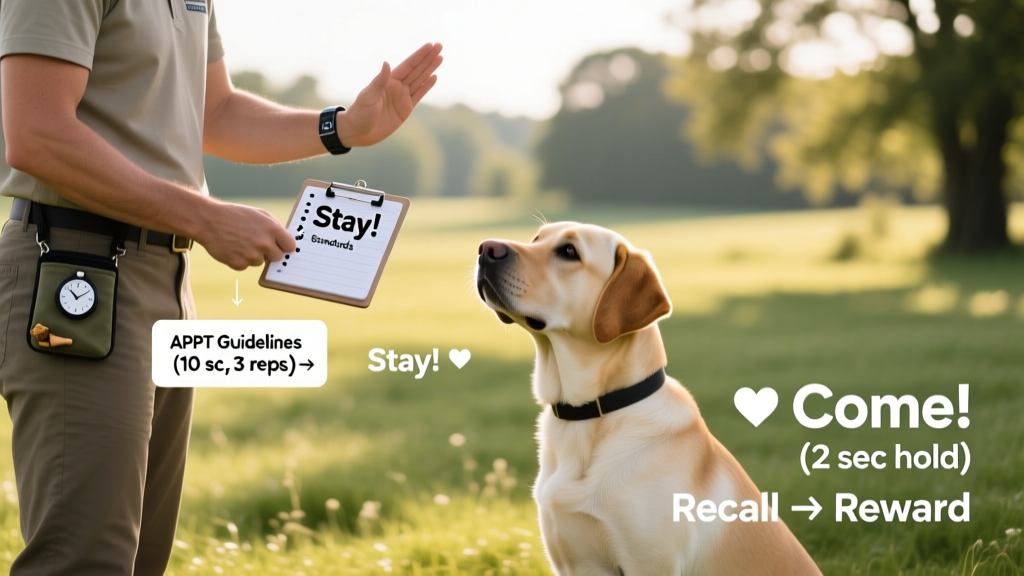
The stay command teaches your dog to remain in place until released, which is invaluable for safety. Imagine being able to tell your dog to stay when a door is open, when guests arrive, or when you need to pick up something they should not eat.
Step-by-step method:
- Ask your dog to sit or lie down.
- Hold your palm flat toward your dog like a stop sign and say "stay" in a calm, clear voice.
- Wait one second, then mark and reward if they have not moved.
- Gradually increase the duration before marking and rewarding—two seconds, then five, then ten, building up over multiple sessions.
- Once your dog can hold a stay for 15 to 20 seconds, begin adding distance. Take one step back, return immediately, mark, and reward.
- Slowly increase the distance you move away, always returning to your dog to deliver the reward rather than calling them to come to you.
- Introduce a release word like "okay" or "free" to signal that the stay is over.
- Practice with distractions: have someone walk by, toss a toy nearby, or ring the doorbell while your dog maintains their stay.
Remember that the three Ds of stay training—duration, distance, and distraction—should be increased one at a time. If you add distance, reduce the expected duration. If you add distractions, reduce both distance and duration. Trying to increase all three simultaneously will set your dog up for failure.
Come (Recall): The Most Important Safety Command
A reliable recall could save your dog's life. If they slip their leash, bolt out an open door, or encounter something dangerous, a strong "come" command is your best line of defense. Yet recall is also one of the most challenging behaviors to train because the world outside is endlessly more interesting than we are.
Step-by-step method:
- Start indoors with minimal distractions. Say your dog's name followed by "come" in an enthusiastic, happy tone.
- Crouch down, open your arms, and make yourself as inviting as possible.
- When your dog comes to you, throw a party—lavish praise, multiple treats, and enthusiastic petting.
- Practice the "recall game" by having family members take turns calling your dog from different rooms, rewarding generously each time.
- Move the training outdoors, starting in a fenced area or using a long training lead (15 to 30 feet) for safety.
- Never call your dog to you for something they perceive as negative—baths, nail trims, or the end of playtime. Instead, go get them for those activities.
- Periodically reward your dog for checking in with you voluntarily during walks, even when you have not called them.
- Practice in increasingly distracting environments, always setting your dog up for success by managing the difficulty level.
For more detailed guidance on recall training, including emergency recall techniques, visit our reliable recall training guide.
Leave It and Drop It: Managing What Your Dog Picks Up
Dogs explore the world with their mouths, which means they will inevitably pick up things they should not—dangerous foods, toxic plants, small objects that pose choking hazards, or simply your favorite pair of shoes. The "leave it" and "drop it" commands give you tools to manage these situations proactively and reactively.
Teaching "leave it":
- Place a low-value treat on the floor and cover it with your hand.
- Say "leave it" and wait. Your dog will sniff, lick, and paw at your hand. Do nothing.
- The moment your dog pulls their nose away or looks up at you, mark and reward with a different, higher-value treat from your other hand.
- Repeat until your dog reliably moves away from the covered treat when they hear "leave it."
- Progress to an uncovered treat, hovering your hand nearby to cover it quickly if your dog goes for it.
- Eventually practice with your hand completely removed, then with items on walks, then with increasingly tempting objects.
Teaching "drop it":
- Give your dog a toy they enjoy but are willing to release.
- Present a high-value treat right at their nose while saying "drop it."
- When they release the toy to take the treat, mark and reward.
- Return the toy after they have eaten the treat, so they learn that giving things up does not mean losing them forever.
- Practice with progressively more valuable items.
- Gradually phase out showing the treat first—say "drop it" and wait a beat, then produce the reward if they release.
Leash Training and Walking Etiquette
Walks should be one of the most enjoyable parts of your day with your dog, but leash pulling, lunging, and reactivity can turn them into stressful ordeals. Proper leash training is one of the most impactful training tips for dogs that owners can implement, and it starts with understanding why dogs pull in the first place.
Dogs pull on the leash because it works. When they pull and you follow, they learn that pulling is the fastest way to get where they want to go. Breaking this cycle requires teaching your dog that a loose leash is the only way to move forward.
The Loose-Leash Walking Method
- Equip yourself with a well-fitting harness (front-clip harnesses are particularly effective for pullers) and a standard four-to-six-foot leash. Avoid retractable leashes during training, as they teach dogs that pulling extends the leash.
- Start in a low-distraction environment like your living room or backyard. Hold the leash with a relaxed grip and stand still.
- Take one step forward. If your dog walks beside you with a loose leash, mark and reward at your side—the position where you want them to be.
- If your dog pulls ahead, stop immediately. Stand like a tree. Do not yank, jerk, or pull back. Simply wait.
- When your dog turns to look at you or takes a step back toward you, creating slack in the leash, mark and reward.
- Resume walking. Repeat the stop-and-wait process every time tension appears on the leash.
- As your dog improves, begin rewarding less frequently but more unpredictably, which strengthens the behavior.
- Gradually move to more challenging environments—your front yard, then a quiet street, then busier areas.
Tips for Successful Leash Training
- Exercise before training. A dog bursting with pent-up energy will struggle to focus on leash manners. Let them burn off steam with a game of fetch or free play in a fenced area before your training walk.
- Use high-value rewards. The outdoors is full of fascinating smells, sights, and sounds. Compete for your dog's attention with especially delicious treats that they only receive during walks.
- Change direction frequently. Randomly changing direction during walks teaches your dog to pay attention to your movements rather than forging ahead on autopilot.
- Allow sniff breaks. Sniffing is mentally stimulating and rewarding for dogs. Use sniffing as a reward for good leash manners by saying "go sniff" after a stretch of polite walking.
- Be patient with progress. Leash training is one of the most challenging behaviors to master because it requires sustained self-control in highly stimulating environments. Celebrate small improvements.
If your dog shows reactivity toward other dogs or people while on leash, consider consulting a professional trainer or behaviorist. Reactivity often stems from fear or frustration rather than aggression, and targeted leash reactivity training can make a tremendous difference.
House Training and Crate Training Essentials
Few training challenges test an owner's patience quite like house training. Whether you are working with a young puppy or retraining an adult dog, the principles of successful house training are straightforward: prevent accidents, reward success, and maintain a consistent schedule.
House Training Step by Step
- Establish a routine. Take your dog outside at consistent times: first thing in the morning, after every meal, after naps, after play sessions, and right before bed. Puppies under four months may need to go out every one to two hours.
- Choose a designated potty spot. Always bring your dog to the same area outdoors. The scent of previous eliminations will trigger the urge to go.
- Use a cue word. Say a consistent phrase like "go potty" while your dog is eliminating. Over time, they will associate the phrase with the action, which is incredibly useful during bad weather or travel.
- Reward immediately. As soon as your dog finishes eliminating outdoors, praise enthusiastically and give a treat. Do not wait until you are back inside—the reward must be connected to the outdoor elimination.
- Supervise closely indoors. When your dog is inside, keep them in your sight at all times. Watch for signs that they need to go: sniffing the floor, circling, whining, or suddenly leaving the room.
- Interrupt accidents calmly. If you catch your dog mid-accident, clap once or say "oops" to interrupt them, then immediately carry or lead them outside to finish. Reward them for finishing outdoors.
- Never punish after the fact. Dogs cannot connect a punishment to something that happened even 30 seconds ago. Rubbing their nose in it or scolding them after the fact only teaches them to fear you and to hide when they need to eliminate.
- Clean accidents thoroughly. Use an enzymatic cleaner specifically designed for pet stains. Regular household cleaners may not eliminate the scent markers that draw dogs back to the same spot.
Crate Training: Creating a Safe Haven
Crate training is one of the most valuable training tips for dogs because it supports house training, prevents destructive behavior when you are away, and gives your dog a personal sanctuary where they can retreat when overwhelmed. When introduced properly, most dogs come to love their crates.
- Choose a crate that is large enough for your dog to stand up, turn around, and lie down comfortably, but not so large that they can eliminate in one corner and sleep in another. For growing puppies, use a divider to adjust the size.
- Place the crate in a common area of your home where the family spends time. Leave the door open and place a soft blanket and a few safe chew toys inside.
- Begin feeding meals near the crate, then inside the crate with the door open, then inside the crate with the door closed (but not latched), and finally with the door latched while you sit nearby.
- Toss treats into the crate and praise your dog for going in to retrieve them. Use a cue word like "crate" or "kennel" as they enter.
- Once your dog enters the crate willingly, close the door for brief periods while you remain in the room. Gradually extend the time.
- Begin leaving the room for short periods, starting with just a minute or two and building up over days or weeks.
- Never use the crate as punishment. It should always be associated with positive experiences.
For more detailed crate training strategies, including troubleshooting common issues like whining and anxiety, read our complete crate training guide.
Socialization and Behavioral Training
A well-trained dog is not just one who knows commands—it is one who is comfortable, confident, and well-adjusted in a variety of situations. Socialization and behavioral training address the emotional and psychological aspects of your dog's development, which are just as important as obedience skills.
The Critical Importance of Socialization
Socialization is the process of exposing your dog to a wide variety of people, animals, environments, sounds, surfaces, and experiences in a positive way. While there is a critical socialization window in puppyhood (roughly 3 to 14 weeks of age), socialization should continue throughout your dog's life.
Effective socialization is not about quantity—it is about quality. A single terrifying encounter with an aggressive dog can create a lasting fear, while dozens of positive, controlled interactions with friendly dogs build confidence. The goal is to create a dog who approaches new experiences with curiosity rather than fear.
Key socialization strategies:
- Introduce new experiences gradually and at your dog's pace. If they seem overwhelmed, increase the distance or reduce the intensity.
- Pair new experiences with high-value treats and praise to create positive associations.
- Expose your dog to different types of people: children, elderly individuals, people wearing hats or uniforms, people using wheelchairs or crutches.
- Let your dog encounter various surfaces: grass, gravel, metal grates, wet floors, stairs.
- Play recordings of common sounds at low volume while giving treats: thunderstorms, fireworks, doorbells, vacuum cleaners, traffic.
- Arrange supervised playdates with vaccinated, friendly dogs who have good social skills.
Addressing Common Behavioral Issues
Even well-socialized dogs can develop behavioral challenges. Understanding the root causes of common issues helps you address them effectively rather than simply suppressing the symptoms.
Jumping on people: Dogs jump because it gets attention—even negative attention like being pushed away or yelled at. The solution is to withhold attention completely when your dog jumps (turn away, cross your arms, look at the ceiling) and reward enthusiastically when all four paws are on the ground. Ask visitors to do the same, and manage the situation by keeping your dog on a leash during greetings until the behavior is under control.
Excessive barking: Barking is a natural canine behavior, but excessive barking usually stems from boredom, anxiety, alert behavior, or learned attention-seeking. Identify the trigger before choosing a strategy. For alert barking, teach a "quiet" command by acknowledging the trigger ("thank you, I see it"), then redirecting and rewarding silence. For boredom barking, increase physical exercise and mental enrichment. For anxiety-related barking, consult a professional behaviorist.
Chewing and destruction: Destructive behavior is often a symptom of insufficient exercise, boredom, separation anxiety, or teething in puppies. Provide appropriate chew toys, ensure adequate daily exercise, and manage the environment by keeping tempting items out of reach. Puzzle toys filled with frozen treats can keep dogs occupied for extended periods.
Separation anxiety: This is one of the most challenging behavioral issues and may require professional guidance. General strategies include gradually desensitizing your dog to departures, providing engaging activities when alone, avoiding dramatic hellos and goodbyes, and in severe cases, working with a veterinarian on anti-anxiety medication alongside a behavioral modification plan. Our separation anxiety guide offers a comprehensive protocol for helping your dog cope with alone time.
Mental Enrichment: Training the Mind
Physical exercise alone is rarely enough to satisfy a dog's needs. Mental stimulation tires dogs out more effectively than physical activity alone and reduces many behavioral problems rooted in boredom. Incorporate these enrichment strategies into your daily routine:
- Puzzle feeders: Replace regular food bowls with puzzle toys that require your dog to work for their meals.
- Scent work: Hide treats around the house or yard and encourage your dog to find them using their nose.
- Training sessions: Even five minutes of learning new tricks provides significant mental stimulation.
- Novel experiences: Take different walking routes, visit new parks, or introduce new toys on a rotating basis.
- Interactive games: Hide-and-seek, flirt pole sessions, and structured fetch all engage your dog's mind and body.
Common Training Mistakes and How to Avoid Them
Even the most dedicated dog owners make mistakes that inadvertently slow progress or create new problems. Being aware of these common pitfalls is half the battle.
Mistake 1: Repeating Commands
Saying "sit, sit, sit, sit" teaches your dog that the command is "sit-sit-sit-sit" and that they do not need to respond the first time. Give the command once, wait up to five seconds, and if your dog does not respond, gently lure them into position or reset and try again in a less distracting environment. Your dog should learn that a command given once is non-negotiable.
Mistake 2: Training When Frustrated
Dogs are remarkably attuned to human emotions. If you are feeling frustrated, impatient, or angry, your dog will sense it and may become anxious, shut down, or act out. If you feel your frustration rising, end the session on a positive note—ask for a behavior your dog knows well, reward generously, and try again later when you are calm.
Mistake 3: Inconsistency Between Family Members
When one person allows the dog on the couch and another scolds them for it, the dog receives conflicting messages that create confusion and anxiety. Hold a family meeting to agree on rules, command words, and training protocols. Post them on the refrigerator if necessary so everyone stays aligned. Consider keeping a shared training journal to track progress and maintain consistency.
Mistake 4: Moving Too Fast
It is tempting to rush through training steps, especially when your dog seems to grasp a concept quickly. However, behaviors learned in quiet, controlled environments often fall apart in the real world. Proof each behavior thoroughly by practicing in multiple locations, with various distractions, at different times of day, and with different people giving the command before considering it "learned."
Mistake 5: Using Punishment-Based Methods
Aversive training methods—including prong collars, shock collars, alpha rolls, and dominance-based techniques—may suppress unwanted behaviors in the short term but often create fear, anxiety, and aggression. These methods damage the trust between you and your dog and can make behavioral problems worse. Modern, science-based training emphasizes rewarding what you want rather than punishing what you do not want. For more on this topic, read our article on positive reinforcement training methods.
Mistake 6: Neglecting to Generalize Behaviors
A dog who sits perfectly in your kitchen may have no idea what "sit" means at the park. Dogs are contextual learners, which means they associate commands with the specific environment where they learned them. To build truly reliable behaviors, practice each command in at least five to ten different locations before expecting consistent performance.
Frequently Asked Questions About Dog Training
How long does it take to train a dog?
There is no single answer because training is an ongoing process rather than a destination. Basic commands like sit, down, and come can be introduced within a few days, but reliable performance in distracting environments typically takes four to eight weeks of consistent practice. More complex behaviors and behavioral modification for issues like reactivity or anxiety may take several months. The most important thing to remember is that every dog learns at their own pace, and comparing your dog's progress to others is rarely productive. Focus on incremental improvement and celebrate each milestone along the way.
Is it ever too late to train an older dog?
The old saying that you cannot teach an old dog new tricks is a myth. Dogs of any age can learn new behaviors, and adult dogs often have advantages over puppies when it comes to training: longer attention spans, better impulse control, and less distractibility. That said, older dogs may have established habits that take longer to change, and physical limitations like arthritis may affect which behaviors they can perform comfortably. Adjust your expectations and methods to suit your senior dog's abilities, use extra-patient shaping techniques, and consult your veterinarian to rule out any medical issues that could affect learning or behavior. Our senior dog training guide provides tailored advice for older learners.
Should I use a clicker for training?
Clicker training is a highly effective form of marker-based training that uses a distinct clicking sound to pinpoint the exact moment a desired behavior occurs. The clicker's advantage over a verbal marker like "yes" is its consistency—the sound never varies in tone, pitch, or emotional inflection, which makes it easier for dogs to recognize. However, clicker training is not necessary for success. A consistent verbal marker works just as well for most training goals. If you choose to use a clicker, start by "charging" it: click and treat 20 to 30 times in a row so your dog learns that the click predicts a reward. Then use the click to mark desired behaviors, always following each click with a treat within one second.
What should I do if my dog is not food-motivated?
Every dog is motivated by something, but not every dog is equally motivated by food—especially in distracting environments. If your dog seems uninterested in treats, first rule out medical issues with your veterinarian. Then experiment with higher-value rewards like real meat, cheese, or freeze-dried liver. Try training before meals when your dog is hungrier. If food truly does not motivate your dog, use alternative rewards: a favorite toy, a game of tug, access to a sniffing spot, or the opportunity to greet another dog. The key is identifying what your individual dog values most and using it strategically. Some breeds are more toy-driven than food-driven, so understanding your dog's breed tendencies can be helpful—browse our breed profiles for insights into what motivates different types of dogs.
When should I hire a professional dog trainer?
While many training goals can be accomplished at home with patience and good resources, there are situations where professional guidance is invaluable. Consider hiring a certified professional dog trainer (CPDT) or a veterinary behaviorist if your dog displays aggression toward people or other animals, has severe separation anxiety, shows fear-based behaviors that are not improving, or if you feel overwhelmed and frustrated despite consistent effort. A good trainer will observe your interactions with your dog, identify areas for improvement in your technique, and create a customized training plan. Look for trainers who use positive reinforcement methods and avoid those who rely on dominance theory or aversive equipment. Group classes can also be an excellent option for basic obedience and socialization, providing structured learning in a controlled environment with built-in distractions from other dogs.
Final Thoughts on Training Your Dog
Training a dog is one of the most rewarding investments you can make in your relationship with your companion. It requires time, patience, and a willingness to learn alongside your dog, but the payoff is immeasurable. A well-trained dog enjoys more freedom, more trust, and more opportunities to participate in your daily life. They can join you on hikes, visit friends, relax at outdoor cafes, and be a genuine joy to be around rather than a source of stress.
Remember that training is not a one-time event but a lifelong conversation between you and your dog. Even after your dog has mastered the basics, continue to practice, reinforce, and build on their skills. Introduce new tricks, explore new environments, and keep challenging your dog's mind. The bond you build through training—rooted in clear communication, mutual respect, and shared positive experiences—will deepen with every session.
Start where you are, use what you have learned in this guide, and be kind to both yourself and your dog along the way. Progress may not always be linear, but with consistency and compassion, you will get there together. For more training resources, breed-specific advice, and tips on every aspect of dog ownership, explore the full collection of guides at Paws & Tales.
Tom Renshaw
All our authors care for dogs every day — read more of their work on the authors page.