Simple Puppy Training Tips: A Step-by-Step Guide for New Dog Owners
Discover simple puppy training tips that actually work. From housebreaking to basic commands, this comprehensive guide helps new owners raise a well-behaved pup.
Simple Puppy Training Tips Every New Dog Owner Needs to Know
Bringing a new puppy home is one of life’s most exciting experiences. That wagging tail, those oversized paws, and those soulful eyes can melt anyone’s heart in an instant. But alongside the joy comes a significant responsibility: training your new furry companion to become a well-behaved, confident, and happy adult dog.
The good news? Puppy training doesn’t have to be overwhelming. With the right approach, a little patience, and some proven techniques, you can lay a rock-solid foundation for your puppy’s behavior in just a few short weeks. Whether you’ve adopted a Labrador Retriever, a German Shepherd, or a mixed-breed rescue pup, the core principles of effective puppy training remain the same.
This comprehensive guide walks you through simple, actionable puppy training tips that work for every breed and every household. From housebreaking and crate training to mastering basic commands and socialization, you’ll find everything you need to start your training journey on the right paw.
Getting Started: Setting Up Your Puppy for Training Success
Before you dive into teaching commands or establishing routines, it’s essential to create an environment that sets your puppy up for success. Training begins the moment your puppy steps through your front door, and the groundwork you lay in those first few days will influence everything that follows.
Establish a Consistent Routine
Puppies thrive on predictability. A consistent daily schedule helps your puppy understand what to expect and when, which dramatically reduces anxiety and unwanted behaviors. Here’s what a solid puppy routine looks like:
- Feeding times: Offer meals at the same times every day, typically three times daily for puppies under six months old, then transitioning to twice daily.
- Potty breaks: Take your puppy outside first thing in the morning, after every meal, after play sessions, after naps, and right before bedtime.
- Training sessions: Schedule short, focused training sessions two to three times per day.
- Playtime and exercise: Provide structured play sessions appropriate for your puppy’s age and breed.
- Sleep schedule: Puppies need 18 to 20 hours of sleep per day, so ensure they have a quiet, comfortable space to rest.
Gather Your Training Supplies
Having the right tools on hand makes training smoother and more effective. Here’s what you’ll need before your first session:
- High-value treats: Small, soft treats that your puppy loves. Think tiny pieces of chicken, cheese, or commercial training treats.
- A clicker or marker word: A clicker provides a precise sound to mark desired behavior. Alternatively, choose a consistent marker word like “Yes!”
- A lightweight leash and flat collar or harness: For guided training and outdoor sessions.
- A properly sized crate: Essential for crate training and giving your puppy a safe den.
- Chew toys and puzzle feeders: To redirect chewing behavior and provide mental stimulation.
Choose Your Training Method
Modern dog training overwhelmingly supports positive reinforcement as the most effective and humane method. This approach rewards desired behaviors rather than punishing unwanted ones, building trust and enthusiasm between you and your puppy. For a deeper dive into training philosophies, check out our complete guide to positive reinforcement dog training.
The core idea is simple: when your puppy does something you like, reward them immediately. Over time, your puppy will repeat those behaviors to earn more rewards. This method works beautifully across all breeds, from energetic Border Collies to gentle Golden Retrievers.
Housebreaking Your Puppy: A Step-by-Step Approach
Housebreaking, also called potty training or house training, is often the number one priority for new puppy owners. The process requires consistency, patience, and a clear understanding of your puppy’s biological limitations. A general rule of thumb is that puppies can hold their bladder for approximately one hour per month of age, so a two-month-old puppy needs a potty break roughly every two hours.
Step 1: Designate a Potty Spot
Choose a specific outdoor area where you want your puppy to eliminate. Take them to this exact spot every single time. The scent will accumulate and serve as a natural prompt, encouraging your puppy to go when they arrive at that location.
Step 2: Use a Consistent Cue Word
Select a phrase like “Go potty” or “Do your business” and say it calmly each time your puppy begins to eliminate. Over time, your puppy will associate the phrase with the action, and you’ll be able to prompt them on command — incredibly useful during rainy weather or late-night outings.
Step 3: Reward Immediately
The instant your puppy finishes eliminating in the correct spot, praise them enthusiastically and offer a high-value treat. Timing is critical here. If you wait until you’re back inside, your puppy won’t connect the reward with the outdoor elimination.
Step 4: Supervise and Prevent Accidents
When inside, keep your puppy within eyesight at all times. Watch for signs that they need to go: sniffing the ground, circling, whining, or suddenly leaving the room. If you catch your puppy mid-accident, calmly interrupt them with a gentle “Oops!” and immediately carry them to the designated potty spot. Never punish a puppy for accidents — this creates fear and can lead to sneaky elimination habits.
Step 5: Clean Accidents Thoroughly
Use an enzymatic cleaner specifically designed for pet stains. Standard household cleaners may mask the smell to human noses, but your puppy’s powerful sense of smell will still detect it, potentially encouraging them to eliminate in the same spot again.
Pro Tips for Faster Housebreaking
- Keep a potty log for the first two weeks to identify patterns in your puppy’s elimination schedule.
- Limit water intake about one to two hours before bedtime, but never restrict water during the day.
- Feed meals on a strict schedule rather than free-feeding, as predictable input leads to predictable output.
- Crate your puppy when you cannot supervise them directly. Dogs naturally avoid soiling their sleeping area.
Teaching Essential Commands: Sit, Stay, Come, and More
Basic obedience commands form the backbone of good canine behavior. They keep your puppy safe, strengthen your bond, and make daily life far more enjoyable for both of you. Keep training sessions short — five to ten minutes for young puppies — and always end on a positive note.
Teaching “Sit”
The sit command is often the easiest for puppies to learn and serves as a gateway to more advanced commands.
- Hold a treat close to your puppy’s nose.
- Slowly move the treat upward and slightly backward over their head.
- As their nose follows the treat, their bottom will naturally lower to the ground.
- The moment their rear touches the floor, say “Yes!” (or click) and give the treat.
- Repeat this process 5 to 10 times per session, gradually adding the verbal cue “Sit” before the hand motion.
Teaching “Stay”
Once your puppy reliably sits on command, you can introduce the stay command.
- Ask your puppy to sit.
- Hold your palm out toward them like a stop sign and say “Stay.”
- Wait just one or two seconds, then reward them if they haven’t moved.
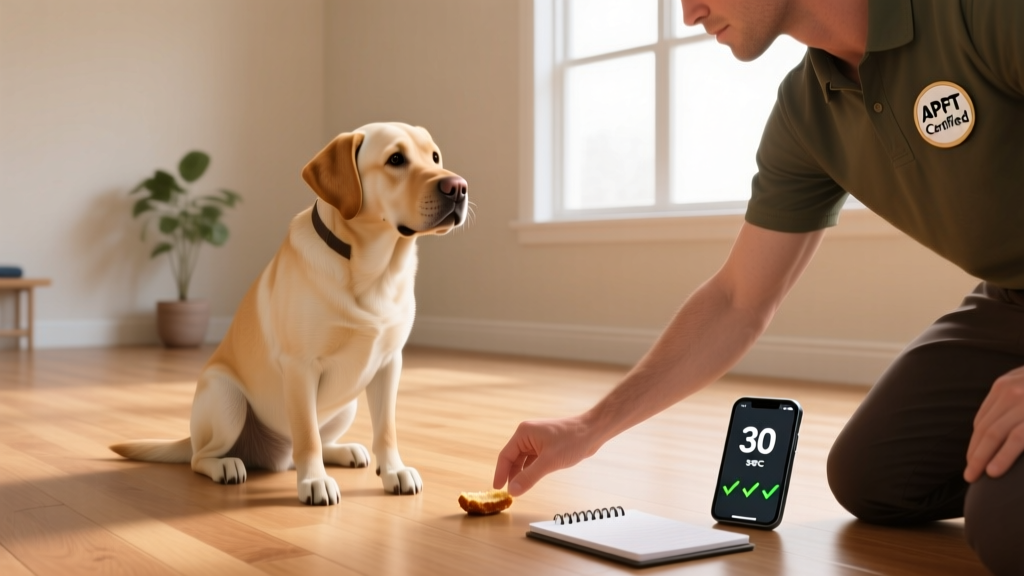
- Gradually increase the duration before rewarding, working up to 30 seconds and beyond.
- Once duration is solid, begin adding distance by taking one step back, then returning to reward.
Teaching “Come” (Recall)
A reliable recall is arguably the most important safety command your puppy will ever learn. For a more detailed breakdown, read our complete recall training guide.
- Start indoors in a low-distraction environment.
- Get down to your puppy’s level and say their name followed by “Come!” in an excited, happy tone.
- When they come to you, reward generously with treats, praise, and play.
- Practice in increasingly distracting environments as your puppy improves.
- Never call your puppy to you for something they perceive as negative, like a bath or nail trim. Always make coming to you the best part of their day.
Teaching “Leave It”
This command can literally save your puppy’s life by preventing them from eating dangerous items.
- Place a low-value treat in your closed fist and present it to your puppy.
- They will sniff, lick, and paw at your hand. Wait patiently.
- The moment they back away or stop trying, say “Yes!” and reward them with a different, higher-value treat from your other hand.
- Once they consistently back away from your closed fist, add the verbal cue “Leave it.”
- Progress to open palm, then items on the floor, always rewarding compliance with a better treat.
Teaching “Drop It”
- Offer your puppy a toy and let them take it in their mouth.
- Present a high-value treat near their nose.
- When they release the toy to get the treat, say “Yes!” and give the treat.
- Add the verbal cue “Drop it” before presenting the treat.
- Practice with various objects, gradually reducing the visibility of the treat reward.
Crate Training and Socialization: Building Confidence and Good Habits
Two of the most impactful things you can do for your puppy’s long-term well-being are proper crate training and early socialization. Together, these practices create a dog who is calm, confident, and adaptable in virtually any situation.
Crate Training Done Right
A crate is not a punishment — it’s your puppy’s personal sanctuary. When introduced properly, most dogs grow to love their crate and will voluntarily retreat to it for naps and quiet time. Our detailed crate training guide covers everything from selecting the right crate to troubleshooting common challenges.
Step-by-step crate introduction:
- Make it inviting: Place soft bedding, safe chew toys, and a few treats inside the crate. Leave the door open and let your puppy explore freely.
- Feed meals in the crate: Start by placing the food bowl near the crate entrance, then gradually move it further inside over several meals.
- Practice short closures: Once your puppy enters willingly, close the door briefly while they eat, then open it immediately after.
- Build duration gradually: Ask your puppy to enter the crate, close the door, and sit nearby for a few minutes. Slowly increase the time and begin stepping away for brief periods.
- Never use the crate as punishment: The crate must always be associated with positive experiences.
The Critical Socialization Window
Puppies have a primary socialization window between approximately 3 and 14 weeks of age. During this period, they are remarkably receptive to new experiences, and positive exposure to a wide variety of stimuli will shape their temperament for life.
Key socialization categories include:
- People: Introduce your puppy to people of different ages, sizes, ethnicities, and appearances. Include people wearing hats, sunglasses, uniforms, and using mobility aids.
- Other animals: Arrange supervised meetings with vaccinated, friendly dogs of various breeds and sizes. For tips on multi-pet households, see our guide on introducing dogs to other pets.
- Environments: Visit parks, city streets, parking lots, pet-friendly stores, and friends’ homes.
- Sounds: Expose your puppy to vacuum cleaners, doorbells, thunderstorms (recordings work well), traffic noise, and children playing.
- Surfaces: Let your puppy walk on grass, gravel, sand, tile, metal grates, and wet pavement.
- Handling: Gently touch your puppy’s paws, ears, mouth, and tail regularly. This prepares them for grooming, veterinary exams, and nail trims.
Socialization Safety Tips
- Always prioritize positive experiences. If your puppy seems frightened, increase the distance from the stimulus and reward calm behavior.
- Never force your puppy into a situation that terrifies them. Let them approach new things at their own pace.
- Carry treats everywhere during the socialization period. Pair every new experience with something delicious.
- Ensure all dogs your puppy interacts with are fully vaccinated and known to be friendly.
Common Puppy Training Mistakes and How to Avoid Them
Even the most dedicated puppy owners make mistakes during the training process. Being aware of these common pitfalls can save you weeks of frustration and help your puppy learn faster.
Mistake 1: Inconsistency Between Household Members
If one person allows the puppy on the couch and another scolds them for it, your puppy receives conflicting messages. This confusion slows training and creates anxiety. Hold a family meeting before bringing your puppy home to establish clear, unified rules. Everyone should use the same command words and enforce the same boundaries.
Mistake 2: Training Sessions That Are Too Long
Puppies have incredibly short attention spans. A 30-minute training session will leave your puppy frustrated, bored, and unresponsive. Stick to sessions of five to ten minutes for puppies under four months, and ten to fifteen minutes for older puppies. Multiple short sessions throughout the day are far more effective than one marathon session.
Mistake 3: Repeating Commands Multiple Times
Saying “Sit, sit, sit, sit” teaches your puppy that they don’t need to respond the first time. Give the command once, wait a few seconds, and if your puppy doesn’t respond, gently guide them into position or reassess whether the distraction level is too high for their current skill level.
Mistake 4: Using Punishment Instead of Redirection
Yelling, physical punishment, or intimidation may suppress a behavior temporarily, but they damage the trust between you and your puppy and often lead to fear-based behavioral problems later. Instead, redirect unwanted behavior toward an appropriate alternative. If your puppy is chewing a shoe, calmly remove the shoe and replace it with an approved chew toy, then praise them enthusiastically for chewing the toy.
Mistake 5: Not Practicing in Different Environments
A puppy who performs a perfect sit in your living room may completely forget the command at a busy park. Dogs are contextual learners, meaning they associate commands with specific environments. Practice every command in multiple locations — indoors, in the backyard, on the sidewalk, at the park — to help your puppy generalize their learning.
Mistake 6: Neglecting Mental Stimulation
Physical exercise alone is not enough to tire out a puppy. Mental stimulation through training, puzzle toys, scent games, and interactive play is equally important and often more exhausting than a walk around the block. A mentally stimulated puppy is a calm, well-behaved puppy. Explore our collection of fun training games to play with your dog for inspiration.
Mistake 7: Expecting Perfection Too Soon
Training is a marathon, not a sprint. Puppies will have setbacks, regressions, and off days. This is completely normal. Celebrate small victories, maintain your consistency, and remember that every interaction with your puppy is a training opportunity.
Frequently Asked Questions About Puppy Training
When should I start training my puppy?
You can and should begin training your puppy the very first day they come home, regardless of their age. Puppies as young as eight weeks old are capable of learning basic commands like “sit” and beginning housebreaking routines. Early training takes advantage of your puppy’s natural curiosity and critical socialization window. Start with simple, short sessions and gradually increase complexity as your puppy matures. Remember that every interaction is a learning opportunity, so be mindful of the behaviors you are reinforcing throughout the day, not just during formal training sessions.
How long does it take to fully housebreak a puppy?
Most puppies develop reliable housebreaking habits between four and six months of age, though some may take longer depending on breed, individual temperament, and the consistency of their training routine. Smaller breeds often take a bit longer due to their smaller bladders and faster metabolisms. The key factors that influence the timeline are supervision quality, schedule consistency, and how effectively accidents are managed. Some puppies may have occasional accidents until they are a year old, especially during periods of excitement or environmental changes. Patience and persistence are absolutely essential throughout this process.
What should I do if my puppy bites or nips during play?
Puppy biting and nipping is completely normal behavior. Puppies explore the world with their mouths, and they also use their mouths during play with littermates. The goal is not to eliminate mouthing entirely right away but to teach bite inhibition — the ability to control the force of their bite. When your puppy nips too hard, let out a high-pitched yelp (mimicking a littermate’s response) and immediately withdraw your attention for 10 to 15 seconds. Redirect them to an appropriate chew toy when they calm down. Consistency from all household members is crucial. Most puppies significantly reduce mouthing behavior by five to six months of age as their adult teeth come in and they learn appropriate play boundaries.
How do I stop my puppy from jumping on people?
Jumping is a natural greeting behavior for dogs — they are trying to reach your face, which is where social interaction happens in dog culture. The most effective approach is to completely ignore your puppy when they jump. Turn your body away, fold your arms, and avoid eye contact. The instant all four paws are on the ground, turn back, praise calmly, and offer a treat or gentle petting. If they jump again, immediately withdraw attention once more. You can also teach an incompatible behavior, such as sitting, when greeting people. Ask visitors to only pet your puppy when they are sitting. Over time, your puppy learns that sitting, not jumping, earns them the attention they crave.
Is it okay to use treats for every training session?
Yes, especially in the early stages of training. Food is one of the most powerful motivators for dogs, and using treats generously during the learning phase helps your puppy understand exactly what behavior you want. However, as your puppy becomes more proficient with a command, you should gradually transition from a continuous reinforcement schedule (rewarding every single time) to a variable reinforcement schedule (rewarding randomly, like a slot machine). This actually strengthens the behavior because your puppy never knows which attempt will earn the reward. You can also begin mixing in other rewards like praise, play, access to the yard, or a favorite toy. The ultimate goal is a dog who responds reliably to commands regardless of whether a treat is visible, but this level of reliability takes months of consistent practice.
Final Thoughts on Puppy Training
Training your puppy is one of the most rewarding investments you can make in your relationship with your dog. The time, patience, and consistency you put in during these early months will pay dividends for the next decade or more of your life together. Remember that every puppy learns at their own pace, and setbacks are a natural part of the process.
Focus on building trust, keeping sessions positive and short, and celebrating every small victory along the way. If you find yourself struggling with specific behavioral challenges, don’t hesitate to reach out to a certified professional dog trainer or your veterinarian for guidance. There is no shame in asking for help — it’s a sign of a dedicated and caring dog owner.
For more expert advice on raising a happy, healthy, and well-trained dog, explore our full library of dog training guides and breed-specific resources. Whether you’re working on leash training, tackling excessive barking, or preparing for your puppy’s first grooming session, Paws & Tales has the resources you need to succeed.
Your puppy is counting on you to be their guide, their teacher, and their best friend. With these simple puppy training tips in your toolkit, you’re well on your way to raising the well-behaved companion you’ve always dreamed of.
Tom Renshaw
All our authors care for dogs every day — read more of their work on the authors page.