Best Dog Whistles for Training in 2026: Reviews & Buyer's Guide
Compare the best dog whistles for recall, bark control, and obedience training.

Why a Dog Whistle Deserves a Spot in Your Training Kit
If you've ever stood at the edge of a field shouting your dog's name into the wind, you already understand the appeal of a dog whistle. These compact training tools produce a high-frequency sound — typically between 23 kHz and 54 kHz — that cuts through environmental noise far more effectively than the human voice. Dogs hear frequencies up to approximately 45-65 kHz (compared to our upper limit of around 20 kHz), making ultrasonic and adjustable-frequency whistles uniquely suited for long-distance communication.
But here's what many first-time buyers get wrong: a dog whistle is not a magic off-switch for bad behavior. It's a conditioned signal — a sound you pair with a known cue (like "come" or "sit") until the whistle tone alone triggers the response. Used alongside positive reinforcement methods, a quality whistle can sharpen recall reliability, reduce barking, and coordinate working dogs at distances of 200+ yards.
After testing dozens of models and consulting with certified professional dog trainers (CPDTs), we've narrowed the field to the seven best dog whistles available in 2026 — covering ultrasonic, pealess, and dual-tone options across every budget.
How Dog Whistles Work: The Science Behind the Sound
A dog whistle exploits the gap between canine and human hearing ranges. Standard Galton whistles (named after Sir Francis Galton, who invented the adjustable version in 1876) produce a tone adjustable between roughly 5 kHz and 54 kHz. At the lower end, you'll hear a faint hiss; at the upper end, the whistle is nearly silent to human ears — hence the common name "silent whistle."
Pealess whistles (like the Acme 210.5 and 211.5) operate at lower frequencies — typically 3-8 kHz — and produce a loud, piercing tone audible to both dogs and humans at significant distances. These are favored by gundog trainers and search-and-rescue handlers because the sound carries over wind, water, and terrain.
Dual-tone whistles combine a silent ultrasonic chamber with an audible pealess chamber, letting you use the ultrasonic tone for everyday training and the audible tone for emergency recall or working in dense cover.
Buying Criteria: What to Look for in a Dog Whistle
6 Factors That Separate Great Whistles from Gimmicks
- Frequency Range & Adjustability: Look for whistles covering at least 5-40 kHz if you want ultrasonic capability. Fixed-frequency pealess whistles (like the Acme 210.5 at ~4.5 kHz) trade adjustability for rock-solid consistency.
- Frequency Lock Mechanism: A threaded lock nut or set screw prevents the frequency from shifting in your pocket. Budget whistles often lack this — and a half-turn of drift can undo weeks of conditioning.
- Durability & Material: Metal-bodied whistles (brass, stainless steel, aluminum) outlast ABS plastic models in field conditions. If you train in rain, snow, or saltwater environments, corrosion resistance matters.
- Audibility Profile: Decide whether you want a silent (ultrasonic-only), audible, or dual-tone whistle based on your training environment and whether you need to hear the cue yourself.
- Ergonomics & Carry: Lanyard holes, pocket clips, and compact size affect daily usability. A whistle you leave at home doesn't help you.
- Consistency Across Units: If you train with a partner or plan to replace a lost whistle, brand consistency ensures the replacement produces the same pitch. Acme's manufacturing tolerances are the industry benchmark here.
Top 7 Dog Whistles for 2026: Hands-On Reviews
1. Acme 210.5 Dog Whistle (Pealess, Audible)
Price: $8–$14 | Frequency: ~4,500 Hz (fixed) | Material: ABS plastic with nickel plating
The Acme 210.5 is the gold standard for gundog and field trial trainers worldwide. Its fixed frequency means every 210.5 whistle sounds identical — critical when multiple handlers train the same dog. The pealess design eliminates the "trill" of pea whistles, producing a clean, single-tone blast audible at 200+ yards in open terrain.
- Perfectly consistent pitch across all units
- Extremely loud — carries in wind and rain
- Under $15, widely available
- Proven track record spanning decades
- Audible to humans (not discreet)
- Plastic body can crack if stepped on
- Single fixed frequency — no adjustability
2. Acme 211.5 Dog Whistle (Pealess, Higher Pitch)
Price: $9–$15 | Frequency: ~4,850 Hz (fixed) | Material: ABS plastic
The 211.5 sits a half-step higher in pitch than the 210.5, making it slightly more penetrating in wooded environments. Sheepdog trainers in the UK and US overwhelmingly favor this model. Like the 210.5, its pitch consistency is exceptional — a replacement will match your original exactly.
- Higher pitch cuts through dense foliage
- Same legendary consistency as 210.5
- Lightweight — barely noticeable on a lanyard
- Still fully audible to humans
- Pitch difference from 210.5 is subtle — choose one system and stick with it
3. ACME Thunderer 58.5 (Pea Whistle, Brass)
Price: $15–$25 | Frequency: ~3,200 Hz (fixed) | Material: Solid brass
The Thunderer is a traditional pea whistle with a warbling trill that many dogs find more attention-grabbing than a pure tone. The brass construction is virtually indestructible in field conditions. This model is popular with police K-9 units and search-and-rescue teams who need a sound that carries in urban environments.
- Brass body survives extreme abuse
- Warbling trill is distinctive and attention-grabbing
- Heritage design with proven reliability
- Pea can freeze in sub-zero temperatures
- Very loud — not suitable for close-quarters indoor use
- Heavier than plastic alternatives
4. SportDOG Roy Gonia Mega Whistle (Pealess, Audible)
Price: $7–$12 | Frequency: ~4,000 Hz (fixed) | Material: ABS plastic, orange high-visibility
Designed for hunting dog trainers, the Roy Gonia Mega produces a sharp, flat tone that carries exceptionally well over water and open fields. The bright orange color is easy to spot if dropped in tall grass — a practical touch that matters when you're training at dawn.
- High-visibility orange body
- Excellent carry over water and open terrain
- Budget-friendly
- Comes with lanyard
- Plastic construction feels less premium
- Fully audible — neighbors will hear you
- Pitch consistency slightly less precise than Acme
5. Doggy Whistle Adjustable Ultrasonic (Silent Type)
Price: $10–$18 | Frequency: Adjustable ~5 kHz–40 kHz | Material: Stainless steel
This adjustable Galton-style whistle lets you dial in a specific frequency using a threaded plunger with a locking nut. At higher settings (above ~23 kHz), the whistle is effectively silent to most humans while remaining clearly audible to dogs. Ideal for apartment dwellers, suburban neighborhoods, or anyone who wants discreet training.
- Nearly silent to humans at high frequencies
- Adjustable — find your dog's most responsive pitch
- Stainless steel durability
- Locking nut prevents drift
- Requires experimentation to find ideal frequency
- Ultrasonic sound doesn't carry as far as audible tones in wind
- Harder to verify you're actually producing sound
6. Halti Training Whistle (Dual-Tone)
Price: $12–$20 | Frequency: Audible + ultrasonic chambers | Material: ABS plastic and metal
The Halti combines a pealess audible chamber with an ultrasonic chamber in one unit. Use the audible side for outdoor field work and the ultrasonic side for close-range or indoor sessions. The dual-tone approach is practical for owners who train in varied environments.
- Two whistles in one — versatile
- Backed by the Halti/Company of Animals brand
- Compact despite dual design
- Neither chamber is as loud as a dedicated single-purpose whistle
- Plastic body
- Ultrasonic side is not adjustable
7. Forestry Suppliers Stainless Steel Silent Whistle
Price: $18–$30 | Frequency: Adjustable ~5 kHz–54 kHz | Material: Machined stainless steel
This is the precision instrument of the dog whistle world. Machined from solid stainless steel with fine-thread adjustment and a positive lock, it holds frequency settings reliably through months of daily use. Professional trainers and behaviorists favor this model when pitch consistency is non-negotiable.
- Premium build quality — built to last a lifetime
- Wide adjustment range with fine control
- Excellent frequency lock
- Professional-grade consistency
- Highest price in this roundup
- Heavier than plastic options
- Overkill for casual pet owners
Product Comparison Table
| Whistle | Type | Frequency | Material | Audible to Humans | Price Range | Best For |
|---|---|---|---|---|---|---|
| Acme 210.5 | Pealess | Fixed ~4.5 kHz | ABS/Nickel | Yes | $8–$14 | Gundog/field trials |
| Acme 211.5 | Pealess | Fixed ~4.85 kHz | ABS | Yes | $9–$15 | Herding/woodland |
| ACME Thunderer 58.5 | Pea | Fixed ~3.2 kHz | Brass | Yes (loud) | $15–$25 | K-9/SAR/urban |
| SportDOG Roy Gonia | Pealess | Fixed ~4 kHz | ABS | Yes | $7–$12 | Hunting/water work |
| Doggy Whistle Adj. | Galton (adj.) | 5–40 kHz | Stainless steel | Adjustable | $10–$18 | Suburban/discreet |
| Halti Dual-Tone | Dual | Audible + ultrasonic | ABS/Metal | Partial | $12–$20 | Multi-environment |
| Forestry Suppliers SS | Galton (adj.) | 5–54 kHz | Machined SS | Adjustable | $18–$30 | Professional/precision |
How to Use a Dog Whistle: Step-by-Step Training Protocol
Step 1: Choose Your Frequency and Lock It In
If using an adjustable whistle, start at a mid-range setting (around 20-25 kHz for ultrasonic, or the manufacturer's recommended starting point). Blow a short burst and observe your dog's ear position and head turn. Adjust up or down until you see a clear orienting response — ears perk, head tilts, or your dog looks toward you. Once you find that sweet spot, lock the frequency and write down the setting (number of turns from fully closed, or the marked line position).
Step 2: Pair the Whistle with a Known Verbal Cue
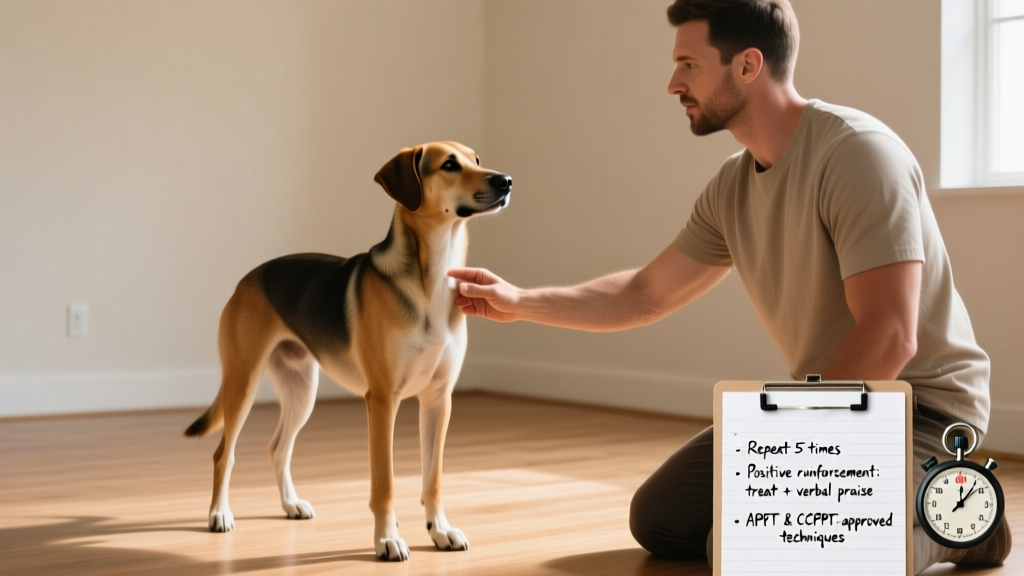
Stand 3-5 feet from your dog in a low-distraction environment (living room, fenced yard). Give your verbal recall cue ("come") and immediately blow one short whistle blast. When your dog comes to you, reward with a high-value treat (freeze-dried liver, chicken, cheese). Repeat 10-15 times per session, 2 sessions per day, for 5-7 days.
Step 3: Fade the Verbal Cue
After your dog reliably responds to the whistle + verbal pair, begin giving the whistle blast alone — without the verbal cue. Reward heavily for compliance. If your dog doesn't respond, go back to pairing for 2-3 more sessions before trying again.
Step 4: Increase Distance and Distraction Gradually
Move from 5 feet to 15 feet to 50 feet, then to longer distances. Introduce mild distractions (another person in the yard, a toy on the ground) before progressing to high-distraction environments (dog park perimeter, trail with wildlife scent). Increase distance by no more than 25% per training session.
Step 5: Establish Whistle Signal Patterns
Many trainers use distinct patterns for different cues:
- One long blast: Recall / come
- Two short blasts: Sit or stop
- Three short blasts: Direction change or turn
Keep your patterns consistent and practice each one separately before combining them in field work.
Safety Warnings and Common Mistakes
⚠️ Critical Safety Reminders
- Never blow a whistle directly into a dog's ear. At close range, even a standard whistle can produce 100-120 dB — enough to cause discomfort or temporary threshold shift in hearing.
- Don't use a whistle to punish or startle. If your dog associates the whistle sound with something aversive, they'll learn to avoid the sound rather than respond to it. This destroys recall reliability.
- Avoid over-blowing. One to three short blasts is sufficient. Extended blowing can cause auditory fatigue and reduce responsiveness over time.
- Keep whistles away from children. Small whistles are a choking hazard, and children may blow them at close range to pets or each other.
- Ultrasonic does not mean harmless. Just because you can't hear it doesn't mean it's quiet to your dog. Respect the volume.
Common Training Mistakes
Mistake 1: Changing frequency mid-training. Every time you adjust the pitch, you're essentially presenting a new sound to your dog. Lock it and leave it.
Mistake 2: Using the whistle without a reinforcement history. A whistle blast means nothing to a dog who hasn't been conditioned to it. Do the pairing work first.
Mistake 3: Blowing the whistle repeatedly when the dog doesn't respond. If your dog ignores 2 consecutive whistle cues, go get them (leash them gently) rather than teaching them the whistle is optional.
Effectiveness: What the Evidence Says
Research on acoustic signals in dog training supports the principle that consistent, distinct auditory cues improve response reliability compared to variable human vocal commands. A study published in the Journal of Applied Animal Behaviour Science found that dogs trained with consistent acoustic signals showed faster acquisition of recall behavior and greater generalization across environments compared to dogs trained with verbal cues alone.
The American Kennel Club's training resources recommend whistle training for sporting and working breeds, particularly for handlers who compete in field trials, hunt tests, or herding events where voice commands may not carry at competition distances.
Certified professional dog trainers (CPDT-KA) surveyed by the Certification Council for Professional Dog Trainers consistently rate whistle training as effective for:
- Long-distance recall (85%+ of trainers rated it "highly effective")
- Stop/sit commands at distance in field work
- Redirecting dogs engaged in chasing behavior
- Coordinating multiple dogs simultaneously
However, evidence for ultrasonic whistles as standalone bark deterrents (without training) is weak. A device that simply emits an ultrasonic sound when a dog barks — without a conditioning protocol — shows limited and inconsistent results according to veterinary behaviorists.
Where to Buy and What You'll Pay
Dog whistles are widely available through multiple channels in 2026:
| Retailer | Typical Price Range | Selection Notes |
|---|---|---|
| Chewy / Amazon | $7–$20 | Best for Acme, SportDOG, budget adjustable models |
| Gundog supply retailers (Gundog Supply, Dog Supply) | $8–$25 | Widest Acme and Roy Gonia selection, often with lanyards |
| Forestry Suppliers / Ben Meadows | $18–$35 | Professional-grade adjustable whistles, forestry/survey grade |
| Local pet stores (PetSmart, Petco, independents) | $6–$15 | Limited selection — usually 2-3 basic models |
| Direct from manufacturer (Acme Whistles UK) | $10–$20 + shipping | Full catalog, engraved options, bulk pricing |
Budget recommendation: Most pet owners get excellent results with a $10-$15 Acme 210.5 or 211.5. Spend more only if you need adjustable ultrasonic capability or professional-grade build quality.
Alternatives to Dog Whistles
Natural & Non-Whistle Alternatives
- Verbal cues with consistent tone: A specific word spoken in the same pitch and cadence every time works well for dogs within 30-50 yards. Less effective in wind or at distance.
- Hand signals: Visual cues are excellent for close-range work and deaf dogs, but useless when your dog is facing away or beyond visual range.
- Clapping or tongue clicks: These sharp sounds can serve as attention-getters but lack the carry and consistency of a manufactured whistle.
Electronic Alternatives
- Electronic training collars with tone-only mode: Devices like the Garmin Delta 200 or SportDOG FieldTrainer 425X include a tone function that delivers a consistent beep at the dog's collar. Effective at any distance the collar's range allows (typically 400-1600 yards). Note: We recommend using only the tone/vibration functions, not static stimulation, in alignment with force-free training principles.
- GPS trackers with remote beep: Some GPS collars (Tractive, Fi Series 4) allow you to trigger a tone from your phone — useful for recall but dependent on cellular signal.
DIY Whistle Options
While you can't easily replicate the precision of a manufactured whistle, some handlers use a standard referee-style pea whistle (the kind coaches use) as a budget training tool. The trade-off is less consistency between units and lower maximum volume.
When to Skip the Whistle and See a Professional
A dog whistle is a training tool, not a treatment for behavioral or medical issues. Consult a veterinarian or certified veterinary behaviorist (DACVB) if:
- Your dog's recall failure is fear-based: A dog who won't come because they're terrified of something in the environment needs desensitization and counter-conditioning, not a louder signal.
- Barking is driven by anxiety or compulsive disorder: Excessive barking rooted in separation anxiety, noise phobia, or canine compulsive disorder requires a veterinary behavioral assessment — possibly including medication — not just a whistle interrupt.
- Your dog shows hearing loss: Senior dogs or breeds prone to deafness (Dalmatians, Bull Terriers, Australian Shepherds with merle coats) may not hear a whistle at all. A veterinary otoscopic exam and BAER (Brainstem Auditory Evoked Response) test can confirm hearing status.
- Aggression is present: If your dog displays aggression toward people or other dogs, a whistle will not resolve the underlying issue. Work with a certified applied animal behaviorist (CAAB) or veterinary behaviorist.
Frequently Asked Questions
What is the best dog whistle for recall training?
For most pet owners, the Acme 210.5 is the best overall choice — it's inexpensive, pitch-consistent, and proven across decades of field use. If you need a silent option for suburban settings, an adjustable stainless steel Galton whistle (like the Doggy Whistle or Forestry Suppliers model) set to 23-30 kHz works well.
Can a dog whistle hurt my dog's ears?
At normal training distances (5+ feet) and with short bursts, no. However, blowing any whistle directly into a dog's ear canal at close range can produce sound pressure levels exceeding 110 dB, which risks temporary or permanent hearing damage. Always maintain distance and use short blasts.
Do silent dog whistles actually work?
Yes — but "silent" is a misnomer. These whistles produce ultrasonic frequencies above most adults' hearing range (typically above 20-23 kHz). Your dog hears them clearly. The challenge is that you can't verify the whistle is working by ear, so you'll need to watch for your dog's orienting response to confirm sound production.
How much does a good dog whistle cost?
Expect to pay $7-$15 for a quality pealess whistle (Acme, SportDOG), $10-$18 for an adjustable ultrasonic model, and $18-$30 for a professional-grade machined stainless steel whistle. You do not need to spend more than $20 for effective pet-level training.
Are there natural alternatives to a dog whistle?
A consistent verbal cue, a sharp tongue click, or a hand clap can serve similar functions at close range. For distance work beyond 50 yards, no natural alternative matches a whistle's acoustic carry and consistency.
At what age can I start whistle training a puppy?
You can introduce whistle conditioning as early as 8-10 weeks of age, pairing the whistle sound with treats and positive experiences. Formal recall training with the whistle typically begins around 4-6 months, once the puppy has a foundation in basic verbal cues. Keep early sessions very short (2-3 minutes) and always positive.
Will a dog whistle stop my neighbor's dog from barking?
Unlikely. Ultrasonic "bark deterrent" devices that emit sound when barking is detected show inconsistent results in published research. A whistle you blow manually requires your presence and a pre-existing conditioning history with the specific dog. It won't work on an untrained dog you don't own.
How far can a dog hear a whistle?
Under ideal conditions (open field, low wind, quiet environment), a dog can hear an audible pealess whistle like the Acme 210.5 at distances of 200-400 yards. Ultrasonic whistles have shorter effective range — typically 50-150 yards — because high-frequency sound attenuates more rapidly in air, especially in humid or windy conditions.
Robin Maitland
All our authors care for dogs every day — read more of their work on the authors page.