When Should a Puppy Leave Its Mom? The Ideal Timeline by Week
When should a puppy leave its mom? Learn the ideal 8-12 week timeline, breed exceptions, developmental milestones, and what happens if puppies leave too early.

If you've been browsing breeder websites or rescue listings, you've probably wondered: when should a puppy leave its mom? The short answer is between 8 and 12 weeks — but the right week depends on breed size, temperament, and what the puppy has learned from its mother and littermates. Pulling a puppy away too early can create behavioral problems that last a lifetime, while waiting too long can mean missing the critical socialization window.
This guide walks you through the science-backed timeline, week by week, so you can make a confident decision and prepare for the day your new puppy comes home.
The Short Answer: 8 Weeks Minimum, 10-12 Weeks for Many Breeds
The American Kennel Club and most veterinary behaviorists agree that 8 weeks is the absolute minimum age for a puppy to leave its mother. However, many responsible breeders now keep puppies until 10 or even 12 weeks, especially for toy breeds and brachycephalic dogs.
| Breed Category | Examples | Ideal Departure Age | Why |
|---|---|---|---|
| Toy breeds (under 12 lb adult) | Chihuahua, Pomeranian, Yorkshire Terrier | 10–12 weeks | Slower neurological development, hypoglycemia risk, fragile immune systems |
| Small breeds (12–25 lb adult) | Beagle, French Bulldog, Cocker Spaniel | 9–11 weeks | Benefit from extended littermate socialization |
| Medium breeds (25–60 lb adult) | Border Collie, Australian Shepherd, Bulldog | 8–10 weeks | Standard developmental timeline |
| Large breeds (60–100 lb adult) | Labrador Retriever, Golden Retriever, German Shepherd | 8–10 weeks | Standard timeline; earlier socialization window is critical |
| Giant breeds (100+ lb adult) | Great Dane, Mastiff, Saint Bernard | 8–10 weeks | Standard timeline, but slower physical maturation overall |
Why the Mother and Littermates Matter: Weeks 3–8 Explained
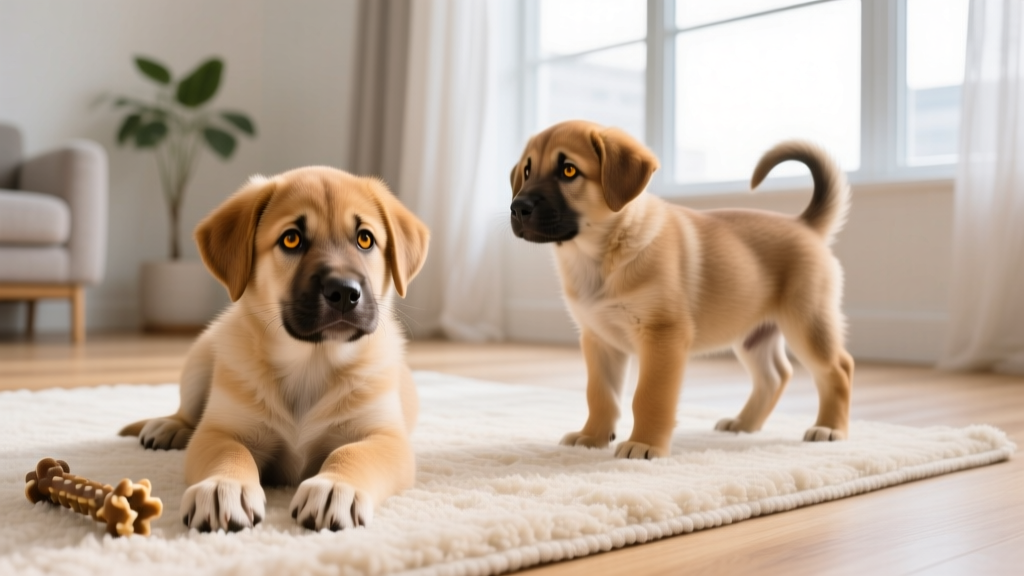
The weeks a puppy spends with its mother and siblings aren't just about nutrition — they're a crash course in canine communication. Here's what puppies learn during this irreplaceable period:
Bite Inhibition (Weeks 4–8)
When puppies play with littermates, they learn how hard is too hard. A puppy that bites too forcefully gets yelped at and excluded from play. This feedback loop teaches bite inhibition — the ability to control jaw pressure. According to the Merck Veterinary Manual, puppies removed before 6–7 weeks often develop problematic mouthing and biting behaviors that are difficult to correct later.
Canine Body Language (Weeks 5–8)
Littermates teach each other to read play bows, submissive rolls, tail positions, and ear signals. Puppies that miss this education may struggle to interact with other dogs throughout life, leading to fear-based reactivity or inappropriate play styles.
Emotional Regulation (Weeks 6–8)
The mother dog begins setting boundaries around week 5 — walking away, growling softly, or physically redirecting puppies that are too rough. This teaches puppies to cope with mild frustration and rejection, building emotional resilience.
Developmental Milestones: What to Expect Week by Week
Whether your puppy comes home at 8 weeks or 10 weeks, understanding the full developmental arc helps you set realistic expectations.
Weeks 4–8: The Litter Phase (Still with Mom)
- Week 4: Puppy teeth emerge; mother begins weaning onto gruel/puppy mush
- Week 5: Play fighting intensifies; puppies learn hierarchy and bite inhibition
- Week 6: First dewclaw/nail trims possible; puppies respond to individual names
- Week 7: Fear period begins — puppies are highly impressionable (positive experiences critical)
- Week 8: Fully weaned; eating solid puppy food; first DHPP vaccine typically given by breeder's vet
Weeks 8–12: The Homecoming Window
- Sleep: 18–20 hours per day (puppies need enforced naps)
- Bladder control: Approximately 1 hour per month of age (an 8-week puppy = ~2 hours max)
- Attention span: 2–5 minutes for training sessions
- Chewing: Exploratory mouthing peaks; everything goes in the mouth
- Attachment: Strong bonding period — ideal time to build trust with new family
Weeks 12–16: The Learning Phase
- Bladder control: Improves to 3–4 hours
- Training: Can learn sit, down, come, name recognition reliably
- Socialization: Still in the prime socialization window (closes around 14–16 weeks)
- Energy: Noticeable increase; needs structured play and mental stimulation
- Fear periods: Second fear period may occur around 12–14 weeks — avoid traumatic experiences
Weeks 16–24 (4–6 Months): The Juvenile Stage
- Teething: Adult teeth begin erupting around 16 weeks; chewing intensity increases
- Independence: Puppy starts testing boundaries; recall may temporarily decline
- Energy: Peak puppy energy — 60–90 minutes of structured activity daily
- Size: Rapid growth phase; giant breeds still growing until 18–24 months
Months 6–12: Adolescence
- Hormonal changes: Intact dogs reach sexual maturity (spay/neuter timing should be discussed with your vet)
- Training regression: Common around 7–9 months — previously reliable commands may be "forgotten"
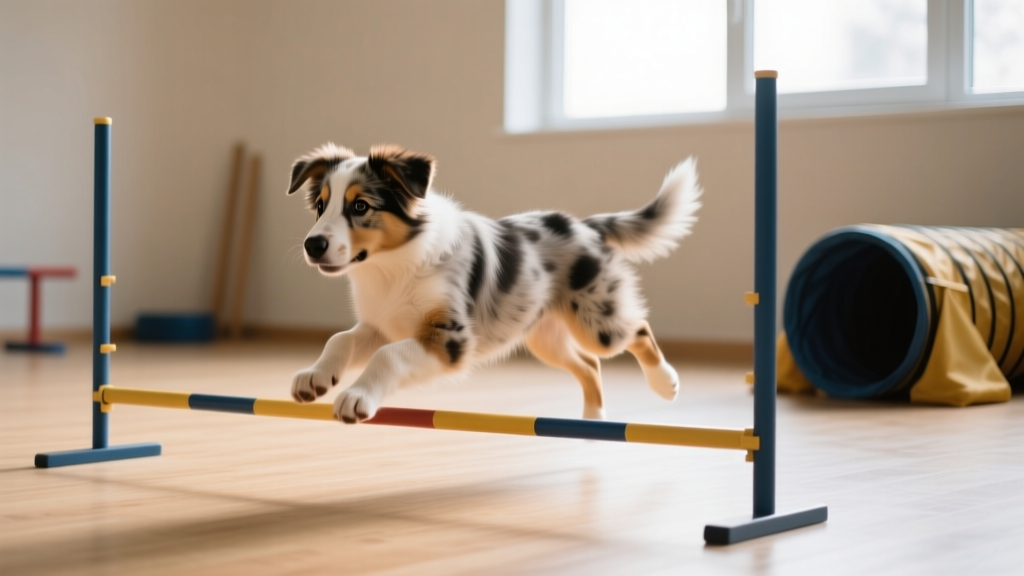
- Energy: Still high but more focused; good time to introduce dog sports foundations
- Social dynamics: May become more selective about dog play partners
Feeding Schedule: Portions and Frequency by Age
Feeding frequency drops as your puppy matures. The portions below are guidelines for a medium-breed puppy (expected adult weight 30–50 lb / 14–23 kg) eating a standard AAFCO-approved puppy kibble (approximately 400 kcal/cup). Always check the feeding chart on your specific food brand, as caloric density varies significantly.
| Age | Meals per Day | Approximate Daily Total | Per Meal (3x/day) | Notes |
|---|---|---|---|---|
| 8–12 weeks | 3–4 | 1–1.5 cups | ¼–⅓ cup | Toy breeds may need 4 meals to prevent hypoglycemia |
| 12–16 weeks | 3 | 1.5–2 cups | ½–⅔ cup | Monitor body condition score; ribs should be palpable |
| 4–6 months | 3 | 2–2.5 cups | ⅔–¾ cup | Growth rate accelerating; large breeds need large-breed formula |
| 6–9 months | 2 | 2.5–3 cups | 1.25–1.5 cups | Transition to 2 meals; reduce if BCS exceeds 5/9 |
| 9–12 months | 2 | 2.5–3.5 cups | 1.25–1.75 cups | Small/medium breeds may transition to adult food at 10–12 months |
| 12–18 months | 2 | Varies by breed | Varies | Large/giant breeds stay on puppy food until 14–18 months |
Vaccination Schedule: Core and Non-Core Vaccines
Your puppy's immune system is still developing, and maternal antibodies gradually wane between 6 and 16 weeks. The American Veterinary Medical Association recommends the following core vaccination timeline. Always consult your veterinarian, as protocols may vary based on local disease prevalence and your puppy's risk factors.
| Age | Vaccine | Type | Notes |
|---|---|---|---|
| 6–8 weeks | DHPP (Distemper, Hepatitis/Adenovirus, Parainfluenza, Parvovirus) — 1st dose | Core | Often given by breeder before puppy leaves |
| 10–12 weeks | DHPP — 2nd dose | Core | Booster critical as maternal antibodies decline |
| 10–12 weeks | Bordetella (Kennel Cough) | Non-core | Recommended if attending puppy classes, boarding, or grooming |
| 10–12 weeks | Leptospirosis — 1st dose | Non-core | Recommended in areas with wildlife exposure or urban rat populations |
| 14–16 weeks | DHPP — 3rd dose (final puppy booster) | Core | Final dose ensures immunity after maternal antibodies fully wane |
| 14–16 weeks | Leptospirosis — 2nd dose | Non-core | Booster required 2–4 weeks after first dose |
| 12–16 weeks | Rabies | Core (legally required) | Timing varies by state law; typically given at 12–16 weeks |
| 12+ weeks | Lyme Disease | Non-core | Recommended in tick-endemic areas (Northeast, Upper Midwest) |
The Socialization Window: Weeks 3–14 (Don't Miss It)
The primary socialization period — when puppies are most receptive to new experiences without fear — runs from approximately 3 to 14 weeks of age. According to the American Veterinary Society of Animal Behavior (AVSAB), inadequate socialization during this window is the leading behavioral reason dogs are surrendered to shelters.
Here's a practical checklist of exposures to aim for before week 14. Each experience should be positive and voluntary — never force a frightened puppy. Pair new experiences with high-value treats (small pieces of boiled chicken, cheese, or commercial training treats).
Socialization Exposure Checklist
- People: Men with beards, people wearing hats/sunglasses, children (supervised), people in wheelchairs, people of different ethnicities and heights, delivery drivers
- Surfaces: Grass, gravel, metal grates, wet pavement, slippery tile, carpet, wooden stairs
- Sounds: Vacuum cleaner (start at low volume, distance), thunderstorms (play recordings at low volume), doorbells, traffic, construction noise, fireworks recordings
- Objects: Umbrellas opening, plastic bags rustling, bicycles, skateboards, strollers, garbage trucks
- Handling: Paw touching, ear inspection, mouth opening, nail clipping simulation, being lifted, wearing a harness
- Environments: Car rides, vet clinic waiting room (social visits, not just for shots), outdoor café patios, friends' houses, different rooms in your home
- Other animals: Fully vaccinated, friendly adult dogs (1-on-1 playdates); avoid dog parks until fully vaccinated
- Grooming: Brush, nail clippers, toothbrush, bath — introduced gradually with treats
Potty Training Timeline and Realistic Expectations
Let's set expectations straight: most puppies are not reliably house-trained until 4–6 months of age, and some small breeds take up to 8–10 months. Bladder capacity physically increases with age — no amount of training can accelerate biology.
| Age | Max Bladder Hold Time | Expected Accidents per Week | Training Focus |
|---|---|---|---|
| 8–10 weeks | 1.5–2 hours | 5–10+ | Establishing routine: out after every meal, nap, and play session |
| 10–14 weeks | 2–3 hours | 3–7 | Consistent verbal cue ("go potty"); rewarding immediately after elimination outdoors |
| 14–20 weeks | 3–4 hours | 1–4 | Building reliability; puppy begins signaling (sniffing, circling, going to door) |
| 5–6 months | 4–5 hours | 0–2 | Near-reliability during the day; overnight hold time improving |
| 6–8 months | 5–6 hours | 0–1 | Most puppies are reliable with a consistent schedule |
Potty Training Troubleshooting
Problem: Puppy pees inside 5 minutes after coming back in from outside.
Cause: Puppy was distracted outside and didn't actually eliminate. Solution: Stand in one spot on a leash, be boring, and wait. Use a consistent cue word. Reward heavily (3–5 treats in a row) when they go.
Problem: Puppy has accidents only when left alone.
Cause: This may be separation anxiety, not a potty training issue. If the accidents happen within the first 30 minutes of departure and are accompanied by destructive behavior or vocalization, consult your veterinarian or a certified veterinary behaviorist.
Problem: Puppy keeps going back to the same indoor spot.
Cause: Enzymatic residue. Standard household cleaners don't break down uric acid crystals. Use an enzymatic cleaner specifically designed for pet urine (brands like Nature's Miracle or Rocco & Roxie) and apply enough to saturate the pad/subfloor.
Crate Training Progression and Time Limits
A crate is your puppy's safe den — not a punishment space. The goal is for your puppy to voluntarily enter and relax. Here's a progressive timeline:
| Age | Max Daytime Crate Time | Max Overnight Crate Time | Notes |
|---|---|---|---|
| 8–10 weeks | 1–2 hours | 3–4 hours (expect overnight potty break) | Keep crate near your bed at night for comfort |
| 10–14 weeks | 2–3 hours | 4–5 hours | Begin moving crate to permanent location gradually |
| 14–16 weeks | 3–4 hours | 5–6 hours | Most puppies can sleep through the night by 14–16 weeks |
| 4–6 months | 4–5 hours | 6–7 hours | Consider a dog walker for midday breaks if you work full-time |
| 6+ months | 5–6 hours | 7–8 hours | Never exceed 6–8 hours total crated time per day |
Crate training steps:
- Leave the crate door open with meals placed inside (start at the entrance, gradually move bowl further back)
- Introduce a verbal cue ("crate" or "kennel") and toss treats inside for the puppy to retrieve
- Close the door for 10 seconds while puppy eats a stuffed Kong, then open before they finish
- Gradually extend closed-door time: 30 seconds → 2 minutes → 5 minutes → 15 minutes → 30 minutes
- Leave the room for brief periods (30 seconds → 5 minutes → 15 minutes) while puppy is calmly resting in the crate
Teething Timeline: 3–6 Months (and How to Survive It)
Puppy teething is a two-phase process that catches many first-time owners off guard:
- Weeks 3–6: Deciduous (baby) teeth erupt — 28 total
- Weeks 12–16: Baby teeth begin falling out; adult teeth start erupting
- Months 4–6: Peak teething discomfort; adult teeth (42 total) push through gums
- Months 6–7: All adult teeth should be in; any retained baby teeth should be evaluated by your vet (common in toy breeds)
Safe Teething Relief Strategies
- Frozen washcloth: Wet a clean washcloth, twist into a rope, freeze for 2 hours, and let puppy chew under supervision
- Rubber teething toys: KONG Puppy (pink/blue rubber, softer than adult version) stuffed with wet puppy food and frozen
- Chilled carrots: Whole peeled carrots from the fridge offer satisfying crunch without splintering
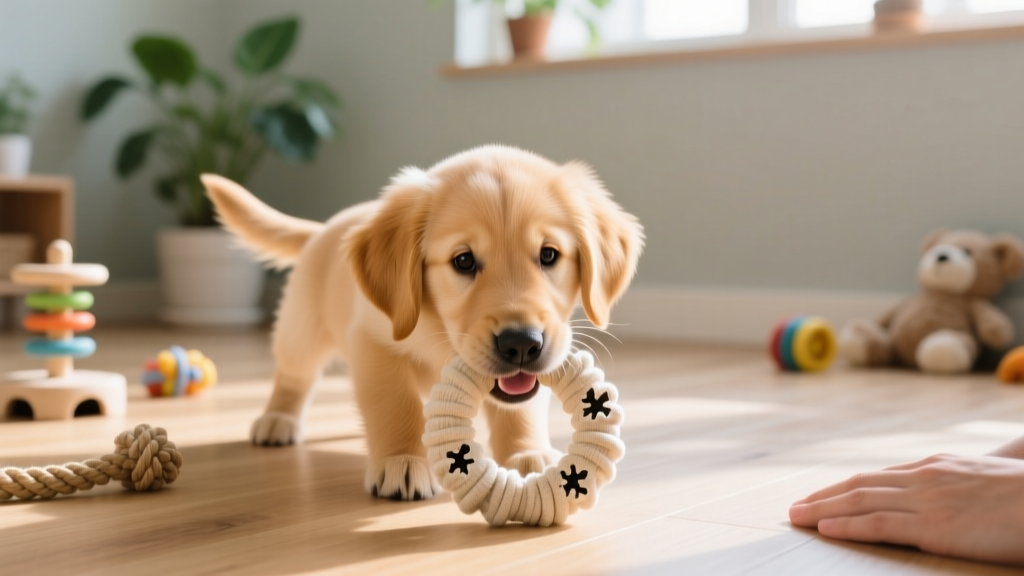
- N-Bone Puppy Teething Rings: Edible, digestible chews designed for puppies under 6 months
Common Puppy Problems and Solutions
Puppy Biting and Nipping
Between 8–16 weeks, puppies explore the world with their mouths. Biting is normal — but it needs to be redirected, not punished.
Solution framework:
- When puppy teeth touch skin, say "ouch" in a calm, medium-pitched voice (not a high squeal, which can excite some puppies)
- Immediately redirect to an appropriate chew toy
- If biting continues, stand up and withdraw attention for 10–20 seconds (time-out from play, not crate punishment)
- Resume play and reward gentle mouth behavior with treats and praise
Never hold a puppy's mouth shut, alpha roll, or use physical punishment. These methods increase fear and can escalate biting. Positive reinforcement and consistent redirection are the only methods recommended by veterinary behaviorists.
Excessive Chewing on Furniture and Shoes
Peak destructive chewing occurs between 3–6 months (teething) and again during adolescence (7–10 months). Management is more effective than correction:
- Use baby gates or an exercise pen to restrict access to puppy-proofed areas only
- Provide a rotating selection of 4–5 appropriate chew toys (rotation prevents boredom)
- Apply bitter apple spray (Grannick's Bitter Apple is a common option) to furniture legs and baseboards as a deterrent
- Supervise 100% of free-roaming time until chewing habits are established (typically 8–12 months)
Whining and Crying (Especially at Night)
The first 3–5 nights in a new home are typically the hardest. Your puppy has never been alone. Strategies:
- Place a warm Snuggle Puppy (a plush toy with a simulated heartbeat) in the crate
- Keep the crate in your bedroom initially — proximity reduces anxiety
- Play soft white noise or a ticking clock near the crate
- Exercise and play in the 1–2 hours before bedtime to promote tiredness
- Remove water 1.5–2 hours before bed to reduce overnight potty needs
When Can My Puppy Go Outside and Meet Other Dogs?
This is one of the most common questions new puppy owners ask, and the answer requires balancing disease risk with socialization urgency.
Safe from day one (with precautions):
- Carrying your puppy in your arms through public spaces (parks, outdoor markets, sidewalks)
- Visiting friends' homes where all resident dogs are fully vaccinated
- Sitting on a blanket in your own yard
- Attending well-managed puppy classes that require proof of at least one DHPP vaccine and a negative fecal test
Avoid until fully vaccinated (after 16-week DHPP booster + 5–7 days):
- Dog parks (highest parvo risk environment)
- Pet store floors (high contamination risk from unvaccinated dogs)
- Playdates with dogs of unknown vaccination status
- Public rest areas where dogs commonly eliminate
The AVSAB recommends that puppies begin socialization classes as early as 7–8 weeks (one week after the first DHPP vaccine), as the behavioral risks of under-socialization statistically outweigh the disease risks in controlled environments.
First-Year Cost Breakdown: Budgeting for Your Puppy
Understanding the financial commitment upfront prevents surprises. These ranges reflect 2026 national averages and vary by region, breed size, and provider.
| Category | Low End | Mid Range | High End | Details |
|---|---|---|---|---|
| Veterinary (wellness + vaccines) | $400 | $700 | $1,200 | 3-4 puppy visits, DHPP series, rabies, fecal tests, heartworm test, spay/neuter |
| Food (puppy formula) | $250 | $500 | $900 | Varies greatly by breed size and food quality (kibble vs. fresh) |
| Preventive medications | $200 | $400 | $600 | Heartworm, flea, and tick prevention (monthly, year-round) |
| Supplies (initial setup) | $200 | $400 | $700 | Crate, bed, leash/harness, bowls, toys, baby gates, enzymatic cleaner |
| Training | $0 | $200 | $600 | Group puppy classes ($100-$250) or private sessions ($75-$150/hour) |
| Microchipping | $25 | $50 | $75 | Often included in spay/neuter or breeder cost |
| Pet insurance (optional) | $350 | $600 | $1,000 | Monthly premiums ($30-$85/month); enroll before first vet visit for best coverage |
| Emergency fund buffer | $0 | $500 | $2,000 | Puppies eat things they shouldn't; foreign body surgery averages $2,000-$5,000 |
| Total First Year | $1,425 | $3,350 | $7,075 | Excludes initial purchase/adoption fee |
Frequently Asked Questions
When should I bring my puppy home?
For most breeds, 8 weeks is the standard minimum. Toy breeds benefit from staying until 10–12 weeks. If your breeder offers to keep the puppy until 10 weeks and provides structured socialization during that time, this is often ideal. The puppy should be fully weaned, eating solid food independently, and have received at least one DHPP vaccine before coming home.
How often should I feed my puppy at 8 weeks old?
At 8 weeks, feed 3–4 meals per day. Toy breeds should receive 4 smaller meals to prevent hypoglycemia (low blood sugar). Medium and large breeds can do 3 meals. Divide the daily portion equally across meals. For example, if your puppy needs 1.2 cups per day across 3 meals, that's 0.4 cups (about ⅓ cup) per meal.
When will my puppy be fully potty trained?
Most puppies achieve daytime reliability between 4–6 months, though some small breeds take until 8–10 months. Overnight reliability typically comes 2–4 weeks after daytime reliability. Consistency is the single biggest factor — puppies with a strict schedule (outside within 15 minutes of eating, drinking, waking, or playing) train significantly faster than those with irregular routines.
What vaccines does my puppy need and when?
Core vaccines include the DHPP series (given at 6–8, 10–12, and 14–16 weeks) and rabies (12–16 weeks, timing varies by state). Non-core vaccines like Bordetella, Leptospirosis, and Lyme disease are recommended based on your puppy's lifestyle and local disease prevalence. Your veterinarian will tailor the protocol to your area.
How do I stop puppy biting and nipping?
Redirect biting to appropriate chew toys every single time. Use a calm "ouch" when teeth touch skin, then immediately offer a toy. If biting persists, withdraw attention for 10–20 seconds. Ensure your puppy gets adequate physical exercise and mental enrichment (food puzzles, training sessions, sniff walks) — overtired and under-stimulated puppies bite more. Most puppies outgrow intense mouthing by 5–6 months as adult teeth come in.
When can my puppy go outside and meet other dogs?
Your puppy can go outside in your arms or in low-risk environments (your yard, friends' homes with vaccinated dogs) immediately. Avoid dog parks, pet stores, and areas with unknown dog traffic until 5–7 days after the final DHPP booster at 14–16 weeks. Well-managed puppy socialization classes are an exception — most accept puppies after the first DHPP vaccine, as the socialization benefits outweigh the controlled disease risk.
Anouk Beaumont
All our authors care for dogs every day — read more of their work on the authors page.