How Do You Train Your Puppy to Sit? Golden Retriever Puppy Guide
Learn how do you train your puppy to sit plus full Golden Retriever puppy care: milestones, feeding, potty training, vaccines, and first-year costs.
Golden Retriever Puppy Milestones: What to Expect Week by Week
Golden Retrievers mature slowly — both physically and mentally. Understanding the developmental windows below prevents frustration when your pup doesn't hit milestones on a generic timeline. These ranges reflect breed-specific observations from AKC breed standards and veterinary developmental research.
Weeks 4–8: Litter Life and Early Learning
Your Golden is still with the breeder during this period. They learn bite inhibition from littermates, begin exploring solid food, and develop basic motor coordination. A responsible breeder introduces novel surfaces (tarps, wobble boards) and starts crate exposure. Do not bring a Golden home before 8 weeks — the 2023 University of Pennsylvania study on retriever behavioral development showed puppies separated before 8 weeks had 2.3x higher rates of separation anxiety and resource guarding.
Weeks 8–12: The Bonding and Foundation Window
This is when your Golden comes home. Expect 18–20 hours of sleep per day. Attention span is roughly 3–5 minutes per training session. Your puppy can learn "sit," "name recognition," and basic handling (paw touches, ear inspections). House training begins immediately — take them out every 1–2 hours during the day. Golden Retrievers are mouthy during this stage; expect constant mouthing of hands, clothing, and furniture.
Weeks 12–16: Expanding the World
Attention span extends to 5–8 minutes. Your Golden can now hold "sit" for 3–5 seconds and begin learning "down," "come," and "leave it." Bladder control improves to approximately 2–3 hours between outings. The fear impact period (weeks 8–11) is ending; continue positive exposures but watch for sudden fear responses to previously neutral stimuli. This is normal and temporary.
Weeks 16–24: Adolescence Begins
Your Golden will test boundaries. Previously reliable cues like "sit" may get ignored — this isn't stubbornness, it's neurological reorganization. Keep training sessions short (5–10 minutes) but consistent. Teething peaks around months 4–5. Exercise increases to 25–30 minutes of structured activity daily (leash walks, fetch, swimming introduction). Golden Retrievers typically reach 50–60% of adult weight by 5 months.
Months 6–12: The Teen Phase
Sexual maturity arrives (if not yet spayed/neutered). Males may begin marking; females enter their first estrus cycle between 6–12 months. Training regression is common — revisit basics with higher-value treats. Exercise needs climb to 40–60 minutes daily. Golden Retrievers do not reach full emotional maturity until 2–3 years, so patience with impulse control is essential throughout the first year.
Feeding Your Golden Retriever Puppy: Portions and Schedule
Golden Retrievers are predisposed to rapid growth-related orthopedic diseases including hip dysplasia and elbow dysplasia. Overfeeding directly increases this risk. The Merck Veterinary Manual recommends large-breed puppy formulas with controlled calcium (0.7–1.2% on a dry matter basis) and calorie density below 3,500 kcal/kg.
| Age | Meals per Day | Daily Amount (Dry Kibble) | Estimated Weight Range |
|---|---|---|---|
| 8–12 weeks | 4 meals | 1.5–2 cups (350–475 kcal) | 10–20 lb / 4.5–9 kg |
| 3–4 months | 3 meals | 2–2.75 cups (475–650 kcal) | 20–35 lb / 9–16 kg |
| 5–6 months | 3 meals → 2 meals | 2.75–3.5 cups (650–825 kcal) | 35–50 lb / 16–23 kg |
| 7–12 months | 2 meals | 3–4 cups (700–950 kcal) | 50–70 lb / 23–32 kg |
How to know if portions are right: Use a body condition score (BCS) assessment. You should feel ribs without pressing hard but not see them prominently. A visible waist when viewed from above and a tucked abdomen from the side indicate ideal condition. If your Golden puppy looks "rotund" rather than "sturdy," reduce portions by 10% and reassess in two weeks.
Transition tip: When switching from breeder food to your chosen brand, mix 75/25 for 2 days, then 50/50 for 2 days, then 25/75 for 2 days before full transition. Sudden food changes cause the diarrhea that new puppy owners often mistake for illness.
How Do You Train Your Puppy to Sit? Step-by-Step for Goldens
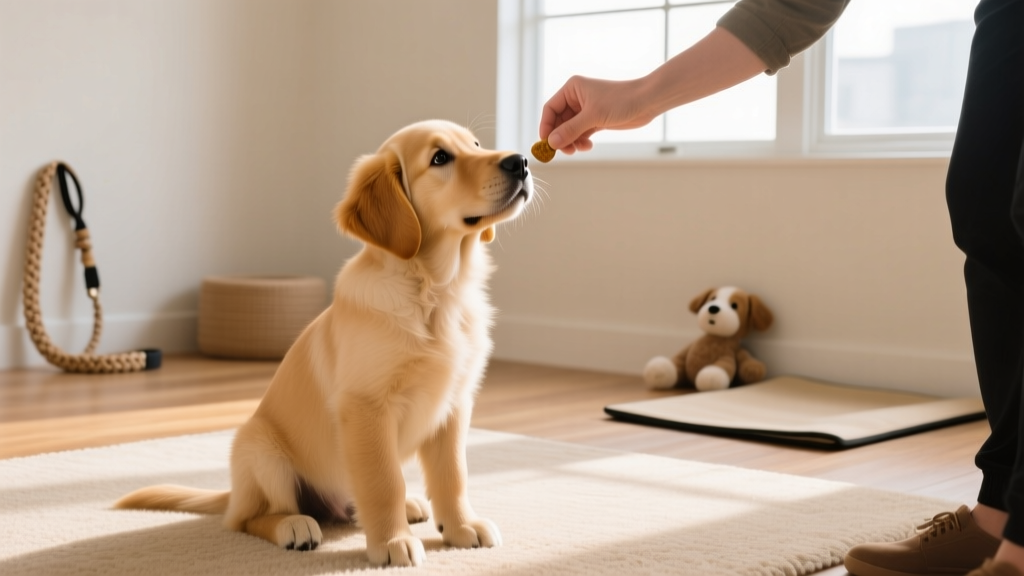
Golden Retrievers are food-motivated and naturally offer behaviors, making "sit" one of the easiest foundational cues to teach. Here is the exact method I recommend for Golden puppies starting at 8 weeks old, using force-free, positive reinforcement training.
The Lure-and-Reward Method (Best for 8–12 Week Goldens)
- Get your puppy's attention. Hold a small, pea-sized treat (Zuke's Mini Naturals or boiled chicken pieces work well) at nose level, about 1 inch from their nose.
- Move the treat slowly upward and slightly back over your puppy's head, toward their tail. Keep the treat close — if you raise it too high, the Golden will jump instead of sit.
- The moment their bottom touches the ground, say "yes!" (or click a clicker) and give the treat immediately. Timing matters more than the word.
- Repeat 5–8 times per session, 2–3 sessions per day. Golden puppies have short attention spans at this age — stop before they lose interest.
- After 3–5 days of consistent success, add the verbal cue "sit" just before you move the lure. Say it once, clearly, then lure.
- Fade the lure gradually: Use an empty hand with the same motion, then reward from your other hand or a treat pouch. This prevents your Golden from only sitting when they see food.
Common Golden Retriever Puppy Sit-Training Problems
| Problem | Why It Happens | Solution |
|---|---|---|
| Puppy jumps for the treat | Lure held too high or puppy is too excited | Lower lure to 1 inch above nose; train before meals when puppy is calmer |
| Puppy backs up instead of sitting | Lure moved too fast or puppy is in a narrow space | Practice with puppy's rear near a wall; slow the lure movement |
| Puppy sits but immediately stands | Reward timing is too slow | Deliver treat within 0.5 seconds of bottom touching floor; reward in the sit position |
| Puppy ignores cue outdoors | Environmental distraction exceeds training level | Practice indoors until 90% reliable, then move to yard, then sidewalk — add distractions gradually |
| Puppy only sits with food visible | Lure was not faded properly | Return to step 6: empty-hand signal, reward from pouch; vary reward schedule (every 2nd, then every 3rd sit) |
Golden-specific tip: Goldens are eager to please but can become "shut down" if corrected harshly. Never push your puppy's rear down physically — this creates resistance and damages trust. If your Golden isn't getting it, end the session on a success (ask for something they already know, like name recognition) and try again later.
Vaccination Schedule for Golden Retriever Puppies
The American Veterinary Medical Association outlines core puppy vaccination protocols that all breeds follow, but Golden Retriever owners should discuss breed-specific considerations with their veterinarian — Goldens have higher rates of vaccine-associated adverse events compared to some breeds, particularly with combination vaccines given simultaneously.
| Age | Vaccines Administered | Notes |
|---|---|---|
| 6–8 weeks | DHPP (Distemper, Hepatitis/Adenovirus, Parainfluenza, Parvovirus) — 1st dose | Often given by breeder; verify records at pickup |
| 10–12 weeks | DHPP — 2nd dose; Bordetella (optional based on lifestyle) | Begin if puppy will attend group classes or boarding |
| 14–16 weeks | DHPP — 3rd dose; Rabies (required by law in most states) | Rabies given separately from DHPP to reduce reaction risk |
| 12–16 months | DHPP booster; Rabies booster; Bordetella (if applicable) | Then DHPP every 3 years; Rabies per local law (1 or 3 year) |
Golden Retriever consideration: Ask your veterinarian about titer testing after the 16-week series. Goldens can develop immune-mediated conditions, and titer tests (which measure antibody levels) may reduce unnecessary boosters later in life. A titer test typically costs $50–$150 depending on the lab.
- Facial swelling or hives within 30 minutes of vaccination
- Vomiting or diarrhea more than twice in 24 hours post-vaccine
- Lethargy lasting more than 48 hours
- Difficulty breathing or collapse (emergency — go to nearest emergency clinic immediately)
Potty Training Your Golden Retriever: Realistic Timeline
Golden Retrievers typically achieve reliable house training between 4–6 months of age, though some individuals take until 8–9 months. "Reliable" means fewer than one accident per week with consistent management. Here is what to actually expect:
| Age | Bladder Capacity | Outing Frequency (Daytime) | Realistic Accident Rate |
|---|---|---|---|
| 8–10 weeks | 30–45 minutes | Every 1–1.5 hours + after meals, naps, play | 2–4 accidents per day is normal |
| 11–14 weeks | 1–2 hours | Every 1.5–2 hours | 0–2 accidents per day |
| 3–4 months | 2–3 hours | Every 2–3 hours | 0–1 accidents per day |
| 5–6 months | 3–4 hours | Every 3–4 hours | 0–1 accidents per week |
| 7–12 months | 4–6 hours | Every 4–5 hours | Rare (stress or schedule changes may cause setbacks) |
Potty Training Troubleshooting for Goldens
Problem: Puppy pees inside 5 minutes after coming back in.
Solution: Your Golden didn't actually empty their bladder outside. Stay out longer, walk to a different spot, and wait quietly (no playing) until they go. Reward heavily with treats and praise the moment they finish.
Problem: Puppy only goes on pee pads, not outside.
Solution: Move the pad progressively closer to the door, then just outside the door, then to the desired outdoor spot over 5–7 days. Golden Retrievers surface-train easily — once they associate grass with elimination, pads become unnecessary.
Problem: Puppy was doing great, then started having accidents again at 5 months.
Solution: This is a normal developmental regression. Hormonal changes and increased independence cause temporary setbacks. Return to more frequent outings for 1–2 weeks. Rule out a urinary tract infection with your vet if accidents are accompanied by frequent small urinations or straining.
The Socialization Window: Weeks 3–14 Checklist
The primary socialization period for all puppies closes around 14 weeks. For Golden Retrievers — a breed expected to be confident and friendly — this window is critical. Under-socialized Goldens are more likely to develop fear-based reactivity, which contradicts the breed's natural temperament.
Balance socialization with disease risk: the AVMA supports controlled exposure to vaccinated dogs and clean environments before the full vaccine series is complete. Avoid dog parks and high-traffic pet store floors until after the 16-week DHPP dose.
Golden-specific note: Goldens are generally bold and curious, which can mask fear. Watch for subtle stress signals: lip licking, yawning when not tired, turning head away, and tucked tail. If your puppy shows these signs, increase distance from the stimulus and let them observe rather than forcing interaction.
Teething, Crate Training, and Common Golden Puppy Problems
Teething Timeline (3–6 Months)
Golden Retriever puppies begin losing deciduous (baby) teeth around 12–16 weeks. The full set of 42 adult teeth typically emerges by 6–7 months. During peak teething (months 4–5), expect increased chewing, drooling, and occasional gum bleeding.
Safe chew recommendations by age:
- 8–12 weeks: Frozen wet washcloth (knot it, soak in water, freeze), Nylabone Puppy Chew (soft formula)
- 3–5 months: Kong Classic (puppy rubber, stuffed with soaked kibble and frozen), Benebone Puppy Wishbone
- 5–7 months: Bully sticks (supervised, 6-inch max), Kong Classic (adult rubber, transition up)
Avoid: Rawhide (choking and blockage risk), antlers and weight-bearing bones (tooth fractures), ice cubes for puppies under 4 months (too hard on developing teeth).
Crate Training Progression
| Age | Maximum Crate Time (Daytime) | Maximum Crate Time (Nighttime) |
|---|---|---|
| 8–10 weeks | 30–60 minutes | 2–3 hours (will need one overnight potty break) |
| 11–14 weeks | 1–2 hours | 3–4 hours |
| 3–4 months | 2–3 hours | 4–5 hours |
| 5–6 months | 3–4 hours | 6–7 hours |
| 7–12 months | 4–5 hours | 7–8 hours |
Golden-specific crate tip: Use a 42-inch wire crate with a divider panel. Goldens grow rapidly — a crate that's too large allows them to eliminate in one corner and sleep in another, undermining potty training. Adjust the divider monthly so the puppy can stand, turn, and lie down comfortably but not have excess room.
Stopping Puppy Biting and Nipping
Golden Retrievers are a retrieving breed — their mouths are their primary tool for exploring the world. Biting peaks between 8–16 weeks and gradually decreases with consistent management. This is not aggression.
Protocol for nipping:
- When teeth touch skin, say "ouch" in a calm, neutral tone (not a yelp — high-pitched sounds can excite some Goldens further).
- Immediately withdraw attention: stand up, cross arms, look away for 10–15 seconds.
- Redirect to an appropriate chew toy. When puppy chews the toy, praise calmly.
- If nipping continues after 3 redirects, the puppy is overtired. Place them in the crate with a frozen Kong for a nap. Most Golden puppies under 4 months need a nap after 45–60 minutes of awake time.
What not to do: Never hold the puppy's mouth shut, alpha roll them, or use bitter sprays on your hands. These methods suppress behavior without teaching alternatives and can create fear-based biting — the opposite of what you want from a family companion breed.
Managing Whining in the Crate
Golden Retrievers are social dogs and often vocalize when separated. For the first 2–3 nights, place the crate next to your bed so the puppy can smell and hear you. Gradually move the crate to its permanent location over 5–7 days. If the puppy whines after being settled for 30+ minutes, they likely need to eliminate — take them out on leash, no play, then return to crate. If they whine immediately upon crating, wait for 3–5 seconds of silence before releasing to avoid reinforcing the vocalization.
First-Year Cost Breakdown for a Golden Retriever
Golden Retrievers are large dogs with breed-specific health needs that make their first-year costs higher than many breeds. Below is a realistic 2026 budget based on national averages and typical Golden care requirements.
| Category | Low Estimate | Mid Estimate | High Estimate | Details |
|---|---|---|---|---|
| Veterinary (wellness + vaccines) | $600 | $900 | $1,400 | 3 puppy visits, vaccines, fecal tests, heartworm start, spay/neuter |
| Food (large-breed puppy formula) | $480 | $720 | $1,100 | $40–$90/month; premium brands like Royal Canin Golden Retriever Puppy or Purina Pro Plan Large Breed |
| Supplies (crate, bed, leash, bowls, toys) | $300 | $500 | $800 | 42-inch crate ($60–$120), orthopedic bed ($80–$200), Kong toys ($15–$25 each) |
| Preventive medications | $240 | $400 | $600 | Heartworm (Heartgard Plus ~$80/year), flea/tick (NexGard or Simparica Trio ~$200–$400/year) |
| Training (group classes or private) | $150 | $400 | $1,200 | Puppy kindergarten ($150–$250 for 6 weeks); private sessions $80–$150/hour |
| Grooming | $200 | $400 | $700 | Professional grooming every 8–12 weeks ($50–$80/session); Goldens are moderate-maintenance |
| Pet insurance (optional but recommended) | $480 | $720 | $1,080 | $40–$90/month; Goldens have high cancer rates later in life — early enrollment avoids pre-existing condition exclusions |
| Total First Year | $2,450 | $4,040 | $6,880 | Excludes initial puppy purchase/adoption fee |
Hidden costs Golden owners often miss: Emergency vet visits for foreign body ingestion ($2,000–$5,000) — Goldens are notorious for eating socks, rocks, and corn cobs. Budget for at least one unexpected vet visit per year, or enroll in pet insurance before your puppy's first birthday.
Frequently Asked Questions
When should I bring my Golden Retriever puppy home?
Between 8–10 weeks of age. A responsible breeder will not release a Golden puppy before 8 weeks. The additional two weeks with littermates (weeks 8–10) significantly improve bite inhibition and social skills. If adopting from a rescue, puppies may be available at varying ages — prioritize getting them into a stable routine as soon as possible regardless of age.
How often should I feed my puppy at each age?
At 8–12 weeks, feed 4 meals per day. At 3–6 months, reduce to 3 meals per day. At 6 months and beyond, feed 2 meals per day. Consistent meal timing (e.g., 7 AM, 12 PM, 5 PM, 9 PM for four meals) aids potty training because puppies typically need to eliminate 15–30 minutes after eating.
When will my puppy be fully potty trained?
Most Golden Retrievers are reliably house trained by 5–6 months with consistent management. "Fully" trained — meaning no accidents even with schedule variations — typically occurs by 8–12 months. Male Goldens may take slightly longer than females. If your puppy is still having daily accidents after 6 months, consult your veterinarian to rule out medical causes like a urinary tract infection or ectopic ureter (a congenital condition with higher prevalence in Golden Retrievers).
What vaccines does my puppy need and when?
Core vaccines follow the DHPP series at 6–8, 10–12, and 14–16 weeks, plus rabies at 14–16 weeks. Non-core vaccines (Bordetella, Leptospirosis, Lyme) depend on your geographic area and lifestyle. Discuss with your veterinarian — Golden Retrievers in tick-endemic areas (Northeast, Upper Midwest) should strongly consider the Lyme vaccine.
How do I stop puppy biting and nipping?
Use the redirect-and-withdraw method: say "ouch" calmly when teeth touch skin, withdraw attention for 10–15 seconds, then offer a chew toy. Ensure your puppy gets 18–20 hours of sleep per day (overtired puppies bite more). Provide appropriate outlets: frozen Kongs, tug toys, and structured play sessions. Expect nipping to decrease significantly by 5–6 months as adult teeth come in and impulse control improves.
When can my puppy go outside and meet other dogs?
Your Golden can go outside in your own yard immediately. For public spaces and meeting unknown dogs, wait until 7 days after the second DHPP vaccine (approximately 11–13 weeks). Controlled puppy classes and playdates with known, vaccinated dogs can begin after the first DHPP at 6–8 weeks, per the AKC's socialization guidelines. Avoid dog parks until the full 16-week series is complete — parvovirus can survive in soil for months and is frequently present in high-traffic dog areas.
When is the best time to spay or neuter my Golden Retriever?
Current research from UC Davis (2020) recommends delaying spay/neuter for Golden Retrievers until at least 12 months for females and 12–18 months for males. Early alteration (before 6 months) was associated with increased rates of hip dysplasia, cranial cruciate ligament tears, and certain cancers in this breed. Discuss timing with your veterinarian based on your individual dog's growth and your management capabilities for intact dogs.
Disclaimer: This guide provides general educational information. Always consult your veterinarian for personalized advice regarding your Golden Retriever puppy's health, nutrition, and vaccination protocol. Individual puppies may have needs that differ from breed averages.
Beth Carrasco
All our authors care for dogs every day — read more of their work on the authors page.


