Top Reasons for Rehoming a Puppy: A Survival Guide by Age and Breed Stage
Explore the most common reasons for rehoming a puppy and how breed-specific milestones, feeding, training, and socialization can help you keep your dog for life.

Why So Many Puppies Get Rehomed (And How to Prevent It)
Every year, thousands of puppies end up surrendered to shelters or passed between homes. The ASPCA estimates that approximately 3.3 million dogs enter U.S. shelters annually, and a significant portion are under one year old. The reasons are rarely simple — they cluster around predictable developmental stages where new owners feel overwhelmed, underprepared, or blindsided by normal puppy behavior.
This guide breaks down the most common reasons for rehoming a puppy by age and developmental stage, then gives you the concrete tools — feeding schedules, potty timelines, socialization checklists, and cost breakdowns — to push through the hard weeks and keep your dog for life.
The Most Common Reasons for Rehoming a Puppy, Ranked
Based on shelter intake data and veterinary behaviorist surveys, these are the top drivers of puppy surrender — and the developmental stages where each one typically erupts:
| Reason for Rehoming | Peak Age | Prevention Strategy |
|---|---|---|
| Potty training failures | 8–16 weeks | Structured schedule + crate training |
| Destructive chewing | 3–6 months (teething) | Appropriate chew rotation + puppy-proofing |
| Biting and nipping | 8–18 weeks | Bite inhibition training + redirection |
| Unexpected costs | Any age (often first emergency) | First-year budget planning + pet insurance |
| Separation anxiety / crying | 8–14 weeks | Graduated alone-time training |
| Breed energy mismatch | 4–10 months | Pre-adoption breed research + exercise plan |
| Aggression or fear reactivity | 6–14 months | Early socialization + professional behavior consult |
Puppy Milestones by Age: What to Expect and When to Worry
Understanding normal developmental stages is the single most effective way to prevent rehoming. Most "problems" are actually age-appropriate behaviors that owners misinterpret as permanent personality flaws.
📅 Weeks 4–8: Litter Learning Phase
- What's happening: Puppies learn bite inhibition from littermates, begin solid food transition, and develop early social skills. The AKC identifies this as a critical imprinting period.
- Normal behaviors: Play-biting siblings, exploring orally, sleeping 18–20 hours/day.
- Red flags: Extreme lethargy, refusal to eat for 12+ hours, visible parasites in stool.
- Your role: If the puppy is still with the breeder, this is not yet your stage — but confirm the breeder is handling socialization (novel surfaces, gentle human contact, household sounds).
📅 Weeks 8–12: The Adjustment Window
- What's happening: Puppy leaves littermates, bonds with new family, and enters peak fear imprinting. Vaccinations are incomplete, so disease risk is high.
- Normal behaviors: Whining at night (first 3–7 nights is typical), following you room-to-room, startling at loud sounds, mouthing hands during play.
- Red flags: Refusing food for 24+ hours, blood in stool, persistent coughing, inability to bear weight on a limb.
- Your role: Establish a consistent routine immediately. Begin crate training in short increments. Limit exposure to unknown dogs until DHPP series is complete.
📅 Weeks 12–16: Testing Boundaries
- What's happening: Puppy gains confidence, begins testing rules, and may regress in potty training. Teething discomfort begins around 12–14 weeks for many breeds.
- Normal behaviors: "Forgetting" potty training, chewing furniture legs, jumping on visitors, selective hearing with recall.
- Red flags: Aggressive growling over food or toys (resource guarding), extreme fear of common stimuli, persistent diarrhea.
- Your role: Increase structured training sessions to 2–3 × 5 minutes/day. Rotate chew toys every 48 hours to maintain novelty. Begin supervised outdoor exploration in low-traffic areas.
📅 Weeks 16–24: The Chewing Storm
- What's happening: Adult teeth erupt, pushing out deciduous (baby) teeth. This is the peak destructive chewing window and the #1 reason owners consider rehoming during this stage.
- Normal behaviors: Chewing baseboards, shoes, and furniture; increased drooling; finding baby teeth on the floor; mild gum bleeding.
- Red flags: Retained baby teeth alongside adult teeth (common in small breeds — consult your vet), refusal to eat hard kibble, facial swelling.
- Your role: Provide frozen chew options (Kong stuffed with wet food and frozen, chilled carrots, rubber teething toys). Puppy-proof all rooms. Increase exercise to burn energy.
📅 Months 6–12: Adolescent Rebellion
- What's happening: Hormonal surges (if intact), increased independence, possible fear periods (especially around 8–10 months). Large breeds may not reach full maturity until 18–24 months.
- Normal behaviors: Ignoring recall, renewed interest in counter-surfing, mounting behaviors, testing physical boundaries (fence-jumping, leash-pulling).
- Red flags: Sudden aggression toward people or dogs, obsessive-compulsive behaviors (tail-chasing, flank-sucking), collapse during exercise.
- Your role: Maintain training consistency. Consider a structured group class for mental stimulation. Discuss spay/neuter timing with your veterinarian — current research suggests waiting until growth plates close for large breeds (typically 12–18 months).
Feeding Schedule: Exact Portions by Age and Weight
Underfeeding causes developmental issues; overfeeding accelerates growth and increases orthopedic disease risk (especially in large breeds like German Shepherds, Great Danes, and Labradors). Use this table as a starting point, then adjust based on body condition score (BCS) — you should be able to feel ribs without pressing hard, and see a visible waist from above.
| Age | Meals/Day | Small Breed (10–25 lb adult) | Medium Breed (26–55 lb adult) | Large Breed (56–100+ lb adult) |
|---|---|---|---|---|
| 8–12 weeks | 4 meals | ¼–½ cup per meal | ½–¾ cup per meal | ¾–1¼ cups per meal |
| 12–16 weeks | 3 meals | ⅓–⅔ cup per meal | ¾–1 cup per meal | 1–1¾ cups per meal |
| 4–6 months | 3 meals | ½–¾ cup per meal | 1–1½ cups per meal | 1½–2½ cups per meal |
| 6–12 months | 2 meals | ¾–1 cup per meal | 1½–2 cups per meal | 2–3½ cups per meal |
Key feeding rules: Use a puppy-formula kibble with an AAFCO statement confirming "complete and balanced for growth." Large-breed puppies MUST eat a food labeled for "large breed growth" (calcium restricted to 1.0–1.8% on a dry matter basis to prevent developmental orthopedic disease). Free-feeding (leaving food out all day) leads to house-training setbacks and obesity.
Potty Training: Realistic Timeline and Troubleshooting
One of the top reasons for rehoming a puppy is repeated indoor accidents. The problem is almost always unrealistic expectations. Here's what a realistic timeline actually looks like:
- 8–12 weeks: Expect accidents every 1–2 hours. Bladder control is physically immature. Take puppy out after every meal, nap, play session, and at minimum every 90 minutes during the day.
- 12–16 weeks: Bladder capacity increases. Accidents should decrease to 1–3 per week with consistent scheduling. Nighttime holds of 4–5 hours become possible for medium/large breeds.
- 4–6 months: Most puppies can hold 5–6 hours during the day and 7–8 hours overnight. Occasional accidents after excitement or schedule changes are still normal.
- 6–12 months: Reliable house training for most breeds. Small breeds (under 15 lb) may take longer due to smaller bladder capacity and higher metabolism.
- Urinating more than every 30 minutes despite empty bladder
- Blood in urine or straining to urinate (possible UTI or crystals)
- Previously trained puppy suddenly having daily accidents (medical regression)
- Diarrhea or soft stool making it impossible to "hold it"
Troubleshooting framework: If accidents persist beyond the expected timeline, audit these four factors before blaming the puppy: (1) Is the schedule consistent? (2) Are you rewarding immediately outdoors with a high-value treat? (3) Are you cleaning indoor accidents with an enzymatic cleaner (not ammonia-based)? (4) Is the puppy getting enough outdoor time to fully empty? Most "stubborn" potty problems trace to one of these four gaps.
Vaccination Schedule: What Your Puppy Needs and When
Incomplete vaccination is both a health risk and a socialization barrier — puppies who can't safely go outside miss the critical socialization window, increasing behavioral problems later. Here is the standard schedule recommended by the AVMA and the American Animal Hospital Association (AAHA):
| Age | Vaccine | What It Protects Against |
|---|---|---|
| 6–8 weeks | DHPP (1st dose) | Distemper, Hepatitis (Adenovirus), Parainfluenza, Parvovirus |
| 10–12 weeks | DHPP (2nd dose) + Bordetella (optional) | Booster + Kennel Cough (required for group training/daycare) |
| 14–16 weeks | DHPP (3rd dose) + Rabies | Final puppy booster + Rabies (legally required in most states) |
| 12–16 months | DHPP booster + Rabies booster | First adult boosters; subsequent boosters every 1–3 years per vet guidance |
Important: Puppies are NOT fully protected until 1–2 weeks after the final DHPP dose at 14–16 weeks. Before that, avoid dog parks, pet store floors, and areas with unknown dog traffic. You CAN carry your puppy in public spaces (outdoor cafés, friends' homes with vaccinated dogs, shopping centers in a sling) to maintain socialization safely.
Socialization Window: The 3–14 Week Critical Period
Veterinary behaviorists consider weeks 3–14 the single most important developmental window in a dog's life. Puppies who are not exposed to a wide range of stimuli during this period are significantly more likely to develop fear-based reactivity, aggression, and anxiety — all leading reasons for rehoming a puppy before age one.
Use this checklist as a minimum target. Each item should be a positive, low-pressure experience paired with treats:
- ☐ 10+ different people (ages, genders, ethnicities, people wearing hats/glasses/uniforms)
- ☐ 5+ other vaccinated, friendly dogs (varying sizes and breeds)
- ☐ Novel surfaces: grass, gravel, metal grates, wet pavement, carpet, tile
- ☐ Sounds: vacuum cleaner, doorbell, thunderstorm recordings, traffic, children playing
- ☐ Handling: paw touching, ear inspection, mouth opening, nail clipping practice
- ☐ Environments: car rides, elevator, outdoor café, friend's house, grooming table
- ☐ Objects: umbrellas opening, bags rustling, bicycles passing, skateboards
- ☐ Alone time: 5–30 minutes in crate or pen without human presence, gradually increasing
The golden rule: Every new experience should end with your puppy under threshold (curious, not frozen or fleeing). If your puppy shows fear, increase distance, reduce intensity, and pair with high-value food. Never force exposure — flooding (overwhelming a fearful puppy) makes reactivity worse, not better.
Teething Timeline: Relief Strategies and Safe Chews
Teething is a major driver of destructive chewing and one of the most common reasons for rehoming a puppy between 3–6 months. Here's the eruption timeline and how to manage it:
- 3–4 weeks: Deciduous (baby) incisors emerge
- 4–6 weeks: Baby canines and premolars emerge
- 12–16 weeks: Baby teeth begin loosening; adult incisors erupt first
- 4–5 months: Adult canines and premolars push through
- 5–7 months: Full set of 42 adult teeth (compared to 28 baby teeth)
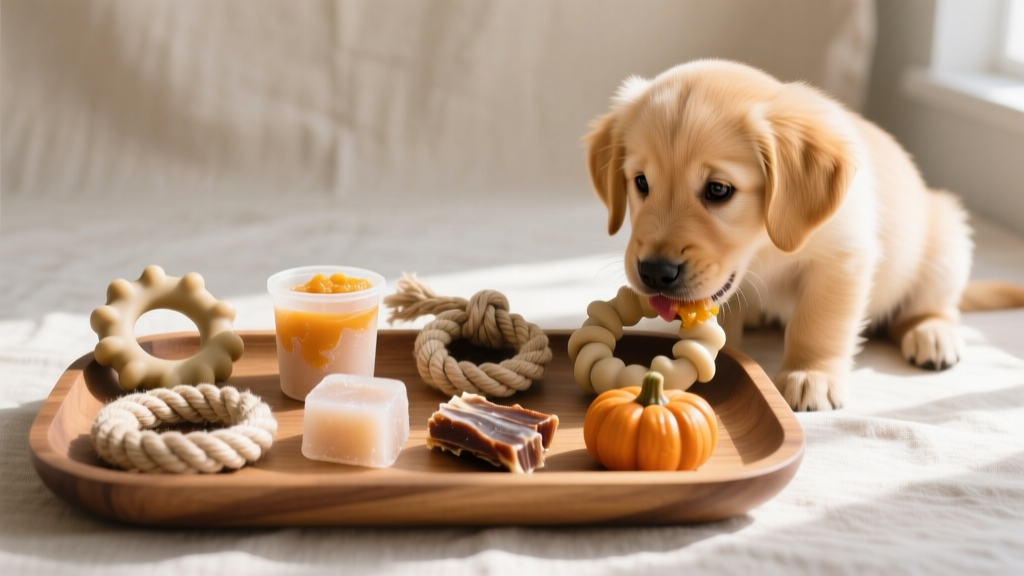
Safe chew options for teething puppies:
- Kong Classic (rubber, stuffable) — frozen with peanut butter or yogurt
- Nylabone Puppy Chew (softer formula, sized to breed)
- Frozen whole carrots or banana slices
- Chilled, wet washcloth (twisted and frozen — supervise to prevent ingestion)
- Benebone Puppy (flexible rubber, bacon-infused)
- Rawhide (choking and intestinal blockage risk)
- Antlers, hooves, and weight-bearing bones (tooth fractures)
- Any toy small enough to swallow whole
- Cooked bones of any kind (splintering risk)
Crate Training Progression and Time Limits
Crate training prevents destructive behavior, aids potty training, and gives your puppy a safe den. But exceeding age-appropriate time limits causes distress, whining, and negative associations — another driver of rehoming decisions.
| Puppy Age | Max Daytime Crate Time | Max Overnight Time |
|---|---|---|
| 8–10 weeks | 30–60 minutes | 2–3 hours (set alarm) |
| 11–14 weeks | 1–2 hours | 3–4 hours |
| 15–16 weeks | 2–3 hours | 4–5 hours |
| 4–6 months | 3–4 hours | 6–7 hours |
| 6+ months | 4–5 hours | 7–8 hours |
Progression method: Start with the crate door open, feeding meals inside. Gradually close the door for 1 minute, then 5, then 10, while you remain in the room. Only leave the room once your puppy is relaxed at 15–20 minutes with the door closed. If whining occurs, wait for a 3-second pause before releasing — never release during active crying, or you reinforce the behavior.
Stopping Puppy Biting and Nipping
Mouthing is normal puppy communication — littermates teach each other bite inhibition through yelping and withdrawing play. When a puppy joins your home, YOU become the littermate. Here's the force-free protocol:
- Redirect: When teeth touch skin, immediately offer a chew toy. Praise enthusiastically when puppy bites the toy instead.
- Withdraw attention: If redirecting fails, stand up, cross your arms, and become still and boring for 10–15 seconds. Resume play when puppy is calm.
- Time-out (last resort): If biting persists after 2–3 redirects, calmly place puppy in a playpen or crate for 30–60 seconds to reset. This is not punishment — it's an arousal-management tool.
- Prevent rehearsal: Puppies bite most when overtired or overstimulated. Enforce naps every 60–90 minutes during active periods. Most "aggressive" biting in 8–12 week puppies is simply an exhausted puppy who needs sleep.
Never use alpha rolls, muzzle-holding, or physical punishment. These methods suppress behavior temporarily but increase fear and can create defensive aggression — a far harder problem to solve than puppy mouthing.
First-Year Cost Breakdown: Budget Before You Commit
Financial surprise is a top-three reason for rehoming a puppy. Here's a realistic first-year budget for a medium-breed puppy (26–55 lb adult weight) in the United States:
| Category | Low Estimate | High Estimate |
|---|---|---|
| Veterinary (vaccines, spay/neuter, wellness exams) | $600 | $1,500 |
| Food (puppy formula, 12 months) | $350 | $700 |
| Supplies (crate, bed, leash, collar, bowls, toys, gates) | $250 | $600 |
| Training (group classes, private sessions) | $150 | $800 |
| Preventive medications (flea/tick, heartworm, 12 months) | $200 | $500 |
| Pet insurance (optional but recommended) | $360 | $720 |
| Emergency fund (recommended reserve) | $500 | $2,000 |
| TOTAL FIRST YEAR | $2,410 | $6,820 |
This does NOT include the purchase or adoption fee. A puppy from a responsible breeder typically costs $1,500–$4,000 depending on breed; adoption fees from rescues range from $200–$600 and often include initial veterinary care.
Frequently Asked Questions
When should I bring my puppy home?
The ideal age is 8–10 weeks for most breeds. Some toy breeds (Chihuahuas, Yorkshire Terriers) benefit from staying with the breeder until 10–12 weeks due to fragility and hypoglycemia risk. Never accept a puppy younger than 7 weeks — early separation is linked to increased fear, aggression, and attachment disorders according to Merck Veterinary Manual.
How often should I feed my puppy at 10 weeks old?
Four meals per day, spaced roughly 4 hours apart during waking hours. For a medium-breed puppy at 10 weeks, that's approximately ½–¾ cup of puppy kibble per meal. Adjust based on body condition — if ribs are visible, increase by 10%; if you can't feel ribs easily, decrease by 10%.
When will my puppy be fully potty trained?
Most puppies achieve reliable house training between 4–6 months. Small breeds may take 6–9 months due to smaller bladder capacity. "Fully trained" means fewer than 1–2 accidents per month. If your puppy is still having daily accidents past 6 months, consult your veterinarian to rule out medical causes (UTI, diabetes, kidney issues).
What vaccines does my puppy need and when?
The core series is DHPP at 6–8 weeks, 10–12 weeks, and 14–16 weeks, plus Rabies at 14–16 weeks. Bordetella is recommended if your puppy will attend group classes or daycare. Leptospirosis and Lyme vaccines are lifestyle-dependent — discuss with your veterinarian based on your geographic area and outdoor exposure.
How do I stop puppy biting and nipping?
Redirect to a chew toy, withdraw attention for 10–15 seconds if biting continues, and enforce naps every 60–90 minutes (overtired puppies bite hardest). Most puppy mouthing decreases significantly by 16–20 weeks as adult teeth erupt and impulse control develops. Consistency across all family members is critical — if one person allows mouthing and another doesn't, the behavior persists longer.
When can my puppy go outside and meet other dogs?
You can carry your puppy in public spaces immediately for socialization. For ground-level exposure to unknown environments (dog parks, pet stores, sidewalks with heavy dog traffic), wait until 1–2 weeks after the final DHPP vaccine at 14–16 weeks — typically around 17–18 weeks of age. Playdates with known, fully-vaccinated dogs in private yards are safe from 8 weeks onward and strongly encouraged during the socialization window.
Beth Carrasco
All our authors care for dogs every day — read more of their work on the authors page.