Puppy Teeth Chart by Age: Complete Teething Timeline & Care Guide
Use this detailed puppy teeth chart to track dental milestones from weeks 3 to 7 months. Includes feeding, vaccines, potty training, and cost breakdowns.

The Complete Puppy Teeth Chart: What to Expect at Every Stage
Every puppy parent eventually faces the same question while examining a tiny, needle-sharp tooth on the carpet: is this normal? A puppy teeth chart gives you a visual roadmap of when deciduous (baby) teeth erupt, when they fall out, and when permanent adult teeth fill in. Understanding this timeline helps you distinguish normal teething from dental emergencies like retained deciduous teeth — a condition affecting an estimated 10-30% of small-breed dogs according to the Merck Veterinary Manual.
This guide pairs a week-by-week puppy teeth chart with the full first-year care picture: feeding portions, vaccination windows, potty training benchmarks, socialization checklists, and a realistic cost breakdown. Whether you're bringing home a Labrador Retriever, a French Bulldog, or a mixed-breed rescue, the dental and developmental milestones follow a predictable pattern.
| Age | Dental Milestone | Total Teeth Present |
|---|---|---|
| 3-4 weeks | Deciduous incisors erupt | 6-12 |
| 4-6 weeks | Deciduous canines and premolars erupt | Up to 28 |
| 8 weeks | Full set of 28 baby teeth typically present | 28 |
| 12-16 weeks | Deciduous incisors begin falling out; permanent incisors erupt | Mixed (20-28) |
| 16-20 weeks | Deciduous canines shed; permanent canines erupt | Mixed (24-32) |
| 20-24 weeks | Deciduous premolars shed; permanent premolars erupt | Mixed (30-38) |
| 5-7 months | All 42 permanent adult teeth should be in place | 42 |
Puppies have 28 deciduous teeth (14 upper, 14 lower): 6 incisors, 2 canines, and 6 premolars per jaw. They do not have deciduous molars. Adult dogs have 42 permanent teeth (20 upper, 22 lower), adding 4 molars on top and 6 molars on the bottom plus additional premolars. If any baby tooth remains alongside its permanent successor past 6 months, consult your veterinarian — retained deciduous teeth can crowd the adult tooth and cause malocclusion or periodontal disease.
Age-Specific Milestones: Weeks 4 Through 12 Months
Weeks 4-8: Neonatal to Early Socialization
At 4 weeks, puppies begin weaning and their first incisors push through the gums. By 6-8 weeks, the full set of 28 baby teeth is typically visible. This is also when the AVMA recommends beginning structured socialization. Puppies learn bite inhibition from littermates during this window — a critical skill that reduces nipping problems later. Expect 2-3 feedings of softened puppy kibble (puppy mush) transitioning to dry kibble by week 7-8.
Weeks 8-12: Homecoming and Rapid Growth
This is when most puppies join their new families. Your puppy has all 28 baby teeth and a jaw bite force that feels disproportionate to their size. Growth rate is fastest now — large-breed puppies may gain 2-4 lb per week, while small breeds gain 0.5-1 lb. Start establishing crate routines, potty schedules, and basic cue training (sit, name recognition). Keep all four paws on the ground in low-traffic areas until the DHPP series is underway.
Weeks 12-16: Pre-Teething Transition
Root resorption of deciduous teeth begins internally even though you won't see external changes yet. Your puppy's chewing drive intensifies noticeably around week 14. This is the peak socialization window closing at approximately 14-16 weeks according to AKC guidelines, so prioritize novel exposures: surfaces, sounds, people in hats, children, car rides, and gentle handling of paws and mouth.
Weeks 16-24: Active Teething Phase
This is where the puppy teeth chart becomes most useful for troubleshooting. You'll find tiny teeth on the floor, in toys, or notice your puppy chewing obsessively. Some puppies swallow their shed teeth — this is harmless and you'll never find them. Gums may appear red or slightly bloody during eruption. If you notice a baby canine tooth sitting directly next to an emerging adult canine (creating a "double tooth" appearance), schedule a veterinary dental evaluation. Small breeds like Chihuahuas, Yorkshire Terriers, and Pomeranians are especially prone to retained deciduous canines.
Months 6-12: Adolescent Settling
By 6-7 months, all 42 adult teeth should be fully erupted. If they aren't, a veterinary dental exam is warranted — surgical extraction of retained baby teeth is a routine procedure typically costing $150-$400 per tooth. Adolescent energy peaks between 6-10 months, and this is when many owners report regression in potty training and obedience. Spay/neuter is commonly performed between 6-9 months for small breeds or 9-15 months for large/giant breeds, per current AVMA recommendations that account for orthopedic development.
Feeding Schedule: Portions by Age and Weight
Feeding frequency changes as your puppy matures. Puppies under 3 months need 4 meals daily to maintain blood glucose — toy and small breeds are especially susceptible to hypoglycemia. Transition to 3 meals at 3-4 months, then 2 meals at 6 months and beyond. Portions below assume a complete-and-balanced AAFCO-approved puppy kibble with a caloric density of approximately 380-420 kcal/cup. Always check your specific food's feeding chart and adjust based on body condition score (BCS) — you should feel but not see ribs, with a visible waist when viewed from above.
| Age | Meals/Day | Small Breed (10-20 lb adult) Cups/Day |
Medium Breed (25-50 lb adult) Cups/Day |
Large Breed (55-90 lb adult) Cups/Day |
|---|---|---|---|---|
| 6-12 weeks | 4 | ½ – ¾ | 1 – 1½ | 1½ – 2½ |
| 3-4 months | 3 | ¾ – 1 | 1½ – 2¼ | 2½ – 4 |
| 5-6 months | 2-3 | ¾ – 1¼ | 2 – 3 | 3½ – 5 |
| 7-12 months | 2 | ¾ – 1¼ | 2 – 3½ | 4 – 6 |
Large and giant breeds (Great Danes, Mastiffs, Saint Bernards) should be fed a large-breed puppy formula with controlled calcium (1.0-1.5% on a dry matter basis) and phosphorus to reduce the risk of developmental orthopedic diseases like osteochondrosis dissecans (OCD) and hip dysplasia. Transition to adult food at 12 months for small breeds, 18-24 months for large breeds.
Vaccination Schedule: Week-by-Week Protocol
The core vaccination protocol follows guidelines established by the American Animal Hospital Association (AAHA) and is supported by the AVMA. Maternal antibodies interfere with early vaccine efficacy, which is why boosters are given every 2-4 weeks until at least 16 weeks of age.
| Age | Vaccines Administered | Type | Estimated Cost |
|---|---|---|---|
| 6-8 weeks | DHPP (Distemper, Hepatitis/Adenovirus, Parainfluenza, Parvovirus) — 1st dose | Core | $20-$40 |
| 8-9 weeks | Bordetella (intranasal or injectable) — optional based on lifestyle | Non-core | $20-$35 |
| 10-12 weeks | DHPP — 2nd dose; Leptospirosis — 1st dose (risk-dependent) | Core / Non-core | $30-$60 |
| 14-16 weeks | DHPP — 3rd (final puppy) dose; Rabies (required by law); Leptospirosis — 2nd dose if started | Core | $40-$80 |
| 12-16 months | DHPP booster; Rabies booster (1-year or 3-year depending on jurisdiction) | Core | $40-$75 |
After the final DHPP dose at 14-16 weeks, wait approximately 1-2 weeks before visiting high-traffic dog areas (dog parks, pet stores, group classes in unvaccinated environments). Your puppy has limited parvovirus protection until the full series is complete — parvo has a mortality rate of up to 91% in untreated puppies, per the Merck Veterinary Manual.
Socialization Window: Weeks 3-14 Exposure Checklist
The primary socialization period closes between 12-14 weeks of age. After this window, unfamiliar stimuli are more likely to trigger fear responses rather than curiosity. The goal isn't to overwhelm your puppy — it's to provide positive, low-pressure exposures paired with treats and praise. Aim for 5-10 novel experiences per day during weeks 8-14.
- ☐ Walk on 5+ different surfaces (grass, gravel, tile, carpet, metal grating, wet pavement)
- ☐ Meet 10+ unfamiliar people (different ages, ethnicities, wearing hats/sunglasses/masks, carrying umbrellas)
- ☐ Gentle handling: ears, paws, tail, mouth (practice for future grooming and vet exams)
- ☐ Hear 8+ novel sounds at low volume (vacuum, thunderstorm recording, doorbell, traffic, clapping)
- ☐ Ride in a car (short trips ending positively — drive to get a treat, not just to the vet)
- ☐ See other species at a safe distance (cats, horses, birds — without chasing)
- ☐ Experience being alone in a crate for 10-30 minutes without distress
- ☐ Encounter children (supervised, calm interactions — teach children not to grab)
- ☐ Practice nail trimming with a Dremel or clippers — touch nails without cutting first
- ☐ Visit a veterinary clinic for a "happy visit" (weigh-in and treats, no procedures)
Carry your unvaccinated puppy in a sling or cart for outdoor exposures rather than placing them on public ground where parvovirus may be present. Puppy socialization classes that require proof of at least one DHPP dose and maintain sanitized facilities are considered safe and beneficial by the AVMA.
Potty Training Timeline: Realistic Expectations and Troubleshooting
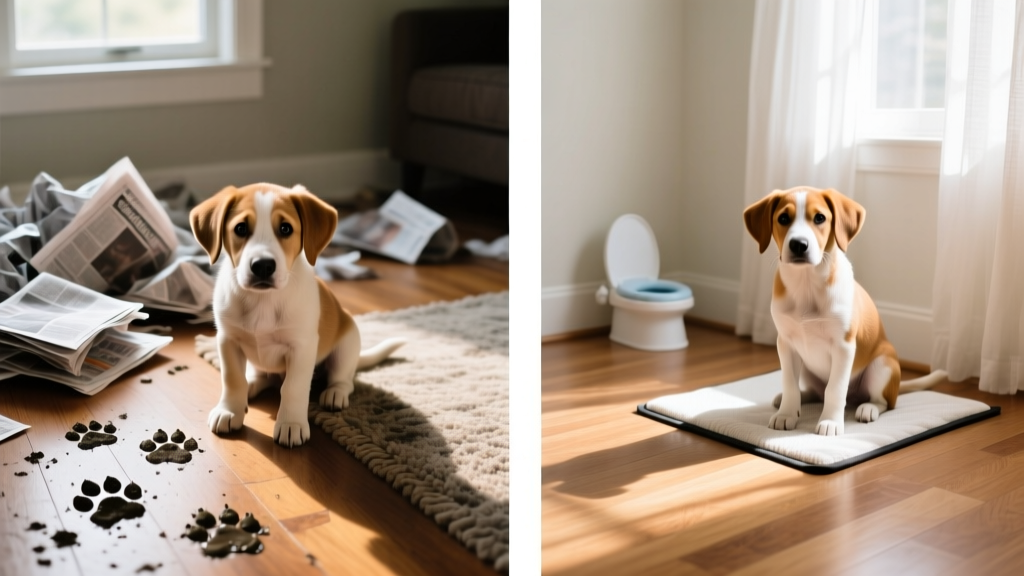
A common misconception is that puppies can be "fully trained" in a weekend. In reality, bladder control develops gradually. A useful rule of thumb: puppies can hold their bladder for approximately one hour per month of age, plus one. A 3-month-old puppy can hold for roughly 4 hours during the day — less at night initially, but nighttime control often develops faster because the puppy is inactive.
| Age | Maximum Daytime Hold | Outdoor Trips/Day | Realistic Accident Rate |
|---|---|---|---|
| 8-10 weeks | 30-60 minutes | 12-15+ | Multiple daily accidents expected |
| 10-14 weeks | 1-2 hours | 8-12 | 1-3 accidents per day is normal |
| 3-4 months | 2-4 hours | 6-8 | Occasional accidents (1-3 per week) |
| 5-6 months | 4-6 hours | 4-6 | Rare accidents if schedule is consistent |
| 6-12 months | 6-8 hours | 4-5 | Mostly reliable; regressions possible |
Key troubleshooting points: If your puppy was reliably potty trained and suddenly has accidents at 6-9 months, rule out a urinary tract infection (UTI) with your veterinarian — UTIs are common in adolescent dogs and require antibiotics. Clean accidents with an enzymatic cleaner (Nature's Miracle or Rocco & Roxie) rather than ammonia-based products, which can attract the puppy back to the same spot. Never punish accidents you didn't witness — the puppy cannot connect the punishment to the behavior after the fact.
Teething Relief: Safe Chew Strategies (3-6 Months)
During active teething (roughly 12-24 weeks), your puppy's gums are inflamed and their need to chew is biologically driven — not a behavioral problem. Providing appropriate outlets prevents destructive chewing of furniture, shoes, and baseboards.
- 8-12 weeks: Soft rubber toys (Kong Puppy, Nylabone Puppy Chew), wet washcloth twisted and frozen for 30 minutes
- 12-16 weeks: Frozen Kong stuffed with plain yogurt or pumpkin puree (no xylitol), Benebone Puppy (soft formula)
- 16-24 weeks: Bully sticks (supervised — remove when small enough to swallow), Yak cheese chews (soak in water first to soften), medium Kong Classic
- 6+ months: Standard Kong Classic (red), Nylabone Dura Chew, deer antler alternatives like EcoKind (softer than antlers, lower fracture risk)
Rawhide (choking and intestinal blockage risk), cooked bones of any kind (splinter into sharp fragments), real antlers (tooth fracture risk — slab fractures of the upper fourth premolar are among the most common dental emergencies), and any chew smaller than your puppy's muzzle width. If you suspect your puppy has swallowed a dangerous object or shows signs of gastrointestinal obstruction (repeated vomiting, lethargy, refusal to eat, abdominal pain), contact your veterinarian or the ASPCA Animal Poison Control at (888) 426-4435 (24/7, consultation fee applies).
Crate Training Progression and Time Limits
Crate training leverages a dog's natural den instinct and is one of the most effective tools for potty training and preventing destructive behavior. The crate should be large enough for your puppy to stand, turn around, and lie down — but not so large that they can eliminate in one corner and sleep in another. Use a divider panel in a wire crate sized for your dog's expected adult dimensions.
| Age | Maximum Daytime Crate Duration | Nighttime Expectation | Training Focus |
|---|---|---|---|
| 8-10 weeks | 30-60 minutes | 2-3 hours before potty break | Positive association: meals in crate, door open |
| 10-14 weeks | 1-2 hours | 3-4 hours before potty break | Short departures, no drama on release |
| 3-4 months | 2-3 hours | 4-6 hours (may sleep through) | Building duration, quiet settle |
| 5-6 months | 3-4 hours | 6-8 hours (most sleep through) | Independence practice, alone-time tolerance |
| 6+ months | 4-5 hours maximum | 7-8 hours | Transition to open-door resting as trust builds |
No dog of any age should be crated for more than 5-6 hours during waking hours on a regular basis. Puppies crated for excessively long periods may develop crate anxiety, begin eliminating inside the crate (breaking their natural den-avoidance instinct), or exhibit hyperactivity upon release. If your work schedule requires longer absences, consider a puppy-proofed exercise pen with a potty area, or arrange mid-day visits from a pet sitter or dog walker ($15-$25 per visit).
Common Puppy Problems and Solutions
Puppy Biting and Nipping
Mouthing is normal puppy behavior — they explore the world with their mouths and their sharp deciduous teeth are designed to help them learn bite inhibition from littermates. When a puppy nips at your hands or ankles, use the following force-free approach: (1) Say a neutral marker like "oops" or "too bad" in a calm tone. (2) Immediately withdraw attention — stand up, cross arms, look away for 10-15 seconds. (3) Redirect to an appropriate chew toy. (4) Resume play and reward gentle mouth contact with continued interaction. Consistency across all household members is essential. Never use physical punishment, alpha rolls, or muzzle grabbing — these increase fear-based aggression rather than teaching bite control.
Whining and Crying in the Crate
Distinguish between protest whining (puppy wants out for attention) and needs-based whining (puppy needs to eliminate). If your puppy was recently outside and is settled, wait for a brief pause in vocalizing before opening the crate — releasing during active crying reinforces the behavior. Place the crate near your bed at night initially and gradually move it to the desired location. A Snuggle Puppy (heartbeat toy) or a blanket that smells like you can ease the transition. Expect 3-7 nights of adjustment.
Destructive Chewing Beyond Teething
If chewing persists intensely past 7 months, evaluate whether your puppy is receiving adequate physical exercise and mental enrichment. A 6-month-old Border Collie or Australian Shepherd may need 60-90 minutes of structured activity daily plus puzzle feeders and training sessions. Understimulated puppies chew as a displacement behavior. Rotate toys weekly to maintain novelty and offer food-dispensing toys (Kong Wobbler, Outward Hound Brick Puzzle) for mental engagement.
First-Year Cost Breakdown
Budgeting for a puppy's first year prevents sticker shock. Costs below reflect 2026 national averages and vary by region — urban areas (San Francisco, New York, Seattle) typically run 20-40% higher.
| Category | Small Breed (10-20 lb) | Medium Breed (25-50 lb) | Large Breed (55-90 lb) |
|---|---|---|---|
| Veterinary (vaccines, exams, spay/neuter, fecal tests, heartworm prevention) | $800-$1,400 | $900-$1,600 | $1,000-$2,000 |
| Food (puppy formula, 12 months) | $250-$500 | $400-$750 | $600-$1,200 |
| Supplies (crate, bed, leash/harness, bowls, toys, grooming tools, enzymatic cleaner) | $200-$400 | $250-$500 | $300-$600 |
| Training (group classes, optional private sessions) | $150-$400 | $150-$400 | $150-$500 |
| Pet insurance (annual premium, accident + illness) | $360-$720 | $400-$800 | $480-$960 |
| Total Estimated First Year | $1,760-$3,420 | $2,100-$4,050 | $2,530-$5,260 |
These figures do not include the initial purchase or adoption fee ($500-$3,000 for a responsibly bred puppy, $50-$500 for shelter adoption). Emergency veterinary visits can add $500-$5,000+ per incident — pet insurance or a dedicated emergency fund of at least $2,000 is strongly recommended.
Frequently Asked Questions
When should I bring my puppy home?
The ideal age is 8-10 weeks for most breeds. Some responsible breeders of toy breeds (Chihuahuas, Pomeranians) retain puppies until 10-12 weeks to ensure adequate weight gain and socialization stability. Bringing a puppy home before 8 weeks can impair bite inhibition development and increase behavioral problems later, as documented in studies published in the Journal of Veterinary Behavior.
How often should I feed my puppy at 3 months old?
At 3 months (12 weeks), feed 3 meals per day spaced approximately 5-6 hours apart during waking hours. A medium-breed puppy (expected 30-40 lb adult) typically needs 1½-2¼ cups of puppy kibble daily, divided across those 3 meals. Reduce to 2 meals at 6 months.
When will my puppy be fully potty trained?
Most puppies achieve reliable daytime house training between 4-6 months with consistent scheduling. Full reliability — including overnight control and no accidents during schedule disruptions — typically takes 8-12 months. Small breeds often take longer due to smaller bladder capacity. If accidents increase suddenly at any age, consult your veterinarian to rule out UTIs, diabetes, or other medical causes.
What vaccines does my puppy need and when?
Core vaccines include DHPP (Distemper, Hepatitis, Parainfluenza, Parvovirus) given at 6-8, 10-12, and 14-16 weeks, plus Rabies at 14-16 weeks. Non-core vaccines like Bordetella, Leptospirosis, and Lyme disease are recommended based on your geographic region and your dog's lifestyle. Your veterinarian will determine the appropriate protocol for your puppy.
How do I stop puppy biting and nipping?
Use positive reinforcement and redirection: when teeth touch skin, calmly say "oops," withdraw attention for 10-15 seconds, then redirect to an appropriate toy. Reward gentle play with continued interaction. Ensure your puppy receives adequate physical exercise and mental stimulation. Biting typically decreases significantly as adult teeth erupt (4-6 months) and further diminishes with consistent training.
When can my puppy go outside and meet other dogs?
Your puppy can explore your own yard immediately (assuming no known parvovirus exposure on the property). Public areas with unknown dog traffic should wait until 1-2 weeks after the final DHPP dose at 14-16 weeks — approximately 16-18 weeks of age. Controlled playdates with fully vaccinated, healthy adult dogs in private settings are acceptable earlier. Puppy socialization classes that verify vaccination status are also safe after the first DHPP dose.
Beth Carrasco
All our authors care for dogs every day — read more of their work on the authors page.