My Puppy Has Diarrhea: A Complete First-Year Health & Care Guide
My puppy has diarrhea — here's what's normal, when to call the vet, and a complete first-year care timeline covering feeding, vaccines, potty training, and costs.

If you've typed "my puppy has diarrhea" into a search engine at 2 a.m., you're far from alone. Gastrointestinal upset is the single most common reason puppies visit emergency veterinary clinics in their first six months, according to data from the American Veterinary Medical Association. But diarrhea is just one thread in the enormous tapestry of puppy care — and understanding the full picture of your puppy's first year helps you distinguish a minor tummy blip from a genuine emergency.
This guide gives you a complete, week-by-week framework for your puppy's first year: what to feed, when to vaccinate, how to potty train, and exactly what to do when your puppy has diarrhea at each developmental stage. All timelines, portions, and costs are based on a medium-breed puppy (expected adult weight 30–50 lb / 14–23 kg). Adjust proportionally for smaller or larger breeds.
When Should I Bring My Puppy Home? (And Why It Affects Gut Health)
The American Kennel Club and most veterinary behaviorists recommend bringing your puppy home between 8 and 10 weeks of age. Puppies removed from their litter before 7 weeks show higher rates of stress-related diarrhea, fear-based behaviors, and difficulty with bite inhibition later in life.
Why does this matter for your puppy's stomach? The weaning period (weeks 4–7) is when a puppy's gut microbiome is being established through gradual introduction to solid food alongside mother's milk. Disrupting this transition with an abrupt environment change can trigger the exact diarrhea episode you're trying to avoid. If your breeder or rescue sends your puppy home at 8 weeks, ask for a 3–5 day supply of the exact food the puppy has been eating. Transition to your chosen food over 7–10 days, mixing 75% old food / 25% new food for days 1–3, then 50/50 for days 4–6, then 25% old / 75% new for days 7–9.
Age-Specific Milestones: Weeks 4 Through 12 Months
Weeks 4–8: The Weaning & Litter Phase
Your puppy is transitioning from mother's milk to gruel (puppy kibble soaked in warm water or puppy milk replacer) to moistened solids. Teeth are emerging — 28 deciduous teeth should be fully in by week 7. Primary socialization with littermates teaches bite inhibition. Deworming typically occurs at weeks 2, 4, 6, and 8. Expected weight gain: roughly 5–10% of body weight per week.
Weeks 8–12: Home Transition & Bonding
This is your critical bonding window. Your puppy will sleep 18–20 hours per day. Expect stress-related loose stools in the first 3–5 days (normal if no blood, vomiting, or lethargy). Begin crate training with 30–60 minute sessions. Introduce a consistent potty schedule: outside every 1–2 hours during the day, plus immediately after waking, eating, and playing. First DHPP vaccine is due if not already given at 6–8 weeks.
Weeks 12–16: Confidence Building
Your puppy's coordination improves dramatically. Teething discomfort begins as adult teeth start loosening baby teeth beneath the gumline. Attention span increases to 5–10 minutes — ideal for short training sessions. The second and third DHPP boosters fall in this window. Potty accidents should decrease if you've maintained a consistent schedule. Fear periods may occur around weeks 12–14; avoid forcing your puppy into overwhelming situations.
Weeks 16–24: The Adolescent Transition
Adult teeth are fully erupting (42 permanent teeth by 6 months). Your puppy will chew relentlessly — provide appropriate outlets or lose your shoes. Spay/neuter surgery is commonly scheduled between 5–6 months for medium breeds. Energy levels increase; daily exercise should be approximately 5 minutes per month of age, twice daily (e.g., a 4-month-old gets 20-minute walks). The rabies vaccine is typically given at 12–16 weeks, depending on local law.
Months 6–12: Adolescence & Settling In
Sexual maturity arrives (intact males may begin marking; females experience first estrus between 6–12 months). Testing boundaries is normal — revisit obedience basics. Growth plates are still open in medium breeds; avoid repetitive high-impact exercise like long-distance running on hard surfaces. Most puppies are reliably house-trained by 6 months, though some males take until 9–12 months. Transition from puppy food to adult food occurs around 10–12 months for medium breeds.
Feeding Schedule: Exact Portions by Age and Weight
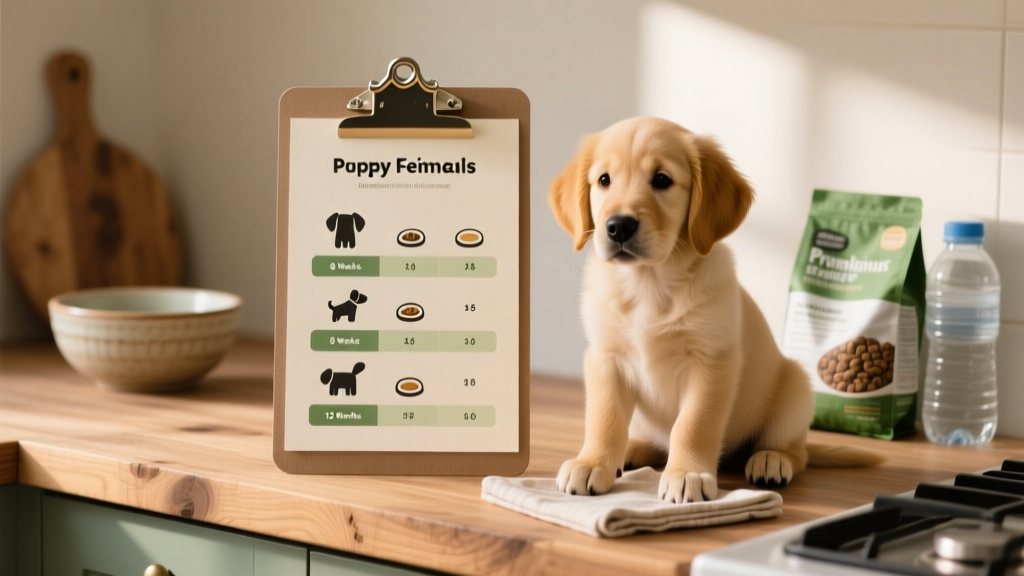
Overfeeding is a leading cause of puppy diarrhea. Use this table as a starting point for a medium-breed puppy (expected adult weight 30–50 lb / 14–23 kg) eating a standard AAFCO-approved dry puppy kibble (approximately 400 kcal/cup). Always check your specific food's feeding chart and adjust based on your puppy's body condition score — you should be able to feel ribs easily without pressing hard, and see a visible waist from above.
| Puppy Age | Weight Range (lb / kg) | Meals Per Day | Total Daily Amount (cups) | Per Meal |
|---|---|---|---|---|
| 8–12 weeks | 5–12 lb / 2.3–5.4 kg | 4 | 1 – 1½ cups | ¼ – ⅜ cup |
| 12–16 weeks | 10–18 lb / 4.5–8.2 kg | 3 | 1½ – 2 cups | ½ – ⅔ cup |
| 4–6 months | 15–30 lb / 6.8–13.6 kg | 3 | 2 – 2¾ cups | ⅔ – ¾ cup |
| 6–9 months | 25–40 lb / 11.3–18.1 kg | 2 | 2½ – 3½ cups | 1¼ – 1¾ cups |
| 9–12 months | 30–50 lb / 13.6–22.7 kg | 2 | 2¾ – 3¾ cups | 1⅜ – 1⅞ cups |
Diarrhea-prevention feeding rules: Never free-feed (leave food out all day). Pick up uneaten food after 15 minutes. Avoid sudden protein changes. Limit treats to ≤10% of daily caloric intake. Skip dairy, fatty table scraps, and sugar-free products containing xylitol (toxic to dogs — call ASPCA Animal Poison Control at (888) 426-4435 if ingested).
My Puppy Has Diarrhea: When to Monitor vs. When to Rush to the Vet
- Bloody diarrhea (bright red streaks or dark, tarry stools)
- Diarrhea combined with vomiting, lethargy, or refusal to eat for 12+ hours
- Signs of dehydration: tacky gums, skin that doesn't snap back when gently pinched, sunken eyes
- Diarrhea in a puppy under 8 weeks old or under 3 lb (1.4 kg)
- Known or suspected exposure to parvovirus (unvaccinated puppy + diarrhea = emergency)
- Diarrhea lasting more than 48 hours in any puppy under 6 months
Home monitoring is reasonable if your puppy is acting normally — playful, drinking water, no vomiting — and the stool is simply soft or unformed (not watery, not bloody). In these cases:
- Withhold food for 12 hours (water should remain available at all times).
- Offer a bland diet: boiled boneless skinless chicken breast (shredded) mixed with plain white rice in a 1:2 ratio. Feed ¼ cup per 10 lb of body weight, divided into 3–4 small meals over the next 24–48 hours.
- Gradually reintroduce regular kibble over 2–3 days once stools firm up.
- Add a canine-specific probiotic (e.g., Purina FortiFlora or Proviable-DC) to support gut flora recovery.
Common causes by age: In 8–12 week puppies, stress colitis and dietary indiscretion top the list. In 12–16 week puppies, parasites (giardia, coccidia, roundworms) are extremely common — a fecal float test at your vet ($35–$65) can identify these. In any unvaccinated or partially vaccinated puppy, parvovirus must be ruled out; a SNAP Parvo test at the clinic costs $50–$85 and returns results in 10 minutes.
According to the Merck Veterinary Manual, the most common infectious causes of puppy diarrhea include parvovirus, coronavirus, giardia, coccidia, and bacterial overgrowth (Campylobacter, Salmonella). Non-infectious causes include dietary changes, stress, foreign body ingestion, and food intolerances.
Vaccination Schedule: Exact Weeks and Vaccine Names
Vaccination timing is non-negotiable for your puppy's survival. Parvovirus alone has a mortality rate of up to 91% in untreated puppies, according to the AVMA. Here is the standard core vaccination schedule for a medium-breed puppy:
| Age | Vaccine | What It Protects Against | Estimated Cost |
|---|---|---|---|
| 6–8 weeks | DHPP (1st dose) | Distemper, Hepatitis (Adenovirus-2), Parainfluenza, Parvovirus | $25–$40 |
| 10–12 weeks | DHPP (2nd dose) + Bordetella (optional) | Same as above; Bordetella adds kennel cough protection | $30–$50 |
| 14–16 weeks | DHPP (3rd dose) + Rabies | Core combo + rabies (legally required in most US states) | $40–$65 |
| 12–16 months | DHPP booster + Rabies booster | Long-term immunity confirmation | $45–$75 |
Non-core vaccines your vet may recommend based on lifestyle: Leptospirosis (if your puppy will be around wildlife or standing water), Lyme disease (tick-endemic areas), and Canine Influenza H3N2/H3N8 (boarding/daycare environments). These typically add $25–$45 per vaccine to your costs.
When can my puppy go outside and meet other dogs? Your puppy should not visit public parks, pet stores, or areas where unknown dogs have been until 7 days after the final DHPP dose at 14–16 weeks (approximately 17 weeks of age). However, controlled socialization with fully vaccinated, known-healthy dogs in private yards is safe and encouraged from 8 weeks onward — this is critical for the socialization window.
Socialization Window (Weeks 3–14): The Critical Exposure Checklist
Research published in the Journal of Veterinary Behavior consistently shows that puppies who lack adequate socialization before 14 weeks are significantly more likely to develop fear-based aggression and anxiety disorders. This window closes rapidly — you have roughly 6 weeks from the day you bring your puppy home at 8 weeks to maximize exposure.
Rule of thumb: Aim for 3–5 new positive experiences per day. Keep sessions short (5–10 minutes). If your puppy shows fear (cowering, tail tucking, freezing), increase distance from the stimulus and offer high-value treats (boiled chicken, cheese). Never force exposure — this creates negative associations that are harder to undo than no exposure at all.
Potty Training Timeline and Troubleshooting
When will my puppy be fully potty trained? Realistically, most medium-breed puppies achieve reliable house training between 4 and 6 months of age, with occasional accidents possible until 9 months. "Reliable" means fewer than 1 accident per month when you maintain a consistent schedule. Claims of "potty trained in 3 days" are marketing fiction.
The biological reality: A puppy can hold their bladder for approximately 1 hour per month of age, plus 1. So a 3-month-old puppy can hold it roughly 4 hours — but that's the absolute maximum, not the target. Take them out far more frequently than you think necessary.
| Age | Daytime Outings (Frequency) | Nighttime Expectation | Typical Accident Rate |
|---|---|---|---|
| 8–10 weeks | Every 1–1.5 hours | 1–2 wake-ups needed | 3–5 per day is normal |
| 10–14 weeks | Every 1.5–2 hours | 1 wake-up (around 2–3 a.m.) | 1–3 per day |
| 14–20 weeks | Every 2–3 hours | Most sleep through (6–8 hours) | 0–2 per week |
| 5–6 months | Every 3–4 hours | Full night (8+ hours) | 0–1 per month |
Diarrhea complicates potty training significantly. A puppy with loose stools physically cannot hold it as long. During diarrhea episodes, double your outing frequency and use an enzymatic cleaner (Nature's Miracle or Rocco & Roxie, $10–$18 per bottle) on any indoor accidents to eliminate odor cues that trigger repeat incidents.
Crate training progression by age:
- 8–10 weeks: 30–60 minutes maximum while you're home; crate next to your bed at night
- 10–14 weeks: 1–2 hours during the day; begin moving crate to a nearby room
- 14–16 weeks: 2–3 hours maximum (never exceed 4 hours for a puppy under 6 months)
- 4–6 months: 3–4 hours during the day
- 6+ months: 4–6 hours maximum — no dog of any age should be crated longer than 8 hours regularly
Teething Timeline (3–6 Months): Relief Strategies
Your puppy's 28 baby teeth begin falling out around 12–16 weeks as 42 permanent teeth push through the gums. This process is uncomfortable, and chewing is your puppy's self-soothing mechanism. Expect increased drooling, mild gum bleeding (pink-tinged chew toys are normal), and occasional reluctance to eat hard kibble.
Safe chew recommendations by stage:
- 12–16 weeks: Frozen damp washcloths (twist and freeze), rubber teething rings (Kong Puppy, $8–$12), chilled carrot sticks
- 16–24 weeks: Kong Classic (red rubber, $12–$18) stuffed with plain pumpkin and kibble, Nylabone Puppy Chew ($6–$10), bully sticks (supervised, 6-inch max for medium breeds, $4–$8 each)
- 6+ months: Transition to adult-durability chews; avoid antlers and weight-bearing bones (fracture risk for developing teeth)
Never use: Ice cubes (can crack teeth), rawhide from unknown sources (choking and contamination risk), cooked bones (splinter hazard), or any chew small enough to swallow whole.
Common Puppy Problems: Biting, Whining, and Chewing Solutions
How do I stop puppy biting and nipping?
Puppy biting peaks between 8 and 16 weeks and is a normal exploratory behavior, not aggression. Use this force-free protocol:
- When teeth touch skin, say "Oops!" in a calm, neutral tone and immediately withdraw attention for 10–15 seconds (stand up, turn away, or step behind a baby gate).
- Return and redirect to an appropriate chew toy. Praise calmly when the puppy mouths the toy.
- Ensure your puppy gets 2–3 structured play sessions daily with tug toys (rules: "drop it" on cue, game ends if teeth touch skin).
- Provide adequate mental stimulation: 10 minutes of sniffing a treat scatter on a snuffle mat tires a puppy as much as 30 minutes of physical exercise.
Biting typically decreases significantly by 5–6 months as adult teeth settle and impulse control improves. If biting intensifies after 6 months or involves growling and stiffening, consult a certified professional dog trainer (CPDT-KA) or veterinary behaviorist.
Nighttime whining in the crate
First 3–5 nights: expect whining. Place the crate in your bedroom. Cover the crate with a light blanket on three sides. Use a heartbeat toy (Snuggle Puppy, $30–$45) or a ticking clock wrapped in a towel. If your puppy whines after 2 a.m. and you've already done a potty break, wait 5–10 minutes before responding — often they settle on their own. If whining persists, take them out on leash (no play), then return to crate immediately.
Destructive chewing
Provide 5–7 approved chew items rotated every 2–3 days to maintain novelty. Puppy-proof your home: use bitter apple spray ($8–$12) on furniture legs, keep shoes in closed closets, and use baby gates to limit unsupervised access. A puppy under 6 months should never have free roam of the house.
First-Year Cost Breakdown: What to Budget
| Category | Items | Estimated Cost (USD) |
|---|---|---|
| Veterinary — Preventive | 3 DHPP vaccines, rabies, fecal tests (×2), heartworm test, deworming (×3) | $300–$500 |
| Veterinary — Wellness | Spay/neuter surgery, microchip, pre-anesthetic bloodwork | $350–$700 |
| Veterinary — Illness | Diarrhea workup (fecal float, parvo test, medications), ear infection treatment | $150–$400 |
| Food | Puppy kibble (12 months, ~4–6 bags at 30 lb each) | $250–$500 |
| Supplies | Crate, bed, bowls, leash, harness, collar, ID tags, gates, enzymatic cleaner, toys, chews | $200–$450 |
| Training | Group puppy class (6–8 weeks), optional private sessions | $150–$400 |
| Preventive Medications | Monthly heartworm/flea/tick prevention (12 months) | $200–$400 |
| TOTAL FIRST YEAR | $1,600–$3,350 |
Pet insurance purchased before your puppy's first vet visit (typically $30–$60/month for accident-and-illness coverage) can offset unexpected costs. Most policies exclude pre-existing conditions, so enrolling early — before any diarrhea visit is documented — is strategically important.
Frequently Asked Questions
When should I bring my puppy home?
Between 8 and 10 weeks of age. Earlier removal from the litter increases the risk of stress diarrhea, poor bite inhibition, and fear-based behavioral issues. If your puppy must come home earlier (rescue situations), work closely with your vet on gut health support and accelerated socialization.
How often should I feed my puppy?
Four meals per day from 8–12 weeks, three meals per day from 12 weeks to 6 months, and two meals per day from 6 months onward. See the feeding schedule table above for exact portions. Consistent meal timing also makes potty training more predictable — puppies typically need to eliminate 15–30 minutes after eating.
What vaccines does my puppy need and when?
Core vaccines: DHPP at 6–8 weeks, 10–12 weeks, and 14–16 weeks, plus rabies at 12–16 weeks. Non-core vaccines (Bordetella, Leptospirosis, Lyme, Canine Influenza) depend on your puppy's lifestyle and local disease prevalence. Your veterinarian will determine the appropriate protocol for your area.
My puppy has diarrhea after every meal — is this normal?
No. Consistent post-meal diarrhea suggests a food intolerance, parasite burden, or underlying gastrointestinal issue. Common culprits include high-fat diets, sudden food transitions, and parasites like giardia. Schedule a vet visit for a fecal panel ($35–$65) and discuss a limited-ingredient or novel-protein diet trial.
When can my puppy go outside and meet other dogs?
Controlled play with known, fully vaccinated dogs in private settings is safe from 8 weeks. Public spaces (dog parks, pet stores, sidewalks where unknown dogs walk) should wait until 7 days after the final DHPP booster at 14–16 weeks — approximately 17 weeks of age. This balances disease risk with the critical socialization window.
How do I stop puppy biting?
Withdraw attention immediately when teeth touch skin, redirect to appropriate chews, and provide structured play with tug toys and mental enrichment. Biting naturally decreases by 5–6 months. Never use physical punishment, alpha rolls, or aversive tools — these increase fear and can escalate to defensive aggression.
Disclaimer: This guide provides general educational information. Always consult your veterinarian for diagnosis and treatment of your puppy's specific health concerns. If your puppy has diarrhea accompanied by blood, vomiting, or lethargy, seek veterinary care immediately.
Aaron Whyte
All our authors care for dogs every day — read more of their work on the authors page.