Louisiana Leopard Dog Puppies: Complete Care & Milestone Guide
Everything you need to raise Louisiana Leopard Dog puppies — age milestones, feeding schedules, vaccination timelines, potty training, and first-year costs.
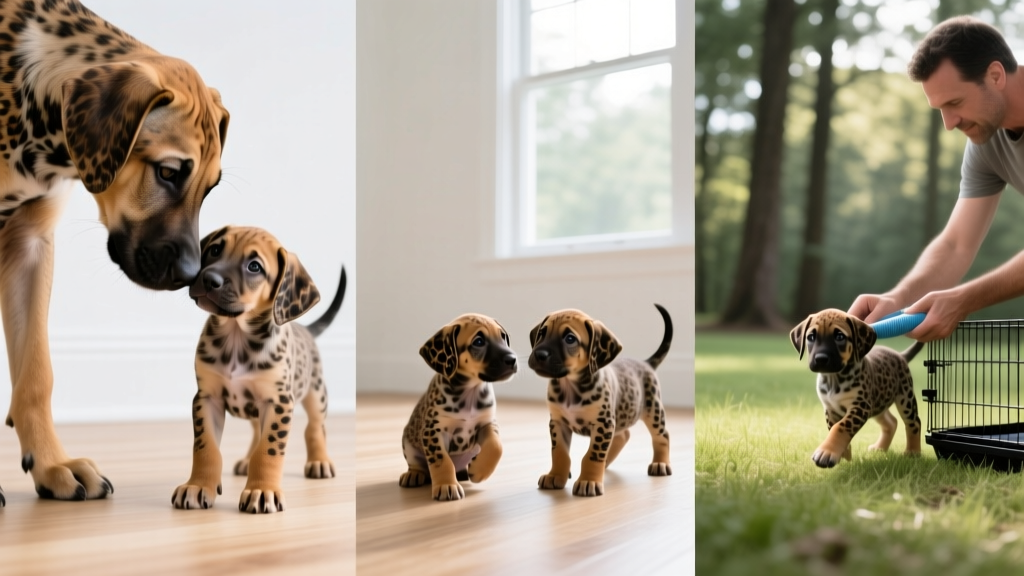
Bringing Home a Louisiana Leopard Dog Puppy: What Makes This Breed Unique
The Catahoula Leopard Dog — Louisiana's state dog and the breed most commonly referenced when people search for "Louisiana Leopard Dog puppies" — is unlike any other companion you've owned. Originally bred to herd wild hogs through the swamps of northern Louisiana, these puppies carry a genetic cocktail of intensity, intelligence, and independence that shows up from day one. If you've committed to raising one, you need a roadmap that accounts for their specific developmental quirks: early wariness of strangers, high prey drive that emerges as early as 10 weeks, and a sensitivity to harsh correction that can shut them down entirely.
This guide walks you through every critical window from 4 weeks to 12 months with breed-specific expectations, exact feeding portions, vaccination timelines aligned with AAHA canine vaccine guidelines, and real first-year cost projections. Catahoulas mature slower than many herding breeds — expect puppy behaviors well into month 14 — so patience and structure are non-negotiable.
When Should I Bring My Louisiana Leopard Dog Puppy Home?
The ideal window is 8 to 10 weeks of age. Responsible Catahoula breeders typically hold puppies until at least 8 weeks because the breed benefits from extended littermate socialization — Catahoulas can develop resource guarding tendencies if separated too early. Weeks 8-10 give you the prime socialization overlap while the puppy still has maternal antibodies providing partial disease protection.
Some breeders of working-line Catahoulas hold puppies to 10-12 weeks to evaluate temperament and structure before placement. If your puppy comes home at 10 weeks, you haven't missed the socialization window — but you'll need to compress your exposure work into weeks 10-14 rather than spreading it across 10+ weeks.
Age-Specific Milestones: What to Expect Each Week
Catahoula Leopard Dogs develop on a slightly extended timeline compared to retrievers or spaniels. Here's what's realistic at each stage:
Weeks 4-8 (Still With Breeder)
- Physical: Eyes fully open, adult coat beginning to emerge over puppy fuzz. Weight should be 4-7 lb (1.8-3.2 kg) depending on litter size and genetics.
- Behavioral: Littermate play teaches bite inhibition — puppies learn that hard bites end the game. This is why early separation damages bite control.
- Sensory: Startle responses to loud noises peak around week 5. A good breeder introduces varied surfaces (tarps, gravel, metal grates) during this fear imprint period.
- What you should verify: Ask your breeder for proof of early neurological stimulation (ENS) protocols and a deworming schedule starting at 2 weeks.
Weeks 8-12 (First Month Home)
- Physical: Rapid growth phase. Expect weight gain of 1.5-2.5 lb (0.7-1.1 kg) per week. Adult Catahoulas range from 50-95 lb (23-43 kg), so your puppy may weigh 10-18 lb (4.5-8.2 kg) by week 12.
- Behavioral: Fear periods occur around weeks 8-10 and again at 12 weeks. Your puppy may suddenly react to objects or people they previously ignored. Do not force interactions — let them approach at their own pace.
- Cognitive: Catahoulas problem-solve earlier than many breeds. Expect your puppy to figure out simple gate latches, crate doors, and food puzzle toys by week 11.
- Training capacity: Can learn sit, down, name recognition, and "come" with 3-5 minute sessions, 3x daily.
Weeks 12-16
- Physical: Baby teeth begin loosening. Weight should be 20-35 lb (9-16 kg). Legs may appear disproportionately long — this is normal for the breed's rangy build.
- Behavioral: Prey drive becomes obvious. Your puppy may stalk cats, chase squirrels with intense focus, or fixate on moving vehicles. Begin "leave it" and "watch me" training immediately.
- Social: The critical socialization window closes around week 14. After this point, new experiences create cautious responses rather than neutral ones. Front-load exposure work.
- Independence: Catahoulas start testing boundaries around week 14. Consistency in rules now prevents stubborn habits later.
Weeks 16-24 (4-6 Months)
- Physical: Adult teeth fully in by 6 months. Weight reaches 35-55 lb (16-25 kg). Growth plates remain open — avoid repetitive high-impact exercise (agility jumps, long runs on pavement) until your vet confirms plate closure, typically around 12-14 months for this breed.
- Behavioral: Second fear period often hits around 6-8 months. Adolescent Catahoulas may become suddenly reactive to stimuli they previously tolerated. Maintain positive exposure without flooding.
- Training: Can handle 15-20 minute sessions. Introduce place training, leash manners, and recall with long-line work in fenced areas.
Months 6-12
- Physical: Approaching adult size (50-95 lb / 23-43 kg). Sexual maturity — spay/neuter typically recommended between 6-9 months unless your vet advises otherwise for orthopedic reasons in larger individuals.
- Behavioral: Adolescent testing peaks between 8-10 months. Recall reliability often drops. Return to long-line training rather than giving full off-leash freedom.
- Energy: This is peak energy for the breed. Expect 60-90 minutes of structured exercise daily, plus mental work (scent games, puzzle feeders, herding ball). A bored adolescent Catahoula will invent destructive entertainment.
Feeding Schedule: Exact Portions by Age and Weight
Catahoulas are active, lean-muscled dogs that need high-quality fuel without excess calories that stress developing joints. Feed a food meeting AAFCO standards for growth (look for the "complete and balanced for growth" statement on the bag). Large-breed puppy formulas with controlled calcium-phosphorus ratios (1.1:1 to 1.4:1) are ideal for Catahoulas given their eventual size.
| Age | Meals Per Day | Daily Amount (Dry Kibble) | Notes |
|---|---|---|---|
| 8-12 weeks | 3-4 meals | 1.5-2.5 cups/day | Soak kibble in warm water for first week if puppy struggles with hard pieces |
| 3-6 months | 3 meals | 2-3.5 cups/day | Adjust based on body condition score — ribs should be palpable but not visible |
| 6-12 months | 2 meals | 3-4.5 cups/day | Transition to adult formula at 12 months; reduce to 2.5-4 cups if activity level drops |
Caloric targets: A growing Catahoula puppy needs approximately 55-65 calories per kilogram of expected adult weight during months 2-6, tapering to 45-55 cal/kg from 6-12 months. For a puppy projected at 70 lb (32 kg) adult weight, that's roughly 1,760-2,080 calories/day at 4 months and 1,440-1,760 calories/day at 8 months. Check your food's caloric density (kcal/cup) and adjust accordingly.
Transitioning foods: Mix 25% new food with 75% old food for days 1-3, then 50/50 for days 4-6, then 75% new for days 7-9. Catahoulas can have sensitive stomachs during transitions — expect loose stool for 24-48 hours even with gradual switching.
Vaccination Schedule for Louisiana Leopard Dog Puppies
Your breeder should provide documentation of the first deworming round (typically at 2, 4, and 6 weeks) and possibly the first DHPP vaccine at 6-8 weeks. Here's the standard schedule your veterinarian will follow, based on Merck Veterinary Manual and AAHA guidelines:
| Age | Vaccine | Notes |
|---|---|---|
| 6-8 weeks | DHPP (Distemper, Hepatitis, Parainfluenza, Parvovirus) — 1st dose | Often given by breeder; verify documentation |
| 10-12 weeks | DHPP — 2nd dose; Bordetella (optional, recommended if attending puppy classes) | Bordetella can be intranasal or injectable |
| 14-16 weeks | DHPP — 3rd dose; Rabies (required by law in all US states) | Rabies is a core vaccine and legally mandated |
| 12-16 months | DHPP booster; Rabies booster (1-year or 3-year depending on vaccine type) | After this, DHPP typically moves to 3-year intervals |
Leptospirosis note: Catahoulas with outdoor/swamp-access lifestyles are higher-risk candidates for Leptospirosis. Ask your vet whether the Lepto vaccine (a non-core vaccine) is appropriate for your area and your dog's exposure. This is especially relevant in the Gulf Coast states where the breed originated.
Heartworm prevention: Start monthly heartworm preventive (ivermectin-based or milbemycin-based) by 8 weeks of age. The American Heartworm Society recommends year-round prevention in all 50 states. Catahoulas in endemic areas (Southeastern US) should never miss a dose.
Socialization Window: Your Weeks 3-14 Exposure Checklist
The AKC emphasizes that the primary socialization period for puppies closes around 12-14 weeks. For Catahoulas — a breed genetically predisposed to wariness and territorial behavior — this window is especially critical. Undersocialized Catahoulas are significantly more likely to develop leash reactivity, stranger-directed aggression, and fear-based resource guarding.
Before your puppy is fully vaccinated (before the 14-16 week DHPP booster), avoid dog parks and high-traffic pet areas. Instead, carry your puppy or use a stroller for exposure, and arrange controlled playdates with fully vaccinated, temperament-tested adult dogs.
Potty Training Timeline: Realistic Expectations
Catahoulas are intelligent and generally quick to learn routines, but their independent streak means they won't generalize "outside = potty" as fast as a Golden Retriever might. Expect the following realistic timeline:
| Age | Bladder Capacity | Expected Accident Frequency | Outing Frequency |
|---|---|---|---|
| 8-10 weeks | 30-45 minutes | 3-5 accidents/day is normal | Every 30-45 min while awake; every 2 hours overnight |
| 10-14 weeks | 1-2 hours | 1-3 accidents/day | Every 1-2 hours; overnight stretch to 3-4 hours |
| 14-20 weeks | 2-4 hours | 0-1 accidents/day | Every 2-3 hours; overnight stretch to 5-6 hours |
| 5-6 months | 4-6 hours | Rare accidents (illness/stress) | Every 3-4 hours; overnight 7-8 hours |
Most Catahoula puppies are reliably house-trained by 5-6 months with consistent management. "Reliable" means fewer than one accident per month. Full bladder control for 8-hour workdays doesn't develop until 8-10 months.
Troubleshooting common Catahoula potty issues:
- Submissive urination: Common in the breed when greeting. Don't punish — ignore the puppy for 30 seconds on arrival, then greet calmly at their level.
- Marking behavior (males): Can begin as early as 4 months. Interrupt with a neutral "oops" and redirect outside. Neutering reduces but doesn't always eliminate marking.
- Rain refusal: Many short-coated Catahoulas hate wet weather. Use a covered potty area or a dog raincoat during training. Don't let them "wait it out" — they'll learn that stalling gets them back inside.
Crate Training Progression: Time Limits by Age
Catahoulas adapt well to crates when introduced positively — they're den-oriented dogs that appreciate a defined safe space. However, their high energy means crating a puppy that hasn't been exercised first will result in protest barking and potential crate anxiety.
| Age | Max Crate Time (Day) | Max Crate Time (Night) | Crate Size |
|---|---|---|---|
| 8-10 weeks | 1-1.5 hours | 2-3 hours (then potty break) | 24" crate with divider panel |
| 10-14 weeks | 2-3 hours | 4-5 hours | 24-30" with divider |
| 4-6 months | 3-4 hours | 6-8 hours | 36-42" crate (adult size) |
| 6-12 months | 4-5 hours | 8 hours | 42" crate (standard adult Catahoula size) |
Exercise before crating is mandatory. A tired Catahoula puppy settles in a crate. An under-exercised one will bark, paw, and potentially injure their teeth on the crate bars. Minimum 20-30 minutes of active play or training before any crate session longer than 1 hour.
Teething Timeline (3-6 Months): Relief Strategies
Catahoula puppies begin losing baby teeth around 12-16 weeks, with all 42 adult teeth typically erupted by 6 months. During this window, their urge to chew is relentless — and Catahoulas have powerful jaw musculature even as puppies.
Safe chew options by stage:
- 12-16 weeks: Frozen wet washcloths (twist and freeze), rubber KONG Classic (puppy size, stuffed with plain yogurt and banana), Nylabone Puppy Chew (soft formula)
- 16-20 weeks: KONG Classic (medium, frozen with peanut butter — xylitol-free only), Benebone Wishbone (puppy formula), frozen carrot sticks
- 20-24 weeks: KONG Extreme (black rubber), antler alternatives like Elk Antler Chew (split, not whole — whole antlers risk tooth fractures), bully sticks (supervised, remove when small enough to swallow)
What to avoid: Rawhide (choking and intestinal blockage risk), hard nylon bones designed for adult dogs (can fracture puppy teeth), cooked bones of any kind (splintering hazard), and ice cubes (too hard for developing teeth).
Common Puppy Problems: Catahoula-Specific Solutions
Problem: Hard Biting and Nipping
Why it happens: Catahoulas are herding dogs — nipping is hardwired. Puppies use their mouths to control movement, and your ankles look like fleeing livestock.
Solution: When teeth touch skin, say "too bad" in a calm tone and immediately leave the room for 10-15 seconds (negative punishment — removing yourself). Return and redirect to a chew toy. Pair with "gentle" cue when they mouth softly. Never hold the mouth shut, alpha roll, or use bitter sprays on hands — these damage trust and can escalate biting in this sensitive breed.
Timeline: Biting intensity should decrease noticeably by 16 weeks with consistent management. Full bite inhibition (soft mouth on human skin) typically solidifies by 6 months.
Problem: Excessive Whining and Vocalization
Why it happens: Catahoulas are vocal dogs — they were bred to alert hunters. Crate whining, demand barking, and excited vocalization are breed traits, not defects.
Solution: For crate whining: ensure exercise needs are met, cover the crate with a light blanket, and use white noise. Do not release the puppy while whining (this teaches whining = freedom). Wait for 5 seconds of silence, then open. For demand barking: completely ignore (no eye contact, no verbal response) and reward silence with attention after 3-5 seconds.
Problem: Destructive Chewing
Why it happens: Under-stimulated Catahoula puppies will dismantle furniture, baseboards, and shoes. This breed needs both physical AND mental exercise — physical exercise alone isn't enough.
Solution: Provide 2-3 approved chew items at all times (rotate to maintain novelty). Use 15-minute daily training sessions as mental exercise. Introduce food puzzles (KONG Wobbler, Outward Hound Nina Ottosson puzzles). Puppy-proof by removing tempting items from floor level. Use bitter apple spray on furniture legs as a deterrent, not as the primary strategy.
Problem: Resource Guarding
Why it happens: Catahoulas have a higher-than-average genetic predisposition to resource guarding, especially around food and high-value chews.
Solution: From week 8, practice "trading up" — approach while puppy eats, drop a higher-value treat (chicken) near their bowl, and walk away. Never take food away as a "dominance test." If guarding behavior appears (freezing, growling, lip curling when approached), consult a certified positive-reinforcement trainer (CPDT-KA or IAABC certified) immediately. Early intervention prevents escalation.
When Can My Puppy Go Outside and Meet Other Dogs?
This is the question every new Catahoula owner asks, and the answer balances disease risk against the closing socialization window:
- Immediately (8+ weeks): Carry your puppy in public spaces — pet-friendly store parking lots, outdoor cafes, friends' homes with vaccinated dogs. Ground exposure in your own yard is fine if no unknown dogs have access.
- Avoid until fully vaccinated (after 16-week DHPP): Dog parks, pet store floors, grooming salons with shared equipment, and areas with heavy unknown dog traffic. Parvovirus can survive in soil for months to years and is often fatal in puppies.
- Controlled puppy classes: Many veterinary behaviorists, following AVMA-endorsed position statements, support structured puppy classes starting at 8-10 weeks IF all puppies have had at least one DHPP vaccine, the facility is sanitized between classes, and no sick dogs are admitted. The behavioral benefit of early class attendance outweighs the disease risk in controlled settings.
- Dog parks: Wait until 1-2 weeks after the final 16-week DHPP booster. Even then, Catahoula puppies can be overwhelmed by rough adult dogs. Start with small, supervised playgroups rather than open dog parks.
First-Year Cost Breakdown
Budgeting realistically prevents surprises. These ranges reflect 2025-2026 pricing across US markets:
| Category | Low Estimate | Mid Estimate | High Estimate |
|---|---|---|---|
| Puppy purchase (responsible breeder) | $600 | $1,200 | $2,500 |
| Veterinary care (vaccines, spay/neuter, wellness visits, heartworm test, fecal exams) | $500 | $800 | $1,400 |
| Food (large-breed puppy formula, 12 months) | $400 | $600 | $900 |
| Preventive medications (heartworm, flea/tick — 12 months) | $180 | $300 | $480 |
| Supplies (crate, bed, leash, harness, bowls, chews, gates, grooming tools) | $250 | $450 | $700 |
| Training (group puppy class + 1 private session minimum) | $200 | $500 | $1,200 |
| Pet insurance (optional, annual premium) | $350 | $550 | $800 |
| TOTAL FIRST YEAR | $2,480 | $4,400 | $7,980 |
Emergency fund recommendation: Set aside $500-$1,000 for unexpected vet visits. Catahoula puppies are athletic risk-takers — lacerations, swallowed foreign objects, and orthopedic injuries are more common in this breed than in lower-energy breeds.
Frequently Asked Questions
How often should I feed my Louisiana Leopard Dog puppy at 10 weeks old?
Feed 3-4 meals per day, totaling 1.5-2.5 cups of large-breed puppy kibble. Divide evenly across meals (roughly ½ to ⅔ cup per meal for 3 meals, or slightly less for 4 meals). Adjust based on your puppy's body condition — you should feel ribs easily without pressing hard, and see a visible waist from above.
When will my puppy be fully potty trained?
Most Catahoula puppies achieve reliable house training by 5-6 months with consistent management. "Reliable" means fewer than one accident per month. Full bladder control for 8-hour stretches doesn't develop until 8-10 months. If accidents increase suddenly at any age, rule out urinary tract infection with your veterinarian before assuming it's behavioral.
How do I stop puppy biting and nipping?
Use negative punishment (remove yourself for 10-15 seconds when teeth touch skin) paired with redirection to appropriate chew toys. Never use physical punishment, mouth-holding, or alpha rolls — Catahoulas are sensitive and these methods increase fear-based biting. Consistent application should reduce biting intensity by 16 weeks, with full soft-mouth behavior by 6 months.
What vaccines does my puppy need and when?
Core vaccines: DHPP at 6-8, 10-12, and 14-16 weeks, plus Rabies at 14-16 weeks. Non-core options to discuss with your vet: Bordetella (before puppy class), Leptospirosis (for outdoor/swamp-exposed dogs), and Lyme disease (in tick-endemic areas). Your veterinarian will tailor the schedule to your puppy's risk profile.
Are Catahoula Leopard Dogs good with children?
Well-socialized Catahoulas can be excellent family dogs, but they tend to herd running children (nipping at heels) and may be too boisterous for toddlers. Supervision is mandatory with children under 8. Teach children to respect the puppy's crate and sleep space. Early, positive exposure to children during the socialization window is critical for this breed.
Do I need pet insurance for my Catahoula puppy?
It's strongly recommended. Catahoulas are predisposed to hip dysplasia (estimated 10-15% prevalence based on OFA data), deafness (particularly in dogs with high white/merle coat patterns), and eye conditions including progressive retinal atrophy. Insurance premiums are lowest when enrolled at 8-10 weeks, before any pre-existing conditions are documented. Expect $30-$65/month for accident-and-illness coverage depending on deductible and reimbursement level.
Dr. Hannah Wickes
All our authors care for dogs every day — read more of their work on the authors page.