How Often Should You Bathe a Puppy? Week-by-Week Puppy Care
Wondering how often you should bathe a puppy? This complete week-by-week guide covers bathing, feeding, potty training, vaccines, and first-year costs.

If you've just brought a new puppy home — or are about to — one of the first questions that pops up is surprisingly practical: how often should you bathe a puppy? The answer depends on your puppy's age, breed, coat type, and activity level. But bathing is just one piece of a much bigger puzzle. This guide walks you through every critical milestone from week 4 through month 12, with exact feeding portions, vaccination timelines, potty training expectations, and a realistic first-year cost breakdown.
Bringing Your Puppy Home: Timing and First 48 Hours
The ideal age to bring a puppy home is 8 to 10 weeks. The American Kennel Club and most veterinary behaviorists agree that puppies benefit from staying with their littermates through at least week 8, where they learn bite inhibition, social cues, and basic canine communication. Some breeders of smaller breeds (Chihuahuas, Yorkshire Terriers) keep puppies until 10–12 weeks because toy breeds mature more slowly and are more vulnerable to hypoglycemia.
Your first 48 hours set the tone. Keep things calm: limit visitors to immediate household members, set up a confined space (a playpen or gated area with the crate, water, and a potty pad if needed), and let your puppy explore at their own pace. Expect some whining the first night — this is normal separation behavior, not a sign something is wrong.
Age-Specific Puppy Milestones: Week 4 Through Month 12
Weeks 4–8 (Still With Breeder/Litter)
- Physical: Baby teeth fully in, coordination improving rapidly, weight doubling weekly in small breeds
- Social: Critical socialization window opens (week 3–14 per the AVMA). Puppies learn play behavior, bite inhibition, and hierarchy from littermates
- Sensory: Full vision and hearing established; startle responses to loud noises begin forming lasting impressions
- Bathing: Do NOT bathe. The mother keeps puppies clean. If a puppy is soiled, use a warm damp cloth and dry immediately to prevent chilling
Weeks 8–12 (Home Transition Period)
- Physical: Rapid growth phase — expect 5–10% body weight gain per week depending on breed size
- Behavioral: Fear imprint period peaks around 8–10 weeks. Negative experiences (harsh punishment, traumatic vet visits, aggressive dogs) can create lifelong phobias
- Training: Begin name recognition, sit, and crate introduction. Keep sessions under 5 minutes
- Bathing: Spot clean only. If a full bath is absolutely necessary (e.g., puppy got into something toxic or has severe diarrhea), use lukewarm water (100–102°F / 38–39°C), puppy shampoo, and a non-slip mat. Dry thoroughly with a towel — avoid blow dryers on hot settings
Weeks 12–16 (Confidence Building)
- Physical: Adult eye color settling in, growth rate slowing slightly for medium/large breeds, still rapid for toy breeds
- Behavioral: Second fear period can occur around 12–14 weeks. Puppy may suddenly seem "spooky" about things they previously ignored
- Training: Leash introduction, come when called, begin structured potty training routine
- Bathing: First full bath can happen now if needed. Keep it positive — treats, calm voice, lukewarm water. This sets the tone for lifelong bath-time comfort
Weeks 16–24 (The Adolescent Shift)
- Physical: Baby teeth begin falling out (see teething section below), growth plates still open, adult coat starting to replace puppy fuzz
- Behavioral: Testing boundaries, increased independence, possible regression in potty training and obedience
- Training: Solidify basic commands, introduce impulse control exercises (leave it, wait), begin social walks in varied environments
- Bathing: Once a month is typically sufficient. Breeds with double coats (Golden Retrievers, Huskies) may need brushing far more often than bathing — over-bathing a double coat disrupts the undercoat's insulating properties
Months 6–12 (Approaching Maturity)
- Physical: Small breeds nearing adult size; large breeds still growing (growth plates close 12–18 months in giant breeds). Spay/neuter typically occurs around 6 months for small breeds, 9–15 months for large breeds per current veterinary guidance
- Behavioral: Adolescent energy peaks. Without adequate physical and mental exercise, destructive behaviors emerge
- Training: Advanced commands, off-leash recall work (in safe areas), continued socialization with new environments
- Bathing: Every 4–8 weeks based on lifestyle. Active outdoor dogs may need monthly baths; indoor-only dogs with short coats can go 8–12 weeks between baths
Feeding Schedule: Exact Portions by Age and Weight
Feeding frequency changes as your puppy matures. The table below uses a projected adult weight of 30 lb (14 kg) as a reference (typical for a medium breed like a Cocker Spaniel or Miniature Poodle). Adjust portions based on your specific food's caloric density — always check the feeding chart on your kibble bag and your puppy's body condition score (BCS).
| Age | Meals Per Day | Portion Per Meal (Medium Breed, ~30 lb Adult) | Daily Total (Approx.) |
|---|---|---|---|
| 8–12 weeks | 4 meals | ¼ – ⅓ cup puppy kibble | 1 – 1⅓ cups |
| 3–6 months | 3 meals | ⅓ – ½ cup puppy kibble | 1 – 1½ cups |
| 6–12 months | 2 meals | ¾ – 1 cup (transition to adult food at 12 months for medium breeds) | 1½ – 2 cups |
Critical note: Large and giant breed puppies (projected adult weight over 50 lb / 23 kg) need a large-breed puppy formula with controlled calcium and phosphorus ratios to prevent developmental orthopedic diseases like hip dysplasia and osteochondrosis. Look for an AAFCO statement that specifically says "growth" or "all life stages" and mentions large-breed growth testing.
Always provide fresh water. A puppy should drink approximately ½ to 1 ounce of water per pound of body weight daily. Restricting water to manage potty accidents is dangerous and can lead to dehydration.
Vaccination Schedule: What Your Puppy Needs and When
The American Veterinary Medical Association outlines core vaccines that every puppy needs regardless of lifestyle, plus non-core vaccines based on risk factors. Below is the standard schedule your veterinarian will follow:
| Age | Vaccine | Type | Notes |
|---|---|---|---|
| 6–8 weeks | DHPP (Distemper, Hepatitis/Adenovirus, Parainfluenza, Parvovirus) — 1st dose | Core | Often given by breeder before pickup |
| 8–10 weeks | Bordetella (Kennel Cough) | Non-core | Required for puppy classes, grooming, boarding |
| 10–12 weeks | DHPP — 2nd dose; Leptospirosis (1st of 2 doses if recommended) | Core + Non-core | Lepto recommended if hiking, rural area, or wildlife exposure |
| 12–14 weeks | Lyme disease (1st of 2 doses if recommended) | Non-core | Tick-endemic regions (Northeast, Upper Midwest, Pacific Coast) |
| 14–16 weeks | DHPP — 3rd (final puppy) dose; Rabies (required by law) | Core | Rabies timing varies by state — some require 12 weeks minimum |
| 16–18 weeks | Leptospirosis 2nd dose; Lyme 2nd dose (if started) | Non-core boosters | Both require 2-dose initial series for immunity |
Socialization Window: Weeks 3–14 Exposure Checklist
The primary socialization window closes around 14 weeks of age. According to the Merck Veterinary Manual, experiences during this period have an outsized and often permanent impact on a dog's temperament. Missing this window doesn't mean your dog is doomed — but it does mean you'll work harder later to address fear and reactivity.
Aim for positive, controlled exposure to the following before week 14. "Positive" means your puppy is relaxed, taking treats, and not showing avoidance behaviors (cowering, tail tucking, freezing):
Track your progress. Many trainers recommend the "100 exposures before 16 weeks" challenge — a structured way to ensure breadth. Keep sessions short (5–10 minutes) and always end on a positive note.
Potty Training Timeline and Troubleshooting
Let's set realistic expectations: most puppies are not reliably potty trained until 4–6 months of age, and some small breeds (which have smaller bladders and faster metabolisms) take until 8–10 months. Anyone promising a "3-day potty training method" is selling you frustration.
Here's what a realistic timeline looks like:
| Age | Bladder Hold Time (Max) | Accidents Per Week (Typical) | What to Expect |
|---|---|---|---|
| 8–10 weeks | 1–2 hours | Daily (multiple) | Puppy has almost no bladder control. Take out every 1–2 hours, plus immediately after eating, drinking, playing, and waking |
| 10–14 weeks | 2–3 hours | 3–5 per week | Puppy starts signaling (sniffing, circling, heading to door). Begin associating a verbal cue ("go potty") with the action |
| 3–4 months | 3–4 hours | 1–3 per week | Noticeable improvement. Accidents usually happen when routine is disrupted or supervision lapses |
| 4–6 months | 4–6 hours | 0–2 per week | Near-reliable if routine is consistent. Regression possible during teething or environmental changes |
| 6–12 months | 6–8 hours | Rare | Fully reliable for most dogs. Marking behavior may emerge in intact males around 6–9 months |
Troubleshooting common problems:
- Puppy pees inside 5 minutes after coming back in: They didn't actually go outside. Stand in one spot, be boring, and wait. Reward heavily when they go.
- Puppy only goes on pads, won't go outside: Gradually move the pad closer to the door over several days, then outside, then remove it. Transition slowly.
- Sudden regression at 4–5 months: Often coincides with teething (discomfort causes stress) or a growth spurt (increased water intake). Rule out a UTI with your vet if accidents spike suddenly.
Crate Training Progression and Time Limits
A crate is your puppy's safe space — not a punishment tool. The general guideline for maximum crate time is your puppy's age in months plus one, in hours (e.g., a 3-month-old can hold for approximately 4 hours). However, these are maximums, not targets. Puppies crated for the maximum duration regularly can develop anxiety and aversion.
- 8–10 weeks: 30–60 minutes max during the day; overnight, expect 1–2 wake-ups for potty breaks
- 10–14 weeks: 1–2 hours max during the day; overnight, 3–4 hours between breaks
- 3–4 months: 2–3 hours max during the day; overnight, 4–5 hours
- 4–6 months: 3–4 hours max during the day; overnight, 6–7 hours (many puppies sleep through the night by now)
- 6+ months: 4–5 hours max during the day; overnight, 8 hours is typical
Crate training steps (positive reinforcement only):
- Leave the crate door open. Toss high-value treats inside. Let puppy enter and exit freely. Do this for 2–3 days.
- Feed meals inside the crate with the door open, then closed briefly, then open again.
- Close the door while puppy is eating, step 2 feet away, return before they finish. Gradually increase distance and time.
- Leave the room for 30 seconds, return calmly. Increase to 1 minute, 5 minutes, 15 minutes over several days.
- Begin crating for short periods while you're home, then transition to leaving the house briefly.
If your puppy cries in the crate: wait for a brief pause in the crying (even 3 seconds of silence) before opening the door. Opening while they're screaming teaches them that screaming opens the door. If crying persists beyond 20–30 minutes consistently, your progression moved too fast — go back a step.
Teething Timeline: Relief Strategies and Safe Chews
Puppy teething follows a predictable pattern:
- 3–4 weeks: Deciduous (baby) teeth erupt — 28 total
- 3–4 months: Baby incisors begin loosening and falling out
- 4–5 months: Canines and premolars shed; this is peak chewing and discomfort
- 5–7 months: All 42 adult teeth should be in. Retained baby teeth (especially canines) are common in small breeds and may require veterinary extraction if they don't fall out within 2 weeks of the adult tooth erupting
Safe relief strategies:
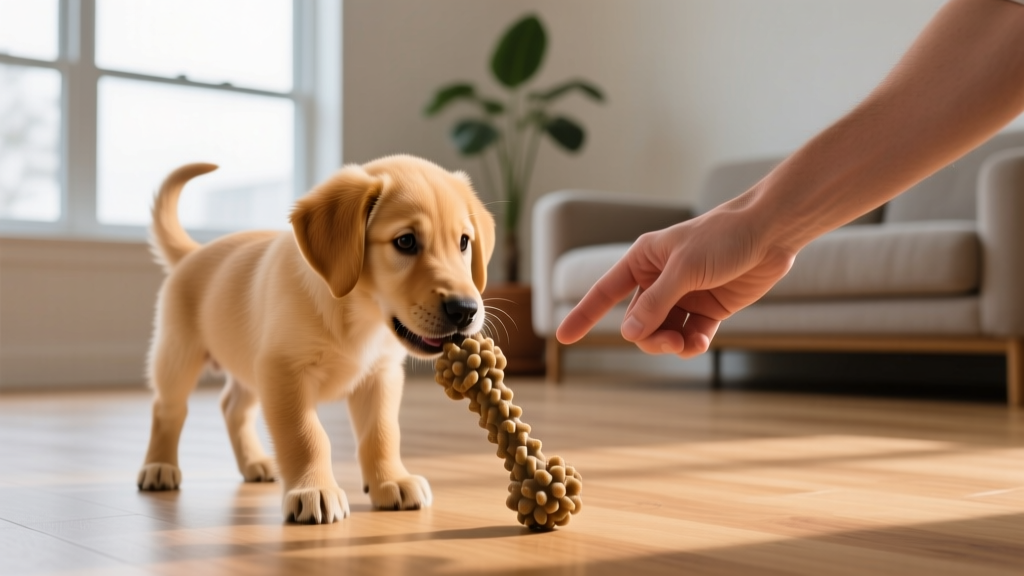
- Frozen, wet washcloth twisted into a rope (supervise — remove if pieces tear off)
- Kong Classic (puppy size) stuffed with plain yogurt and banana, frozen overnight
- Benebone Puppy or Nylabone Puppy chews (textured, size-appropriate)
- Carrot sticks (large, whole carrots — not baby carrots, which are a choking hazard for small puppies)
- Ice cubes made from low-sodium chicken broth
Avoid: Rawhide (choking and intestinal blockage risk), antlers and weight-bearing bones (tooth fractures), any chew toy small enough to swallow whole, and "teething gels" containing benzocaine (toxic to dogs).
Common Puppy Problems and Solutions
Puppy Biting and Nipping
Why it happens: Puppies explore the world with their mouths. Littermates teach bite inhibition — when you remove a puppy from the litter, you become the teacher.
Solution: When teeth touch skin, say "ouch" in a calm, medium-volume voice and immediately withdraw attention (stand up, turn away, or step behind a baby gate) for 10–15 seconds. Return and redirect to an appropriate chew toy. Consistency from every household member is essential. Never hold the puppy's mouth shut, hit, or use physical punishment — these methods increase fear-based aggression.
Nighttime Whining
Why it happens: Separation from littermates, need to eliminate, or general overstimulation from a new environment.
Solution: Place the crate near your bed for the first 1–2 weeks so your puppy can hear and smell you. Set an alarm for one overnight potty break (around 3–4 hours after bedtime). Keep overnight interactions boring — no play, no talking, dim lights, straight outside and back to crate. A Snuggle Puppy (with heartbeat simulator) or a warm water bottle wrapped in a towel can ease the transition.
Destructive Chewing
Why it happens: Teething discomfort, boredom, insufficient exercise, or anxiety.
Solution: Puppy-proof your home (use bitter apple spray on baseboards, manage access with baby gates, pick up shoes and cords). Provide 4–6 appropriate chew options of varying textures. Rotate toys weekly to maintain novelty. Ensure your puppy gets adequate physical exercise (5 minutes of structured exercise per month of age, twice daily — e.g., a 4-month-old gets 20-minute walks) and mental stimulation (food puzzles, sniffy walks, short training sessions).
Bathing Your Puppy: The Full Breakdown
Now let's address the core question in detail. How often should you bathe a puppy? Here's the comprehensive answer based on coat type and age:
| Coat Type | Bath Frequency (3–6 months) | Bath Frequency (6–12 months) | Notes |
|---|---|---|---|
| Short/smooth (Boxer, Beagle, Doberman) | Every 6–8 weeks | Every 8–12 weeks | Wipe down with damp cloth between baths; these coats need minimal bathing |
| Double coat (Golden Retriever, Husky, German Shepherd) | Every 6–8 weeks | Every 6–8 weeks | Brush 3–5x per week; over-bathing damages the weatherproof undercoat |
| Curly/wavy (Poodle, Doodle, Bichon) | Every 4–6 weeks | Every 3–4 weeks | Regular grooming essential; matting occurs quickly without maintenance |
| Wire/harsh (Schnauzer, Terriers) | Every 6–8 weeks | Every 4–6 weeks | Hand-stripping may be needed; use shampoo formulated for wire coats |
| Long/silky (Shih Tzu, Maltese, Afghan) | Every 3–4 weeks | Every 2–3 weeks | Daily brushing mandatory; use conditioner to prevent tangles |
Bathing best practices:
- Water temperature: 100–102°F (38–39°C) — slightly warmer than your comfort preference
- Use only puppy-formulated, soap-free, pH-balanced shampoo (canine skin pH is 6.2–7.4 vs. human skin at 5.5)
- Avoid eyes, ears, and nose. Place a cotton ball in each ear canal before bathing to prevent water entry and potential ear infections
- Rinse thoroughly — residual shampoo is the #1 cause of post-bath skin irritation
- Towel dry, then keep puppy in a warm, draft-free area until fully dry. For thick-coated breeds, a high-velocity dog dryer on cool/warm (never hot) setting is far more effective than a human hair dryer
First-Year Cost Breakdown
New puppy owners are frequently surprised by first-year expenses. Here's a realistic breakdown for a medium-breed puppy in the US (costs vary by region — expect 20–40% higher in major metro areas):
| Category | Low Estimate | High Estimate | Details |
|---|---|---|---|
| Puppy purchase/adoption | $300 (rescue) | $3,500+ (breeder) | Varies enormously by breed and source |
| Veterinary (vaccines, spay/neuter, wellness) | $600 | $1,500 | Includes initial vaccine series, fecal tests, heartworm prevention, spay/neuter |
| Food (puppy formula) | $300 | $700 | Based on quality kibble at $2–4/lb; raw diets cost significantly more |
| Supplies (crate, bed, bowls, leash, harness, toys) | $250 | $600 | Wire crate ($50–80), quality harness ($25–50), chew toys ($50–100) |
| Training (group classes or private) | $150 (group) | $800+ (private) | 6-week group puppy class: $150–250; private sessions: $80–150/hour |
| Grooming (if applicable) | $0 (short coat) | $600+ (curly/long coat) | Professional grooming every 4–6 weeks at $50–80/session |
| Preventive medications (flea/tick, heartworm) | $200 | $450 | Year-round prevention recommended in most US regions |
| TOTAL (excluding purchase price) | $1,500 | $4,650+ | Does not include emergency vet visits or pet insurance ($30–70/month) |
Budget tip: Pet insurance purchased before your puppy develops any conditions typically costs $30–50/month for accident-and-illness coverage with a $250 deductible. This can save thousands if your puppy swallows a foreign object (intestinal surgery averages $3,000–7,000) or develops a chronic condition. Pre-existing conditions are never covered, so enrolling early is critical.
Frequently Asked Questions
When can my puppy go outside and meet other dogs?
Your puppy can go outside in controlled, low-risk environments (your own yard, a friend's fenced yard with a known-vaccinated dog) immediately after coming home. However, avoid high-traffic dog areas (dog parks, pet store floors, busy sidewalks with unknown dogs) until 5–7 days after the final DHPP booster at 14–16 weeks. Carrying your puppy in a sling or backpack for neighborhood walks provides safe socialization exposure during this vulnerable period.
How often should I feed my puppy at 10 weeks old?
At 10 weeks, feed 4 meals per day spaced roughly 4 hours apart during waking hours. Example schedule: 7 AM, 11 AM, 3 PM, 7 PM. Remove uneaten food after 15–20 minutes to establish meal-time routine and make potty timing more predictable.
How do I stop my puppy from biting my hands and ankles?
Redirect to an appropriate chew toy every single time teeth touch skin. If nipping continues, implement a brief time-out: calmly place the puppy in their crate or a playpen for 30–60 seconds, then release and try again. This teaches that biting ends play. Consistency across all family members is non-negotiable — if one person allows mouthing and another doesn't, the puppy will be confused and the behavior will persist longer.
What if my puppy has an accident in the house?
Clean it with an enzymatic cleaner (Nature's Miracle or Rocco & Roxia are reliable brands) that breaks down the uric acid crystals. Standard household cleaners don't eliminate the scent markers that draw puppies back to the same spot. Never punish a puppy for an accident you discover after the fact — they cannot connect the punishment to the action. If you catch them mid-act, clap once to interrupt, carry them outside immediately, and reward if they finish outdoors.
Should I use pee pads?
Pee pads can be useful for apartment dwellers without easy outdoor access, toy breeds with tiny bladders, or as a temporary overnight solution. However, they can slow outdoor potty training because they teach the puppy that indoor elimination is acceptable. If you use them, place them near the door and gradually move them outside over 1–2 weeks.
When will my puppy sleep through the night?
Most puppies sleep through the night (6–8 hours without a potty break) between 3 and 4 months of age. To get there: take away water 1.5–2 hours before bedtime, provide a final potty break right before crating, and set one overnight alarm for the first few weeks. Gradually push the alarm later until it's no longer needed.
Robin Maitland
All our authors care for dogs every day — read more of their work on the authors page.