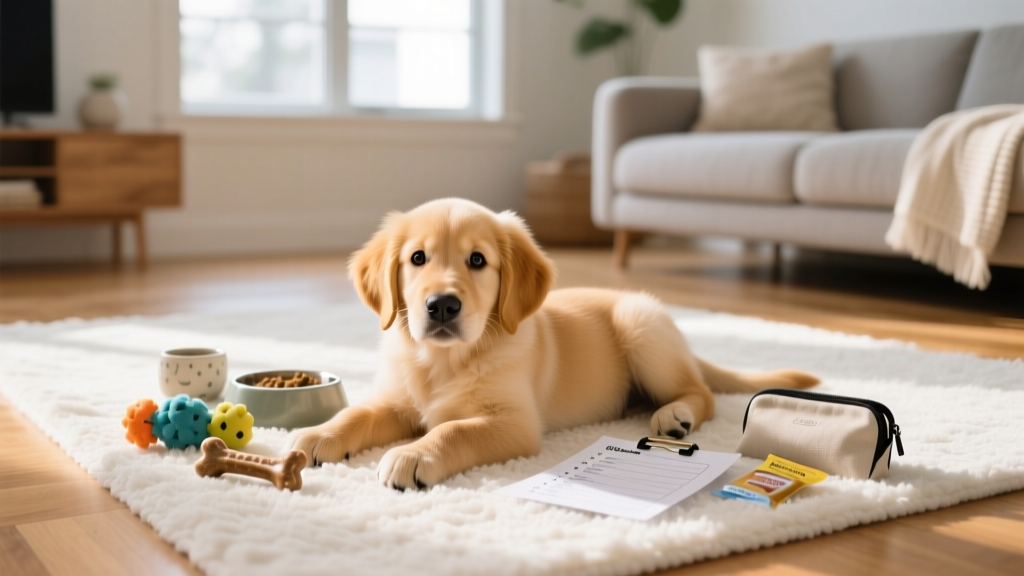
Good Puppy Names for Golden Retrievers: First-Year Care Guide
Picking good puppy names for your Golden Retriever? This first-year guide covers milestones, feeding, potty training, vaccines, costs, and naming tips.

Picking Good Puppy Names for Your Golden Retriever (And Everything Else You Need to Know)
You've decided on a Golden Retriever puppy. Now comes the fun part — and the hard part, which often happen simultaneously. Choosing good puppy names for a Golden Retriever means finding something that suits a dog who will grow from a 10-pound fluffball into a 65-pound athlete with the emotional intelligence of a therapist. But naming your puppy is just the beginning of a very busy first year.
This guide pairs naming strategy with a complete, week-by-week roadmap for raising a Golden Retriever puppy in 2026. Golden Retrievers have specific developmental needs — their socialization window is narrow, their growth rate predisposes them to joint issues if overfed, and their mouthiness (they're retrievers, after all) requires targeted management. We'll cover every milestone from the day you bring them home through their first birthday, with exact feeding amounts, crate time limits, vaccine schedules, and a realistic first-year budget.
When Should I Bring My Golden Retriever Puppy Home?
The American Kennel Club and most responsible breeders release Golden Retriever puppies between 8 and 10 weeks of age. Some breeders hold puppies until 10-12 weeks, particularly for show or working lines, to allow additional littermate socialization and an extra round of vaccinations before the transition.
Bringing a puppy home before 8 weeks is strongly discouraged. The weeks between 6 and 8 are critical for bite inhibition learning — puppies teach each other how hard is too hard through play. Removing a Golden puppy from the litter at 6 weeks often results in a harder-mouthed adolescent, which is the last thing you want from a breed already known for carrying everything in their mouth.
First 48 hours home: Expect disrupted sleep, whining in the crate, and possibly loose stools from stress. This is normal. Keep the environment calm, limit visitors to immediate household members, and sleep with the crate in your bedroom so your puppy can hear and smell you.
Golden Retriever Puppy Milestones: Weeks 4 Through 12 Months
Golden Retrievers mature more slowly than many breeds. While a Border Collie might be functionally adult at 12 months, your Golden will continue filling out physically and mentally until 18-24 months. Here's what to expect at each stage.
Weeks 4-8 (Still With the Breeder)
During this period, puppies transition from mother's milk to gruel to solid food. Their baby teeth are fully erupted. The fear imprint period begins around week 8, meaning traumatic experiences during this window can have lasting effects. A good breeder introduces novel surfaces (tarps, wobble boards, different flooring), sounds (vacuum, doorbell recordings), and gentle handling by multiple people. Puppies should receive their first DHPP vaccine at 6-8 weeks and be dewormed on a schedule starting at 2 weeks.
Weeks 8-12 (The Adjustment Period)
This is your bonding window. Your Golden puppy will be highly impressionable, eager to follow you, and relatively easy to manage. They'll sleep 18-20 hours per day. Expect attention spans of 5-10 minutes for training sessions. House training accidents will be frequent — a puppy this age can hold their bladder for approximately 1 hour per month of age, so a 2-month-old puppy needs potty breaks every 2 hours, including overnight. Mouthing and nipping peak during this stage as puppies explore the world with their mouths and experience early teething discomfort.
Weeks 12-16 (Confidence Building)
Your puppy is gaining coordination and confidence. This is the ideal window for introducing crate training as a positive space, beginning leash walking in low-distraction environments, and enrolling in a positive-reinforcement puppy kindergarten class. The second fear period may emerge around 12-14 weeks — your previously bold puppy may suddenly startle at trash cans or refuse to walk on certain surfaces. Respond with calm encouragement and treats; never force them toward something that frightens them.
Weeks 16-24 (The Adolescent Shift Begins)
Baby teeth start falling out around 16 weeks (4 months), and the chewing intensity ramps up significantly. You'll find tiny teeth on the floor and blood spots on chew toys — both normal. This is when many Golden owners feel they're losing control: recall that worked at 12 weeks may suddenly fail, and jumping/mouthing behaviors can resurge with more force behind them. Consistency in training is critical here. Spay/neuter surgery typically occurs during this window (your veterinarian will advise on optimal timing based on your puppy's growth and current research on joint development in large breeds).
Months 6-12 (Full Adolescence)
Your Golden Retriever is now physically large (40-60 lb / 18-27 kg) but emotionally still a puppy. Hormonal surges in intact dogs can cause increased roaming, marking, and selective hearing. Energy levels are high — plan for 45-60 minutes of structured exercise daily, split into multiple sessions to protect developing joints. Avoid forced running, agility jumps, or repetitive fetch on hard surfaces until growth plates close (typically 14-18 months for Goldens, per Merck Veterinary Manual). Mental stimulation — puzzle feeders, scent games, training sessions — tires them out more effectively than physical exercise alone.
Golden Retriever Puppy Feeding Schedule by Age and Weight
Golden Retrievers are prone to rapid growth, which increases the risk of hip and elbow dysplasia. Research published in the Journal of the American Veterinary Medical Association has shown that keeping large-breed puppies lean and on controlled-calorie diets reduces the incidence of developmental orthopedic disease. Your puppy should be on a food specifically formulated for large-breed puppies — these contain controlled calcium and phosphorus ratios and lower caloric density than standard puppy formulas.
| Age | Estimated Weight | Meals Per Day | Total Daily Amount | Notes |
|---|---|---|---|---|
| 8-12 weeks | 10-20 lb (4.5-9 kg) | 3 meals | 1.5 - 2 cups | Soften kibble with warm water if needed |
| 3-4 months | 20-35 lb (9-16 kg) | 3 meals | 2 - 2.75 cups | Transition to dry kibble |
| 4-6 months | 35-50 lb (16-23 kg) | 2 meals | 2.75 - 3.5 cups | Drop midday meal gradually |
| 6-9 months | 50-60 lb (23-27 kg) | 2 meals | 3 - 3.75 cups | Monitor body condition score closely |
| 9-12 months | 55-70 lb (25-32 kg) | 2 meals | 3.25 - 4 cups | Begin transition to adult food at 12 months |
How often should I feed my puppy at each age? Three meals daily from 8 weeks to 4 months, then two meals daily from 4 months onward. Never free-feed a Golden Retriever puppy — they will overeat, and excess weight directly stresses developing joints. You should be able to feel (but not prominently see) your puppy's ribs, and they should have a visible waist when viewed from above. If you're unsure, ask your veterinarian to assess body condition score (BCS) at each visit.
Transition to an adult large-breed formula gradually around 12 months, mixing 25% new food with 75% puppy food for 3 days, then 50/50 for 3 days, then 75% new for 3 days before going fully to the adult diet.
Potty Training Your Golden Retriever: Realistic Timeline and Log
When will my puppy be fully potty trained? Most Golden Retrievers are reliably house-trained by 4-6 months of age, though some take until 8 months, especially smaller females or puppies who had inconsistent early routines. "Reliably trained" means fewer than one accident per month with consistent schedule-following. This is not a 3-day process — anyone promising that is selling something.
Track these data points for the first 4-8 weeks to identify your puppy's natural patterns:
- Time taken outside (e.g., 7:00 AM)
- Result (urinated / defecated / both / neither)
- Time of any indoor accident and location
- What happened before the accident (playing, waking from nap, drinking water)
Within 1-2 weeks of logging, you'll see clear patterns — most puppies need to go out within 15 minutes of eating, immediately after waking, and after vigorous play sessions.
Golden-specific troubleshooting: Goldens are enthusiastic urinaters — submissive urination (peeing when greeting) is common through 6-8 months. Don't punish this; it's an involuntary response. Instead, greet your puppy calmly outdoors, crouch sideways rather than looming over them, and avoid excited greetings until they're older. Excitement urination during play is similarly common and resolves with maturity.
Take your puppy to the same outdoor spot each time. The scent of previous elimination triggers the urge to go. Use a consistent cue word ("go potty," "do your business") while they're in the act, and reward immediately with a treat after they finish — not after they come back inside. If you're using a crate, the crate floor should be just large enough for your puppy to stand, turn around, and lie down. Too much space allows them to eliminate in one corner and sleep in another.
Vaccination Schedule for Golden Retriever Puppies
What vaccines does my puppy need and when? The American Veterinary Medical Association classifies vaccines as core (essential for all dogs) or non-core (based on lifestyle and regional risk). Your veterinarian will tailor this schedule to your area and your puppy's exposure risk.
| Age | Core Vaccines | Non-Core (Lifestyle-Dependent) | Notes |
|---|---|---|---|
| 6-8 weeks | DHPP (Distemper, Hepatitis, Parainfluenza, Parvovirus) — 1st dose | Bordetella (kennel cough) if entering group classes | Often given by breeder before pickup |
| 10-12 weeks | DHPP — 2nd dose | Leptospirosis (2-dose series, 2-4 weeks apart); Lyme disease if in tick-endemic area | Can begin controlled outdoor socialization after this visit |
| 14-16 weeks | DHPP — 3rd dose; Rabies (required by law) | Canine influenza (H3N2/H3N8) if boarding or in outbreak areas | Full protection develops 1-2 weeks after final DHPP |
| 12-16 months | DHPP booster; Rabies booster (1-year or 3-year depending on vaccine) | Boosters for non-core vaccines per vet recommendation | Transition to adult vaccine schedule |
When can my puppy go outside and meet other dogs? This is one of the most common questions, and the answer balances disease risk against the critical socialization window. The American Veterinary Society of Animal Behavior recommends that puppies begin socialization classes and controlled exposure as early as 7-8 weeks, at least one week after their first DHPP vaccine. Avoid dog parks, pet stores, and areas with unknown dog traffic until the full DHPP series is complete (typically 16 weeks). Controlled playdates with fully vaccinated, known-healthy adult dogs in private yards are safe and encouraged.
Socialization Window: Weeks 3-14 (The Critical Period)
The primary socialization window for puppies closes between 12 and 14 weeks of age. After this, unfamiliar things trigger suspicion rather than curiosity. For Golden Retrievers — a breed expected to be confident, friendly, and adaptable — missing this window can result in fearfulness that's difficult to remediate. You cannot "make up" for missed socialization later.
Aim for positive exposure to each item. Pair every new experience with high-value treats (small pieces of boiled chicken, cheese, or commercial training treats). If your puppy shows fear, increase distance and let them observe before approaching.
- Surfaces: grass, gravel, sand, metal grates, wet pavement, carpet, tile, wobble board
- People: children (supervised), elderly individuals, people wearing hats/sunglasses/masks, people with canes or wheelchairs, delivery workers, people of different ethnicities and sizes
- Animals: vaccinated adult dogs (various sizes), cats (if safe), livestock at a distance
- Sounds: thunder recordings (start at low volume), fireworks recordings, vacuum cleaner, doorbell, car horns, construction noise, hair dryer
- Objects: umbrellas opening, trash cans, bicycles, skateboards, plastic bags blowing, flags
- Handling: paw touching, ear examination, mouth opening, nail trimming practice, gentle restraint, being lifted and carried
- Environments: car rides (short trips to fun destinations), outdoor cafe patios, hardware stores (if dog-friendly), school pickup lines, outdoor seating at restaurants
- Alone time: brief separations (5-15 minutes) in crate or puppy-proofed room to prevent separation anxiety
For Golden Retrievers specifically, prioritize mouth-related socialization: practice trading items for treats (so resource guarding doesn't develop), handling their mouth and teeth, and accepting that hands near their face don't mean a game of "bite the hand." Goldens who weren't socialized to gentle mouth handling as puppies are significantly harder to medicate, tooth-brush, and examine as adults.
Crate Training Progression and Time Limits
Crate training protects your puppy from household hazards and gives them a secure den. The maximum time a puppy should spend in a crate follows a simple formula: age in months plus one equals maximum hours. A 3-month-old puppy can hold it for approximately 4 hours; an 8-week-old puppy, about 3 hours maximum.
| Puppy Age | Max Crate Time (Day) | Max Crate Time (Night) | Progression Goal |
|---|---|---|---|
| 8-10 weeks | 2 hours | 3-4 hours (set alarm for potty break) | Puppy enters crate willingly for meals and treats |
| 10-14 weeks | 3 hours | 5-6 hours | Puppy settles without prolonged whining |
| 14-18 weeks | 4 hours | 7-8 hours | Puppy sleeps through the night consistently |
| 4-6 months | 4-5 hours | 8 hours | Crate door can be left open; puppy chooses to rest inside |
| 6-12 months | 5-6 hours | 8 hours or free-roam if reliable | Transition to open crate or puppy-proofed room if fully trained |
Never use the crate as punishment. Feed meals inside with the door open, provide a stuffed Kong or frozen chew toy for crate-time entertainment, and cover the crate with a light blanket to create a den-like atmosphere. If your Golden puppy whines at night, wait 5-10 minutes to see if they self-settle. If whining continues, take them out on leash for a boring potty break (no play, no talking), then return them to the crate. This prevents them from learning that whining equals playtime.
Teething Timeline and Safe Chew Recommendations
Golden Retriever puppies begin teething around 3-4 weeks (baby teeth erupting) and go through the most intense teething phase between 3 and 6 months as 28 baby teeth are replaced by 42 adult teeth. During this period, your puppy's urge to chew is not a behavioral problem — it's a physiological need. They are in discomfort, and chewing relieves pressure in their gums.
Safe chew options during teething:
- Frozen wet washcloths: Wet a clean washcloth, twist into a rope, freeze, and supervise while puppy chews. The cold numbs sore gums. Remove when it thaws.
- Rubber chew toys (Kong Classic, West Paw Toppl): Stuff with a mixture of plain yogurt and mashed banana, then freeze. The Kong Classic size "Medium" (red) is appropriate for puppies 15-35 lb.
- Bully sticks (6-inch, odor-free): Supervise all bully stick use. Remove when the piece becomes small enough to swallow whole. Bully sticks are fully digestible unlike rawhide.
- Carrots (whole, chilled): A low-calorie, safe option. Most puppies gnaw rather than crunch, making these long-lasting.
Avoid: rawhide (choking and intestinal blockage risk), antlers and weight-bearing bones (tooth fractures — Goldens have powerful jaws), ice cubes (can crack teeth in aggressive chewers), and any chew small enough to be swallowed whole.
Common Golden Retriever Puppy Problems and Solutions
How Do I Stop Puppy Biting and Nipping?
Golden Retrievers are a mouth-oriented breed — they were literally developed to carry waterfowl gently. Mouthing is not aggression; it's breed-typical exploration. However, a puppy's needle teeth hurt, and the behavior needs redirection, not suppression.
The redirection method: When puppy teeth touch skin, say "ouch" in a calm, slightly surprised tone (not a yell), immediately withdraw your hand, and offer an appropriate chew toy. When they bite the toy, praise and continue play. If the puppy is overstimulated and continues biting after 2-3 redirections, they likely need a nap — place them in their crate with a chew toy for a 30-60 minute enforced rest. Most biting episodes in puppies under 16 weeks are driven by overtiredness, not defiance.
Consistency from every household member is essential. If one person allows mouthing and another scolds for it, your puppy cannot learn the rule. Expect mouthing to decrease significantly by 5-6 months as adult teeth come in, though some Goldens remain mouthy (carrying hands, arms, clothing gently) well into adulthood — it's who they are.
Jumping, Chewing, and Counter-Surfing
Jumping up: Goldens greet with enthusiasm. Teach an incompatible behavior — a dog who is sitting cannot simultaneously jump on guests. Practice "sit for greetings" with family members first, then generalize to visitors. Ask guests to ignore your puppy (no eye contact, no talking, no touching) until all four paws are on the floor, then reward with calm attention.
Destructive chewing: Golden puppies chew baseboards, shoes, furniture legs, and drywall. Puppy-proof your home by removing accessible items and providing 8-10 appropriate chew toys rotated weekly to maintain novelty. A bitter apple spray deterrent (such as Grannick's Bitter Apple) can be applied to furniture legs, but this works best combined with providing better alternatives, not as a standalone solution.
First-Year Cost Breakdown for a Golden Retriever Puppy
Budgeting accurately prevents unpleasant surprises. These ranges reflect 2026 US pricing and vary by region. Golden Retrievers are a large breed, so food, medication, and gear costs are higher than for smaller dogs.
| Category | Low Estimate | High Estimate | Details |
|---|---|---|---|
| Puppy purchase (responsible breeder) | $2,000 | $4,500 | Health-tested parents, OFA hips/elbows, AKC registration. Adoption from rescue: $300-$600. |
| Veterinary care (first year) | $600 | $1,200 | 3-4 puppy visits, DHPP series, rabies, fecal tests, deworming, spay/neuter ($400-$800) |
| Food (large-breed puppy formula) | $400 | $700 | Premium brands (Royal Canin, Purina Pro Plan, Hill's) at $60-$90 per 30-lb bag |
| Preventive medications | $250 | $500 | Heartworm (Heartgard Plus), flea/tick (NexGard, Simparica Trio) — dosed by weight |
| Supplies and gear | $300 | $600 | Crate ($80-$150), harness, leash, bowls, grooming tools, baby gates, exercise pen, chew toys |
| Training classes | $150 | $500 | Puppy kindergarten ($150-$250 for 6-week session), optional basic obedience follow-up |
| Grooming | $0 | $400 | Goldens don't require professional grooming, but many owners use groomers for nail trims and sanitary trims ($40-$60 per visit) |
| Pet insurance (optional) | $500 | $900 | $40-$75/month. Recommended for Goldens due to hip dysplasia and cancer risk later in life. |
| Total first-year estimate | $4,200 | $9,300 | Excluding emergency veterinary care |
After the first year, expect annual costs of $1,500-$2,800 for food, preventives, routine vet care, and insurance. Golden Retrievers have a higher-than-average cancer rate (estimated 60% of Goldens will develop cancer, per the AKC), making pet insurance or a dedicated emergency fund particularly important for this breed.
Frequently Asked Questions About Golden Retriever Puppies
What are good puppy names for a Golden Retriever that won't confuse training?
Choose a two-syllable name that doesn't rhyme with common commands. "Buddy" sounds too close to "steady" or could be confused in a noisy park — test it. Names like "Cooper," "Sadie," "Riley," "Maggie," and "Scout" are popular for Goldens because they're easy to call, have clear vowel endings, and suit the breed's friendly temperament. Avoid one-syllable names that blend into background noise and names over three syllables that you'll inevitably shorten anyway.
Should I get pet insurance for my Golden Retriever puppy?
Yes, ideally within the first month. Golden Retrievers are predisposed to hip dysplasia (approximately 20% prevalence per OFA data), elbow dysplasia, certain cancers (hemangiosarcoma, lymphoma), and hypothyroidism. Enrolling while your puppy is young and before any conditions are documented means no pre-existing condition exclusions. Look for policies that cover hereditary conditions with annual limits of at least $10,000-$15,000.
When should I start grooming my Golden Retriever puppy?
Begin handling and brushing from week one at home. Daily 5-minute brushing sessions with a slicker brush prevent matting and accustom your puppy to being handled. Golden Retrievers have a dense double coat that sheds year-round with heavy seasonal blows in spring and fall. Never shave a Golden — the double coat provides insulation and sun protection. Introduce nail trimming (using a Dremel or guillotine-style clipper) by touching paws and rewarding for 1-2 weeks before attempting actual trims.
How much exercise does a Golden Retriever puppy need?
The general guideline is 5 minutes of structured exercise per month of age, twice daily. A 4-month-old puppy gets 20-minute walks, twice a day. This is structured, leashed exercise — free play in a yard doesn't count against this limit but also shouldn't replace it. Avoid high-impact activities (jumping off furniture, running on hard surfaces, repetitive ball-fetching) until growth plates close around 14-18 months. Swimming is excellent low-impact exercise for Goldens of any age — introduce gradually and always supervise near water.
My puppy is whining in the crate at night. What should I do?
First, rule out a potty need. If your puppy is under 12 weeks, they likely need to eliminate. Take them out on leash, wait 3-5 minutes, return to crate. If they continue whining after a potty break, they may be seeking attention. Wait 10-15 minutes before intervening — many puppies self-settle. If whining persists, a snuggle toy with a heartbeat simulator (such as the Smart Pet Love Snuggle Puppy, approximately $35-$45) can ease the transition from sleeping with littermates. Never let a puppy "cry it out" for extended periods, as this can create lasting crate anxiety.
Marcus Aldridge
All our authors care for dogs every day — read more of their work on the authors page.