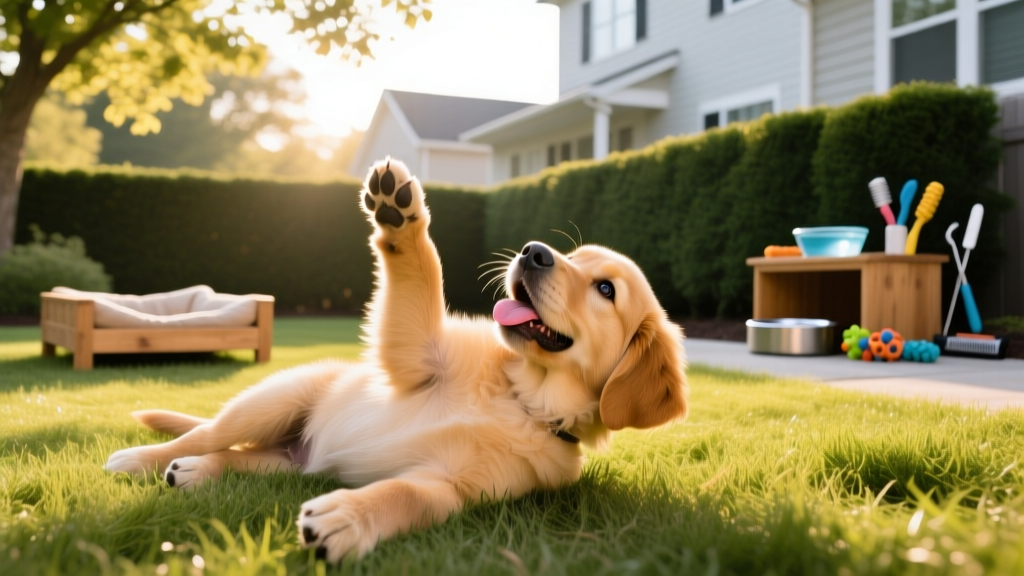
Golden Retriever Puppy Sister Meeting
Planning a golden retriever puppy sister meeting? Learn age-specific milestones, feeding, potty training, vaccination schedules, and littermate introduction tips.

Why the First Meeting Between Golden Retriever Sisters Matters
Whether you're bringing home a golden retriever puppy to meet an older sister, reuniting littermates, or introducing a new puppy to a resident female golden, that first encounter sets the tone for months of cohabitation. Golden retrievers are famously sociable — the AKC breed standard describes them as friendly, reliable, and trustworthy — but even the most easygoing breed can develop friction if introductions are rushed or poorly managed.
This guide covers everything you need to raise a well-adjusted golden retriever puppy alongside a canine sister: age-specific milestones from 8 weeks through adolescence, precise feeding portions, potty training timelines, the critical socialization window, vaccination schedules, and a realistic first-year cost breakdown. Every recommendation below is breed-specific to golden retrievers, whose growth rates, energy levels, and mouthiness demand tailored planning.
When Should I Bring My Golden Retriever Puppy Home?
The consensus among veterinary behaviorists and the AVMA is clear: 8 weeks of age is the earliest acceptable time to bring a golden retriever puppy home, and 8-10 weeks is ideal. Here's why timing matters for the sister meeting:
- Before 7 weeks: Puppies haven't completed the primary socialization period with littermates. Removing them early correlates with higher rates of fear-based aggression and bite inhibition problems later.
- 8-10 weeks (ideal): The puppy has learned basic canine communication from siblings and dam. This is when the fear imprint period begins (weeks 8-11), meaning new experiences — including meeting a sister — have outsized impact on long-term temperament.
- 10-12 weeks: Some responsible breeders retain puppies until 12 weeks for additional socialization. These puppies often transition more smoothly but have a narrower socialization window remaining.
If you're introducing a new golden retriever puppy to an older sister already in the home, plan the first meeting on neutral territory — a quiet park, a neighbor's yard, or a calm stretch of sidewalk — rather than inside the house where the resident dog may feel territorial.
Golden Retriever Puppy Milestones: Week by Week
Golden retrievers mature more slowly than smaller breeds. Expect puppy behaviors to persist well into the second year. Below is a concrete milestone timeline so you know what's normal — and when to intervene.
| Age Range | Developmental Stage | What to Expect | Key Actions |
|---|---|---|---|
| 4-8 weeks | Litter socialization | Learning bite inhibition from siblings; eyes/ears fully functional; start of solid food transition; early fear responses emerge around week 5 | If still with breeder: ensure daily human handling, exposure to varied surfaces, and introduction to crate |
| 8-12 weeks | Human bonding & fear imprint | Intense attachment to new family; short attention span (5-8 min); bladder capacity ~1-2 hours; heavy mouthing and nipping; sleep 18-20 hours/day | Begin name recognition, gentle handling exercises, short positive exposures to new people/places; schedule first vet visit |
| 12-16 weeks | Rapid learning window | Noticeable improvement in focus (10-15 min sessions); bladder control extends to 2-3 hours; teething discomfort begins; testing boundaries | Enroll in puppy kindergarten class; increase structured socialization; begin leash walking practice |
| 16-24 weeks | Juvenile period | High energy bursts followed by deep sleep; adult teeth erupting (expect chewing escalation); may regress on previously learned commands; sexual maturation begins | Provide structured exercise (20-30 min walks, 2x/day); reinforce obedience daily; discuss spay/neuter timing with vet |
| 6-12 months | Adolescence | Peak energy and distractibility; "selective hearing" on known commands; growth plates still open (avoid repetitive jumping); coat transition from puppy fuzz to adult double coat | Advance to intermediate training; maintain 45-60 min daily exercise; monitor joint health; consistent rules despite testing |
Feeding Your Golden Retriever Puppy: Portions & Schedule
Golden retrievers are prone to rapid growth-related orthopedic problems, including hip dysplasia and elbow dysplasia. Research published in the Merck Veterinary Manual indicates that keeping golden retriever puppies lean — body condition score 4-5 out of 9 — significantly reduces hip dysplasia incidence. Overfeeding is one of the most common owner mistakes with this breed.
Use a large-breed puppy formula (AAFCO-designated for growth/all life stages) that provides controlled calcium and phosphorus ratios. Below are typical feeding guidelines based on expected adult weight of 55-75 lb (25-34 kg) for females and 65-75 lb (29-34 kg) for males:
| Age | Meals Per Day | Approximate Daily Amount (Dry Kibble) | Notes |
|---|---|---|---|
| 8-12 weeks | 4 meals | 1.5 – 2 cups total (divided into 4 portions of ~0.4-0.5 cups each) | Soften kibble with warm water if transitioning from breeder's food |
| 12-16 weeks | 3 meals | 2 – 2.5 cups total (divided into 3 portions of ~0.7-0.8 cups each) | Begin phasing out softened food; dry kibble aids teething |
| 4-6 months | 3 meals | 2.5 – 3.5 cups total (divided into 3 portions) | Adjust based on body condition — you should feel ribs without pressing hard |
| 6-9 months | 2 meals | 3 – 4 cups total (divided into 2 portions of 1.5-2 cups each) | Transition to 2 meals/day; monitor for growth spurts increasing appetite |
| 9-12 months | 2 meals | 3 – 4 cups total (divided into 2 portions) | Begin gradual transition to adult food around 12 months; some vets recommend waiting until 15-18 months for large breeds |
Brand-specific guidance: If feeding Purina Pro Plan Large Breed Puppy, the label recommends 2¾ – 4¼ cups/day for a dog expected to reach 51-75 lb at maturity. Royal Canin Golden Retriever Puppy formula suggests 265-390 g/day depending on expected adult weight. Always use the feeding guide on your specific bag as a starting point, then adjust based on your puppy's body condition score.
Potty Training Timeline: Realistic Expectations for Golden Retrievers
Golden retrievers are generally eager to please and pick up potty routines faster than many breeds — but "fully reliable" is a marathon, not a sprint. Here's an honest timeline:
- 8-10 weeks: Accidents every 1-2 hours. Take puppy out after every meal, nap, play session, and crate release. Expect 10-15 outdoor trips per day.
- 10-14 weeks: Beginning to signal (sniffing, circling, whining at door). Accidents drop to 2-4 per week with consistent schedule.
- 14-20 weeks: Bladder capacity reaches ~3-4 hours. Most puppies are reliable during the day with scheduled outings. Nighttime holding improves to 5-6 hours.
- 5-7 months: Daytime reliability for most golden retrievers. Occasional regression during teething or routine changes is normal.
- 8-12 months: Full reliability, including overnight (8+ hours). Some males take longer due to marking behavior onset.
Troubleshooting common issues:
- Submissive urination when greeting: Extremely common in golden retrievers. Do not punish — ignore the puppy for 30 seconds upon entering, then greet calmly at their level. This typically resolves by 6-8 months.
- Excitement urination during play: Pre-empt by taking puppy out before active play sessions. Keep greetings low-key.
- Regression at 4-6 months: Often coincides with teething stress or a fear period. Return to more frequent outings and increase praise for outdoor elimination.
- Crate accidents overnight: If puppy soils the crate, the crate may be too large (they eliminate in one corner and sleep in another). Use a divider to size it so the puppy can stand, turn, and lie down — but no more.
The Critical Socialization Window: Weeks 3-14
The American Veterinary Society of Animal Behavior (AVSAB) identifies weeks 3-14 as the primary socialization period for puppies. Experiences during this window — positive or negative — have disproportionate influence on adult temperament. For golden retrievers, whose role as family companions demands confidence in diverse environments, structured socialization is non-negotiable.
Important: The AVSAB and AVMA both state that the risk of behavioral problems from inadequate socialization exceeds the risk of infectious disease exposure in properly managed settings. Do not isolate your puppy until vaccinations are complete — instead, socialize safely.
Socialization Checklist for Your Golden Retriever Puppy
Aim for positive exposure to each item below before week 14. "Positive" means the puppy is relaxed or playful — not fearful, frozen, or overwhelmed. Pair every new experience with high-value treats (small pieces of boiled chicken, freeze-dried liver).
| Category | Specific Exposures (Aim for 3-5 Each) | Safe Setting |
|---|---|---|
| People | Men with beards, children under 10, people wearing hats/sunglasses, people in wheelchairs, delivery workers, people of different ethnicities | Invite calm visitors to your home; sit on porch and observe passersby |
| Other Animals | Fully vaccinated adult dogs (known health status), cats (controlled introductions), puppies of similar age in class | Puppy kindergarten class; playdates with vetted dogs only — avoid dog parks until fully vaccinated |
| Surfaces | Gravel, wet grass, metal grates, wooden decks, slippery tile, tarps/plastic sheeting | Set up an obstacle course in your yard using household items |
| Sounds | Vacuum cleaner, thunderstorms (play recordings at low volume), doorbell, fireworks recordings, traffic noise, children yelling | Play audio at 20% volume during mealtime; gradually increase over days |
| Handling | Paw handling, ear inspection, mouth opening, nail clipping simulation, being lifted, wearing a harness | Daily 5-minute handling sessions paired with treats |
| Environments | Car rides, pet store (carried if not fully vaccinated), outdoor café patio, friend's house, groomer visit (happy visit only) | Keep sessions under 15 minutes; end on a positive note |
| Sister/Resident Dog | Parallel walking, shared yard time with supervision, eating in proximity (separate bowls, 6+ feet apart), calm co-resting | Neutral territory first; gradual home integration over 1-2 weeks |
Vaccination Schedule for Golden Retriever Puppies
Golden retrievers follow the standard core and non-core vaccination protocol recommended by the AVMA and the AAHA Canine Vaccination Guidelines. Your veterinarian will adjust timing based on local disease prevalence and maternal antibody levels.
| Age | Vaccines Administered | Details |
|---|---|---|
| 6-8 weeks | DHPP (1st dose) | Distemper, Hepatitis (Adenovirus-2), Parainfluenza, Parvovirus. Often given by breeder before you bring puppy home. |
| 10-12 weeks | DHPP (2nd dose), Bordetella (optional), Leptospirosis (1st dose, if recommended) | Bordetella (kennel cough) recommended if attending puppy classes or boarding. Leptospirosis is increasingly recommended in suburban/rural areas with wildlife exposure. |
| 14-16 weeks | DHPP (3rd/final puppy dose), Rabies, Leptospirosis (2nd dose, if started), Lyme disease (if in endemic area) | Rabies is legally required — timing varies by state (12-16 weeks). Lyme vaccine for golden retrievers in tick-endemic regions (Northeast, Upper Midwest, Pacific Coast). |
| 12-16 months | DHPP booster, Rabies booster (1-year or 3-year depending on product), Leptospirosis annual | After this, DHPP and Rabies typically move to 3-year intervals. Leptospirosis, Bordetella, and Lyme remain annual. |
When can my puppy go outside and meet other dogs? Your puppy can explore your own yard immediately. For public spaces and dog-dog interactions: wait until 7 days after the second DHPP dose (around 12-13 weeks) for controlled settings like puppy classes with vaccinated peers. Full public access (dog parks, hiking trails with unknown dog traffic) should wait until 7 days after the final DHPP at 16 weeks — approximately 17 weeks of age.
Teething Timeline & Relief Strategies
Golden retrievers are a mouthy breed by nature — they were developed to carry waterfowl gently — and teething amplifies this tendency considerably. Expect a chew-happy household from about 3 to 7 months.
| Age | Teething Stage | What's Happening | Relief Strategy |
|---|---|---|---|
| 3-4 months | Deciduous incisors loosen | Front teeth begin to fall out; you may find tiny teeth on the floor or notice puppy chewing more | Introduce frozen wet washcloth (twist, soak in water, freeze); rubber teething toys like Kong Puppy |
| 4-5 months | Canines and premolars erupt | Peak discomfort period; bleeding gums possible; increased nipping during play | Offer frozen carrots, Benebone Puppy (softer rubber formula), or Nylabone Puppy Chew; redirect all biting to toys |
| 5-6 months | Adult molars emerge | Final teeth coming in at the back of the mouth; puppy may chew with a "sideways" motion | Durable rubber toys (Kong Classic, West Paw Toppl); avoid hard antlers or bones that can fracture immature teeth |
| 6-7 months | All 42 adult teeth in place | Chewing continues as a behavioral habit even after teeth are fully erupted | Transition to adult-appropriate chews; continue providing daily chew outlets to prevent destructive chewing |
Safe chew recommendations by age:
- 8-16 weeks: Kong Puppy (pink/blue rubber), frozen washcloth, Bullymake puppy box items, Whimzees Puppy
- 4-6 months: Kong Classic (red, medium size), West Paw Bumi, Earth Animal No-Hide chews (supervised), frozen stuffed Toppl
- 6+ months: Kong Classic (red, large), Benebone Wishbone, yak cheese chews (supervised), digestible dental chews approved by VOHC (Veterinary Oral Health Council)
Avoid: Rawhide (choking and blockage risk), cooked bones (splintering), antlers (tooth fractures in young dogs), and any chew small enough to swallow whole. If you're unsure whether a chew is safe, apply the thumbnail test — if you can't indent it with your thumbnail, it's too hard for a puppy's developing teeth.
Crate Training Progression & Time Limits
Golden retrievers adapt well to crate training when introduced positively. The crate becomes a safe den — essential for potty training, managing destructive chewing, and giving your puppy a retreat from the household (and from an older sister who may need space).
Crate size for golden retrievers: Start with a 36-inch crate with a divider panel. As your puppy grows, move the divider to allow enough room to stand up, turn around, and lie down stretched out. A full-grown golden typically needs a 42-inch crate.
| Age | Maximum Crate Time (Daytime) | Overnight | Training Focus |
|---|---|---|---|
| 8-10 weeks | 30-60 minutes max | 2-3 hours (set alarm for potty break) | Feed meals in crate; toss treats inside; close door for 10-second intervals, building to 1 minute over first week |
| 10-14 weeks | 1-2 hours | 3-4 hours (one potty break likely needed) | Practice leaving room for 5-10 minutes; give a stuffed Kong upon crating to build positive association |
| 14-20 weeks | 2-3 hours | 5-6 hours | Puppy should enter crate willingly; begin phasing out treats for entry (intermittent reinforcement) |
| 5-7 months | 3-4 hours | 7-8 hours | Crate is now a resting place; leave door open during the day so puppy can self-select napping there |
| 8+ months | 4-5 hours (not to exceed 6 regularly) | 8+ hours | Consider transitioning to an open crate or puppy-proofed room if dog has earned freedom |
Never use the crate as punishment. If your golden retriever puppy whines in the crate, wait for a brief pause in whining before opening the door — releasing during active whining reinforces the behavior. If whining persists beyond 20-30 minutes, assess whether the puppy needs to eliminate, is too hot/cold, or needs more exercise before crating.
Common Golden Retriever Puppy Problems & Solutions
Puppy Biting and Nipping
Golden retrievers are a "mouthy" breed — they explore the world with their mouths, and their retrieving instinct drives them to carry and chew. Puppy biting in goldens is notably more persistent than in many breeds, often continuing through 5-6 months.
How to stop puppy biting/nipping:
- Redirect immediately: When teeth touch skin, say "oops" in a calm tone, withdraw your hand, and present an appropriate chew toy. Praise chewing on the toy.
- Time-outs (not isolation): If redirecting fails after 2-3 attempts, stand up and turn your back for 15-20 seconds, or step behind a baby gate. This teaches that biting ends play — without creating crate fear.
- Satisfy the mouth: Provide 3-4 daily structured chew sessions with approved toys. A golden puppy who has had adequate chew time is less likely to nip.
- Teach "leave it" and "drop it": Start with low-value items, trading up for high-value treats. These commands are essential for a breed that will pick up everything from socks to rocks.
Whining and Vocalization
Golden retrievers are vocal dogs. Puppies whine to communicate needs — but they also learn quickly that whining gets attention. Distinguish between need-based whining (potty, hunger, pain) and attention-seeking whining (boredom, wanting to be near you).
For attention whining: ignore completely (no eye contact, no talking, no touching) until the puppy is quiet for 5 seconds, then reward the silence. For need-based whining: address the need calmly and without fanfare.
Destructive Chewing
Golden retriever puppies can destroy baseboards, shoes, remote controls, and furniture legs with alarming speed. Prevention is more effective than correction:
- Puppy-proof every room before granting access (use bitter apple spray on furniture legs as a deterrent)
- Provide a rotation of 5-7 chew toys — novelty maintains interest
- Supervise or confine: when you cannot actively watch your puppy, they should be in a crate, exercise pen, or puppy-proofed room
- Ensure adequate physical and mental exercise: a tired golden puppy is a well-behaved golden puppy (aim for 5 minutes of structured exercise per month of age, twice daily — e.g., a 4-month-old gets 20-minute sessions)
Introducing Your Golden Retriever Puppy to a Sister Dog
Whether the "sister" is a littermate you're adopting alongside your puppy, an older golden retriever already in the home, or a female dog of another breed, structured introductions prevent resource guarding, jealousy, and fear-based reactions.
Step-by-step introduction protocol:
- Neutral territory walk (Day 1): Have each dog handled by a separate person. Walk parallel at a distance of 10-15 feet, gradually closing the gap over 15-20 minutes as both dogs remain relaxed. Do not force face-to-face greetings.
- Yard introduction (Day 1-2): Remove all toys, food bowls, and high-value items from the yard. Allow the dogs to sniff and interact freely while you observe. Interrupt any stiffening, hard staring, or mounting with a cheerful recall.
- Indoor introduction (Day 2-3): Bring both dogs inside together on leash. Walk through the house room by room. Feed treats to both dogs simultaneously for calm behavior.
- Separate resources permanently: Feed in separate rooms or crates. Provide separate beds. Pick up toys when not in supervised play. Resource guarding between same-household dogs is one of the most common behavioral issues — prevention through management is far easier than treatment.
- Individual attention daily: Spend 15-20 minutes one-on-one with each dog every day. This prevents "littermate syndrome" (hyper-bonding between two puppies raised together) and reassures the resident dog that the puppy's arrival hasn't diminished their standing.
First-Year Cost Breakdown for a Golden Retriever Puppy
Budgeting realistically prevents financial stress from compromising your puppy's care. Below are 2026 estimated costs for the first year of golden retriever ownership in the United States. Ranges reflect regional variation (lower in rural/Southern areas, higher in coastal metros).
| Category | Low Estimate | Mid Estimate | High Estimate | Notes |
|---|---|---|---|---|
| Puppy purchase (responsible breeder) | $2,000 | $3,000 | $4,500 | AKC-registered, health-tested parents (OFA hips/elbows, heart, eyes). Adoption from breed rescue: $300-$600. |
| Veterinary (first year) | $600 | $900 | $1,500 | Includes initial exam, 3 DHPP doses, rabies, Bordetella, fecal tests, deworming, spay/neuter. Higher end includes Lyme/Lepto vaccines and unexpected illness visits. |
| Food (large-breed puppy formula) | $450 | $650 | $900 | Based on premium brands (Purina Pro Plan, Royal Canin, Hill's) at $55-$85/bag, 1 bag every 3-4 weeks. |
| Supplies (initial) | $350 | $550 | $800 | Crate ($60-$120), exercise pen ($50-$90), leash/harness ($30-$60), bowls, grooming tools, baby gates, chew toys rotation, bed. |
| Training | $150 | $350 | $700 | Puppy kindergarten class ($150-$250 for 6-week session). Higher end includes private sessions for specific issues. |
| Preventive medications | $200 | $350 | $500 | Heartworm preventive (Heartgard, Interceptor), flea/tick (NexGard, Simparica Trio). Year-round in most US regions. |
| Grooming | $0 | $200 | $500 | Goldens don't need professional grooming like poodles, but many owners use groomers for nail trims ($15-$25/visit), sanitary trims, and de-shedding treatments. |
| Pet insurance (optional) | $400 | $600 | $900 | Monthly premiums $33-$75 for accident+illness. Golden retrievers have higher-than-average claim rates due to cancer and orthopedic predispositions. |
| Total First Year | $4,150 | $6,600 | $10,300 | Excludes emergency vet visits (budget an additional $500-$2,000 emergency fund). |
Frequently Asked Questions
How often should I feed my golden retriever puppy at each age?
At 8-12 weeks, feed 4 meals per day (totaling 1.5-2 cups of large-breed puppy kibble). At 12-16 weeks, reduce to 3 meals per day (2-2.5 cups total). At 6 months, transition to 2 meals per day (3-4 cups total). Always divide the daily amount evenly across meals — never feed one large meal, as golden retrievers are predisposed to gastric dilatation-volvulus (bloat).
When will my golden retriever puppy be fully potty trained?
Most golden retrievers achieve reliable daytime potty habits between 5-7 months of age with consistent scheduling. Full overnight reliability (8+ hours) typically develops by 8-12 months. Individual variation is significant — some goldens are reliable by 4 months, while others take until 9-10 months. Consistency in schedule and positive reinforcement for outdoor elimination are the strongest predictors of faster training.
What vaccines does my golden retriever puppy need and when?
Core vaccines: DHPP at 6-8, 10-12, and 14-16 weeks, with rabies at 14-16 weeks. Non-core vaccines your vet may recommend based on lifestyle: Bordetella (10-12 weeks, for puppies attending classes), Leptospirosis (10-12 and 14-16 weeks, two-dose series), and Lyme disease (14-16 weeks, in tick-endemic areas). Consult your veterinarian for a protocol tailored to your region and your puppy's exposure risk.
How do I stop my golden retriever puppy from biting and nipping?
Redirect every bite to an appropriate chew toy, and end play sessions with a brief 15-20 second time-out (turn away or step behind a gate) if teeth touch skin. Provide 3-4 structured chew sessions daily with approved toys. Teach "leave it" and "drop it" using positive reinforcement with high-value food trades. Expect mouthing to persist through 5-6 months — this is a breed trait, not a training failure. Never use physical punishment, which damages trust and can escalate to fear-based aggression.
When can my golden retriever puppy go outside and meet other dogs?
Your puppy can explore your own private yard immediately. For controlled socialization with known, vaccinated dogs (puppy classes, playdates), wait until 7 days after the second DHPP dose — typically around 12-13 weeks of age. For full public access including dog parks and high-traffic trails, wait until 7 days after the final DHPP at 16 weeks — approximately 17 weeks. During the restricted period, carry your puppy to new environments for socialization exposure without ground contact.
Should I be concerned if my older golden retriever sister growls at the puppy?
Low-level growling with relaxed body language during initial introductions is normal canine communication — the older dog is setting boundaries. Do not punish growling, as this suppresses a warning signal and may escalate to biting without warning. Instead, supervise closely, separate the dogs if the older dog seems stressed, and ensure the resident dog has puppy-free spaces (a gated room, an elevated bed) where they can retreat. If growling is accompanied by stiffening, snapping, or resource guarding of food/toys/people, consult a certified professional dog trainer (CPDT-KA) or veterinary behaviorist promptly.
Marcus Aldridge
All our authors care for dogs every day — read more of their work on the authors page.