Greenfield Puppies in Pennsylvania: Complete Puppy Care Guide
raising Greenfield Puppies in Pennsylvania — vaccination schedules, feeding, potty training, socialization, and first-year costs.
Bringing Home a Greenfield Puppy in Pennsylvania: What to Expect
If you're expecting a puppy from Greenfield Puppies — the Lancaster County-based network connecting Pennsylvania breeders with families — you're likely juggling excitement with a flood of questions. Greenfield Puppies primarily features small and medium breeds popular in PA: Goldendoodles, Cavapoos, Beagles, French Bulldogs, Maltipoos, and Bernedoodles, among others. Each breed has unique developmental needs, but the foundational puppy care timeline remains consistent across the board.
This guide gives you the exact week-by-week roadmap for raising your Greenfield puppy through the first year, with Pennsylvania-specific considerations including local veterinary costs, seasonal socialization challenges, and the state's dog licensing requirements. Whether you're picking up an 8-week-old Maltipoo from a breeder in Intercourse or a 10-week-old Beagle from a farm near Lititz, the milestones below apply.
Veterinary Reminder: Schedule your puppy's first wellness exam within 48–72 hours of bringing them home. Many Pennsylvania veterinarians offer new-puppy packages ranging from $85–$175 for the initial visit. Always consult your veterinarian before starting or changing any vaccination, medication, or feeding protocol.
When Should I Bring My Greenfield Puppy Home?
Greenfield Puppies breeders typically release puppies between 8 and 10 weeks of age. Pennsylvania law (under the Dog Purchaser Protection Act, also known as the "Puppy Lemon Law") requires that puppies sold by dealers be at least 7 weeks old and fully weaned. However, reputable breeders within the Greenfield network generally hold puppies until 8 weeks minimum, and many small-breed specialists keep toy breeds (Chihuahuas, Yorkies, Pomeranians) until 10–12 weeks to ensure stability.
- Toy breeds (under 12 lb adult weight): 10–12 weeks — these puppies are fragile and benefit from extra time with littermates
- Small breeds (12–25 lb): 8–10 weeks
- Medium breeds (25–60 lb): 8 weeks
- Large/giant breeds (60+ lb): 8 weeks, though some breeders prefer 9–10 weeks for Labrador and Golden Retriever lines
Resist the urge to pick up earlier than 8 weeks. Puppies separated from their mothers before this critical period show higher rates of separation anxiety, resource guarding, and bite inhibition problems later in life, according to AVMA socialization guidelines.
Week-by-Week Puppy Milestones: What's Normal at Every Stage
Understanding developmental stages prevents panic when your puppy hits predictable (but surprising) behavioral shifts. Here's your milestone map:
| Age Range | Developmental Stage | What to Expect | Your Action Items |
|---|---|---|---|
| Weeks 4–8 | Socialization with littermates; weaning complete | Learning bite inhibition from siblings, exploring textures, startle responses to loud sounds | If still with breeder: request photos/videos, confirm deworming schedule (typically at 2, 4, 6, and 8 weeks) |
| Weeks 8–12 | Human bonding period; fear imprint window begins | Intense attachment to primary caregiver, may startle at new objects, short attention spans (3–5 minutes), frequent napping (18–20 hrs/day) | Keep environment calm, begin name recognition, handle paws/ears/mouth daily, start crate training |
| Weeks 12–16 | Testing boundaries; second fear period may emerge | Increased independence, may "forget" learned cues, mouthing intensifies, start of juvenile energy bursts | Enroll in positive-reinforcement puppy class (e.g., through AKC STAR Puppy program), increase structured play |
| Weeks 16–24 | Teething peak; social hierarchy awareness | Destructive chewing, loose baby teeth found around house, increased vocalization, may challenge household rules | Provide appropriate chew outlets, maintain training consistency, increase physical exercise |
| 6–12 months | Adolescence; sexual maturity (if intact) | Energy peaks, possible regression in training, roaming interest increases, growth plates closing (varies by breed size) | Discuss spay/neuter timing with vet, increase mental enrichment, maintain socialization exposure |
Feeding Schedule: Exact Portions by Age and Weight
Greenfield Puppies breeders will tell you what food the puppy has been eating — stick with that brand for at least the first 2 weeks to avoid gastrointestinal upset. If transitioning, mix 75% old food with 25% new food for 3 days, then 50/50 for 3 days, then 25/75 for 3 days before fully switching.
Look for an AAFCO statement on the bag confirming the food is "complete and balanced for growth" or "for all life stages." For large-breed puppies (expected adult weight over 50 lb), the statement must specifically say "growth including large-size dogs."
| Puppy Age | Meals Per Day | Approximate Daily Amount (Dry Kibble) | Notes |
|---|---|---|---|
| 8–12 weeks | 4 meals | Toy/small: ¼–½ cup total; Medium: ½–¾ cup; Large: ¾–1¼ cups | Soften kibble with warm water for first 1–2 weeks if puppy struggles with hard pieces |
| 12–16 weeks | 3 meals | Toy/small: ⅓–⅔ cup total; Medium: ¾–1 cup; Large: 1–2 cups | Transition to dry kibble fully; monitor stool consistency |
| 16–24 weeks | 3 meals (drop to 2 at 20 weeks) | Toy/small: ½–¾ cup; Medium: 1–1½ cups; Large: 1½–2½ cups | Adjust based on body condition score — ribs should be felt but not prominently visible |
| 6–12 months | 2 meals | Toy/small: ½–1 cup; Medium: 1½–2½ cups; Large: 2–4 cups | Transition to adult formula at 10–12 months for small breeds, 12–18 months for large breeds |
Vaccination Schedule for Your Greenfield Puppy
Greenfield Puppies breeders typically administer the first round of vaccinations before release. Your puppy should arrive with a health record showing which vaccines were given and at what age. Pennsylvania does not have a statewide rabies vaccination requirement for puppies under 12 weeks, but rabies vaccination is required by PA law (3 P.S. § 455.8) by 16 weeks of age.
Here is the core vaccination schedule as recommended by the AVMA and the American Animal Hospital Association (AAHA) canine vaccination guidelines:
| Age | Vaccine | What It Protects Against | Typical Cost at PA Vet Clinics |
|---|---|---|---|
| 6–8 weeks | DHPP (1st dose) | Distemper, Hepatitis (Adenovirus-2), Parainfluenza, Parvovirus | $25–$45 (often given by breeder) |
| 10–12 weeks | DHPP (2nd dose) + Bordetella (optional) | Same as above; Bordetella protects against kennel cough | $30–$55 + $20–$35 for Bordetella |
| 14–16 weeks | DHPP (3rd dose) + Rabies | Core protection + Rabies (legally required in PA) | $30–$55 + $20–$40 for Rabies |
| 12–16 months | DHPP booster + Rabies booster | Long-term immunity maintenance | $50–$85 combined |
Non-core vaccines to discuss with your veterinarian based on your PA lifestyle:
- Leptospirosis — recommended if your puppy will hike in wooded areas of central/northern PA where wildlife (raccoons, deer) are common
- Lyme disease — Pennsylvania has one of the highest Lyme disease rates in the US; strongly recommended for dogs in the Lehigh Valley, Poconos, and Susquehanna corridor
- Canine influenza (H3N2/H3N8) — recommended if your dog will be boarded, attend daycare, or participate in group training classes
Socialization Window: The Critical Weeks 3–14 Period
The primary socialization window closes between 12 and 14 weeks of age. After this window, puppies become significantly more cautious about novel experiences. This is not a suggestion — it's developmental neurology. Puppies deprived of adequate socialization during this window are statistically more likely to develop fear-based aggression, separation anxiety, and noise phobias, per research published in the Journal of Veterinary Behavior.
Your Greenfield puppy will arrive at 8 weeks, meaning you have approximately 4–6 weeks of this critical window remaining. Use them deliberately:
- ☐ Walk on 5+ different surfaces: grass, gravel, tile, hardwood, carpet, concrete, metal grates
- ☐ Hear 10+ novel sounds at low volume: vacuum, doorbell, thunderstorm audio, fireworks audio, clapping, dropping pots, hair dryer, car horn
- ☐ Meet 10+ different people: varying ages, heights, wearing hats/glasses/masks, carrying umbrellas/bags
- ☐ See 5+ other animals from a safe distance: cats, horses, livestock (common in Lancaster County), birds, other dogs (vaccinated, calm adults only)
- ☐ Experience 5+ car rides to non-vet destinations: park, drive-through, friend's house
- ☐ Practice handling: nail trims (even if just clipping tips), ear cleaning, tooth brushing, gentle restraint
- ☐ Encounter 3+ weather conditions: light rain, wind, evening darkness, bright sun
- ☐ Visit a pet-friendly store while being carried (Home Depot, Tractor Supply, outdoor garden centers)
Pennsylvania-specific socialization advantage: Lancaster County and surrounding areas offer unique early exposure to farm animals, Amish horse-and-buggy traffic, and rural environments that urban puppies rarely experience. If your breeder is in a farming community, ask whether puppies were exposed to barn sounds, livestock smells, and tractor vibrations — these early exposures transfer to calmer behavior around novel stimuli later.
Potty Training Timeline: Realistic Expectations and Troubleshooting
Let's set expectations clearly: most puppies are not reliably house-trained until 4–6 months of age. Small breeds (under 15 lb) often take longer — up to 8–10 months — because their bladders are physically smaller and their metabolisms process food faster. If anyone promises you a fully potty-trained puppy in a week, they're selling something.
| Puppy Age | Maximum Bladder Hold Time | Outing Frequency | Accident Expectation |
|---|---|---|---|
| 8–10 weeks | 1–2 hours | Every 1–2 hours + after every meal, nap, and play session | Multiple accidents daily — this is normal |
| 10–14 weeks | 2–3 hours | Every 2–3 hours + key trigger times | 1–2 accidents per week if consistent |
| 14–20 weeks | 3–4 hours | Every 3–4 hours during day | Occasional accidents when routine is disrupted |
| 5–6 months | 4–6 hours | 4–5 outings per day | Rare accidents; puppy should signal (go to door, whine) |
| 7–12 months | 6–8 hours | 3–4 outings per day | Reliable with consistent schedule; setbacks possible during adolescence |
Core potty training protocol:
- Take puppy to the same outdoor spot every time (scent triggers elimination)
- Use a consistent verbal cue: "Go potty" or "Do your business" — say it while they're eliminating, not after
- Reward immediately with a high-value treat (small piece of chicken, cheese, or commercial training treat) within 2 seconds of finishing
- Supervise 100% when loose indoors — use baby gates, exercise pens, or tether puppy to you with a leash
- If you catch them mid-accident: interrupt calmly ("Oops!") and carry outside immediately — never punish, rub nose in it, or yell
- For accidents discovered after the fact: clean with enzymatic cleaner (Nature's Miracle or Rocco & Roxie), never ammonia-based products
PA winter potty training challenge: December through March in Pennsylvania means cold, snow, ice, and salt-treated walkways. Many puppies refuse to eliminate in snow or on salted surfaces. Solutions: shovel a designated potty patch, use booties for salt protection, or set up an indoor grass patch (Fresh Patch or DoggieLawn) as a temporary backup. Never punish a puppy for being reluctant to go outside in freezing weather — it's a comfort issue, not defiance.
Teething Timeline: Relief Strategies and Safe Chew Options
Puppy teething follows a predictable pattern, and knowing the timeline helps you prepare rather than react:
- 3–4 weeks: Deciduous (baby) incisors erupt — usually handled by the breeder
- 4–6 weeks: Deciduous canines and premolars erupt
- 12–16 weeks: Baby incisors begin falling out; adult incisors push in — you may find tiny teeth on the floor or in chew toys
- 16–20 weeks: Adult canines erupt; this is peak mouthing and nipping intensity
- 20–24 weeks: Adult premolars and molars erupt; chewing drive remains high
- 6–7 months: All 42 adult teeth should be in — if baby canines haven't fallen out ("retained deciduous teeth"), your vet may need to extract them, especially common in toy breeds
Safe teething relief options:
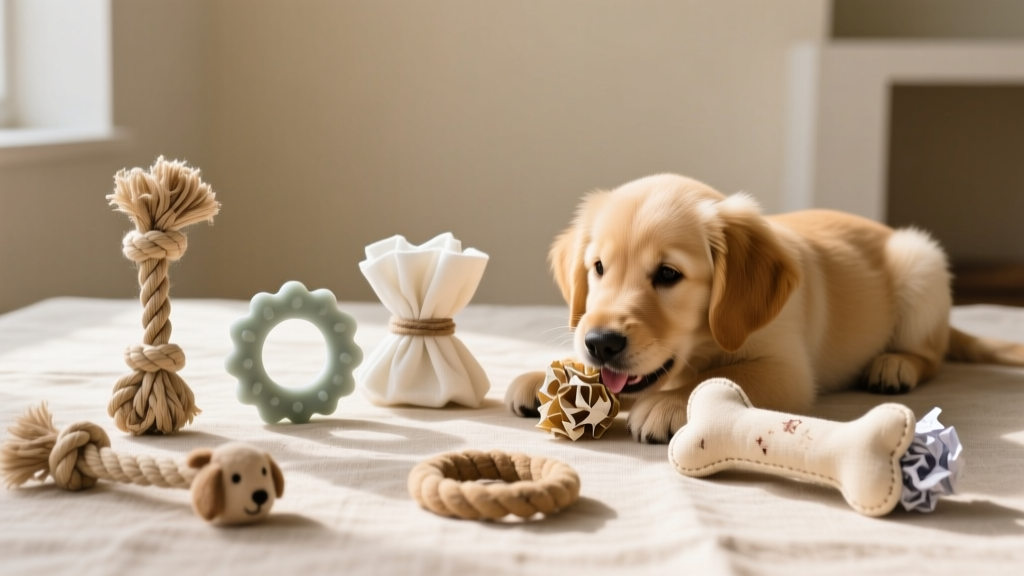
- Frozen washcloth: Wet a clean washcloth, twist into a rope, freeze for 2 hours — the cold numbs gums and the texture satisfies chewing urge
- KONG Classic (red rubber, size-appropriate): Stuff with puppy-safe peanut butter (xylitol-free — always check the label) and freeze
- Benebone Wishbone: Nylon chew with bacon or chicken flavor infusion; choose puppy-specific softer versions for dogs under 6 months
- Carrot sticks (frozen): Low-calorie, safe, and naturally soothing — supervise to prevent choking on large pieces
- Nylabone Puppy Chew: Softer formula designed for developing teeth; discard when pieces become small enough to swallow
Crate Training Progression: Time Limits and Step-by-Step
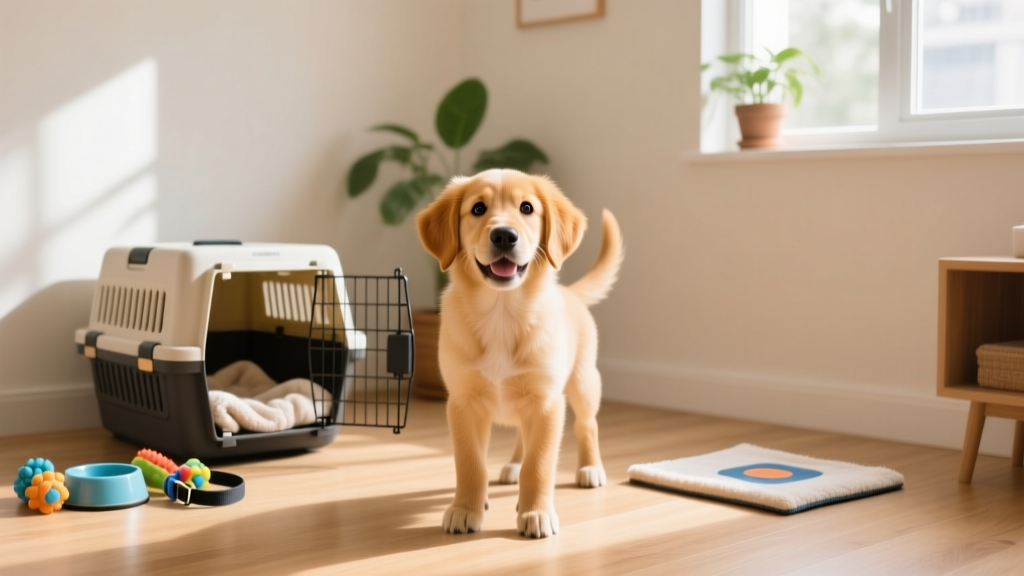
Crate training leverages a dog's natural den instinct and is one of the most effective tools for potty training, preventing destructive behavior, and creating a safe retreat space. The key is gradual progression — never use the crate as punishment.
| Puppy Age | Maximum Crate Time (Daytime) | Maximum Crate Time (Overnight) | Crate Size Guidance |
|---|---|---|---|
| 8–10 weeks | 1–2 hours | 3–4 hours (set alarm for potty break) | Large enough to stand, turn, lie down — use divider panel in larger crate |
| 10–14 weeks | 2–3 hours | 4–5 hours | Same — adjust divider as puppy grows |
| 14–20 weeks | 3–4 hours | 5–6 hours | Gradually expand space as bladder control improves |
| 5–6 months | 4–5 hours | 7–8 hours | Full crate size appropriate for expected adult weight |
| 7–12 months | 5–6 hours | 8 hours (if needed) | Adult-sized crate; dog should be comfortable spending time in it voluntarily |
Crate training steps:
- Day 1–3: Leave crate door open. Toss treats inside. Feed meals near, then inside, the crate. Let puppy enter and exit freely.
- Day 4–7: Close door during meals. Open immediately when finished. Gradually extend closed-door time by 30-second increments while you sit nearby.
- Week 2: Close door, leave the room for 1–5 minutes. Return before puppy escalates crying. Gradually extend absence.
- Week 3–4: Begin crating for longer periods during the day while you're home. Puppy should nap quietly. Start brief departures from the house (5–15 minutes).
- Week 5+: Puppy should enter crate willingly, settle, and sleep through the night with one possible potty break (depending on age).
Expected whining: Some vocalization in the first 3–7 nights is universal. Place the crate near your bed initially so your presence is reassuring. If whining persists beyond 10–15 minutes, take puppy out for a quick, boring potty trip (no play, no treats), then return to crate. This prevents the puppy from learning that crying = fun time.
Common Puppy Problems and Solutions
Puppy Biting and Nipping
Mouthing is normal puppy behavior — it's how they explore and play. However, it must be redirected, not punished. Here's the protocol:
- When teeth touch skin: Say "Ouch!" in a high-pitched yelp (mimicking littermate feedback), then immediately withdraw attention for 10–15 seconds (stand up, turn away, or step behind a baby gate)
- Redirect: Once puppy calms, offer an appropriate chew toy and praise enthusiastically when they bite that instead
- Time-outs: If biting continues after 2–3 redirects, calmly place puppy in a playpen or crate for a 30–60 second "cool down" — this is not punishment, it's a reset
- Prevent rehearsal: If puppy consistently bites during specific activities (e.g., petting sessions that last too long), manage the environment — keep interactions short and end before the puppy becomes overstimulated
Never hold the puppy's mouth shut, alpha-roll, or use physical punishment. These methods increase fear and can escalate biting behavior, according to position statements from both the AVMA and the American Veterinary Society of Animal Behavior.
Destructive Chewing
Puppies chew to relieve teething discomfort and explore their environment. Management is 90% of the solution:
- Puppy-proof accessible areas: remove shoes, cords, children's toys, and anything within mouth-height
- Provide 5–8 appropriate chew items of varying textures (rubber, nylon, natural, frozen)
- Rotate chew toys every 2–3 days to maintain novelty
- Use bitter apple spray (Grannick's Bitter Apple) on furniture legs and baseboards as a deterrent — test on a hidden area first for staining
- Supervise or confine — unsupervised puppies will find things to destroy
Whining and Crying
Determine the cause before responding:
- Needs to eliminate: Take outside immediately (especially if 2+ hours since last outing or shortly after eating/drinking)
- Overtired: Enforce a nap in the crate — puppies often fight sleep like toddlers and become nippy and vocal when exhausted
- Attention-seeking: Wait for 3–5 seconds of quiet before rewarding with attention — this teaches that calm behavior earns interaction
- Fear/anxiety: Provide comfort; do not ignore genuine distress. A newly separated 8-week-old puppy is experiencing a major life transition
When Can My Puppy Go Outside and Meet Other Dogs?
This is where owners often get conflicting advice. Here's the evidence-based answer: socialization should begin immediately, but with strict disease-prevention protocols until vaccination is complete.
- Weeks 8–12 (before 2nd DHPP): Carry puppy in public. Use a sling, carrier, or stroller. Let them observe people, traffic, other dogs from a distance. Avoid ground contact in public areas where unknown dogs have been. Puppy can meet known, fully-vaccinated, healthy adult dogs in controlled home environments.
- Weeks 12–14 (after 2nd DHPP): Begin brief, supervised ground walks in low-traffic residential areas. Still avoid dog parks and pet store floors.
- Weeks 16+ (1–2 weeks after 3rd DHPP): Full access to public spaces, dog parks (if you choose — though many trainers recommend structured play dates over chaotic dog parks), hiking trails, and group classes.
Pennsylvania's many state parks (Ricketts Glen, French Creek, Ohiopyle) and local Rails-to-Trails paths are excellent socialization and exercise venues once your puppy is fully vaccinated. Just ensure your puppy is on a leash (required in all PA state parks) and that you bring water and waste bags.
First-Year Cost Breakdown for a Greenfield Puppy in Pennsylvania
Budgeting accurately prevents surprises. Here's a realistic first-year cost breakdown based on 2025–2026 pricing at veterinary clinics and pet supply retailers in southeastern Pennsylvania:
| Category | Items Included | Estimated Cost Range |
|---|---|---|
| Puppy purchase | Greenfield Puppies listed breeds (small to medium) | $1,500–$4,500 |
| Veterinary care | Initial exam, 3 DHPP doses, rabies, fecal tests, deworming, heartworm test/preventive, spay/neuter | $650–$1,400 |
| Food | 12 months of quality puppy food (AAFCO-approved) | $300–$700 |
| Supplies | Crate, bed, leash, collar, harness, bowls, baby gates, exercise pen, grooming tools | $250–$500 |
| Toys & chews | Chew toys, puzzle toys, training treats, teething relief items | $150–$300 |
| Training | Puppy class (6–8 week course), possible private sessions for specific issues | $150–$400 |
| Licensing & ID | PA dog license (required by 3 months of age, ~$8.70/year if spayed/neutered), microchip | $50–$80 |
| Pet insurance | Annual premium (recommended — accident/illness plan) | $400–$800/year |
| Emergency fund | Set aside for unexpected illness or injury (GI blockage, infection) | $500–$2,000 (hopefully unused) |
Total first-year estimated cost (excluding puppy purchase): $2,500–$6,500
Pennsylvania requires all dogs over 3 months to be licensed. License fees vary by county but are generally $6.70–$8.70 for spayed/neutered dogs and $12.70–$18.70 for intact dogs. You can purchase licenses through your county treasurer's office or online via the PA Department of Agriculture.
Frequently Asked Questions
How often should I feed my 8-week-old puppy?
Four meals per day, spaced approximately 4–5 hours apart during waking hours. For a small-breed puppy expected to reach 10–15 lb, this typically means 2–3 tablespoons of kibble per meal. Always follow the feeding guide on your specific food brand, adjusting for your puppy's body condition and activity level.
When will my puppy be fully potty trained?
Realistically, between 4 and 6 months for medium and large breeds, and 6 to 10 months for toy and small breeds. "Fully trained" means fewer than one accident per month with a consistent schedule. Setbacks during growth spurts, moves, or routine changes are normal and temporary.
What vaccines does my puppy need and when?
Core vaccines: DHPP at 6–8 weeks, 10–12 weeks, and 14–16 weeks, plus Rabies at 14–16 weeks. Non-core vaccines (Lyme, Leptospirosis, Bordetella, Canine Influenza) depend on your lifestyle and location. In Pennsylvania, Lyme vaccination is strongly recommended due to high tick prevalence. Your veterinarian will tailor the protocol to your puppy's risk profile.
How do I stop puppy biting and nipping?
Use the yelp-and-withdraw method: make a high-pitched "Ouch!" sound when teeth contact skin, withdraw attention for 10–15 seconds, then redirect to an appropriate chew toy. Consistency from all household members is essential. Most puppies significantly reduce mouthing by 5–6 months as adult teeth come in and they learn bite inhibition. Never use physical punishment.
When can my puppy go to the dog park?
Wait until 1–2 weeks after the final DHPP vaccine at 14–16 weeks — so approximately 16–18 weeks of age. Even then, choose dog parks carefully: visit during off-peak hours, watch for appropriate play styles, and leave immediately if any dog displays bullying behavior. Many certified trainers recommend structured play dates with known, vaccinated dogs as a safer alternative to public dog parks.
Should I get pet insurance for my Greenfield puppy?
Enrolling while your puppy is young and healthy is the most cost-effective approach — premiums are lowest for puppies, and no pre-existing conditions exist yet. In Pennsylvania, emergency vet visits for common puppy issues (foreign body ingestion, parvovirus treatment, fracture repair) can range from $1,500 to $6,000. Companies like Trupanion, Healthy Paws, and Lemonade offer puppy-specific plans starting around $35–$65/month. Review coverage details for hereditary condition inclusion, as this matters for purebred and designer breeds commonly sold through Greenfield Puppies.
Tom Renshaw
All our authors care for dogs every day — read more of their work on the authors page.