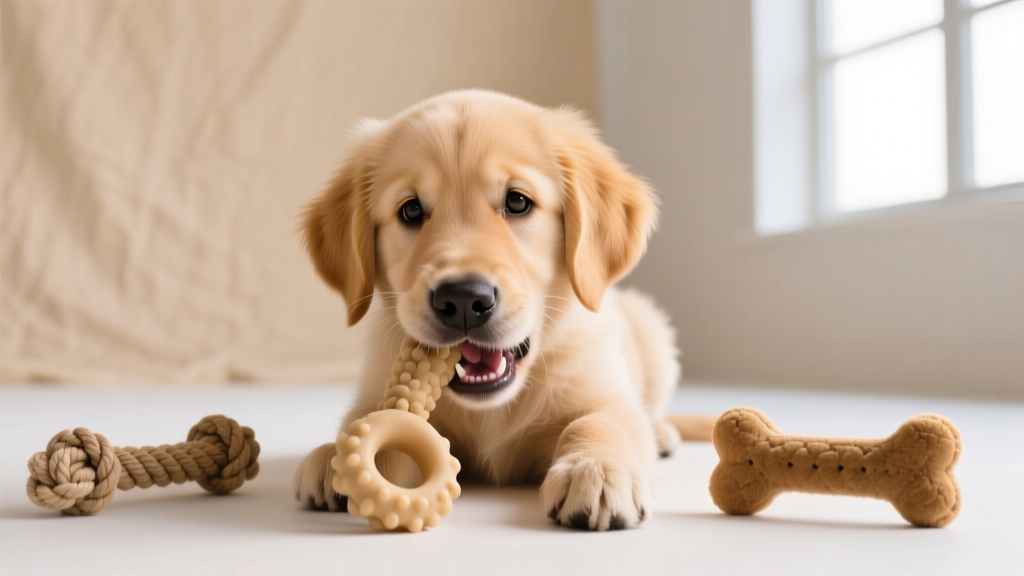
Golden Retriever Puppy Care: Milestones, Feeding & Puppy...
Complete Golden Retriever puppy guide covering milestones, feeding schedules, potty training, vaccines, and when to start puppy obedience classes.

Bringing Home Your Golden Retriever Puppy: What to Expect
Golden Retrievers consistently rank among the top three most popular breeds in the United States, and for good reason — their intelligence, gentle temperament, and trainability make them exceptional family dogs. But raising a Golden Retriever puppy requires breed-specific knowledge that generic puppy advice simply doesn't cover. Goldens mature slower than many breeds, both physically and mentally, which affects everything from crate training timelines to when you should enroll in puppy obedience classes.
This guide walks you through every developmental stage with concrete numbers, schedules, and expectations tailored specifically to Golden Retrievers. Whether you're bringing home an 8-week-old from a responsible breeder or adopting from a rescue, you'll have the exact roadmap you need.
When Should I Bring My Golden Retriever Puppy Home?
The ideal age to bring a Golden Retriever puppy home is 8 weeks (56 days). The American Kennel Club and the AVMA both recommend that puppies remain with their littermates and dam until at least 8 weeks of age. For Golden Retrievers specifically, many reputable breeders hold puppies until 9 or even 10 weeks because the breed benefits from the extra socialization period with siblings.
During weeks 4-8, your Golden puppy is learning critical bite inhibition, canine body language, and social hierarchy from littermates. Removing a Golden before 8 weeks increases the risk of behavioral problems including excessive mouthing, separation anxiety, and poor dog-to-dog communication skills later in life.
Golden Retriever Puppy Milestone Timeline
| Age Range | Weight Range | Key Milestones | Your Action Items |
|---|---|---|---|
| 4-8 weeks | 5-15 lb (2.3-6.8 kg) | Weaning complete, first socialization with littermates, eyes/ears fully functional, deciduous teeth erupting | If still at breeder: request daily handling, exposure to household sounds, introduction to crate |
| 8-12 weeks | 15-30 lb (6.8-13.6 kg) | Fear imprint period begins (8-11 weeks), rapid learning, primary socialization window opens, bladder control developing | Begin name recognition, introduce crate, start potty training routine, enroll in first puppy obedience classes (after initial vaccine) |
| 12-16 weeks | 30-45 lb (13.6-20.4 kg) | Fear imprint period ends, socialization window narrowing, teething begins, testing boundaries, growth plates still open | Intensive socialization exposure, advance obedience training, redirect chewing, increase exercise gradually |
| 16-24 weeks | 45-65 lb (20.4-29.5 kg) | Adult teeth emerging, independence streak begins, sexual maturity approaching, sustained attention improving | Continue puppy obedience classes, introduce longer walks (5 min per month of age rule), begin leash manners refinement |
| 6-12 months | 55-75 lb (25-34 kg) | Second fear period possible (6-14 months), adolescent regression in training, growth plates closing (12-18 months for Goldens), coat transitioning from puppy to adult | Maintain consistent training expectations, avoid forced repetitive exercise, consider spay/neuter timing discussion with vet |
Feeding Schedule: Exact Portions by Age and Weight
Golden Retrievers are predisposed to obesity and joint problems including hip dysplasia and elbow dysplasia. Controlled growth during puppyhood is critical — a Golden puppy should grow steadily but never rapidly. According to research published in the Merck Veterinary Manual, overfeeding large-breed puppies increases the risk of developmental orthopedic diseases by up to 25%.
Feed a food specifically labeled for large-breed puppy growth — these formulas contain controlled calcium-to-phosphorus ratios (1.1:1 to 1.4:1) and reduced caloric density compared to standard puppy foods. Look for an AAFCO statement confirming the food meets nutritional requirements for growth or all life stages.
| Age | Meals Per Day | Daily Amount (Large-Breed Puppy Kibble) | Expected Weight Range | Notes |
|---|---|---|---|---|
| 8-12 weeks | 3 meals | 1.5-2.5 cups/day (split into 3) | 15-30 lb (6.8-13.6 kg) | Soak kibble in warm water for first 1-2 weeks if transitioning |
| 12-16 weeks | 3 meals | 2-3.5 cups/day (split into 3) | 30-45 lb (13.6-20.4 kg) | Begin using food as training rewards; subtract treat calories from meals |
| 4-6 months | 2-3 meals | 2.5-4 cups/day | 45-60 lb (20.4-27.2 kg) | Transition to 2 meals at 6 months; body condition score should be 4-5/9 |
| 6-12 months | 2 meals | 3-4.5 cups/day | 55-75 lb (25-34 kg) | Ribs should be palpable but not visible; adjust portions based on BCS |
| 12-18 months | 2 meals | 3-5 cups/day (adult formula) | 55-75 lb (25-34 kg) | Transition to adult large-breed food at 12-15 months; Goldens mature slowly |
How often should I feed my puppy at 8 weeks? Three times daily, approximately 8 hours apart. A typical schedule: 7:00 AM, 12:00 PM, 5:00 PM. Pick up uneaten food after 15-20 minutes — this establishes a routine that makes potty training significantly easier.
Potty Training Your Golden Retriever: Timeline and Troubleshooting
Golden Retrievers are among the easier breeds to house-train thanks to their eagerness to please and food motivation. However, realistic expectations matter: most Golden Retriever puppies achieve reliable potty training between 4-6 months of age, with occasional accidents possible until 8-10 months.
The general rule for bladder capacity is: a puppy can hold it for approximately one hour per month of age, plus one. So an 8-week-old (2-month) Golden can hold for roughly 3 hours maximum — but you should be taking them out far more frequently than that to prevent accidents and build the habit.
Potty Training Schedule by Age
- 8-10 weeks: Take outside every 1-2 hours, plus immediately after waking, eating, drinking, playing, and crate release. Expect 10-15 outings per day.
- 10-14 weeks: Every 2-3 hours during the day. One overnight outing may still be needed around 2-3 AM. Accidents should decrease to 1-2 per week.
- 14-20 weeks: Every 3-4 hours. Overnight holding typically develops (6-8 hours). Accidents should be rare (1-2 per month).
- 20-28 weeks: Every 4-6 hours. Most Goldens are reliably house-trained by this point. Remaining accidents usually indicate a medical issue (UTI) or a missed signal.
Troubleshooting: If your 5-month-old Golden is still having daily accidents, consult your veterinarian to rule out urinary tract infection, diabetes, or congenital kidney issues before assuming it's a training problem.
When will my puppy be fully potty trained? For Golden Retrievers, expect reliable house training between 4-6 months. Males may take 1-2 months longer than females. Consistency in schedule, immediate praise/treats for outdoor elimination, and zero punishment for accidents (which creates hiding behavior) are the keys to hitting the earlier end of that range.
Socialization Window: The Critical 3-14 Week Period
This is arguably the most important section in this entire guide. The American Veterinary Medical Association defines the primary socialization period as approximately 3-14 weeks of age. For Golden Retrievers — a breed that thrives on social connection — this window shapes their lifelong confidence and behavior.
When can my puppy go outside and meet other dogs? The 2022 AAHA guidelines (still current) recommend that puppies begin controlled socialization before completing their full vaccine series. The risk of behavioral problems from inadequate socialization exceeds the risk of disease exposure in controlled environments. However, avoid dog parks, pet stores, and areas with unknown dog traffic until 7 days after the final puppy vaccine (typically 16-17 weeks).
Vaccination Schedule for Golden Retriever Puppies
Your Golden Retriever puppy will receive a series of core vaccines starting at 6-8 weeks. The AAHA Canine Life Stage Guidelines recommend the following schedule, which your veterinarian will customize based on regional disease prevalence and your puppy's risk factors.
| Age | Vaccine | Type | Estimated Cost | Notes |
|---|---|---|---|---|
| 6-8 weeks | DHPP (Distemper, Hepatitis/Adenovirus, Parainfluenza, Parvovirus) — 1st dose | Core | $25-$45 | Often given by breeder; verify records |
| 10-12 weeks | DHPP — 2nd dose; Bordetella (optional, required for puppy classes) | Core + Non-core | $40-$65 | Bordetella strongly recommended if attending group puppy obedience classes |
| 14-16 weeks | DHPP — 3rd dose; Rabies | Core | $45-$75 | Rabies required by law in all 50 states; timing varies by state (12 vs 16 weeks) |
| 16-18 weeks | Leptospirosis (2-dose series, 2-4 weeks apart); Lyme disease (2-dose series) | Non-core (lifestyle-dependent) | $35-$55 each | Recommended for Goldens who hike, swim in natural water, or live in tick-endemic areas |
| 12-16 months | DHPP booster; Rabies booster (1-year or 3-year depending on vaccine) | Core | $50-$85 | After this, DHPP moves to every 3 years; discuss titer testing as alternative |
What vaccines does my puppy need and when? At minimum, your Golden needs three DHPP doses (at 6-8, 10-12, and 14-16 weeks) and one Rabies vaccine (at 14-16 weeks). Bordetella, Leptospirosis, and Lyme are non-core vaccines your vet will recommend based on your lifestyle. If you plan to attend puppy obedience classes, Bordetella is typically required by training facilities.
When to Start Puppy Obedience Classes and What to Expect
For Golden Retrievers, the ideal time to start puppy obedience classes is 10-12 weeks of age, after the first DHPP vaccine and Bordetella have been administered. Many accredited training facilities now accept puppies as young as 10 weeks, following the AVMA's position that early socialization in controlled environments outweighs the minimal disease risk.
Golden Retrievers are biddable, food-motivated, and attentive — traits that make them stars in obedience classes. But their friendliness can also be a challenge: young Goldens often become over-excited around other dogs and people, making focus difficult in group settings. Here's what to expect from a quality puppy obedience class program:
Puppy Obedience Class Progression for Golden Retrievers
- Puppy Kindergarten (8-16 weeks): Focuses on socialization, bite inhibition, name recognition, sit, down, come, handling exercises, and confidence building. Cost: $120-$200 for a 6-8 week session. Class size should be 4-8 puppies maximum.
- Basic Obedience (4-6 months): Builds on foundation skills with leash walking, stay, leave it, drop it, recall with distractions, and impulse control. Goldens typically excel here. Cost: $150-$250 for 6-8 weeks.
- Intermediate/CGC Prep (6-12 months): Prepares for the AKC Canine Good Citizen test — heeling, supervised separation, accepting a friendly stranger, reaction to distractions. Many Goldens earn their CGC by 12-14 months. Cost: $175-$300 for 6-8 weeks.
Training method requirement: Only enroll in classes that use positive reinforcement (treats, toys, praise). Avoid any facility that uses shock collars, prong collars, leash corrections, or alpha roll techniques. Look for instructors certified by CCPDT (Certification Council for Professional Dog Trainers) or KPA (Karen Pryor Academy).
Teething Timeline and Safe Chew Recommendations
Golden Retriever puppies begin losing their 28 deciduous (baby) teeth around 3-4 months of age, with all 42 adult teeth typically in place by 6-7 months. During this period, your puppy will chew relentlessly — and Goldens are already a mouth-oriented breed genetically predisposed to carrying things in their mouths.
| Teething Stage | Age | What's Happening | Recommended Chew Items |
|---|---|---|---|
| Early teething | 12-16 weeks | Incisors loosening, gums inflamed, increased drooling | Frozen wet washcloth (twisted and soaked in water), KONG Puppy (pink/blue rubber), Benebone Puppy |
| Peak teething | 16-24 weeks | Canines and premolars erupting, maximum chewing drive, baby teeth found in food/toys | KONG Classic (red, medium), Nylabone Puppy Chew, frozen carrot sticks, bully sticks (supervised only) |
| Late teething | 24-28 weeks | Molars erupting, retained baby teeth possible (common in Goldens — check with vet) | KONG Classic (red, large), West Paw Zogoflex Tux, yak cheese chews, deer antler alternatives (avoid real antlers — fracture risk) |
Safety note: Avoid rawhide (choking and blockage risk), cooked bones (splinter risk), and any chew item harder than your puppy's teeth. The "thumbnail test" is a good rule: if you can't indent the chew with your thumbnail, it's too hard and risks tooth fractures. If your Golden puppy ingests a foreign object or you suspect a blockage (vomiting, lethargy, no bowel movements), contact your veterinarian immediately. For toxic ingestion concerns, call the ASPCA Animal Poison Control at (888) 426-4435 (24/7, consultation fee applies).
Crate Training Progression and Common Puppy Problems
Golden Retrievers generally adapt well to crate training because they have a natural den instinct and, when introduced properly, view the crate as a safe retreat. The key is never exceeding your puppy's physical capacity to hold their bladder and never using the crate as punishment.
| Age | Maximum Crate Time (Daytime) | Maximum Crate Time (Overnight) | Crate Size |
|---|---|---|---|
| 8-10 weeks | 1-2 hours | 3-4 hours (expect one overnight potty break) | 36-inch crate with divider panel |
| 11-14 weeks | 2-3 hours | 5-6 hours | 36-inch with divider (expand as puppy grows) |
| 15-16 weeks | 3-4 hours | 6-8 hours | Remove divider gradually |
| 4-6 months | 4-5 hours | 8 hours | Full 42-inch crate (adult Golden size) |
| 6+ months | 5-6 hours maximum | 8 hours | 42-inch crate — Goldens need the space |
Common Golden Retriever Puppy Problems and Solutions
Puppy biting and nipping: Goldens are mouthy by nature — they were bred to carry game. This makes nipping more intense than in many breeds. How do I stop puppy biting? Use the redirection method: when teeth touch skin, say "ouch" in a calm voice, withdraw attention for 10-15 seconds, then offer an appropriate chew toy. Never hold the mouth shut, slap the muzzle, or use physical punishment — these methods increase fear-based biting. Consistent redirection combined with puppy obedience classes (which provide structured bite inhibition practice with other puppies) typically resolves nipping by 5-6 months.
Whining in the crate: Distinguish between protest whining (stops within 5-10 minutes) and distress whining (escalating, frantic). For protest whining, wait for a brief pause in the noise before releasing — rewarding silence teaches that quiet earns freedom. For distress, your puppy may need to be moved closer to your bedroom initially, with the crate gradually relocated over 2-3 weeks.
Destructive chewing: Goldens chew well past the teething phase — many continue power-chewing into adulthood. Management is key: puppy-proof every room, provide 5-8 appropriate chew items of varying textures, and rotate toys weekly to maintain novelty. Never leave a Golden puppy unsupervised with access to shoes, furniture, or electrical cords.
First-Year Cost Breakdown for a Golden Retriever
Budgeting realistically prevents the financial stress that leads to surrendered dogs. Here's a detailed first-year cost estimate for a Golden Retriever puppy based on 2025-2026 pricing data from veterinary clinics and pet supply retailers across the United States:
| Category | Item | Estimated Cost (Low-High) |
|---|---|---|
| Veterinary | Initial exam + puppy vaccine series (3 visits) | $200-$450 |
| Rabies + non-core vaccines (Bordetella, Lepto, Lyme) | $80-$180 | |
| Spay/neuter (6-12 months; Golden-specific: many vets recommend waiting until 12-18 months) | $400-$900 | |
| Heartworm prevention (12 months, e.g., Heartgard Plus) | $80-$140 | |
| Flea/tick prevention (12 months, e.g., Bravecto, NexGard) | $150-$300 | |
| Food | Large-breed puppy food (first 12 months, ~400-500 lb total) | $400-$800 |
| Training treats (12 months) | $60-$120 | |
| Supplies | 42-inch wire crate with divider | $60-$120 |
| Leash, collar, harness (front-clip recommended for Goldens) | $50-$100 | |
| Chew toys, puzzle feeders, KONGs (rotation set) | $80-$200 | |
| Grooming supplies (slicker brush, undercoat rake, nail clippers) | $40-$80 | |
| Training | Puppy kindergarten classes (6-8 weeks) | $120-$200 |
| Basic obedience classes (6-8 weeks) | $150-$250 | |
| Pet Insurance | Annual premium (accident + illness, e.g., Trupanion, Healthy Paws) | $480-$900 |
| TOTAL FIRST YEAR | $2,350-$4,740 |
Note: This does not include the initial purchase price of the puppy ($1,500-$3,500 from a responsible AKC breeder with OFA health testing, or $200-$600 from a breed-specific rescue). Emergency veterinary care for common Golden puppy issues like foreign body ingestion can add $2,000-$6,000 in a single incident — pet insurance is strongly recommended for this breed.
Frequently Asked Questions
When should I bring my Golden Retriever puppy home?
Between 8-10 weeks of age. While 8 weeks is the legal minimum in most states, many Golden Retriever breeders prefer to hold puppies until 9-10 weeks because the breed benefits from additional littermate socialization. Never accept a puppy younger than 7 weeks — this is associated with significantly higher rates of behavioral problems.
How often should I feed my Golden Retriever puppy at 12 weeks?
Three meals per day, approximately 8 hours apart, totaling 2-3.5 cups of large-breed puppy food daily. Divide the total equally across three meals. Use a slow-feeder bowl if your Golden inhales food — this breed is prone to bloat (gastric dilatation-volvulus), and slowing meal consumption is one preventive strategy. Always consult your veterinarian for portion adjustments based on your individual puppy's body condition score.
When will my Golden Retriever puppy be fully potty trained?
Most Golden Retrievers achieve reliable house training between 4-6 months of age with consistent schedule management. Males may take slightly longer. If your puppy is still having frequent accidents past 6 months, consult your veterinarian to rule out urinary tract infection or other medical causes before attributing it to training gaps.
What vaccines does my Golden Retriever puppy need and when?
Core vaccines: DHPP at 6-8 weeks, 10-12 weeks, and 14-16 weeks; Rabies at 14-16 weeks. Non-core (lifestyle-dependent): Bordetella at 10-12 weeks (recommended for puppy obedience classes), Leptospirosis and Lyme disease starting at 16 weeks if your dog will have outdoor exposure in endemic areas. Your veterinarian will tailor the schedule to your region and risk factors.
How do I stop my Golden Retriever puppy from biting and nipping?
Redirect to appropriate chew toys every single time teeth contact skin. Withdraw attention for 10-15 seconds after nipping (stand up, turn away, or step behind a baby gate). Enroll in puppy obedience classes where structured play with other puppies accelerates bite inhibition learning. Never use physical punishment — it increases fear-based aggression. Expect mouthing to diminish significantly by 5-6 months as adult teeth come in and impulse control develops.
When can my Golden Retriever puppy go outside and meet other dogs?
Controlled socialization can begin immediately after bringing your puppy home (8 weeks). Carry your puppy to new environments, invite fully vaccinated adult dogs to your home, and attend puppy classes after the first DHPP + Bordetella vaccines (typically by 10-12 weeks). Avoid high-risk areas — dog parks, pet store floors, areas with unknown dog feces — until 7 days after the final DHPP vaccine at 14-16 weeks. The socialization window closes around 14 weeks, so waiting until all vaccines are complete means missing the most critical developmental period.
Are puppy obedience classes worth it for Golden Retrievers?
Absolutely. While Goldens are naturally biddable, puppy obedience classes provide two things you cannot replicate at home: structured socialization with unfamiliar dogs and people, and training practice around distractions. Group classes also teach you proper timing and technique for positive reinforcement. The investment ($120-$200 for puppy kindergarten) pays dividends in preventing the behavioral problems that are the leading cause of dogs ending up in shelters.
Disclaimer: This guide provides general educational information. Always consult your veterinarian for personalized advice regarding your Golden Retriever puppy's health, nutrition, vaccination schedule, and spay/neuter timing. Individual puppies may have needs that differ from breed averages.
Beth Carrasco
All our authors care for dogs every day — read more of their work on the authors page.