Golden Retriever Puppy Crates & Care Guide: Week-by-Week Training Plan
Complete Golden Retriever puppy guide covering crate training timelines, feeding schedules, potty training, vaccines, and first-year costs with week-by-week milestones.

Bringing a Golden Retriever puppy home is one of life's great joys — and one of its most exhausting undertakings. Goldens are famously eager to please, but their first year demands serious preparation: a properly sized crate, a structured feeding plan, a vaccination timeline you can actually follow, and the patience to survive the teething phase without losing your favorite pair of shoes.
This guide walks you through every critical stage from 8 weeks to 12 months, with specific numbers, real product recommendations, and honest timelines. No "your puppy will be trained in three days" promises — just the practical framework I've seen work across hundreds of Golden Retriever households.
When Should I Bring My Golden Retriever Puppy Home?
The American Kennel Club and most veterinary behaviorists agree: 8 weeks is the absolute minimum, and 9-10 weeks is ideal for Golden Retrievers. Here's why the extra week or two matters:
Weeks 4-8 (at the breeder): Your puppy should be fully weaned onto solid food (typically a large-breed puppy formula like Purina Pro Plan Large Breed Puppy or Royal Canin Golden Retriever Puppy), receiving their first DHPP vaccine at 6-8 weeks, and undergoing early neurological stimulation (ENS) and early scent introduction (ESI) if the breeder follows AKC Breeder of Merit protocols. They should be crate-acclimated — sleeping in individual crates at night by week 7.
Before pickup, confirm your breeder has provided:
- Written health guarantee covering hips, elbows, heart, and eyes (minimum 2 years)
- OFA or PennHIP hip scores for both parents
- First DHPP vaccine record with veterinarian signature
- Deworming record (typically pyrantel pamoate at 2, 4, 6, and 8 weeks)
- Microchip registration paperwork
Golden Retriever Puppy Crate Training: Sizing, Setup, and Time Limits
Golden Retrievers are among the easier breeds to crate train because they're den-oriented and generally food-motivated. But "easy" still requires the right crate, the right size, and realistic time expectations.
Crate Sizing for Golden Retrievers
Adult Goldens typically weigh 55-75 lb (25-34 kg) and need a 42-inch crate (42"L × 28"W × 30"H). But a full-size crate for an 8-week-old puppy who weighs 10-15 lb is a potty-training disaster — they'll eliminate in one corner and sleep in the other.
Recommended approach: Buy a 42-inch wire crate (MidWest iCrate or Frisco Double Door) with an adjustable divider panel. These cost $55-$85 and grow with your puppy. Expand the space as they gain bladder control.
| Puppy Age | Max Crate Time (Day) | Max Crate Time (Night) | Divider Setting |
|---|---|---|---|
| 8-10 weeks | 1-2 hours | 3-4 hours (expect 1-2 night wakings) | Smallest — just enough to stand, turn, lie down |
| 11-14 weeks | 2-3 hours | 4-5 hours | Slightly expanded — add 4-6 inches |
| 15-16 weeks | 3-4 hours | 6-7 hours | Mid-range |
| 4-6 months | 4-5 hours | 7-8 hours | Nearly full crate |
| 6-12 months | 5-6 hours (not daily) | 8 hours | Full 42" crate |
Critical rule: No puppy under 6 months should be crated for more than their age in months plus one hour during the day. A 3-month-old Golden = 4 hours maximum. Exceeding this leads to distress, self-injury, and regression in house training.
Stopping Crate Whining (Without Creating Worse Problems)
Golden Retriever puppies are vocal. Expect 3-7 nights of protest whining when you first bring them home. Here's the protocol that works:
- Exercise before crating: 15-20 minutes of play/training before bedtime. A tired puppy sleeps.
- Last potty break at 10:30-11 PM: Keep it boring — leash, outside, eliminate, straight back to crate. No play.
- Cover the crate with a breathable blanket on three sides (reduces visual stimulation).
- White noise machine or a ticking clock wrapped in a towel (mimics littermate heartbeats).
- If they whine after 20 minutes: Wait. If it escalates past 30 minutes of continuous crying, take them out on leash for a quick potty break, then immediately back in. Do not play, cuddle, or talk excitedly.
- Never let them out while actively whining (unless you suspect a potty emergency). This teaches "noise = freedom."
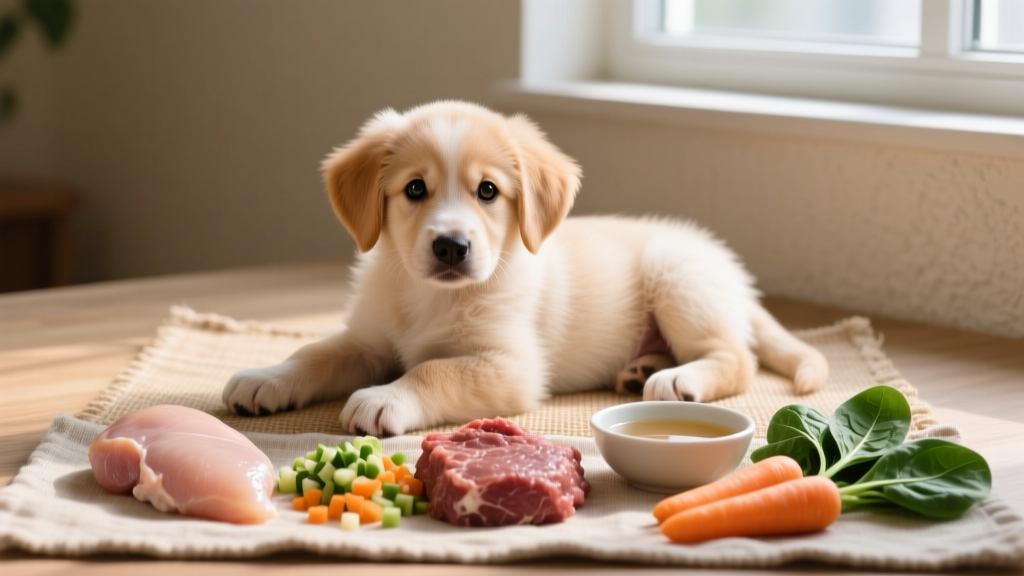
Feeding Your Golden Retriever Puppy: Schedule and Portions
Golden Retrievers are prone to rapid growth-related orthopedic diseases — hip dysplasia, elbow dysplasia, and osteochondritis dissecans (OCD). Research from Merck Veterinary Manual confirms that overfeeding and excess calcium directly increase these risks. You want your Golden to grow slowly.
Food selection: Choose a large-breed puppy formula that meets AAFCO standards for growth. Look for guaranteed analysis showing 26-30% protein, 12-17% fat, and calcium at 1.0-1.5% on a dry matter basis. Recommended options include Purina Pro Plan Large Breed Puppy, Hill's Science Diet Large Breed Puppy, or Royal Canin Golden Retriever Puppy.
| Age | Meals Per Day | Daily Total (approx.) | Expected Weight |
|---|---|---|---|
| 8-12 weeks | 3-4 meals | 1.5-2.5 cups/day | 10-22 lb (4.5-10 kg) |
| 3-6 months | 3 meals | 2.5-4 cups/day | 22-50 lb (10-23 kg) |
| 6-9 months | 2 meals | 3-4.5 cups/day | 50-65 lb (23-29 kg) |
| 9-12 months | 2 meals | 3.5-5 cups/day | 60-75 lb (27-34 kg) |
Important: These are starting points. Adjust based on body condition score (BCS). You should be able to feel (but not prominently see) your puppy's ribs, and they should have a visible waist when viewed from above. If your puppy looks round and barrel-shaped, reduce portions by 10-15%. Consult your veterinarian for individualized guidance.
Vaccination Schedule: What Your Golden Retriever Puppy Needs and When
Golden Retrievers follow the standard core vaccine protocol recommended by the American Veterinary Medical Association. Here's the exact timeline:
| Age | Vaccine | Notes |
|---|---|---|
| 6-8 weeks | DHPP (Distemper, Hepatitis/Adenovirus, Parainfluenza, Parvovirus) — 1st dose | Usually given by breeder before pickup |
| 10-12 weeks | DHPP — 2nd dose; Bordetella (optional, recommended if attending puppy classes) | First vet visit after coming home; fecal test for parasites |
| 14-16 weeks | DHPP — 3rd (final) dose; Rabies (required by law) | Maternal antibodies have waned; this dose provides reliable immunity |
| 12-16 months | DHPP booster; Rabies booster (1-year or 3-year, per local law) | After this, DHPP typically every 3 years; discuss titer testing as alternative |
Non-core vaccines to discuss with your vet based on lifestyle:
- Leptospirosis: Recommended if you hike, live near standing water, or have wildlife exposure. Given as a 2-dose series starting at 12+ weeks.
- Lyme disease: Recommended in tick-endemic areas (Northeast, Upper Midwest, Pacific Northwest). 2-dose series starting at 9+ weeks.
- Canine influenza (H3N2/H3N8): Recommended if your puppy will be boarded, attend daycare, or compete in events.
The Socialization Window: Weeks 3-14 (Don't Miss This)
This is the single most important section of this guide. The primary socialization period closes around 12-14 weeks. After this window, unfamiliar things trigger fear rather than curiosity. A Golden Retriever who wasn't socialized during this window is far more likely to develop fear-based reactivity, noise phobias, and anxiety later in life.
The challenge: Your puppy isn't fully vaccinated until 16 weeks. So you socialize carefully — controlled exposure, not random dog park visits.
Golden Retriever Puppy Socialization Checklist
People (goal: 100 different people by 14 weeks):
- ☐ Children (supervised, calm interactions)
- ☐ Elderly individuals, people using canes/wheelchairs
- ☐ People wearing hats, sunglasses, hoodies, masks
- ☐ People of different heights, builds, skin tones
- ☐ Delivery drivers, mail carriers (in uniform)
Environments:
- ☐ Car rides (start with 5 minutes, build to 20)
- ☐ Pet-friendly store parking lots (carry puppy, don't set on ground)
- ☐ Different floor surfaces: tile, hardwood, gravel, grass, metal grates
- ☐ Elevators, automatic doors, revolving doors
- ☐ Busy streets (observed from a distance, then closer)
Sounds and objects:
- ☐ Vacuum cleaner (start in another room, gradually closer)
- ☐ Thunderstorm recordings (play at low volume during meals)
- ☐ Umbrellas opening, pots clanging, doorbells
- ☐ Bicycles, skateboards, strollers passing by
Handling (critical for grooming and vet visits):
- ☐ Paw handling — all four paws, daily
- ☐ Ear inspection and gentle cleaning
- ☐ Mouth opening, teeth inspection
- ☐ Nail trimming practice (even if you only clip one nail per session)
- ☐ Brushing with a slicker brush
Rule of thumb: Every new experience should be paired with high-value treats (small pieces of boiled chicken, cheese, or commercial training treats like Zuke's Mini Naturals). If your puppy shows fear — tucked tail, frozen posture, hiding — increase distance from the stimulus and let them observe. Never force a frightened puppy closer.
Potty Training Your Golden Retriever: Timeline and Troubleshooting
Golden Retrievers are generally quicker to house-train than terriers or toy breeds, but "quick" still means 4-6 months for reliable daytime control and 6-8 months for overnight reliability. Any article promising faster should be viewed skeptically.
Potty Training Schedule by Age
| Age | Daytime Frequency | Nighttime Frequency | Bladder Capacity |
|---|---|---|---|
| 8-10 weeks | Every 30-60 minutes | Every 2-3 hours | ~30-45 minutes active, 2-3 hours sleeping |
| 11-14 weeks | Every 1-1.5 hours | Every 3-4 hours | ~1-1.5 hours active |
| 15-20 weeks | Every 2 hours | Every 4-6 hours | ~2 hours active |
| 5-6 months | Every 3-4 hours | 6-8 hours (often sleeping through) | ~3-4 hours active |
| 7-12 months | Every 4-6 hours | 8 hours | Adult-level control developing |
The protocol:
- Take puppy to the same outdoor spot every time (scent triggers elimination).
- Use a consistent cue word: "Go potty" or "Hurry up." Say it while they're eliminating, not before.
- Reward immediately — within 2 seconds — with a treat and verbal praise. Not when you go back inside. Outside, right there.
- Supervise 100% when loose indoors. If you can't watch them, they're in the crate or a puppy-proofed pen.
- If you catch them mid-accident: interrupt with a calm "oops" or clap, scoop them up, carry outside to finish. Never rub their nose in it or yell — this teaches them to hide when eliminating.
When will my puppy be fully potty trained? Most Golden Retrievers have reliable daytime control by 5-6 months and sleep through the night without accidents by 4-5 months. However, excitement urination (peeing when greeting people) can persist until 12-18 months and is a separate behavioral issue, not a house-training failure.
Teething, Biting, and Chewing: Surviving Months 3-6
Golden Retriever puppies are mouthy. This is the breed that was literally designed to carry things in their mouths, and that genetic impulse combines with teething discomfort to create what many owners describe as "living with a baby alligator."
Teething Timeline
- 3-4 weeks: Deciduous (baby) teeth erupt — 28 total
- 8-12 weeks: Peak puppy nipping phase — exploring the world with their mouth
- 12-16 weeks: Baby incisors begin loosening and falling out
- 4-6 months: Peak teething discomfort — adult teeth (42 total) pushing through gums. Most destructive chewing occurs here.
- 6-7 months: All adult teeth should be in. If baby canines haven't fallen out by 7 months, your vet may need to extract them (retained deciduous teeth are somewhat common in Goldens).
Stopping Puppy Biting and Nipping
How do I stop my Golden Retriever puppy from biting? You don't eliminate it overnight — you redirect and shape it over 6-8 weeks. The method:
- Redirect to a toy: Every time teeth touch skin, say "ouch" in a calm voice, withdraw attention for 5-10 seconds, then offer an appropriate chew toy (KONG Classic, Nylabone Puppy, or a frozen washcloth twisted into a rope).
- Reward soft mouths: When they lick or mouth gently without pressure, praise and treat. You're teaching bite inhibition — not "never use your mouth" but "your mouth must be gentle."
- Time-outs for hard bites: If a bite breaks skin or is deliberately hard, end the interaction immediately. Stand up, turn away, or step behind a baby gate for 30 seconds. This mimics littermate behavior.
- Provide 4-6 appropriate chews at all times: Rotate them to maintain novelty. Frozen KONGs stuffed with plain yogurt and blueberries are excellent for teething pain.
- Never use physical punishment: No alpha rolls, no muzzle grabbing, no hitting. These damage the trust relationship and can create fear-based aggression. The American Veterinary Society of Animal Behavior explicitly advises against aversive methods in puppy training.
Safe chew recommendations for Golden Retriever puppies:
- KONG Puppy (pink/blue rubber, sized Large for Goldens) — $12-$16
- Benebone Puppy Wishbone — $14-$18
- Bully sticks (supervised only, remove when under 3 inches to prevent choking) — $3-$6 each
- Frozen carrots — free, excellent for teething, low calorie
- West Paw Zogoflex Toppl — $18-$24, great for stuffing and freezing
Age-by-Age Milestones: What to Expect Each Month
Weeks 8-12: The Adjustment Period
What's happening: Your puppy is learning your home, your routines, and your rules. Expect crying at night, frequent accidents, and clingy behavior. This is normal — they've just left their entire family.
Key tasks: Establish a consistent daily routine (same wake time, same feeding times, same potty spot). Begin crate training. Start basic name recognition ("Look at me" with a treat). Enroll in a positive-reinforcement puppy kindergarten class (many accept puppies from 10 weeks with at least one DHPP dose).
Exercise: 5 minutes of structured walking per month of age, twice daily. An 8-week-old Golden gets 10-minute walks. Don't exceed this — their growth plates are open and overexercise can damage developing joints.
Weeks 12-16: The Learning Sponge Phase
What's happening: Fear periods may occur around 12-14 weeks. Your previously confident puppy may suddenly spook at a garbage can or a person wearing a hat. This is developmental, not permanent. Stay calm, don't force exposure, and let them investigate at their own pace with treats.
Key tasks: Introduce "sit," "down," "come," and "leave it" using positive reinforcement. Practice handling exercises daily. Continue socialization aggressively — you have until roughly week 14 before the window closes.
Weeks 16-24: The Teenage Test
What's happening: Your Golden has been vaccinated, has bladder control, and is starting to test boundaries. They'll "forget" commands they knew perfectly at 12 weeks. This is normal adolescent regression, not failure.
Key tasks: Increase training difficulty (practice "come" with distractions, work on loose-leash walking). Begin longer walks (20-30 minutes). Start recall training in fenced areas with a long line (15-30 foot training leash). Spay/neuter is typically performed around 6 months for Goldens — discuss timing with your veterinarian, as some evidence suggests delaying until 12+ months may reduce orthopedic risks in large breeds.
Months 6-12: The Adolescent Marathon
What's happening: Your Golden will look nearly adult-sized but behave like a puppy. Energy levels peak around 8-10 months. Destructive chewing may resurge. Males may begin marking territory; females will experience their first heat cycle (typically 6-12 months) if not spayed.
Key tasks: Increase physical exercise to 45-60 minutes daily (walks, fetch, swimming). Add mental stimulation — puzzle toys, scent work, trick training. Consider a manners class or introductory obedience course. Transition from puppy food to adult large-breed formula around 12 months (or 15-18 months per your vet's recommendation).
First-Year Cost Breakdown: Budgeting for Your Golden Retriever
Golden Retrievers are not a budget breed. Here's a realistic first-year cost breakdown based on 2026 national averages:
| Category | Estimated Cost | Details |
|---|---|---|
| Puppy purchase (responsible breeder) | $2,000-$4,500 | Health-tested parents, AKC registration, health guarantee. Adoption/rescue: $300-$600. |
| Veterinary (first year) | $800-$1,500 | 3-4 wellness visits, DHPP series, rabies, fecal tests, heartworm prevention, spay/neuter ($400-$800) |
| Food (large-breed puppy formula) | $600-$1,000 | ~$50-$85/month for quality large-breed puppy food |
| Supplies | $400-$700 | Crate ($55-$85), bed, leash/harness, bowls, toys, chews, grooming tools, baby gates, puppy pen |
| Training | $200-$600 | Puppy kindergarten ($150-$250 for 6-8 weeks), optional manners class ($150-$250) |
| Preventive medications | $300-$500 | Monthly heartworm (e.g., Heartgard Plus), flea/tick prevention (e.g., NexGard, Bravecto) |
| Pet insurance (optional) | $400-$700 | $35-$60/month; highly recommended for Goldens given cancer and orthopedic predispositions |
| Total first year | $4,700-$9,500 | Does not include emergency veterinary care ($1,000-$5,000+ per incident) |
Money-saving tips that don't compromise health: Buy pet food in bulk (Chewy autosave saves 5-10%), use Costco's Kirkland Signature puppy food (meets AAFCO standards at roughly half the price of premium brands), and invest in pet insurance early — pre-existing conditions are never covered, and Golden Retrievers have high lifetime cancer rates (approximately 60% per the Golden Retriever Club of America).
Frequently Asked Questions
How often should I feed my 8-week-old Golden Retriever puppy?
Feed 3-4 meals per day, totaling approximately 1.5-2 cups of large-breed puppy food daily. Divide evenly across meals. Feed at consistent times (e.g., 7 AM, 12 PM, 5 PM, and optionally 9 PM). Remove uneaten food after 15-20 minutes to establish a routine and prevent free-feeding, which makes potty training harder.
When will my Golden Retriever puppy stop biting everything?
The worst nipping occurs between 8-16 weeks (exploration phase) and 4-6 months (teething phase). With consistent redirection, most Goldens show significant improvement by 6-7 months. Some mild mouthing may persist into adolescence (8-12 months) but should be gentle and easily redirected. If biting intensifies or seems aggressive after 6 months, consult a certified professional dog trainer (CPDT-KA) or veterinary behaviorist.
What size crate do I need for a Golden Retriever puppy?
Buy a 42-inch wire crate with an adjustable divider panel ($55-$85). Start with the divider set small — just enough room for your puppy to stand up, turn around, and lie down comfortably. Expand the space every 3-4 weeks as they grow. By 6-7 months, the full 42-inch crate will be appropriate. Avoid buying a smaller crate and upgrading — it's more expensive and the puppy needs to learn the larger space gradually.
Should I wake my puppy up at night to go potty?
Yes, for the first 12-16 weeks. Set an alarm for 3-4 hours after bedtime. Take them out on leash, keep it quiet and boring, then straight back to the crate. As their bladder capacity increases (typically around 4-5 months), they'll sleep longer stretches and you can phase out the alarm. If they consistently sleep 6+ hours without accidents for a week, try removing the nighttime wake-up.
Is it normal for my Golden puppy to sleep 18-20 hours a day?
Yes, completely normal. Puppies aged 8-16 weeks typically sleep 18-20 hours per day, including nighttime sleep and daytime naps. Growth hormone is released during sleep, and their developing bodies need it. If your puppy seems lethargic when awake (not just sleepy, but weak, unresponsive, or refusing food), contact your veterinarian — that's different from normal puppy sleepiness.
This guide provides general educational information. Always consult your veterinarian for personalized advice regarding your Golden Retriever puppy's health, nutrition, and vaccination needs. Individual puppies may have different requirements based on health status, genetics, and environment.
Beth Carrasco
All our authors care for dogs every day — read more of their work on the authors page.