Golden Retriever Puppies: The Complete Week-by-Week Care Guide
Everything you need to raise golden retriever puppies: week-by-week milestones, feeding schedules, vaccination timelines, potty training, and first-year costs.

Golden retriever puppies are famously friendly, eager to please, and — let's be honest — a whirlwind of chewing, shedding, and muddy paws. Raising one well requires more than love; it demands a structured plan grounded in developmental science and breed-specific knowledge. This guide walks you through every critical stage from bringing your puppy home through adolescence, with exact numbers, timelines, and strategies that actually work.
When Should You Bring Your Golden Retriever Puppy Home?
The optimal age to bring a golden retriever puppy home is 8 to 10 weeks. The American Kennel Club recommends that puppies remain with their littermates and dam for at least 8 weeks to develop bite inhibition, learn canine social cues, and build immune resilience through maternal antibodies.
Some responsible breeders of large breeds like golden retrievers retain puppies until 10 or even 12 weeks. This extended period can benefit socialization and confidence, particularly for puppies destined for therapy or service work. If your breeder offers this option, it's generally a sign of conscientiousness — not a red flag.
What to avoid: Any breeder offering puppies before 7 weeks is cutting corners on critical developmental windows. Puppies separated too early show higher rates of separation anxiety, fear-based reactivity, and poor bite inhibition later in life.
Golden Retriever Puppy Milestones: Week by Week
Golden retrievers mature more slowly than many breeds — both physically and mentally. Don't expect adult behavior until 2 to 3 years of age. Here's what to expect at each developmental stage.
Weeks 4–8 (Breeder's Care)
During this period, your puppy is still with the breeder. Key developments include:
- Sensory maturation: Eyes fully open by week 4; hearing sharpens by week 5.
- Social play: Littermate wrestling teaches bite inhibition — yelping siblings signal "too hard."
- Weaning begins: Puppies transition from mother's milk to gruel (puppy kibble soaked in warm water or puppy formula) around week 4, fully weaned by week 7.
- First deworming: Typically at weeks 2, 4, 6, and 8 per Merck Veterinary Manual protocols.
Weeks 8–12 (Home Transition)
This is the most impressionable period after coming home. Expect:
- Weight: 10–22 lb (4.5–10 kg) depending on sex and lineage.
- Sleep: 18–20 hours per day — yes, really. Enforce naps in the crate.
- Bladder capacity: Roughly 1 hour per month of age (so ~2 hours max at 8 weeks).
- Behavior: Intense mouthing, following you room-to-room, crying at night, and startling at novel sounds.
- Learning capacity: Can learn sit, name recognition, and crate entry with food luring.
Weeks 12–16 (Rapid Growth Phase)
Your puppy hits a major growth spurt. Key changes:
- Weight: 22–40 lb (10–18 kg).
- Teething begins: Deciduous (baby) teeth start loosening; you may find tiny teeth on the floor.
- Fear period: Weeks 8–11 and again around 14–16 weeks. Puppies may suddenly become wary of previously familiar stimuli. Keep experiences positive — never force interactions.
- Coordination: Legs grow faster than the body remembers. Expect clumsy, "gangly" movement.
- Training: Can reliably learn sit, down, come (short distances), and leash walking basics.
Weeks 16–24 (Juvenile Stage)
Energy and independence surge during this phase:
- Weight: 40–60 lb (18–27 kg).
- Adult teeth: All 42 permanent teeth typically in by 6 months.
- Exercise capacity: Structured walks of 5 minutes per month of age, twice daily (e.g., 20 minutes at 4 months).
- Behavior: Testing boundaries, selective hearing on recall, increased prey drive (chasing squirrels, leaves, anything that moves).
- Coat change: Puppy fluff begins transitioning to the denser, water-repellent adult double coat.
Months 6–12 (Adolescence)
The teenage phase — often the most challenging period for golden retriever owners:
- Weight: 50–75 lb (23–34 kg); males typically heavier.
- Sexual maturity: Intact females may experience first estrus (heat) between 6–12 months. Discuss spay/neuter timing with your vet — current evidence from AVMA suggests large-breed dogs may benefit from delayed gonadectomy (after 12–18 months) to reduce orthopedic and cancer risks.
- Training regression: Commands your dog "knew" at 4 months may seem forgotten. This is normal. Maintain consistent, positive reinforcement sessions.
- Chewing: A second chewing phase often occurs around 7–10 months as jaw muscles strengthen and adult teeth settle.
- Mental maturity: Still very much a puppy mentally. Goldens are notoriously slow to mature — expect puppy-like enthusiasm through at least age 2.
Feeding Schedule for Golden Retriever Puppies
Golden retrievers are prone to rapid growth-related orthopedic issues (hip dysplasia, elbow dysplasia) and obesity. Feeding a large-breed puppy formula is non-negotiable — these diets contain controlled calcium-phosphorus ratios (1.0:1 to 1.5:1) and reduced caloric density to slow growth rates and protect developing joints.
Look for an AAFCO statement reading: "This product is formulated to meet the nutritional levels established by the AAFCO Dog Food Nutrient Profiles for growth/all life stages, including growth of large-size dogs (70 lb or more as an adult)."
| Age | Meals/Day | Approx. Cups/Day (Dry Kibble) | Notes |
|---|---|---|---|
| 8–12 weeks | 3–4 | 1.5–2.5 cups | Soak kibble in warm water if puppy struggles with hard pieces |
| 3–6 months | 3 | 2.5–4 cups | Adjust based on body condition score (BCS 4-5/9 ideal) |
| 6–12 months | 2 | 3.5–5 cups | Transition to 2 meals/day around 6 months |
| 12–24 months | 2 | 3.5–5 cups (adult formula) | Gradually transition to adult food over 7–10 days at 12–18 months |
Body Condition Score (BCS) check: You should be able to feel your puppy's ribs without pressing hard, and see a visible waist when viewed from above. If ribs are hard to feel, reduce portions by 10%. If ribs are visible, increase by 10%.
Recommended brands with large-breed puppy formulas: Purina Pro Plan Large Breed Puppy, Royal Canin Golden Retriever Puppy, Hill's Science Diet Large Breed Puppy, or Fromm Gold Large Breed Puppy. Always transition foods over 7–10 days by mixing 25% new / 75% old, then 50/50, then 75/25.
Vaccination Schedule and Health Protection
Your golden retriever puppy's immune system is immature and vulnerable. Maternal antibodies provide partial protection early on but wane unpredictably — which is why a series of boosters is essential. Here's the standard protocol per the AVMA and AAHA canine vaccination guidelines:
| Age | Vaccine(s) | Type | Estimated Cost |
|---|---|---|---|
| 6–8 weeks | DHPP (Distemper, Hepatitis/Adenovirus, Parainfluenza, Parvovirus) — 1st dose | Core | $25–$40 |
| 10–12 weeks | DHPP — 2nd dose; Bordetella (kennel cough); Leptospirosis (if risk area) | Core + Non-core | $40–$75 |
| 14–16 weeks | DHPP — 3rd (final puppy) dose; Rabies (required by law); Lyme (if tick-endemic area) | Core + Non-core | $50–$90 |
| 12–16 months | DHPP booster; Rabies booster; Bordetella (if boarding/daycare); Leptospirosis booster | Core + Non-core | $60–$100 |
Socialization Window: Weeks 3–14
The primary socialization period for puppies closes around 12–14 weeks of age. This is a biologically fixed window during which novel experiences are processed as "normal" rather than "threatening." Miss this window, and your golden retriever — despite the breed's legendary friendliness — may develop fear responses that require professional behavioral intervention later.
Because your puppy won't be fully vaccinated during this window, the AKC and the American Veterinary Society of Animal Behavior (AVSAB) recommend carrying your puppy or using a stroller/sling for exposure, and arranging playdates only with known, vaccinated, healthy dogs.
Potty Training Timeline and Troubleshooting
Golden retrievers are generally quick to housetrain — their food motivation and desire to please work in your favor. However, realistic timelines matter.
When will my puppy be fully potty trained? Most golden retriever puppies achieve reliable housetraining between 4 and 6 months of age. "Reliable" means fewer than 1 accident per month. Some puppies, particularly males and those with frequent schedule disruptions, may take until 8–9 months. This is normal and not a sign of failure.
| Age | Max Bladder Hold Time | Nighttime Breaks Needed | Accident Expectation |
|---|---|---|---|
| 8–10 weeks | 1–2 hours | 2–3 per night | Multiple daily — expect it |
| 10–14 weeks | 2–3 hours | 1–2 per night | 1–2 daily if supervised well |
| 3–4 months | 3–4 hours | 0–1 per night | Occasional — usually after play/excitement |
| 5–6 months | 5–6 hours | 0 (sleeping through) | Rare — regressions possible during stress |
Troubleshooting common issues:
- Submissive/excitement urination: Common in golden puppies. Don't punish — it makes it worse. Greet calmly, take puppy outside immediately upon arrival, and avoid direct eye contact during greetings until the behavior fades (usually by 6–9 months).
- Regression at 4–5 months: Often coincides with teething discomfort or increased independence. Return to more frequent potty breaks and higher-value outdoor rewards.
- Marking behavior (males): Leg-lifting typically begins around 6–9 months. Interrupt calmly and redirect outside. Neutering may reduce but doesn't always eliminate marking.
Crate Training, Teething, and Common Puppy Challenges
Crate Training Progression
A crate is your puppy's safe den — not a punishment tool. Golden retrievers typically adapt well to crates because of their den-seeking instinct, but the process must be gradual.
Maximum crate time by age (while awake/alone):
- 8–10 weeks: 30–60 minutes maximum during the day
- 10–14 weeks: 1–2 hours
- 3–4 months: 2–3 hours
- 5–6 months: 3–4 hours
- Overnight (all ages): Puppies can typically hold it 1 hour longer than their daytime capacity because sleep suppresses bladder signals. An 8-week-old may manage 3–4 hours overnight before needing a break.
Progression steps:
- Leave crate door open with meals fed inside for the first 3–5 days.
- Close door during meals, open immediately after eating (days 5–7).
- Close door for 5 minutes after eating while you sit nearby (week 2).
- Gradually extend closed time to 15, then 30 minutes, while you remain in the room (weeks 2–3).
- Step out of the room for 1 minute, then 5, then 15 (weeks 3–4).
- Begin leaving the house for short errands (week 5+).
For whining: If your puppy whines after being settled and toileted, wait 5–10 minutes before responding. If whining escalates to panic (continuous screaming, self-injury attempts), the crate training progression moved too fast. Go back one step. Never let a puppy "cry it out" for extended periods — this creates crate aversion.
Teething Timeline and Relief (3–6 Months)
Golden retriever puppies begin losing their 28 deciduous teeth around 12–16 weeks, with all 42 adult teeth typically erupted by 6–7 months. During this period, expect:
- Increased chewing on everything (furniture, shoes, hands, baseboards)
- Drooling more than usual
- Occasional bleeding gums (a small amount on chew toys is normal)
- Reluctance to eat hard kibble (soak if needed)
- Finding small teeth on the floor or in bedding (many puppies swallow them — harmless)
Safe chew recommendations:
- Kong Classic (puppy rubber, pink/blue): Stuff with plain yogurt mixed with kibble and freeze for 2–4 hours. The cold numbs sore gums.
- Benebone Puppy Wishbone: Designed for puppy teeth; softer nylon than adult versions.
- Frozen washcloth: Wet a clean washcloth, twist into a rope, freeze for 2 hours. Supervise to prevent swallowing fabric.
- Carrots (whole, large): Cold, crunchy, low-calorie. Too large to choke on for most puppies.
Avoid: Rawhide (choking and intestinal blockage risk), antlers or weight-bearing bones (tooth fractures), and any chew smaller than your puppy's muzzle width.
Stopping Puppy Biting and Nipping
Golden retrievers are a mouthy breed — they were literally developed to carry waterfowl. Biting is not aggression; it's breed-typical exploration. However, it must be redirected.
Step-by-step protocol:
- Redirect: When teeth touch skin, immediately offer an appropriate chew toy. Praise enthusiastically when puppy bites the toy instead.
- Withdraw attention: If redirecting fails, stand up, fold your arms, and turn away for 10–15 seconds. No talking, no eye contact. Resume interaction only when all four paws are on the floor.
- Time-out: If biting persists after 2–3 redirections, calmly place puppy in a playpen or crate for a 30–60 second "reset." This is not punishment — it's an arousal-reduction tool.
- Prevent rehearsal: Keep a toy within reach during all interactions for the first 3 months. Proactively offer it before puppy mouths you.
What NOT to do: Never hold the puppy's mouth shut, yell, use alpha rolls, or physically punish. These methods increase fear and can create defensive aggression. Positive reinforcement and management are the only methods recommended by veterinary behaviorists.
When Can My Puppy Go Outside and Meet Other Dogs?
This question requires balancing disease risk with socialization needs — and the answer is nuanced.
Safe outdoor exposure (8–16 weeks, pre-full-vaccination):
- Your own fenced yard — immediately
- Carried in a sling or stroller through neighborhoods, shopping centers, parks — immediately
- Private homes of friends with known, vaccinated, healthy dogs — from week 8
- Puppy kindergarten classes (most reputable programs require at least the first DHPP dose and a negative fecal test) — from week 10–12
Wait until 1 week after final DHPP (typically 15–17 weeks):
- Public dog parks
- Pet store floors
- Shared common areas where unknown dogs have been
- Off-leash hiking trails
The AVSAB position statement is clear: the risk of behavioral problems from inadequate socialization outweighs the disease risk for most puppies in most environments. Controlled exposure is the standard of care.
First-Year Cost Breakdown for a Golden Retriever
Budgeting realistically prevents surrender — golden retrievers are among the most commonly surrendered breeds to rescues, often due to owners underestimating costs. Here's a detailed first-year estimate based on 2025–2026 pricing:
| Category | Low Estimate | Mid Estimate | High Estimate |
|---|---|---|---|
| Puppy purchase (responsible breeder) | $1,500 | $2,500 | $4,000+ |
| Adoption (breed-specific rescue) | $300 | $500 | $700 |
| Veterinary (vaccines, spay/neuter, fecal tests, heartworm prevention) | $600 | $1,000 | $1,800 |
| Food (large-breed puppy formula, 12 months) | $500 | $800 | $1,200 |
| Supplies (crate, bed, leash, harness, bowls, toys, grooming tools) | $250 | $500 | $900 |
| Training (puppy kindergarten + basic manners, 8–16 weeks of classes) | $200 | $450 | $800 |
| Pet insurance (annual premium) | $400 | $650 | $1,000 |
| Grooming (professional, every 8–12 weeks; goldens need moderate grooming) | $0 (home grooming) | $240 | $480 |
| TOTAL (excluding puppy purchase) | $1,950 | $3,640 | $6,180 |
Hidden costs many owners miss: Emergency vet visits ($500–$3,000+ per incident — golden retriever puppies are notorious for eating foreign objects), boarding/pet-sitting ($40–$80/night), and damage to household items (shoes, furniture, garden landscaping).
Frequently Asked Questions
How often should I feed my 8-week-old golden retriever puppy?
Feed 3 to 4 meals per day of a large-breed puppy formula. Divide 1.5–2.5 cups of dry kibble evenly across meals. For example, if feeding 2 cups daily: ½ cup at 7 AM, ½ cup at 12 PM, ½ cup at 5 PM, and ½ cup at 9 PM. Consistent timing helps regulate digestion and potty schedules.
My golden retriever puppy bites everything — is this normal?
Completely normal and breed-typical. Goldens are an oral breed (retrieving heritage). The key is consistent redirection to appropriate chew items and withdrawing attention when teeth contact skin. Most puppies show significant improvement by 5–6 months as adult teeth come in and they learn bite inhibition through your feedback. If biting seems aggressive (stiff body, growling, guarding resources), consult a certified professional dog trainer (CPDT-KA) or veterinary behaviorist.
Should I get pet insurance for my golden retriever puppy?
Strongly recommended. Golden retrievers have a high lifetime risk of expensive conditions: cancer (approximately 60% of goldens die from cancer, per the Golden Retriever Lifetime Study by the Morris Animal Foundation), hip dysplasia (prevalence ~20% per OFA data), elbow dysplasia, and cardiac conditions. Enrolling as a puppy (before any conditions are diagnosed) ensures no pre-existing condition exclusions. Expect $35–$85/month for comprehensive coverage with an 80–90% reimbursement rate.
How much exercise does a golden retriever puppy need?
Use the "5 minutes per month of age, twice daily" guideline. A 3-month-old puppy gets 15-minute walks, twice a day. A 6-month-old gets 30-minute walks, twice a day. Avoid forced running, jumping from heights, and repetitive fetch sessions on hard surfaces until growth plates close (typically 14–18 months). Free play in a fenced yard doesn't count toward this limit — let your puppy self-regulate during unstructured play.
When will my golden retriever puppy calm down?
Most golden retrievers begin settling into a calmer adult temperament between 2 and 3 years of age. However, "calm" for a golden still means enthusiastic greeting, regular play needs, and a wagging tail at every visitor. If your dog seems hyperactive beyond age 3, evaluate whether daily exercise and mental enrichment needs are being met — a bored golden is a destructive golden. Puzzle feeders, scent work, and obedience training sessions tire them out more effectively than physical exercise alone.
What is the best crate size for a golden retriever puppy?
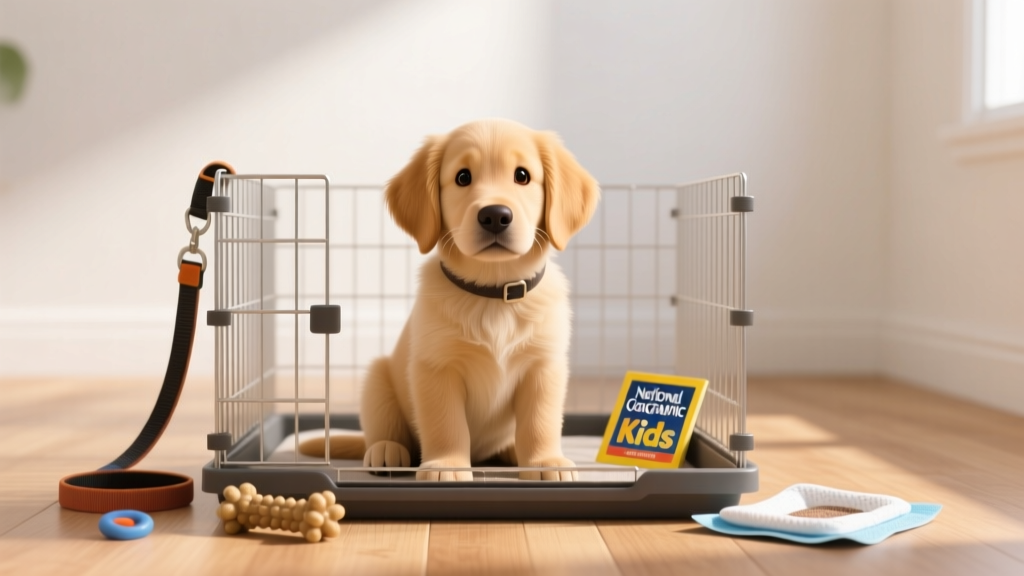
Buy a 42-inch crate (the adult size for most goldens) with a divider panel. Adjust the divider so the puppy has just enough room to stand, turn around, and lie down — no more. Too much space allows the puppy to eliminate in one corner and sleep in another, undermining potty training. Expand the space as your puppy grows. Wire crates (such as the MidWest iCrate or Frisco Heavy Duty) offer better ventilation than plastic travel crates for home use.
Quick Reference: Golden Retriever Puppy Emergency Contacts
- ASPCA Animal Poison Control: (888) 426-4435 (24/7, consultation fee applies)
- Pet Poison Helpline: (855) 764-7661 (24/7, consultation fee applies)
- Your emergency vet clinic: [Save your local 24-hour clinic number here before you need it]
Call immediately if your puppy ingests chocolate, grapes/raisins, xylitol (sugar-free gum, peanut butter), rodent poison, human medications, or any unknown substance.
Marcus Aldridge
All our authors care for dogs every day — read more of their work on the authors page.