French Bulldog Dogs Puppies: Complete Week-by-Week Care Guide
Everything you need to raise French Bulldog dogs puppies — feeding schedules, vaccination timelines, potty training, socialization, and first-year costs.
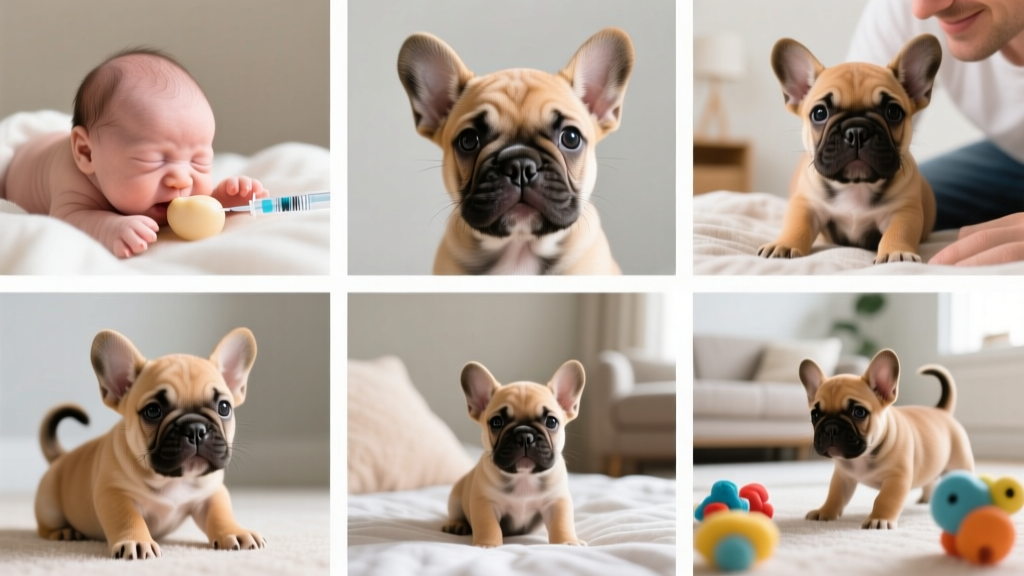
Bringing Home French Bulldog Dogs Puppies: What Makes This Breed Different
French Bulldog puppies are not like other puppies. Their brachycephalic (flat-faced) anatomy, compact size, and sensitive digestive systems demand a care approach that goes beyond generic puppy advice. If you're preparing to bring home one of these charming, bat-eared companions, you need breed-specific guidance — not a one-size-fits-all pamphlet.
Frenchies typically weigh 1.5–2.5 lb (0.7–1.1 kg) at 8 weeks old and reach their adult weight of 16–28 lb (7–13 kg) by 10–12 months, according to the AKC breed standard. Their short muzzles mean they overheat easily, snore loudly, and require careful monitoring during exercise and meals. Understanding these breed-specific realities from day one will save you sleepless nights and expensive emergency vet visits.
Responsible French Bulldog breeders typically release puppies between 8–10 weeks of age. Many reputable Frenchie breeders prefer to keep puppies until 10–12 weeks because the breed matures slowly and benefits from extra littermate socialization. Never accept a French Bulldog puppy younger than 8 weeks — early separation increases behavioral problems and weakens immune development.
French Bulldog Puppy Milestones: Week by Week
Here's a detailed developmental timeline so you know exactly what to expect at each stage. French Bulldog dogs puppies develop on a slightly different trajectory than larger breeds — they tend to be slower to house-train and may remain "puppy-like" in behavior until 14–18 months.
| Age Range | Weight Range | Key Milestones | What to Expect |
|---|---|---|---|
| Weeks 4–8 | 1–2.5 lb (0.5–1.1 kg) | Eyes/ears fully open, weaning onto solid food, first socialization with littermates, dewclaw removal (if done) | Still with breeder. Learning bite inhibition from siblings. First deworming at 2, 4, 6 weeks. |
| Weeks 8–12 | 2.5–5 lb (1.1–2.3 kg) | Goes to new home, first vet visit, DHPP vaccine #1, begins crate training, peak socialization window opens | Frequent napping (18–20 hrs/day). Short attention spans. Potty accidents every 1–2 hours. Fear periods possible around 8–10 weeks. |
| Weeks 12–16 | 5–8 lb (2.3–3.6 kg) | DHPP vaccine #2 and #3, rabies vaccine, longer crate durations, potty training progress, basic commands | Second fear period around 12–14 weeks. Increased independence. Teething begins (~14 weeks). May test boundaries. |
| Weeks 16–24 | 8–14 lb (3.6–6.4 kg) | Vaccination series complete, socialization window closes (~16 weeks), active teething, puppy classes | Chewing everything in sight. Energy bursts followed by long naps. Potty training nearing reliability. Can handle 20–25 minute walks. |
| 6–12 Months | 14–28 lb (6.4–12.7 kg) | Spay/neuter (typically 6–9 months), transition to adult food (~10–12 months), sexual maturity, adult teeth fully in | "Teenage" regression in training. May develop selective hearing. Slower growth rate. Settling into adult personality. |
Feeding Your French Bulldog Puppy: Schedule and Portions
French Bulldogs are notoriously prone to food sensitivities, flatulence, and obesity. Getting the feeding schedule right from day one prevents digestive upset and sets healthy habits. Always choose an AAFCO-approved puppy food formulated for small breeds — large-breed formulas have calcium-phosphorus ratios unsuitable for Frenchie growth rates.
I recommend starting with the food your breeder used for at least the first 2–3 weeks. If you switch, do it gradually over 7–10 days: 75% old food/25% new for days 1–3, then 50/50 for days 4–6, then 25% old/75% new for days 7–9, and fully transitioned by day 10.
How Often Should I Feed My Puppy at Each Age?
| Age | Meals Per Day | Approximate Daily Amount (Dry Kibble) | Notes |
|---|---|---|---|
| 8–12 weeks | 4 meals | ½ – ¾ cup total (split across meals) | Kibble slightly moistened with warm water for easier chewing. Remove uneaten food after 15 min. |
| 12–16 weeks | 3 meals | ¾ – 1 cup total | Transition to dry kibble fully. Monitor stool consistency — loose stool may mean too much food or too-fast transition. |
| 4–6 months | 3 meals | 1 – 1¼ cups total | Growth spurts increase appetite. Adjust based on body condition score (BCS) — ribs should be felt but not visible. |
| 6–12 months | 2 meals | 1 – 1½ cups total | Reduce to 2 meals around 6 months. Switch to adult food at 10–12 months (Frenchies mature slower than some breeds). |
Breed-specific feeding tips: French Bulldogs gulp air while eating due to their flat faces, leading to gas and potential bloat risk. Use a slow-feeder bowl (like the Outward Hound Fun Feeder, ~$12–18) or a snuffle mat to slow intake. Elevate food bowls 4–6 inches to reduce air swallowing. Avoid vigorous exercise for 30 minutes before and after meals.
Vaccination Schedule for French Bulldog Puppies
Your Frenchie puppy's immune system is immature and vulnerable. Following a precise vaccination schedule is non-negotiable — parvovirus and distemper are frequently fatal in unvaccinated puppies. The AVMA core vaccination guidelines recommend the following timeline, which your veterinarian will adjust based on local disease prevalence.
What Vaccines Does My Puppy Need and When?
| Age | Vaccines Given | Type | Estimated Cost |
|---|---|---|---|
| 6–8 weeks | DHPP (Distemper, Hepatitis, Parainfluenza, Parvovirus) #1 | Core | $25–$50 |
| 10–12 weeks | DHPP #2, Bordetella (kennel cough), Leptospirosis (risk-dependent) | Core + Non-core | $40–$75 |
| 14–16 weeks | DHPP #3, Rabies (required by law), Leptospirosis booster if started | Core + Legal requirement | $50–$90 |
| 12–16 months | DHPP booster, Rabies booster, Bordetella booster | Core + Non-core | $60–$100 |
Brachycephalic breeds have a slightly higher rate of vaccine reactions than the general dog population. Watch for facial swelling, hives, vomiting, or difficulty breathing within 1–4 hours post-vaccination. Some vets recommend splitting vaccines across two visits (DHPP one day, Rabies a week later) to reduce reaction risk. Always discuss this with your veterinarian before the appointment.
When Can My Puppy Go Outside and Meet Other Dogs?
Until your puppy completes the full DHPP series (typically around 16 weeks), they are vulnerable to parvovirus and distemper. This means:
- No public dog parks, pet stores, or high-traffic dog areas until 1 week after the final puppy vaccine (~17 weeks)
- Safe socialization IS allowed with known, fully vaccinated dogs in controlled private environments (your yard, a vaccinated friend's home)
- Carrying your puppy in public spaces for exposure to sights and sounds is safe — just keep them off the ground where parvo can survive for months
- Puppy classes are generally acceptable if all attendees are vaccinated to age and the facility disinfects between sessions (the American Veterinary Society of Animal Behavior supports this approach)
Potty Training Your French Bulldog Puppy
Let me be direct: French Bulldogs are not the easiest breed to house-train. Their small bladders, stubborn streak, and sensitivity to cold/wet weather (many Frenchies refuse to go outside in rain) make potty training a 4–8 month process for most owners. Unrealistic expectations are the #1 reason people give up on Frenchie potty training.
When Will My Puppy Be Fully Potty Trained?
Most French Bulldog puppies achieve reliable house training between 5–8 months of age. Some take up to 12 months. Here's a realistic timeline:
- 8–12 weeks: Accidents every 1–2 hours. Take outside every 30–45 minutes while awake. You are managing, not training.
- 12–16 weeks: Starting to signal (sniffing, circling, going to the door). Accidents still happen 2–4 times per week.
- 4–6 months: Bladder capacity increases. Can hold 3–4 hours during the day. Nighttime accidents become less frequent.
- 6–8 months: Most Frenchies are mostly reliable with a consistent schedule. Occasional regression is normal, especially during fear periods or routine changes.
- Rain refusal: Many French Bulldogs hate wet weather. Try a covered patio area, an umbrella, or a puppy raincoat (Ruffwear Overcoat Fuse, ~$65–80). Some owners use indoor grass patches (Fresh Patch, ~$30–35/month) as a weather backup.
- Submissive urination: Common in young Frenchies. Don't punish — crouch to their level, avoid direct eye contact during greetings, and take them outside immediately after calm greetings.
- Crate accidents: If your puppy soils the crate, the crate may be too large (they'll eliminate in one corner and sleep in another). Use a divider to size it so they can stand, turn, and lie down — no more. Clean with enzymatic cleaner (Nature's Miracle, ~$10–14) to eliminate odor markers.
The Critical Socialization Window: Weeks 3–14
The Merck Veterinary Manual identifies the primary socialization period in puppies as weeks 3–14. For French Bulldogs, this window is your single most important investment in future temperament. Under-socialized Frenchies are prone to fear-based reactivity, separation anxiety, and territorial behavior.
Socialization Exposure Checklist
Aim for positive, non-threatening exposure to the following before 14 weeks. Each experience should be paired with high-value treats and praise — never force exposure if your puppy shows fear.
| Category | Exposure Targets | Goal by Week 14 |
|---|---|---|
| People | Children (supervised), elderly, people in hats/sunglasses/uniforms, tall men, people with canes or wheelchairs | 15–20 different people, positive interactions |
| Surfaces | Grass, gravel, tile, metal grates, carpet, wet pavement, stairs | Confident walking on 6+ surface types |
| Sounds | Vacuum, doorbell, thunder (use recordings at low volume), car horns, children playing, fireworks (distant recordings) | Calm or recovering response to 10+ sounds |
| Handling | Paw touching, ear inspection, mouth opening, nail clipping practice, being held on back, towel wrapping | Accepts all handling without snapping or struggling |
| Other Animals | Vaccinated adult dogs (various sizes), cats (supervised), birds at a distance | 5–8 calm dog-dog interactions, neutral response to cats |
| Environments | Car rides, vet clinic (happy visits), outdoor café, elevator, busy sidewalk | 8–10 novel environments visited |
Crate Training Progression and Time Limits
A properly sized crate becomes your Frenchie's safe den and is essential for potty training, travel safety, and preventing destructive chewing. French Bulldogs generally adapt well to crates because they are den-oriented and love cozy spaces — but you must respect age-appropriate time limits.
| Puppy Age | Maximum Crate Time (Daytime) | Nighttime Expectation | Crate Size Recommendation |
|---|---|---|---|
| 8–10 weeks | 30–60 minutes | 2–3 hours, then potty break | Small (18"–22" crate with divider) |
| 11–14 weeks | 1–2 hours | 3–4 hours, then potty break | Small with divider expanded |
| 15–16 weeks | 2–3 hours | 4–5 hours | Medium (24" crate) |
| 4–6 months | 3–4 hours | 6–7 hours (most can hold overnight) | Medium (24" crate) |
| 6+ months | 4–5 hours maximum | 7–8 hours | Medium (24"–26" crate, adult size) |
Crate training steps: Leave the crate door open with a soft blanket and a stuffed Kong inside. Feed meals near, then inside, the crate. Practice closing the door for 30 seconds, then 1 minute, building up gradually. Never use the crate as punishment. If your Frenchie whines, wait for a 5-second pause before opening — you want to reward quiet, not reinforce vocalization.
Teething Timeline and Relief Strategies (3–6 Months)
French Bulldog puppies begin losing baby teeth around 12–16 weeks, with the full adult set (42 teeth) typically in place by 6–7 months. Brachycephalic breeds are especially prone to retained deciduous teeth (baby teeth that don't fall out), which can cause overcrowding and dental disease. Your vet should check for retained teeth at the spay/neuter appointment.
Safe Chew Recommendations by Stage
- 12–16 weeks (early teething): Frozen washcloth (wet, twist, freeze), rubber teething rings (Kong Puppy, ~$8–12), chilled carrot sticks (supervised)
- 16–20 weeks (peak discomfort): Nylabone Puppy Chew (soft formula, ~$6–9), frozen blueberries, Benebone Puppy (softer rubber, ~$13–16)
- 20–28 weeks (adult teeth emerging): Bully sticks (supervised, ~$3–5 each), yak cheese chews (long-lasting, ~$8–12), transition to adult Kong Classic (~$12–16)
Never give: Rawhide (choking and blockage risk), cooked bones (splintering), ice cubes (tooth fracture risk in small breeds), or any chew smaller than your puppy's muzzle width. If your puppy swallows a large piece of any chew, contact your vet or call ASPCA Animal Poison Control at (888) 426-4435 (24/7, consultation fee applies).
Common French Bulldog Puppy Problems and Solutions
How Do I Stop Puppy Biting and Nipping?
French Bulldog puppies are mouthy — this is normal developmental behavior, not aggression. Biting peaks between 10–16 weeks and gradually diminishes with consistent redirection. Here's a force-free approach:
- Redirect: When teeth touch skin, say "oops" in a calm tone, immediately offer a chew toy, and praise when they bite the toy instead.
- Withdraw attention: If biting continues, stand up, cross your arms, and turn away for 10–15 seconds. This teaches that biting ends play.
- Provide alternatives: Keep 3–4 chew toys accessible at all times. Rotate them every 2–3 days to maintain novelty.
- Manage arousal: Overtired puppies bite more. If biting escalates, your puppy likely needs a nap — gently guide them to their crate with a treat.
Never use physical punishment, alpha rolls, or holding the mouth shut. These methods increase fear and can trigger defensive aggression — counterproductive with a breed that needs to trust its handler for lifelong health management (face cleaning, breathing monitoring, dental care).
Excessive Whining and Crying
Frenchies are vocal dogs. Whining in the first 2–3 weeks home is usually caused by separation from littermates, not distress. Respond to whining by ensuring needs are met (potty, food, comfort), then reward quiet moments with calm praise. A Snuggle Puppy with heartbeat (~$35–45) can ease the transition from littermates during the first week.
Destructive Chewing
Peak chewing occurs between 4–7 months during active teething. Puppy-proof your home by removing shoes, cords, and low-shelf items. Provide structured chew sessions: offer a frozen Kong stuffed with puppy-safe peanut butter (xylitol-free — always check labels) for 15–20 minutes, 2–3 times per day.
First-Year Cost Breakdown for a French Bulldog Puppy
French Bulldogs are one of the more expensive breeds to own due to their health predispositions and specialized care needs. Here's a realistic first-year budget based on 2026 pricing:
| Category | Low Estimate | Mid Estimate | High Estimate |
|---|---|---|---|
| Puppy purchase (responsible breeder, health-tested parents) | $2,500 | $3,500 | $5,500+ |
| Veterinary care (vaccines, spay/neuter, wellness exams, fecal tests, heartworm prevention) | $600 | $900 | $1,400 |
| Food (high-quality small-breed puppy formula, ~$55–80/bag) | $350 | $500 | $700 |
| Supplies (crate, bed, bowls, harness, leash, toys, grooming tools, enzymatic cleaner, baby gates) | $250 | $450 | $700 |
| Training (puppy class, 6–8 week course) | $150 | $250 | $500 |
| Pet insurance (recommended for brachycephalic breeds, annual premium) | $500 | $700 | $1,000 |
| Emergency fund (BOAS episode, allergic reaction, foreign body ingestion) | $0 | $500 | $3,000+ |
| TOTAL FIRST YEAR | $4,350 | $6,800 | $12,800+ |
A note on adoption: While this guide focuses on breeder-sourced puppies, French Bulldog rescue organizations (like the French Bulldog Rescue Network) occasionally have puppies and young adults available for $500–$1,000. Adoption is a valid and rewarding path — just request veterinary records and ask about any known health or behavioral history.
I strongly recommend pet insurance for French Bulldogs. Their predisposition to brachycephalic obstructive airway syndrome (BOAS), allergies, IVDD, and hip dysplasia means emergency vet bills are not a matter of "if" but "when." Enrolling as a puppy (before any conditions are documented) prevents pre-existing condition exclusions.
Frequently Asked Questions
When should I bring my French Bulldog puppy home?
Between 8–12 weeks of age. Many reputable Frenchie breeders prefer 10–12 weeks because the breed benefits from extended littermate socialization. Never accept a puppy younger than 8 weeks.
How often should I feed my French Bulldog puppy?
Four meals per day from 8–12 weeks, three meals from 12 weeks to 6 months, and two meals from 6 months onward. Total daily portions range from ½ cup (8 weeks) to 1½ cups (6–12 months), depending on the specific food's caloric density and your puppy's growth rate.
When will my French Bulldog puppy be fully potty trained?
Realistically, between 5–8 months for most Frenchies, with some taking up to 12 months. Consistency, crate training, and a fixed schedule are the keys. Expect setbacks during fear periods and weather changes.
What vaccines does my French Bulldog puppy need?
Core vaccines include DHPP (given at 6–8, 10–12, and 14–16 weeks) and Rabies (14–16 weeks). Non-core vaccines like Bordetella and Leptospirosis depend on your lifestyle and local risk factors. Your veterinarian will determine the appropriate schedule.
How do I stop my French Bulldog puppy from biting?
Use redirection to appropriate chew toys, withdraw attention when biting continues, and manage arousal levels by ensuring adequate naps. Biting typically peaks at 10–16 weeks and decreases with consistent positive reinforcement. Never use physical punishment.
When can my French Bulldog puppy go outside and meet other dogs?
Controlled socialization with known, vaccinated dogs in private settings can begin immediately. Avoid public dog parks, pet stores, and high-traffic areas until 1 week after the final DHPP vaccine (around 17 weeks). Carrying your puppy in public for exposure is safe at any age.
This guide provides general care information for French Bulldog puppies. Every puppy is an individual, and your veterinarian is the best resource for personalized advice on nutrition, vaccination timing, spay/neuter timing, and breed-specific health screening. Schedule your first wellness visit within 48–72 hours of bringing your puppy home.
Aaron Whyte
All our authors care for dogs every day — read more of their work on the authors page.


