Golden Puppy Breeds: The Complete Week-by-Week Care Guide
Everything you need to raise golden puppy breeds: feeding schedules, vaccination timelines, potty training, socialization windows, and first-year costs.

What Are Golden Puppy Breeds?
When people search for "golden puppy breeds," they're usually referring to puppies from the Golden Retriever family tree — purebred Golden Retrievers, English Cream Golden Retrievers, and popular designer crosses like the Goldendoodle, Golden Irish Setter mix, and Golden Mountain Dog. These puppies share a common foundation: a retriever's soft mouth, an eagerness to please, and a famously friendly temperament that makes them one of the most sought-after family dogs in the United States.
According to the American Kennel Club, the Golden Retriever consistently ranks among the top three most popular breeds in America. That popularity extends to Golden mixes, which inherit similar traits but may vary in coat type, size, and energy level depending on the other parent breed.
This guide covers the critical first year of raising a golden puppy breed — from the day you bring them home through adolescence — with breed-specific timelines, feeding charts, and real cost data for 2026.
When Should I Bring My Golden Puppy Home?
Responsible breeders keep Golden Retriever puppies with their littermates until at least 8 weeks. This period is non-negotiable for proper bite inhibition development and canine social skills. Puppies removed before 8 weeks show higher rates of fear-based reactivity and resource guarding later in life.
If you're working with a breeder raising an English Cream or a Goldendoodle (F1 or F1B generation), expect to pick up your puppy between 8 and 10 weeks. Some breeders of larger designer crosses like the Golden Mountain Dog may hold puppies until 10 weeks because giant-breed crosses benefit from the extra developmental time with their mother.
First 48 hours at home: Limit visitors to immediate household members. Set up a crate in a quiet area with a blanket that smells like the litter. Expect crying the first 2-3 nights — this is normal separation distress, not a behavioral problem. A Snuggle Puppy heartbeat toy ($25-$35) can reduce nighttime whining significantly.
Golden Puppy Age Milestones: Weeks 4 Through 12 Months
Golden puppy breeds develop on a predictable timeline. Here's what to expect at each stage, with breed-specific notes where Goldens and their crosses differ from the average puppy.
| Age Range | Developmental Milestone | What You Should Do |
|---|---|---|
| 4-8 weeks | Socialization with littermates; weaning onto solid food; bite inhibition begins; primary fear period starts around 8 weeks | Breeder handles daily exposure to household sounds, textures, and gentle handling. You receive puppy at the tail end of this window. |
| 8-12 weeks | Peak bonding period; bladder control ~1 hour per month of age; teething discomfort begins; attention span of 5-10 minutes | Begin crate training, name recognition, and short positive-reinforcement sessions. Establish feeding and potty routines immediately. |
| 12-16 weeks | Socialization window closing (ends ~14-16 weeks); deciduous teeth start loosening; can hold bladder 2-3 hours; testing boundaries | Maximize safe social exposures before window closes. Begin leash training. Increase training session length to 10-15 minutes. |
| 16-24 weeks | Adult teeth erupting; fear imprint period (6-14 months begins); can hold bladder 4-5 hours; chewing intensity peaks | Provide structured chew outlets. Avoid forcing puppy into frightening situations. Continue positive socialization. |
| 6-12 months | Sexual maturity (spay/neuter discussion with vet); adolescent energy surge; growth plates still open (especially in larger Golden crosses); regression in training is normal | Maintain training consistency. Increase physical exercise to 45-60 min/day. Avoid high-impact jumping until 12-18 months for joint health. |
Breed-specific note: Golden Retrievers and their larger crosses (Golden Mountain Dog, Golden Irish Setter) have growth plates that don't fully close until 14-18 months. The Merck Veterinary Manual advises limiting forced exercise (running alongside a bike, repetitive fetch on hard surfaces) until skeletal maturity to reduce hip and elbow dysplasia risk — conditions Goldens are genetically predisposed to at rates estimated between 10-20% depending on lineage.
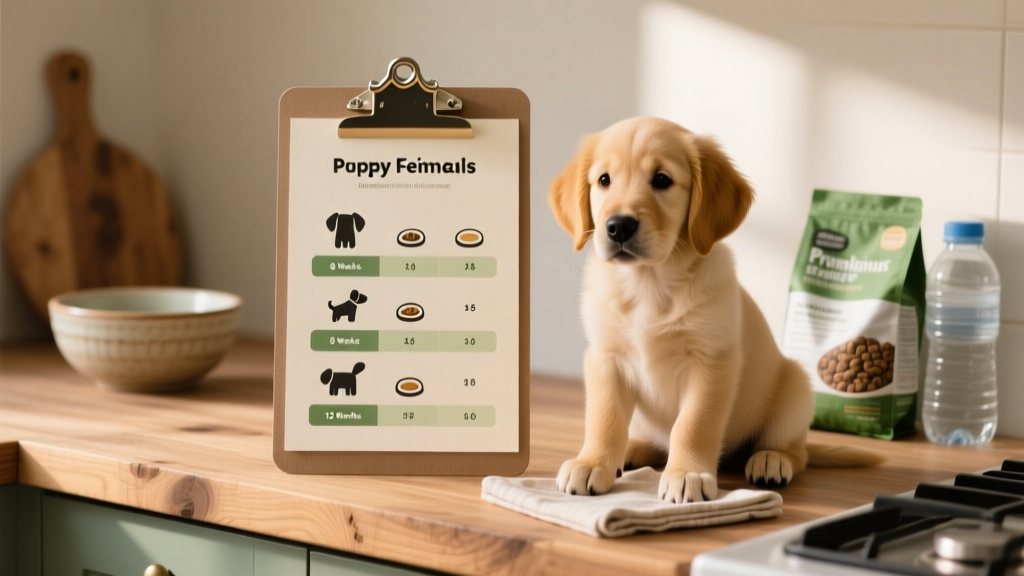
Feeding Your Golden Puppy: Schedule and Portions
Golden Retrievers are prone to rapid growth and obesity, both of which increase the risk of orthopedic disease. Feeding a large-breed puppy formula (with controlled calcium and phosphorus ratios) is essential for purebred Goldens and larger Golden crosses. The ASPCA recommends following AAFCO guidelines for "growth" or "all life stages" formulations.
| Puppy Age | Meals Per Day | Daily Amount (Large-Breed Puppy Kibble) | Notes |
|---|---|---|---|
| 8-12 weeks | 4 meals | 1.5 - 2 cups total | Moisten kibble with warm water for first 1-2 weeks if puppy struggles with hard pieces |
| 12-16 weeks | 3 meals | 2 - 2.5 cups total | Transition to dry kibble; monitor body condition score (ribs palpable but not visible) |
| 4-6 months | 3 meals | 2.5 - 3.5 cups total | Adjust based on weight gain; expected weight ~30-40 lb by 6 months |
| 6-12 months | 2 meals | 3 - 4 cups total | Transition to adult food at 12-18 months (consult your veterinarian for timing) |
Recommended brands for golden puppy breeds: Purina Pro Plan Large Breed Puppy ($55-$65/34 lb bag), Royal Canin Golden Retriever Puppy ($60-$70/30 lb bag), or Hill's Science Diet Large Breed Puppy ($50-$60/30 lb bag). All carry the AAFCO statement for large-breed growth.
Goldendoodle and smaller Golden crosses: If your puppy's expected adult weight is under 50 lb (common with Miniature Goldendoodles from F1B generations), a standard puppy formula is acceptable — large-breed formulas are specifically designed for dogs expected to exceed 70 lb as adults.
Potty Training Timeline and Realistic Expectations
Golden Retrievers are generally fast learners when it comes to housebreaking, but "fast" still means 4-6 months for reliable outdoor elimination. Here's the realistic timeline:
| Age | Bladder Capacity | Expected Accidents Per Week | Your Action |
|---|---|---|---|
| 8-10 weeks | 30-60 minutes | 3-5 (normal) | Take outside every 30-45 min when awake; after every meal, nap, and play session |
| 10-14 weeks | 1-2 hours | 1-3 | Begin associating a verbal cue ("go potty") with outdoor elimination; reward immediately |
| 14-20 weeks | 2-3 hours | 0-2 | Begin extending time between outings; use crate to prevent unsupervised accidents |
| 5-6 months | 4-5 hours | 0-1 | Most golden puppies signal to go out (scratching at door, pacing) by this age |
- Puppy pees inside immediately after coming back in: They didn't fully empty outside. Go back out and wait 5 more minutes. Reward generously when they finish.
- Submissive urination when greeting: Common in Golden Retrievers. Ignore the puppy for first 2 minutes when arriving home; greet calmly at their level. Never punish — this is involuntary.
- Regression at 4-5 months: Normal developmental phase. Return to more frequent outings for 1-2 weeks.
The Critical Socialization Window: Weeks 3-14
The American Veterinary Society of Animal Behavior (AVSAB) states that the primary socialization period for puppies closes between 12-14 weeks. For golden puppy breeds — naturally sociable dogs — this window is your opportunity to build a confident, well-adjusted adult. Miss it, and you risk fear-based reactivity, which is harder to remediate than to prevent.
Here's your breed-specific socialization checklist for weeks 8-14 (the portion of the window you control after bringing puppy home):
- Surfaces: Grass, gravel, metal grates, wet pavement, carpet, tile, hardwood, tarps, bubble wrap
- People: Children (supervised), elderly individuals, people in hats/sunglasses/uniforms, people using wheelchairs or crutches, tall/short individuals, people of different ethnicities
- Sounds: Vacuum cleaner, doorbell, thunderstorms (play recordings at low volume), traffic, construction noise, fireworks recordings, other dogs barking
- Objects: Umbrellas opening, plastic bags rustling, brooms, bicycles, skateboards, strollers, delivery trucks
- Handling: Paw touching, ear examination, mouth opening, nail clipping practice, being lifted, wearing a harness
- Animals: Fully vaccinated adult dogs (known health status), cats (if household has them), livestock (if rural)
- Environments: Pet-friendly stores, outdoor café patios, parking lots, fields, bridges, car rides, grooming tables
Rule: Every new experience must be paired with high-value treats (small pieces of boiled chicken, cheese, or commercial training treats like Zuke's Mini Naturals). If puppy shows fear, increase distance and let them observe — never force interaction.
Vaccination Schedule for Golden Puppies
Your veterinarian will customize the vaccination protocol based on your area's disease prevalence, but the core schedule for golden puppy breeds follows standard AAHA (American Animal Hospital Association) guidelines:
| Age | Vaccine | Purpose | Estimated Cost |
|---|---|---|---|
| 6-8 weeks | DHPP (1st dose) | Distemper, Hepatitis (Adenovirus), Parainfluenza, Parvovirus | $25-$40 |
| 10-12 weeks | DHPP (2nd dose) + Bordetella (optional) | Booster for core diseases; kennel cough protection if attending group classes | $40-$65 |
| 14-16 weeks | DHPP (3rd dose) + Rabies | Final core booster; rabies required by law in all 50 states | $50-$80 |
| 12-16 months | DHPP booster + Rabies booster | 1-year booster; subsequent boosters every 3 years per AAHA guidelines | $60-$90 |
When can your golden puppy go outside and meet other dogs? The AVMA and AVSAB both recommend that puppies begin controlled socialization outings 7 days after their first DHPP vaccine (typically around 9 weeks). Avoid high-risk areas like dog parks and pet store floors until the full DHPP series is complete at 16 weeks. Safe outings include: carrying puppy in a sling through shopping centers, visiting friends' homes with known-vaccinated dogs, and attending structured puppy classes that require proof of first vaccination.
Teething, Crate Training, and Common Puppy Problems
Teething Timeline (3-6 Months)
Golden Retriever puppies begin losing their 28 deciduous teeth around 12-16 weeks, with all 42 adult teeth typically erupted by 6-7 months. During this period, chewing intensity increases dramatically — and golden puppy breeds are already genetically predisposed to mouthiness (they were bred to carry game).
Safe chew recommendations by stage:
- 12-16 weeks: Frozen wet washcloths (twist and freeze), Nylabone Puppy Chew ($8-$12), KONG Puppy teething stick ($10-$14)
- 16-24 weeks: Benebone Wishbone ($15-$20), frozen KONG stuffed with plain yogurt, bully sticks (supervised, limit to 10 min/day)
- 24+ weeks: Yak cheese chews ($12-$18 for a pack), Nylabone Power Chew, antlers (split, not whole — reduced fracture risk)
Never give: Cooked bones (splinter risk), rawhide from unverified sources, ice cubes (tooth fracture risk in powerful chewers like Goldens), or anything small enough to swallow whole.
Crate Training Progression
Golden Retrievers generally adapt to crates well due to their den-seeking instinct, but time limits are critical to prevent distress and accidents:
- 8-10 weeks: Maximum 30-60 minutes during the day; crate beside your bed at night (set alarm for 2-3 AM potty break)
- 10-14 weeks: Maximum 1-2 hours during the day; may sleep 5-6 hours at night with one potty break
- 14-20 weeks: Maximum 3 hours during the day; many golden puppies sleep 7-8 hours through the night by 16-18 weeks
- 5-6 months: Maximum 4-5 hours during the day; overnight 8 hours is typical
Never use the crate as punishment. Feed meals inside the crate, provide a stuffed KONG for extended crating periods, and always exercise the puppy before crating.
Stopping Puppy Biting and Nipping
Golden Retriever puppies are notoriously mouthy. Biting is not aggression — it's normal exploratory behavior and teething relief. Here's how to manage it using force-free methods:
- Redirect to a toy: Every time puppy mouths skin, immediately offer an appropriate chew. Praise when they take the toy.
- The "ouch" method: When teeth touch skin, say "ouch" in a calm, slightly surprised tone and withdraw attention for 10-15 seconds (stand up, cross arms, look away).
- Enforced naps: Puppies bite most when overtired. If nipping escalates after 45-60 minutes of awake time, put puppy in crate with a chew for a 1-2 hour nap.
- Consistent rules: Every household member must follow the same protocol. Mixed signals (letting puppy mouth one person but not another) extend the biting phase by weeks.
Most golden puppy breeds significantly reduce mouthing by 5-6 months once adult teeth are fully in. If biting intensifies after 6 months or is accompanied by growling and stiffening, consult a certified professional dog trainer (CPDT-KA) or veterinary behaviorist.
First-Year Cost Breakdown for Golden Puppy Breeds
Budgeting accurately prevents surprises. Here's what golden puppy breeds actually cost in the first year, based on 2026 pricing data:
| Category | Low Estimate | High Estimate | Details |
|---|---|---|---|
| Puppy purchase/adoption | $500 | $4,500 | Rescue: $300-$700; Responsible breeder: $1,500-$4,500 (English Cream and F1B Goldendoodles at top of range) |
| Veterinary (vaccines, spay/neuter, wellness) | $600 | $1,200 | Includes 3 puppy visits, DHPP series, rabies, heartworm prevention, spay/neuter ($300-$600) |
| Food (large-breed puppy formula) | $400 | $700 | Based on 3-4 cups/day; premium brands at higher end |
| Supplies (crate, bed, leash, toys, bowls) | $200 | $500 | 42-inch wire crate for adult Goldens ($60-$90); orthopedic bed ($50-$120) |
| Training (group classes, private sessions) | $150 | $600 | 6-week group class: $150-$250; private sessions: $80-$150/hour |
| Preventive medications (heartworm, flea/tick) | $200 | $450 | Simparica Trio, NexGard, or Interceptor Plus — weight-based pricing |
| Pet insurance (optional but recommended) | $350 | $700 | Monthly premiums $30-$60 for Golden Retriever puppies; covers accidents + illness |
| TOTAL FIRST YEAR | $2,400 | $8,650 | Does not include emergency veterinary care (budget an additional $500-$2,000 emergency fund) |
Frequently Asked Questions
How often should I feed my golden puppy at each age?
At 8-12 weeks, feed 4 meals per day (about 0.4-0.5 cups each). At 12-16 weeks, drop to 3 meals per day. At 6 months, transition to 2 meals per day. Never free-feed a Golden Retriever puppy — they tend to overeat, and rapid growth increases hip dysplasia risk.
When will my golden puppy be fully potty trained?
Most golden puppy breeds are reliably housebroken between 5-6 months, meaning fewer than one accident per month. Full reliability (including overnight and during excitement) typically comes by 8-10 months. Male Goldens may take slightly longer than females.
What vaccines does my golden puppy need and when?
The core series is DHPP at 6-8 weeks, 10-12 weeks, and 14-16 weeks, plus rabies at 14-16 weeks. Your vet may also recommend Bordetella (kennel cough) if attending puppy classes, and Leptospirosis if you live in an area with wildlife exposure. Always consult your veterinarian for a schedule tailored to your region.
How do I stop my golden puppy from biting and nipping?
Redirect every mouth-to-skin contact to an appropriate chew toy. Withdraw attention for 10-15 seconds after bites. Enforce naps when puppy is overtired (the most common trigger for escalated biting). Consistency from all family members is essential — expect 4-8 weeks of consistent effort before seeing significant improvement.
When can my golden puppy go outside and meet other dogs?
Controlled outdoor exposure can begin 7 days after the first DHPP vaccine (around 9 weeks). Stick to low-risk environments: friends' yards with vaccinated dogs, carrying puppy through public spaces, structured puppy classes. Avoid dog parks, pet store floors, and unknown dogs until the full DHPP series is complete at 16 weeks.
Should I get pet insurance for my golden puppy?
Strongly recommended. Golden Retrievers have a high lifetime incidence of cancer (estimated 60% according to the Golden Retriever Club of America), hip dysplasia, and cardiac conditions. Enrolling at 8-10 weeks (before any pre-existing conditions develop) locks in the lowest premiums and broadest coverage. Plans from Trupanion, Healthy Paws, or Lemonade range from $30-$60/month for a Golden puppy in 2026.
Robin Maitland
All our authors care for dogs every day — read more of their work on the authors page.