Cavalier Charles Puppy: Complete Week-by-Week Care & Training Guide
Your complete cavalier charles puppy guide: week-by-week milestones, feeding schedules, vaccination timelines, potty training, socialization checklists

The Cavalier King Charles Spaniel consistently ranks among the American Kennel Club's top 20 most popular breeds — and for good reason. Their gentle, affectionate temperament makes them exceptional companions. But raising a Cavalier King Charles puppy from 8 weeks to adulthood requires breed-specific knowledge that generic puppy guides simply don't cover. Cavaliers have unique developmental sensitivities, a critical socialization window that closes faster than many owners realize, and health predispositions that demand proactive management from day one.
This guide walks you through every developmental stage with concrete timelines, exact feeding portions, vaccination schedules, and troubleshooting strategies tailored specifically to the Cavalier King Charles Spaniel. Whether you're expecting your first litter or bringing home a puppy next week, you'll find the precise data you need.
When Should You Bring Your Cavalier Charles Puppy Home?
Responsible Cavalier breeders typically release puppies between 8 and 10 weeks of age. While some breeders hold toy and small breeds until 10-12 weeks to ensure adequate size and immune maturity, the AKC recommends that most puppies transition to their new homes at 8 weeks.
What to expect at pickup (8 weeks): Your Cavalier puppy should weigh approximately 4-6 lb (1.8-2.7 kg), have received their first DHPP vaccination at 6-8 weeks, be dewormed at minimum twice, and come with a health certificate from the breeder's veterinarian. Reputable breeders will also provide documentation of the parents' health clearances — specifically cardiac evaluations for mitral valve disease (MVD) and OFA or PennHIP scores for hip dysplasia.
Age-Specific Milestones: What to Expect Each Week
Cavalier King Charles puppies develop rapidly in the first six months. Here's a concrete timeline of developmental milestones with breed-specific notes.
Weeks 4-8: Neonatal to Transitional (Still with Breeder)
- Week 4: Eyes fully open, ears functional. Puppies begin exploring beyond the whelping box. Deciduous (baby) teeth start erupting — incisors first.
- Week 5: Play behavior emerges with littermates. This is when bite inhibition learning begins. Puppies start lapping gruel (puppy kibble soaked in warm water or puppy milk replacer).
- Week 6: First DHPP vaccine administered by breeder's vet. Fear imprinting period begins (weeks 6-8) — negative experiences during this window can create lasting phobias. Cavaliers are particularly sensitive to loud noises and harsh handling.
- Week 7: Puppies can eat softened kibble independently. Social hierarchy behaviors emerge. Breeders should begin short individual handling sessions.
- Week 8: Second DHPP due. Puppies are typically ready for home transition. Weight: approximately 4-6 lb (1.8-2.7 kg).
Weeks 8-12: Home Adjustment & Bonding
- Week 8-9: Expect clinginess and whining, especially at night. Your Cavalier is a breed that bonds intensely — separation anxiety risk is high. Crate training should begin immediately but gently.
- Week 10: Puppies begin recognizing their name reliably. Start short (3-5 minute) positive reinforcement training sessions using treats. Cavaliers respond eagerly to food motivation.
- Week 11: Fear period often peaks around week 11. Avoid overwhelming experiences — no crowded dog parks, loud events, or forced interactions with strangers.
- Week 12: Third DHPP vaccine. Puppy can begin short, controlled outdoor exploration in low-risk areas (your yard, quiet sidewalks). Weight: approximately 7-10 lb (3.2-4.5 kg).
Weeks 12-16: Confidence Building & Foundation Training
- Week 12-14: Socialization window is closing rapidly (primary window ends at 14 weeks per veterinary behaviorists). Maximize positive exposures now.
- Week 14: Puppy should reliably respond to name, sit, and come (in low-distraction environments). Begin leash walking practice indoors.
- Week 15-16: Final DHPP booster. Rabies vaccine administered (required by law in most US states). Puppy can now safely visit public areas and meet fully vaccinated dogs.
- Week 16: Weight: approximately 9-12 lb (4.1-5.4 kg). Potty training should show significant progress — expect 1-2 accidents per week maximum.
Weeks 16-24 (4-6 Months): Adolescence Begins
- Month 5: Teething intensifies. Baby teeth begin loosening. Expect increased chewing and mouthing. Cavaliers may become mouthy when excited or tired.
- Month 6: Most baby teeth should be shed. If baby canines remain alongside adult teeth (common in small breeds), consult your vet — retained deciduous teeth may need extraction. Spay/neuter timing discussion with your veterinarian typically occurs now. Weight: approximately 11-14 lb (5.0-6.4 kg).
Months 6-12: Maturing Adolescent
- Month 7-8: Second fear period often occurs (6-10 months). Previously confident Cavaliers may suddenly show fear of familiar objects or situations. Counter-conditioning with high-value treats helps.
- Month 9-10: Energy levels stabilize. Cavaliers typically settle into a moderate activity pattern — 30-45 minutes of structured exercise daily is sufficient for most adults.
- Month 12: Transition from puppy to adult food. Adult weight: 13-18 lb (5.9-8.2 kg) per the AKC breed standard. Full height reached: 12-13 inches (30-33 cm) at the withers.
Feeding Schedule: Exact Portions by Age and Weight
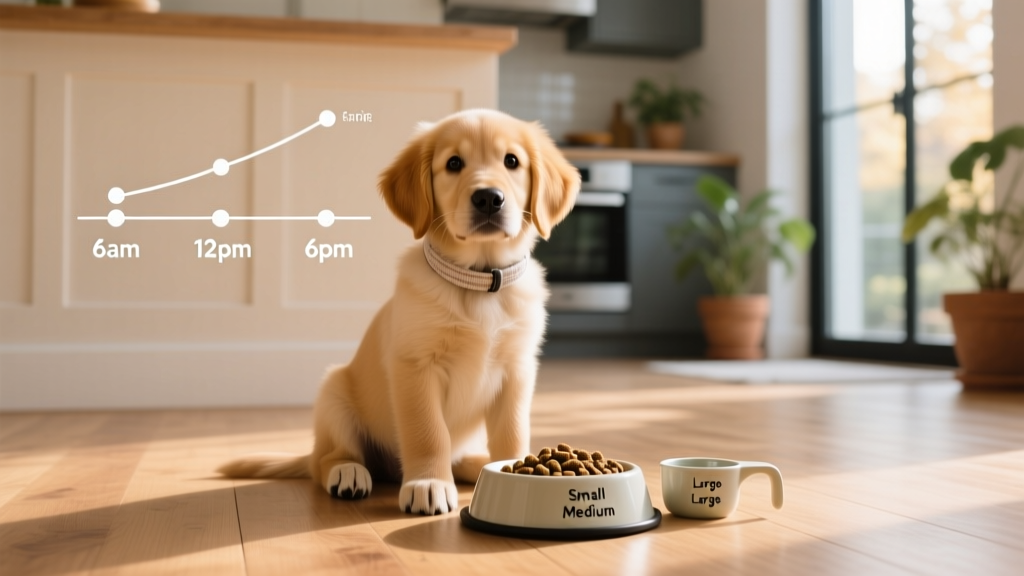
Cavalier King Charles Spaniels are prone to obesity, which exacerbates their predisposition to mitral valve disease and joint problems. Precise portion control from puppyhood is essential. The following schedule assumes a high-quality, AAFCO-approved puppy food with approximately 380-420 kcal per cup (check your specific brand's guaranteed analysis).
| Age | Expected Weight | Meals Per Day | Total Daily Amount | Per Meal |
|---|---|---|---|---|
| 8-12 weeks | 4-8 lb (1.8-3.6 kg) | 4 | ½ - ¾ cup | 2-3 tablespoons |
| 3-4 months | 8-11 lb (3.6-5.0 kg) | 3 | ¾ - 1 cup | ¼ - ⅓ cup |
| 5-6 months | 11-14 lb (5.0-6.4 kg) | 3 | 1 - 1¼ cups | ⅓ - ⅜ cup |
| 7-12 months | 13-18 lb (5.9-8.2 kg) | 2 | 1 - 1½ cups | ½ - ¾ cup |
Food selection specifics: Look for a puppy food with a named animal protein as the first ingredient (chicken, lamb, or salmon), minimum 22% crude protein and 8% crude fat on the guaranteed analysis, and DHA (docosahexaenoic acid) for brain development. Brands that meet these criteria and are commonly recommended include Royal Canin Cavalier King Charles Spaniel Puppy (breed-specific formula), Hill's Science Diet Puppy, and Purina Pro Plan Puppy.
Vaccination Schedule: Exact Timing and Vaccine Names
Cavalier puppies follow the standard core vaccination protocol, but their small size means post-vaccine monitoring is especially important. Mild lethargy and soreness for 24 hours is normal; facial swelling, vomiting, or collapse requires emergency veterinary attention.
| Age | Vaccine | What It Protects Against | Notes |
|---|---|---|---|
| 6-8 weeks | DHPP (1st dose) | Distemper, Hepatitis (Adenovirus), Parainfluenza, Parvovirus | Typically given by breeder before pickup |
| 10-12 weeks | DHPP (2nd dose) + Bordetella (optional) | Same core diseases + Kennel Cough | Bordetella recommended if attending puppy classes or grooming |
| 14-16 weeks | DHPP (3rd/final dose) + Rabies | Core diseases + Rabies | Rabies required by law; puppy is fully protected 2 weeks after final DHPP |
| 12-16 months | DHPP booster + Rabies booster | All core diseases | Subsequent boosters every 1-3 years per your vet's protocol |
When can your puppy go outside and meet other dogs? Until your Cavalier completes their full DHPP series (2 weeks after the 14-16 week dose), avoid public dog areas — parks, pet stores, and dog beaches. Controlled playdates with known, fully vaccinated adult dogs in private yards are acceptable from 8 weeks onward. Puppy socialization classes that require proof of at least one DHPP dose and maintain sanitized facilities are considered safe from 10 weeks per the American Veterinary Society of Animal Behavior, which emphasizes that the behavioral risk of inadequate socialization outweighs the disease risk in controlled environments.
The Critical Socialization Window: Weeks 3-14
This is arguably the most important section in this guide. The primary socialization window for puppies closes between 12-14 weeks of age. After this period, novel experiences are more likely to trigger fear than curiosity. Cavaliers are genetically predisposed to sensitivity and timidity — missing this window can result in a permanently anxious dog.
Cavalier Socialization Exposure Checklist
Aim to check off at least 3-5 items per category before week 14. Every exposure must be positive — pair new experiences with high-value treats (boiled chicken, cheese, commercial training treats). If your puppy shows fear (cowering, tail tucking, freezing), increase distance and reduce intensity. Never force an interaction.
People: Children (supervised), elderly individuals, people wearing hats/sunglasses/masks, people of different ethnicities and heights, delivery workers
Sounds: Vacuum cleaner (from another room first), doorbell, thunderstorm recordings (start at low volume), traffic, construction noise, clapping
Objects: Umbrellas opening, plastic bags rustling, bicycles, skateboards, strollers, car rides
Animals: Fully vaccinated adult dogs (various sizes), cats (if household has them), calm livestock if accessible
Handling: Paw touching, ear inspection, mouth opening, nail clipping practice, being held by different people, gentle restraint
Environments: Veterinary clinic (happy visits only — no vaccines that day), pet-friendly stores, outdoor café patios, friend's houses, car rides to pleasant destinations
Cavalier-specific socialization priority: This breed is prone to developing noise phobias. Begin desensitization to thunderstorms, fireworks, and household appliances early. Play recordings at very low volume during meals or play, gradually increasing volume over weeks. Pair with treats to build positive associations.
Potty Training Timeline and Troubleshooting
Cavalier King Charles Spaniels are generally eager to please and learn potty routines faster than many toy breeds. However, their small bladders mean more frequent outings are non-negotiable in the early months.
Realistic Potty Training Timeline
- 8-10 weeks: Expect an accident every 1-2 hours. Take puppy outside every 30-45 minutes when awake, immediately after meals, after naps, and after play sessions. Use a consistent verbal cue ("go potty" or "do your business").
- 10-14 weeks: Bladder control improves. Accidents should decrease to 1-2 per day. Puppy begins to signal (sniffing, circling, moving toward the door).
- 14-20 weeks: Most Cavaliers can hold for 2-3 hours during the day. Nighttime control (6-7 hours) typically develops around 16 weeks. Accidents become rare (1-2 per week).
- 20-24 weeks (5-6 months): Your Cavalier should be reliably house-trained with zero to one accident per month. If accidents persist beyond 6 months, consult your veterinarian to rule out urinary tract infection or anatomical issues.
The general rule: A puppy can hold their bladder for approximately one hour per month of age plus one. So a 3-month-old puppy can hold for roughly 4 hours maximum — but this is an upper limit, not a target. More frequent outings prevent accidents from happening in the first place.
Crate Training Progression: Time Limits by Age
Cavaliers are companion dogs that thrive on proximity to their people. Crate training requires patience and positive association — this is not a breed that takes naturally to isolation. However, a properly crate-trained Cavalier is safer during travel, vet visits, and emergencies.
| Age | Maximum Crate Time (Daytime) | Maximum Crate Time (Night) | Crate Size |
|---|---|---|---|
| 8-10 weeks | 30-45 minutes | 2-3 hours (will need overnight potty break) | Small wire or plastic crate (24"L x 18"W x 21"H) with divider |
| 10-14 weeks | 1-1.5 hours | 4-5 hours | Same crate, adjust divider |
| 14-20 weeks | 2-3 hours | 6-7 hours | Remove divider as puppy grows |
| 5-6 months | 3-4 hours | 7-8 hours | Final size: 24" x 18" x 21" (should be able to stand, turn, lie down) |
Building positive crate association: Feed all meals in the crate with the door open initially. Provide a stuffed Kong or lick mat for extended crate sessions. Never use the crate as punishment. For nighttime whining (extremely common in the first 2 weeks), place the crate near your bed so the puppy can hear and smell you. Gradually move the crate to its permanent location over 1-2 weeks.
Teething Timeline: Months 3-6
Cavalier puppies begin losing their 28 deciduous teeth around 12-16 weeks, with the process typically complete by 6 months. Adult dogs have 42 permanent teeth. During this period, expect increased chewing, drooling, mild gum bleeding, and occasional decreased appetite.
Safe Chew Recommendations by Stage
- 3-4 months (early teething): Frozen washcloths (wet, twisted, frozen), rubber teething toys (Kong Puppy, Nylabone Puppy Chew), chilled carrot sticks (supervised). Avoid hard nylon bones — puppy teeth are fragile and can fracture.
- 4-5 months (peak teething): Bully sticks (supervised, remove when small enough to choke on), Benebone puppy line, frozen Kong stuffed with plain yogurt or peanut butter (xylitol-free — check the label carefully). Avoid rawhide, which poses choking and intestinal blockage risks.
- 5-6 months (late teething): Introduce slightly firmer chews as adult teeth set. Dental chews approved by the Veterinary Oral Health Council (VOHC) can be introduced. Continue to avoid antlers, hooves, and ice cubes — these are too hard and cause slab fractures in premolars.
Common Cavalier Puppy Problems and Solutions
Problem 1: Puppy Biting and Nipping
Cavalier puppies use their mouths during play — this is normal canine behavior, not aggression. However, their needle-sharp baby teeth make it painful.
Solution: When teeth touch skin, let out a high-pitched "ouch" and immediately stop all interaction for 10-15 seconds (stand up, turn away). Resume play and redirect to an appropriate chew toy. Reward when the puppy mouths the toy instead of your hand. Consistency across all family members is critical — mixed signals ("sometimes mouthing is okay") will prolong the behavior. Most Cavaliers outgrow mouthing by 5-6 months with consistent redirection.
Problem 2: Separation Anxiety and Whining
This is the most common behavioral issue in Cavalier King Charles Spaniels. The breed was literally developed to be a lap companion — they are genetically wired to be with their people.
Solution: Begin alone-time training from day one. Start with 30-second departures: step outside the front door, immediately return. Gradually extend to 1 minute, 5 minutes, 15 minutes over several weeks. Always leave and return calmly — no emotional goodbyes or excited greetings. Provide a long-lasting treat (stuffed Kong) when departing. For severe cases (destructive behavior, self-injury, excessive vocalization lasting more than 30 minutes), consult a certified veterinary behaviorist. Anti-anxiety medication combined with behavior modification is sometimes necessary and should be discussed with your veterinarian.
Problem 3: Destructive Chewing
Cavalier puppies chew most intensely between 4-7 months (teething overlap with adolescent exploration).
Solution: Puppy-proof your home by removing accessible shoes, cords, and small objects. Provide 5-7 appropriate chew toys of varying textures, rotating them every 2-3 days to maintain novelty. Supervise all free-roaming time until the puppy is 12+ months old and has demonstrated reliability. Use bitter apple spray on furniture legs as a deterrent, but pair with redirection to appropriate items — deterrents alone don't teach what to chew.
First-Year Cost Breakdown
Budgeting accurately for a Cavalier King Charles puppy prevents financial stress and ensures consistent care. The following estimates reflect 2026 US averages for a single puppy in a suburban or urban area. Costs may be 15-30% higher in major metropolitan areas.
| Category | Low Estimate | Medium Estimate | High Estimate |
|---|---|---|---|
| Puppy Purchase (responsible breeder) | $2,500 | $3,500 | $5,000+ |
| Veterinary (Year 1) — vaccines, exams, spay/neuter, fecal tests, heartworm prevention | $800 | $1,200 | $1,800 |
| Food — quality puppy food, treats, supplements | $350 | $500 | $750 |
| Supplies — crate, bed, bowls, leash, harness, toys, grooming tools, enzymatic cleaner | $250 | $450 | $700 |
| Training — group puppy class, optional private sessions | $150 | $350 | $800 |
| Grooming — professional grooming every 6-8 weeks (Cavaliers need regular maintenance) | $300 | $480 | $720 |
| Pet Insurance — recommended for Cavaliers due to MVD risk | $360 | $600 | $900 |
| TOTAL FIRST YEAR | $4,710 | $7,080 | $10,670 |
Why pet insurance is particularly important for Cavaliers: Mitral valve disease affects approximately 50% of Cavaliers by age 5 and nearly all by age 10. Cardiac medications, echocardiograms ($300-$500 each), and eventual specialist care can cost $5,000-$15,000+ over the dog's lifetime. Enrolling in a comprehensive insurance plan while your puppy is young and healthy — before any cardiac murmur is detected — ensures coverage for this near-certain condition. Also budget for an emergency fund of $1,000-$2,000 for unexpected illnesses or injuries not fully covered by insurance.
Frequently Asked Questions
How often should I feed my Cavalier puppy at 10 weeks old?
At 10 weeks, feed 4 meals per day, spaced approximately 4 hours apart (e.g., 7am, 11am, 3pm, 7pm). Each meal should be approximately 2-3 tablespoons of high-quality puppy kibble, totaling ½ to ¾ cup per day. Always measure with an actual measuring cup — "eyeballing it" leads to overfeeding in this obesity-prone breed.
When will my Cavalier puppy be fully potty trained?
Most Cavalier King Charles puppies are reliably house-trained by 5-6 months of age with consistent scheduling and positive reinforcement. Some individuals may take until 7-8 months, particularly if the schedule has been inconsistent. Nighttime bladder control typically develops by 16 weeks. If your puppy is still having daily accidents past 6 months, consult your veterinarian to rule out medical causes such as a urinary tract infection or ectopic ureter.
What vaccines does my Cavalier puppy need and when?
Core vaccines follow this schedule: DHPP (Distemper, Hepatitis, Parainfluenza, Parvovirus) at 6-8 weeks, 10-12 weeks, and 14-16 weeks. Rabies vaccine is given at 14-16 weeks and is legally required. Optional lifestyle vaccines include Bordetella (for dogs attending classes or boarding) and Leptospirosis (for dogs with outdoor/wildlife exposure). Your veterinarian will tailor the protocol to your puppy's specific risk profile.
How do I stop my Cavalier puppy from biting and nipping?
Use the "ouch and redirect" method: when teeth contact skin, say "ouch" in a high-pitched voice, withdraw attention for 10-15 seconds, then offer an appropriate chew toy. Reward heavily when the puppy chews the toy. Ensure all family members follow the same protocol. Provide adequate physical exercise and mental enrichment (snuffle mats, training sessions, food puzzles) — overtired and under-stimulated puppies mouth more. Expect the behavior to diminish significantly by 5-6 months as adult teeth come in and impulse control improves.
When can my Cavalier puppy go to the dog park?
Wait until 2 weeks after the final DHPP vaccine (typically around 16-18 weeks of age). Even then, dog parks carry inherent risks — unvaccinated dogs, rough play, and disease exposure. For Cavaliers, who are small and gentle, a controlled playdate with one or two known, vaccinated, temperamentally appropriate dogs is often a better socialization choice than a chaotic dog park environment.
My Cavalier puppy whines all night in the crate — what do I do?
First, ensure the puppy has been exercised, has eliminated, and hasn't been crated too long for their age. Place the crate next to your bed for the first 1-2 weeks so the puppy can sense your presence. Cover the crate with a breathable blanket to create a den-like feel. A Snuggle Puppy (a plush toy with a heartbeat simulator) can ease the transition from littermates. If whining persists for more than 20 minutes, take the puppy outside to eliminate (carry them, no play), then return to the crate. Avoid letting the puppy out while actively whining — this teaches that whining opens the door.
Aaron Whyte
All our authors care for dogs every day — read more of their work on the authors page.